Showing posts with label blockbusters. Show all posts

Wednesday, July 12, 2017

Franchises, Fandom, and Film Criticism

It is hard for me to write about films of which I am not a fan. I can do it, and sometimes I have produced good analytical papers by doing so, but here on the blog I mainly post about films toward which I am positively inclined.

This truism partly explains why I have been so slow to complete my promised review of Star Wars Episode II: Attack of the Clones. I want to get that piece out there, but it is more an intellectual goal than a passion project. I want to review a Star Wars prequel to show I'm a good sport and to inoculate myself against accusations of bias against them. But the truth is, I am biased: as a movie fan, I loathe and despise all three prequels.

Winchester: "I loathe you, Pierce."
Pierce: "I call your loathe and raise you two despises."

Conversely, I noticed recently that there are certain film-worlds I simply enjoy inhabiting and will take the opportunity to visit them even via relatively mediocre movies, e.g., the Tron universe or G.I. Joe: The Rise of Cobra (2009) or anything involving the Fantastic Four. Then there are other cinematic universes, like that of the X-Men, that I don't find too compelling. I enjoyed X-Men: First Class (2011), for example, but I cannot rally the enthusiasm to make it all the way through Days of Future Past (2014). It's a perfectly well-crafted movie, and if I were really into the X-Men I would probably love it, but I am not invested and no X-Men movie, no matter how good, has much re-watch value for me. Maybe I am just Wolverine-fatigued?

Owen Gleiberman wrote a recent piece that gets to the heart of this issue. Ostensibly about his disappointment with Pirates of the Caribbean 5 and Alien Covenant, the article notes that
Franchises are the basic commercial architecture on which the movie business now rests, so the whole culture — audiences, critics, the industry — has a vested interest in viewing this situation without cynicism.
That is, the way the film industry is structured right now encourages viewers to buy into a whole different kind of movie -- the intertextual franchise entry -- than existed in the recent past. According to Gleiberman, our experience of sequels and franchises has shifted since the blockbuster era began in the 1980s:
One of the reasons the word “franchise” passed from industry talk to a colloquial term is that it sounds strong and powerful. You’re not just seeing a movie, you’re glimpsing a part of something larger. You’re not just watching it, you’re joining it. 
This "joining" with something larger can be great fun, and explains my enjoyment of the G.I. Joe films, yet sometimes I just want to see a well-made movie that isn't hyperlinked to a bunch of other stuff. As I said in my review, part of what makes Patty Jenkins' Wonder Woman so refreshing is that, whatever its internal flaws, it mostly feels like its own movie, even if you can tell from its overuse of slo-mo combat sequences that it is part of the "DC Universe" and that Zack Snyder vaguely oversaw its production.

I ultimately advocate for both experiences. It can be fun to immerse oneself in a franchise-universe that you enjoy, and this kind of fandom creates a special relationship to (at least certain) films in the franchise, e.g., my love of Prometheus. Yet as Gleiberman suggests, "it can be healthy to return to the mindset of the ’80s and remind yourself that a sequel is often just a sequel: a movie that has no organic reason for being, even if it pretends otherwise." Agreed.

I greatly enjoy hanging out in the Alien universe, and absolutely loved Alien Covenant, but I totally agree with Gleiberman when he says that "the thing that can’t be recaptured, even by director Ridley Scott, is the essence of the original 1979 Alien: the sense of revelation, of seeing a monster that immerses the audience in transcendent horror." I agree. Yet as a committed fan of the Alien franchise, I don't go into Prometheus or Covenant expecting to relive the greatness of the original film. I go in wanting simply to hang out in that world some more.

Still, there are limits and contours to my Alien franchise fandom. For example, I find the abominable Alien Resurrection (1997) all but unwatchable. I re-watch Alien and Prometheus much more often than I do James Cameron's generally excellent Aliens (1986). And I am currently enjoying Ridley Scott's run of Alien prequels quite a bit -- see this EW review for a gloss of what I think of Covenant.

I have written about movie fandom before -- maybe the best thing I came up with (besides the catch phrase "Fuck the Tomatometer") is that "holistic film criticism is always colored by the history, tastes, predilections, hatreds, and fandoms of the individual reviewer." In saying that I am echoing Gamasutra's Katherine Cross, who writes that criticism is "the product of a gut reaction; it is a melange of values, emphasis, and personal judgement. It can never be objective."

To the extent to which that is true, criticism and fandom are somewhat inextricable. Yet it is the critic's job to be as clear as possible about their fandoms and leanings so that the reader can have some kind of barometer to use in evaluating the critic's work.

This means being able to talk about fandom -- a kind of gut-level, euphoric, gushy thing -- in concrete terms. I've been thinking that fandom has a few different levels:
  • casual fandom, describing someone who will remain loyal to a franchise or genre or star in a vague way, but doesn't get too wrapped up in the deep mythology or details
  • fandom proper, which exists in a big range but includes a certain loyalty to a brand, studio, star, director, franchise, starring character, etc. Often the true fan tries to protect what they see as the canon of their preferred genres and franchises, and probably has some apocryphal knowledge
  • crazy-assed fandom that is so specific and particular that it destroys the fan's ability to enjoy a thing transposed into another medium or changed in the "wrong" way
I have this last thing with Lord of the Rings. I love the original J.R.R. Tolkien books so much, and they were so deeply influential upon me at an early age, that for me no film version of those works has ever really come close to the version I have in my mind. I find the Ralph Bakshi Lord of the Rings (1978) watchable, and Peter Jackson's The Fellowship of the Ring (2001) passable, but I guess I will always be swayed by my abiding fandom of those novels. Of course, the Rankin and Bass animated The Hobbit (1977) is an exception to this rule, since it is a brilliant and beautiful work of genius that is utterly enjoyable on its own merits, especially its delightful songs.

This is not to say that Jackson's Rings movies aren't good movies in some more objective sense -- though they do get worse as they go, especially screenplay-wise -- but simply that I will probably never love them the way many fans do. As a critic, I can see their positive qualities (e.g., high production values, great casting and visuals), even though I can also see the concrete reasons (e.g., contrived dialogue, shitty characterizations, numbingly bombastic battle sequences) that make at least the second two entries completely unappealing to me. My loyalty to the books plays a key role in how I respond as a viewer, and I acknowledge this in my criticism, but I also have legitimate critiques of the Lord of the Rings films themselves. I am a fan and a critic.

In "Hollywood Blames Critics for Its Movies Being Unimaginative Pieces of Shit," The Daily Beast's Kevin Fallon observes that
When a film like Get Out or Hidden Figures skyrockets to surprise box office success on the fuel of critics’ raves, it’s a credit to the value of positive reviews. But if a well-reviewed film is a box office bomb, then it’s used to argue that they don’t matter. What’s interesting, though, is how often critics and general audiences’ tastes align.
Indeed. Gleiberman echoes this sentiment in his article on superhero movie fandom, writing that "1) Critics are fans. 2) Fans are critics." As Gleiberman concludes:
Take the all-too-relevant issue of critics and comic-book movies. Do we critics reflexively dislike them? No. Do we sometimes dislike them? Yes. Do fans of comic-book movies agree with us? More often than not, I would say…yes. Four years from now, will people be talking about what a kickass movie Suicide Squad was? Prediction: Not really.
But all of us, critic-fans and fan-critics alike, will continue to passionately debate the films, franchises, and pop cultural loyalties we enjoy, nurture, refuse, and resist. The best thing we can do is to articulate these positions clearly and be as respectful as possible in how we communicate our ideas and passions.

Sunday, June 4, 2017

Review: Wonder Woman (2017)


Wonder Woman is a big-budget superhero movie, and despite a couple of clever comments Diana (Gal Gadot) makes near the end about heroes being unable to solve complex problems like war and human corruption, it is fundamentally an earnest one rather than a deconstructive one. That is, it feels like it could have been made ten years ago, and probably it would have felt fresher then, situated among other straightforward origin stories like Iron Man (2008) and Captain America: The First Avenger (2011).

This is not Wonder Woman's fault -- Hollywood has dragged so much goddamned ass finally making an A-grade female-led superhero film that it beggars belief. We have been waiting for a Wonder Woman movie for so many years, even decades, and our having to wait this long for a movie centered on such an iconic character is glaring evidence of Hollywood's deep and pervasive structural sexism.

But the movie is finally here now, and it is a lot of fun. Like all superhero films, Wonder Woman takes its cues from the blockbuster writ large, inheriting its DNA from the 1980s Spielberg-Lucas template. So like any big-budget action-adventure film made in the wake of Star Wars (1977) and Raiders of the Lost Ark (1981), Wonder Woman is entirely predictable. There are no surprises or revelations here -- we've seen all this before.

However, that said, Wonder Woman is well-executed and possesses a few key strengths that make it a pleasure to watch:
  • a very likable, positive, and non-brooding protagonist
  • a particularly game and enjoyable supporting cast, especially Chris Pine as Steve Trevor -- Gadot and Pine exhibit delightful onscreen chemistry
  • minimal (though some) running-time bloat and (thank god) minimal crossover exposition -- no distracting Superman or Batman cameos here
That first item is the most important and is what sets this film apart from all the others in the recent DC Universe franchise.* I am sick to death of dark, tortured protagonists in action-adventure blockbusters so when I heard that Wonder Woman was not going that route, I breathed a huge sigh of relief. Wonder Woman's Diana is not quite so upbeat and booster-ish as Christopher Reeve's Superman or Melissa Benoist's Supergirl, but she abides in that general area -- grimly determined but not grim, and generally optimistic about human potential and the human spirit. I like superheroes like that.


Teamed up with Gadot as Diana is Chris Pine (a personal favorite) as Steve Trevor. He is a delight and his chemistry with Gadot is spot-on. I agree with AV Club's A.A. Dowd that
Pine, with his square-jawed deadpan, bounces nicely off of Gadot’s tourist curiosity; the two actors have a chemistry of innuendo and hesitant camaraderie—the makings of a screwball romantic comedy, simmering around the edges of the story.
Indeed, I wouldn't have minded if the Diana-Steve duo spent a little more time in London exchanging banter and having fun with Etta (a hilarious Lucy Davis) before slogging into the whole combat mission. But this is a blockbuster, there are action beats to get to, I get it. As Dowd puts it, "One just wishes [director Patty Jenkins] were working outside of a house style not already etched in stone." Hear, hear.

At least Wonder Woman avoids annoying franchise hyperlinks that distract from the story at hand. Recall the marred ending of Winter Soldier, about which I have written:
Captain America: The Winter Soldier was okay but should have ended right when Cap comes ashore at the lakeside after the film's climactic battle. Everything else after that is franchise-connection filler and is superfluous to this movie. 
Sure, Wonder Woman has a brief frame story in which Diana (in the present day) receives a note and photograph from "Wayne Enterprises" and subsequently sends an email message back to "Bruce Wayne." But there is no pointless cameo by any other DC franchise character or some out-of-context teaser for the upcoming Justice League movie, in which Diana will also appear.** So hearty kudos to Wonder Woman for simply being its own movie, an increasing rarity in today's franchise-dominated blockbuster world.

To characterize it in the terms fleshed out in this post, Wonder Woman is a simple, generic blockbuster.

Wonder Woman hangs out on the top left with blockbusters like The Avengers (2012). 

Simple blockbusters, indicating the simplicity of their plots, "make pretty clear from the get-go what is at stake" and "do not depend upon mystery or surprise." There is only one major "surprise reveal" of a character's true identity near the end of Wonder Woman, and if you don't see that coming from leagues away, then god help you. No, Diana sets off from Themyscira to do a certain thing, and by the end of the movie she does exactly that.

Generic blockbusters, referring to genre and style, are "films that adhere more closely to the established parameters of their genre, with less evident authorial flourishes or deviations in tone or visual aesthetics." In this context we have to see genre in terms of franchise and branding as well. I would describe Wonder Woman as a generic superhero blockbuster in the Warner Brothers / DC post-Nolan, Zack Snyder-ish style.  There's slo-mo combat, there's a big boss villain, there are super-weapons, there are parent / child things being worked out, etc.

If Wonder Woman has noticeable flaws, they are:
  • a too-long running time and a pointless and boring final battle -- the film is emotionally over about twenty minutes before it concludes, around the time Diana confronts Ludendorff and then Steve Trevor on the elevated tower near the airstrip. 
  • some incomprehensible, sloppily choreographed and/or shot action sequences, especially during Diana's early training. This is not unique to Wonder Woman -- pretty much all superhero films and blockbusters follow "Chaos cinema" aesthetics in their action sequences these days -- but it is still unfortunate.
That said, some of the slow motion in the action sequences, used more judiciously by Jenkins than it is in the Zack Snyder-directed movies I've seen, works really well, creating a kind of comic book panel or splash page type effect. Combined with this, Gadot, for me, possesses the physicality, prowess, and aura to really pull off this role. For me, her Diana in Wonder Woman is as visually iconic as Christopher Reeve in Superman (1978) -- I mean that as a supremely positive comment.  

In his review, Entertainment Weekly's Chris Nashawaty compliments Gadot's "undeniable star power" and accurately describes Wonder Woman as "assured and sly." He writes that Gadot's Diana "is both awesomely fierce and surprisingly funny" and "her chemistry with Pine is just as unexpected and electric." I agree with these points and with the overall conclusions of that review.

And importantly, as Dowd and others have noted, despite the shortness of her skirt-thingy and a few gratuitous bare-leg shots, the film mostly resists sexually objectifying Diana, thank christ. It's sad that the bar is so low that we are relieved simply when a mainstream film doesn't objectify or ogle its female characters, but there you have it.

She usually looks more like this. 

In short, definitely see Wonder Woman if you like enjoyable blockbuster action movies. This one won't condescend to you. It will provide "sly and assured" entertainment and action thrills, Diana's assault on the village of Veld being my favorite instance of the latter. I also really enjoyed the brief alley fight that happens in London. Diana's whip, weapons, and style are cool, and the film's climactic message, while entirely corny, is the sort of popcornish thing I want to hear at this time of year and in these troubled times. That Wonder Woman's message of love comes from the lips of Hollywood blockbuster cinema's first bona fide female stand-alone superhero franchise protagonist is, I think, cause for celebration. Long live Diana, Princess of the Amazons.


UPDATE 6/5/2017: Please read this feminist critique of the film by Nerds of Color's N'jaila Rhee and consider also this more deprecatory feminist analysis by Slate.com's Christina Cauterucci.

UPDATE 6/9/2017: For even more nuanced discussion of the feminist implications of Wonder Woman, read Noah Berlatsky's incisive rundown of how the film fails to acknowledge -- and even works against -- the "sisterhood" elements of the original comics, and also this smart dialogue between Carolyn Petit and Anita Sarkeesian of Feminist Frequency.

---
* Note that I have not seen Man of Steel (2013) nor Batman v. Superman (2016) and don't plan to see either one. I have no truck with a brooding, "dark" interpretation of Superman and I was tired of the "dark" version of Batman by the time The Dark Knight (2008) rolled its end credits.
** To be fair, I did not stick around to see if Wonder Woman has a clunky, Marvel-esque post-credits sequence pointing toward future franchise entries.

Sunday, March 12, 2017

Review: Kong Skull Island (2017)

Bearing in mind that I am the guy who re-watches The Lost World more often than I do the original Jurassic Park, I saw Kong Skull Island over the weekend and got exactly what I expected: a brainless, action-packed good time.

Is the film thin on the ground plot-wise and character development-wise? Yes, quite.

Are the only characters who can be said to have any personality or character arc Samuel L. Jackson's Packard and John C. Reilly's Marlow? Yes.

Indeed, Entertainment Weekly's Chris Nashawaty is correct to note that "there are about a half dozen too many characters to keep track of once the film gets underway." True -- I remember almost none of them except the two already mentioned plus John Goodman's Randa. Most egregiously, superb actors Tom Hiddleston and Brie Larson are especially underused here -- they get barely any lines and are mainly around to pose attractively in the foreground of tableaux shots.

As David Palmer writes in his negative review,
If ever there was a blockbuster that was the definition of "studio picture" it’s this. Everything feels been there/done that, and even the scenes where Kong is Gronk-spiking helicopters manage to feel lifeless and almost completely devoid of joy. Slow-mo is overused to the point of eye-rolling and [director Jordan] Vogt-Roberts doesn’t seem to give any character direction to his actors.
I agree with all this and yet, unlike Palmer, I thoroughly enjoyed Kong Skull Island. I knew what I was in for and had no expectation that the film would be anything more than what it is: a big, dumb, action movie in which a giant gorilla beats hell out of a bunch of stuff. Nashawaty calls Skull Island "a big, loud, and kinda silly monster mash that feels like a throwback to the late-‘90s Bruckheimer era of gung-ho, budgets-be-damned macho adventure" and I agree.

Skull Island's soundtrack is riddled with hackneyed, over-used Vietnam-era classic rock tracks: The Chambers Brothers' "Time Has Come Today," Jefferson Airplane's "White Rabbit," and of course CCR's "Run Through the Jungle." As Nashawaty remarks, the film's song choices evince "lack of care" and "have as much imagination as a Time-Life Songs of the ‘70s set." I found these choices annoying.

Yet the movie's weirdest musical choice -- which constitutes my single biggest complaint about Kong: Skull Island overall -- is its use of Vera Lynn's "We'll Meet Again" right near the end. That song forever belongs to the apocalyptic montage at the end of Kubrick's Dr. Strangelove (1964). To use it in any other movie -- especially as used here, as a straight-faced piece of WWII nostalgia -- ends up feeling macabre and off-putting due to that unavoidable intertextual reference. These filmmakers should have known better.*

My other big problem with Skull Island is its bald-faced Orientalism in portraying the native tribe with whom Reilly's Marlow coexists. Between Marlow's Heart of Darkness-evoking surname and the decision to have the natives never speak -- they just silently nod and gesture throughout -- the filmmakers obviously mean to signal that they are "in on the joke," that they are re-hashing these racist, imperialist tropes knowingly, with a nudge and a wink. Yet the tropes are still damaging, and the film's racist, one-dimensional depiction of the 1970s Skull Islanders is distractingly offensive. They could have been done so differently.

In conclusion, I do not know if I will ever watch Kong Skull Island again, but there is a vastly greater chance of that happening than me ever watching Peter Jackson's overlong, draggy, bombastic, and boring King Kong remake again (believe me, I've tried). The difference lies in aspiration, not execution. Both 2005's Kong and 2017's Skull Island are well-executed blockbusters. But the 2005 film is trying too hard to be an "epic," serious homage to the 1933 original, so despite its great casting and better script, it is, for the most part, slow-paced and mind-numbingly boring.

Skull Island, in contrast, wastes no time getting to the island and the Kong fight scenes, so is a much more worthwhile investment of my time and entertainment dollar. I recommend it for what it is: blockbuster thrills held together with a stupid plot and flat characters -- but with the common decency not to pretend to be otherwise. Its honesty in this regard, which reminds me of Pacific Rim (2013), is refreshing.  

King Kong sez: "Eat my shorts, Peter Jackson."

--
* Unless, of course, they were misguidedly trying to "steal the song back" from Kubrick on purpose, a hubristic and futile attempt which utterly backfires. How can anyone who has ever seen Strangelove forget that sequence and song?

Wednesday, May 25, 2016

Periodizing the Blockbuster Era


The above diagram schematizes some of the factors influencing the transition from the Hollywood Renaissance period (1967-1980) to the early decades of the Blockbuster Era (1975-present).

In the middle part of the chart (with the "synergy" arrow), I draw a boundary at about 1981, walling off the Hollywood Renaissance from the Blockbuster Era. Going solely by the content, tone, and look of the films, it's easy to impose that gap, with Raging Bull (1980) the last barbaric yawp of the European-influenced Hollywood Renaissance period and Raiders of the Lost Ark (1981) the herald of the big-budget Blockbuster Era.*

You can even see the difference between these cultural and industrial moments -- Renaissance and Blockbuster -- in the two (successful) Spielberg films that straddle the turn of the decade. Close Encounters of the Third Kind (1977), for all its third-act spectacle, is a film of the Hollywood Renaissance, or as close as Spielberg ever gets to directing one barring The Sugarland Express (1974). Close Encounters is an auteurist passion project for Spielberg, based on one of the few screenplays (outside of Sugarland and Poltergeist) he ever wrote himself. It features French New Wave icon Francois Truffaut performing in the movie, his presence a direct nod to Renaissance-era auteurism. More surprisingly for Spielberg, Close Encounters ends ambivalently: an emotionally unbalanced man abandons his earthbound family to fly away with aliens.

And then there's Raiders of the Lost Ark, a tightly episodic, sequel-spawning, consciously "calculated" action blockbuster.

However, at the infrastructural level, and as the short line at the bottom of my chart indicates, the transition between Renaissance and Blockbuster starts well before 1980. Disney is already lucratively synergizing their various product lines (live-action films, animated films, TV shows, theme parks, toys, etc.) by the 1950s, and TransAmerica buys United Artists in 1967. Disney and UA are the corporate harbingers of the post-1970s era of multinational corporate takeovers, corporate mergers, and the dominance of the synergistic business model built around "tentpole" summer blockbusters.

Film historian and political economist Thomas Schatz claims that 1974-5 represents the "peak and, as it turned out, the waning" of the Hollywood Renaissance period, its last hurrah consisting of films like Nashville, Night Moves, Chinatown, and The Conversation.** Indeed, film historians Kristin Thompson and David Bordwell tell us that the multinational corporate takeover of the major studios was more or less complete by 1982, at which point "all the Majors except 20th Century Fox had become wings of diversified conglomerates" like Gulf + Western, MCA, and Coca-Cola.†

Popeye Doyle sez: "We better enjoy this Hollywood Renaissance thing while we can, Cloudy -- it ain't gonna last."

Yes, certain artsy, downbeat, auterist films continue to be made into the late 1970s and early 1980s: The Deer Hunter, Coming Home (both 1978), Apocalypse Now, Being There (both 1979), Raging Bull, Reds (1981), and even First Blood (1982).

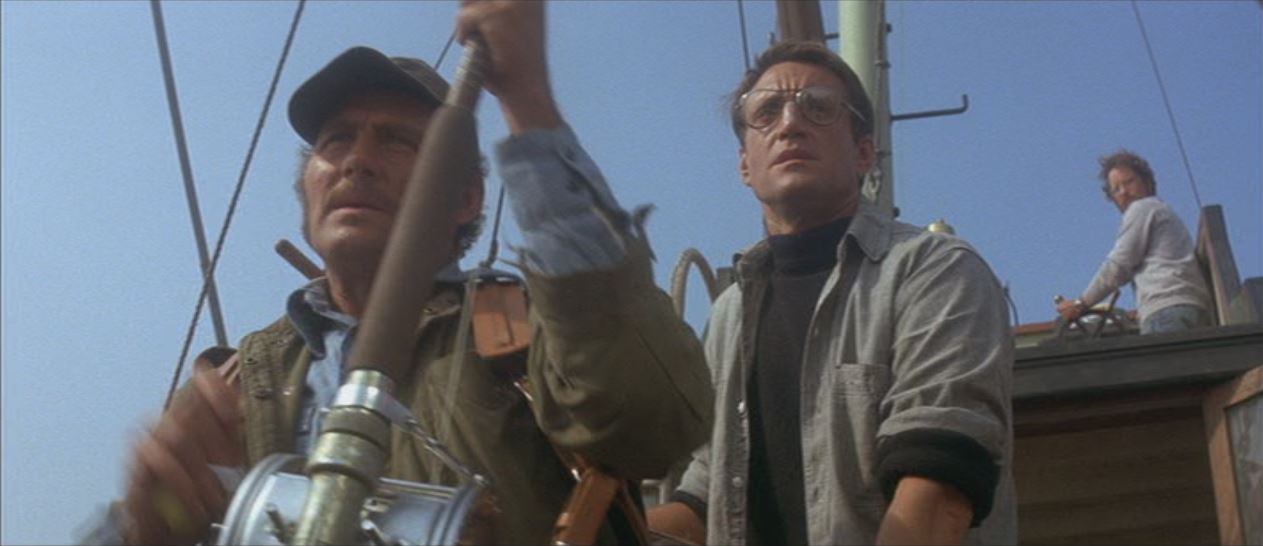
But despite all these promising late entries, there's no denying the implications of 1975's Jaws, "a social, industrial, and cultural phenomenon of the first order, a cinematic idea and cultural commodity whose time had come" (Schatz p. 26). Jaws is extremely well-made entertainment by super-genius director Steven Spielberg -- it's a totally badass movie, even according to Mark Kermode. Furthermore, it establishes the broad template for all subsequent blockbusters via its postmodern genre-mixology:
Jaws was essentially an action film and a thriller, though it effectively melded various genres and story types. It tapped into the monster movie tradition with a revenge-of-nature subtext (like King Kong, The Birds, et. al.), and in the film's latter stages the shark begins to take on supernatural, even Satanic, qualities a la Rosemary's Baby and The Exorcist. And, given the fact that the initial victims are women and children, Jaws also had ties to the high-gore "slasher" film, which had been given considerable impetus a year earlier by The Texas Chainsaw Massacre. (Schatz p. 25)
Genre-wise, then, the post-1975 blockbuster is nearly always an action-adventure film, even when hybridized with or superficially "skinned" to resemble another genre. Usually set "in the romantic past or in an inhospitable place in the present," the action-adventure typically features "a propensity for spectacular physical action, a narrative structure involving fights, chases and explosions, and in addition to the deployment of state-of-the-art special effects, an emphasis in performance on athletic feats and stunts." As Steve Neale, quoting Michael Nerlich, writes:
the ideology of adventure in its modern sense -- its association with the active seeking out of such events -- was developed in conjunction firstly with the medieval cult of the courtly knight, secondly with merchant adventuring (and state-sponsored piracy) in the early modern period, and thirdly with the spread of empire during the course of the nineteenth century. Hence its links with colonialism, imperialism and racism, as well as with traditional ideals of masculinity, run very deep.††
By defaulting to action-adventure pastiche, rather than artfully revising or reworking specific genres like many Renaissance films do, and by "recalibrating the profit potential of the Hollywood hit" to new, astronomical levels, Jaws and Star Wars toll the death knell of the auteurist Renaissance. Schatz writes that "the promise of Jaws was confirmed by Star Wars" -- its "emphasis on plot over character" solidifies the still-dominant action-blockbuster template (Schatz 24, 31, 29).

In 1981, Lucas and Spielberg's Raiders of the Lost Ark confirms the successful formula and sets the tone for the biggest hits of the coming decade:

Top Grossing Movies of the 1980s (adjusted for inflation) according to Box Office Mojo
1. E.T. the Extra-Terrestrial (1982)
2. The Empire Strikes Back (1980)
3. Return of the Jedi (1983)
4. Raiders of the Lost Ark (1981)
5. Ghostbusters (1984)
6. Beverly Hills Cop (1984)
7. Batman (1989)
8. Back to the Future (1985)
9. Indiana Jones and the Temple of Doom (1984)
10. Indiana Jones and the Last Crusade (1989)
My favorite sequence from Raiders of the Lost Ark, 1981's highest grosser and the film that sets the template for the summer blockbuster. 

Quoting Richard Schickel, Schatz notes that blockbusters from this point forward all belong to one of two "metacategories," either the comedy (e.g., Beverly Hills Cop, Ghostbusters) or the action film (e.g., all the other films on the above list). Schatz describes Star Wars in particular as the key proto-"high concept" summer blockbuster. For him, Star Wars exemplifies the tension between story and spectacle that characterizes the summer popcorn movie writ large:
One the one hand, the seemingly infinite capacity for multimedia reiteration of a movie hit redefines textual boundaries, creates a dynamic commercial intertext that is more process than product, and involves the audience(s) in the creative process -- not only as multimarket consumers but also as mediators in the play of narrative signification. On the other hand, the actual movie "itself," if indeed it can be isolated and understood as such (which is questionable at best), often has been reduced and stylized to a point where, for some observers, it scarcely even qualifies as a narrative. (39)
I agree with this account and have myself written about the recent blockbuster's trend toward spectacle over narrative.

What I want to do with the rest of this post is to try to break down the Blockbuster Era (so far) into smaller constituent periods, mainly derived from the chronological sketch given by Mark Harris in his must-read 2014 piece "The Birdcage":
The revolution of George Lucas’s game-changer — in purely financial terms — was that it confirmed what the James Bond series had suggested a decade earlier: There was no ceiling on how much money the right kind of series with the right kind of potentially escalating fan obsession could take in. Over the 25 years that followed Star Wars, franchises went from being a part of the business to a big part of the business. Big, but not defining: Even as late as 1999, for instance, only four of the year’s 35 top grossers were sequels. 
That’s not where we are anymore. In 2014, franchises are not a big part of the movie business. They are not the biggest part of the movie business. They are the movie business. Period. Twelve of the year’s 14 highest grossers are, or will spawn, sequels. A successful franchise is no longer used to finance the rest of a studio’s lineup; a studio’s lineup is brands and franchises, and that’s it.
To continue where Harris leaves off, I turn to Pamela McClintock's recent piece "Hollywood's Obsession with the 'Requel'" for its succinct definition of the latest transmogrification of the blockbuster: the requel. A requel is "a movie that's both a reboot and a sequel, blending old with new in an effort to extend the life of a franchise and, in the best cases, reinvent it for a 'universe' of follow-up movies."

The most successful requel so far.

Whereas the "hard" reboot usually retells an origin story, as with Star Trek (2009) or The Amazing Spider-Man (2012), the requel, according to McClintock, is different from either the reboot or the pure remake "in that it nods to and exploits goodwill toward the past while launching a new generation of actors and stories." It is, in essence, a thinly veiled remake in which the same basic stuff, with slight new variations, happens all over again to a new generation of characters. I like to describe it as "strangely similar things happening to slightly different people."

It's appropriate that Jurassic World should lead the (successful) charge into the Requel period, since it is so transparently a remake of Jurassic Park (Lee Sabo calls it "fan-fiction story-telling"), which in 1993 was already hyper-aware of its status as a global commodity.

The most important shot in Jurassic Park: Jurassic Park's gift shop. 

To sum up: origin-story-retelling reboots include Batman Begins (2005), Star Trek (2009), and The Amazing Spider-Man (2012).

Recent "pure remakes" include King Kong (2005), Cinderella, and Pan (both 2015).

Our requels category is so far inhabited by Terminator Genisys, Jurassic World, and Star Wars: The Force Awakens (all 2015), and Batman v. Superman: Dawn of Justice (2016).

I propose the following Periodization of the Blockbuster Era so far:

1975-85: Marking the inception of the Blockbuster Era proper with Jaws and Star Wars, these are the "Ten years that shook the industry" (J. Hoberman), the inception of the mega-blockbuster era. Schatz notes the increase in sequels and remakes from 1974 onward, writing that "From 1964 to 1968, sequels and reissues combined accounted for just under 5 percent of all Hollywood releases. From 1974 to 1978, they comprised 17.5 percent" ("New Hollywood" p. 27).

1986-99: The period of international conglomeration, worldwide release, and global synergy. The period during which Schatz's "calculated Blockbuster" -- calculated to be a major hit, produce sequels and spinoffs, and synergize with a larger product line and brand -- becomes the driving force behind the Hollywood film industry. As Thompson and Bordwell write,
The first wave of film studio acquisitions, from the 1960s through the early 1980s, had been initiated largely by conglomerates who wanted to diversify their holdings, to add a movie company to a menu of bowling alleys, parking lots, soft-drink bottling, or funeral parlors. The wave that began in the mid-1980s was more narrowly targeted, aimed at synergy -- the coordination of several compatible business lines to maximize income. (p. 664)
This period includes the Michael Eisner regime at Disney -- he's CEO 1984-2005. Eisner focuses on synergy and developing branded content, placing "special emphasis on activities and services that went beyond moviegoing or TV viewing" (T&B p. 696).

1989 is a key year, the starting point for the "dark" and "adult" interpretation of Batman on film. As Eileen Meehan documents, a dark interpretation of Batman was test-marketed beforehand by the release of Frank Miller's comic The Dark Knight Returns into mainstream bookstores.‡

Neale notes that in the 1990s Hollywood "conglomeration and synergy tended to accelerate on a national and international scale, as some of the mini-majors disappeared and as others were absorbed by the majors, and as the costs of making blockbusters and routine features alike continued to rise" (p. 230).

This period sees the wholesale onset of computer generated imagery (CGI) with pioneering effects-driven blockbuster films The Abyss (1989), Terminator 2: Judgment Day (1991), and of course Jurassic Park (1993).

Jurassic Park (1993) is perhaps the key film of this period -- a landmark in computer-generated effects, synergistic product lines, and global release strategies (Thompson and Bordwell p. 697).

Michael Keaton in 1989's Batman, another key film of the 1986-99 period.  

2000-14: I am tempted to call this the "Pointlessly Serious Superhero Movie" period. Fox's X-Men franchise launches eponymously in 2000, setting the general tone for the period. Disney's Marvel Cinematic Universe, which starts with Iron Man in 2008, goes a bit lighter in tone than X-Men, whereas Christopher Nolan's Dark Knight trilogy (2005-12) and Zack Snyder's Watchmen (2009), Man of Steel (2013), and Batman v Superman all go darker and more pretentious.

Speaking of Nolan and Snyder, Kevin Tsujihara becomes Time Warner's chairman/CEO in 2013 and announces a slate of ten Warner Bros. movies based on DC Comics characters to be released between 2016 and 2020. Of Tsujihara, Harris writes:
He has never produced a movie; in fact, he is the first studio head to rise in the ranks purely through brand extension and ancillary divisions, and brand extension is what he’s all about. Besides the DC announcement, his big accomplishments have been to nail down those three additional [J.K.] Rowling movies to add to the studio’s portfolio of eight, and to turn one Lego movie into four.
Tsujihara's counterpart at Universal is Jeff Shell, who becomes CEO in 2013 and about whom Variety's Peter Bart and Claudia Eller write that "Shell’s background and management style is strictly corporate and solidly Comcast." Significantly, Shell rises through the corporate ranks on the television side. Writing in 2014, Mark Harris suggests that by making seven- and ten-year plans for interlocking franchises a la Disney's Marvel Cinematic Universe, contemporary movie franchises replicate formulas that have been honed to perfection on and by television:
TV looms large over this new movie lineup. How could it not? TV is everything. TV is how people see movies; TV is where people want to watch movies, on demand and on their own terms; TV is what Twitter wants to talk about. Most of all, TV knows how to keep people coming back, which is its job, every day and every week, and is a quality that, above all others, the people who finance movies would dearly love to poach.
2015: The Requel period begins. In addition to the McClintock piece referenced above, see also Adam Sternbergh's recent essay on the studio as auteur and the "Marvel movie" as prototypical blockbuster. Analyzing directorial duo Joe and Anthony Russo's successful run of MCU films, Sternbergh writes:
As TV becomes more cinematic in its execution (multiple locations, expensive FX), and films become more TV-like in their storytelling (single chapters in an ongoing story), the decision to employ TV directors on Marvel films starts to make sense. Which is why directors like the Russos — talented, proficient, flexible, and instinctually collaborative — are perfectly suited to flourish.
If the release of Jaws marks the beginning of the Blockbuster Era, then it's been forty-one years since then. We are over forty headlong years into this Era, it is barreling along, we are just beginning the Requel period, and there's no end in sight. We don't even really know what we're in for yet. As Harris concludes,
What we are witnessing is not stability but transition — the evolutionary moment of overlap in Hollywood when the old way and the new way transiently coexist. Ten years from now, the old way will be gone. The new way will simply be the way.
The way of the endless requel and its mutant spawn.

Hi, I'm Mark Harris. I'm so goddamned smart about movies and a fine writer, too. Carter is quite impressed with me.

--
* You'll notice that I call the Hollywood Renaissance a period and the Blockbuster Era an era. That's because the former is a short transitional period bridging the stretch between the decline of the Studio Era (and it is surely in decline by the 1950s) and the rise of the Blockbuster Era. The Hollywood Renaissance years constitute the tail end of a longer period that begins circa 1948 when the Paramount Decree critically alters the makeup of the Golden Age Studio System. Thomas Schatz describes the 1947-60 period in the later chapters of his The Genius of the System (Pantheon Books, 1988).
** Schatz, "The New Hollywood," in Movie Blockbusters, Ed. Julian Stringer (Routledge 2003),  p. 27.
† Thompson and Bordwell, Film History: An Introduction (Third Edition, McGraw-Hill, 2009) p. 664.
†† Neale, Genre and Hollywood (Routledge, 2005) pp. 49, 46, 51.
‡ Meehan, "Holy Commodity Fetish, Batman!" in The Many Lives of the Batman (Ed. Roberta E. Pearson and William Uricchio, Routledge 1991) p. 53.

Thursday, May 19, 2016

Film Reviews Are Subjective

FUCK THE TOMATOMETER!

Assigning numbers to creative works, even factory assembled ones like movies, is stupid. Reviews of cultural products like movies should be subjective and qualitative. They should tell you stuff ABOUT the movie, not try to force a meaningless number on it.

This is the main reason why I despise and refuse to use or endorse the Rotten Tomatoes website or its ridiculous Tomatometer.* The Tomatometer is a big-picture aggregator of reviews, which is not the same as an individual review assigning a numerical score. But it still attaches numbers (and its too-broad "Fresh" and "Rotten" labels) to something that (in my view) cannot be quantified -- not without losing its nuance and hence its utility.


Numerical ratings have no place in reviews of individual movies. As Gamasutra's video game reviewer Katherine Cross writes:
What may be an 8.5 to me is very different from what merits an 8.5 to another critic. And what’s worth marking down three tenths of a point? Is my site’s 6.75 different from another’s? What is the difference between a 9.0 soundtrack and a 9.5? Critics give scores on the basis of rubrics provided by their publications, often as not, but even there the score is still the product of a gut reaction; it is a melange of values, emphasis, and personal judgement. It can never be objective.
Yes, exactly that. We might as well embrace our fandoms and biases and just admit that film criticism is a subjective art. There is no point in pretend-quantifying the process.

I've been recently pondering an illustrative case. Reading fellow film blogger Sal Alonci's review of Captain America: Civil War, I noticed the superlatives he uses to describe what is, for him, a genre-pushing, evolutionary superhero movie:
"with Captain America: Civil War, Marvel Studios has once again redefined the superhero genre"

"Putting it simply, Captain America: Civil War is one of the smartest and best superhero films ever made"
I totally get where he is coming from -- this sounds like fandom and I definitely have my fandoms.** I love the excitement of Alonci's review. Furthermore, there are legitimate interpretive angles that a true fan with background knowledge of the comics can bring to bear on a genre film like this, as Alonci does in his sharp overview of the Marvel Universe films so far.

Darth Vader sez: "I am your father!" NOBODY fuckin' knew if THAT was true 
ahead of seeing Return of the Jedi in 1983.

Similarly, The Mary Sue's Christy Admiraal points out that foreknowledge often enhances a fan's viewing experience: "Knowing the identity of a previously unseen character can make it much more exciting when they finally make an entrance, and knowing what’s coming next before it happens can feel like keeping a secret; the informed viewer and the creators are in on it, while the general public will have to wait and see what happens." Alonci clearly possesses this kind of knowledge so his experience of the MCU movies is heightened relative to mine.

There is a lot of subjective fandom in Alonci's Civil War review, especially in passages like: "It's my favorite movie of the year so far, and will probably be my favorite movie of the whole summer." I mean, Alonci isn't hiding anything here. He is admirably up-front about his status as a fan: "I've already seen it three times and I'm going to see it again soon."

What this exemplifies is that ALL of us who write film criticism do so subjectively, at least in part because we are fans of the medium (and of specific genres, films, directors, stars, periods, etc.). This is as it should be. For while there are technical and numerical things we can learn about a movie -- its all-time grosses, for example, or its average shot length -- holistic film criticism is always colored by the history, tastes, predilections, hatreds, and fandoms of the individual reviewer.

For example, I have no interest in, and no intention of seeing, Captain America: Civil War. I never even really considered seeing it, but if I had, that consideration would've ended once I saw this review, in which Mike -- Mike! -- finally says (around the 26:28 mark) that "I got tired of all the punching. I think I'm done with superhero movies. It's no longer exciting to me. It's just punching."


Mike sez: "I think I'm done with superhero movies. It's no longer exciting to me. It's just punching." This is an example of a reviewer's film tastes changing over time. 

I felt like Mike does now a whole MCU Phase ago -- I quit after the first Avengers (2012). So for me, the whole MCU phenomenon is a thing happening to other people -- albeit LOTS of other people, if worldwide grosses are any indicator.

I keep my finger vaguely on the MCU's pulse, reading review articles and the like, and based on what I've read and heard, I may yet watch Captain America: The Winter Soldier (2014) one of these days. But as I have written before, I am not all that "on board" with the Marvel films in general. I am a superhero movie burnout case.


What, then, do we make of my recent defense of Escape from New York (1981)? Escape is a dystopian, science-fiction-y action film whose dark tone and "all-time icy badass" protagonist, Snake Plissken (Kurt Russell), make it an obvious cinematic precursor to the post-2000 superhero film. So why do I defend Snake Plissken yet show such callous lack of interest in Steve Rodgers and Bucky Barnes as they enjoy their moment of massive worldwide fame?

Part of it is the passage of time and the transmogrification of my film tastes. In the 1980s, I was a big action-movie fan. Action films (including James Bond) and Star Wars-esque science-fantasy were my go-to genres in those early years. That and comedy.

Nowadays I can hardly be bothered to write seriously about a superhero film or a Transformers film because I just don't care all that much about them. My tastes have grown up and changed, and if I pen anything as gushy as Alonci's Civil War review, it's going to be about something a bit less mainstream like Belle or Snowpiercer or Mad Max: Fury Road.

It is now the superhero fans' moment in the sun, and I do not begrudge them it, even if I have reservations about the dangerous cultural messages geek-centered power-fantasy films typically convey to their target audience. I am not alone in this concern. But hey, there is a time and a place for fantasy, and I grew up on Snake Plissken and James Bond movies and I turned out okay.

In any case I better get used to it. Disney has Marvel movies planned out until 2020. Those super-profitable motherfuckers aren't going anywhere.

Meanwhile, in my own musty corner of the blogosphere, I pen defenses of science-fiction movies nobody else likes, low-budget 1970s horror films, and offbeat directors of whom most people have never heard. Long live fandom.

Werner Herzog sez: "Go for the ecstatic truth, man."

UPDATE 8/5/2016: Slate.com's Matthew Dessem agrees with my view, opening his smart piece saying that "If your opinion about a work of art can be expressed as a number, it’s not a very interesting opinion." He contends that "there’s little value in assigning a number to how much we liked [movies]. The interesting questions are 'Why?' and 'How?,' not 'How much?'"
There’s nothing wrong with the question “Should I see this movie?,” and criticism can definitely help answer it. But the right way to find an answer is to consult one or two critics whose taste you trust, not a thousand critics you don’t know.
My sentiments exactly -- well said Mr. Dessem.

--
* As Kevin P. Sullivan reminds us, the Tomatometer "doesn’t measure film’s quality in the eyes of critics" but is rather "a record of critical agreement." Possibly so, though the value of even that aspect of the Rotten Tomatoes site has been called into question by Film School Rejects' Landon Palmer: "the numbers featured on Rotten Tomatoes provide some notion of a critical response ('critical consensus,' by comparison, is something that can only be argued, not tabulated) conveniently devoid of substance and content. Thus, Rotten Tomatoes can serve a purpose as an initial point of access, but never as a substitute for criticism itself." 
** Even beyond my love of Bond, rekindled embers of my ancient Star Wars fandom surely account for some of my warmth toward The Force Awakens.

Sunday, May 8, 2016

Review: Star Wars: The Force Awakens (2015)

One of my favorite bits from The Force Awakens.

I have written before about Star Wars Episode VII: The Force Awakens, J.J. Abrams' "requel"-style sequel to the original Star Wars trilogy. I claim the new movie
is better (by far) than any Star Wars prequel and better (by less far) than Jurassic World. The dialogue is decent, the characterization (especially of the new characters, Rey, Finn, Kylo Ren and BB-8) is good, and the action sequences and overall narrative flow work really well. I agree with A.A. Dowd when he says that the film does not slow down and develop its characters and worlds quite enough and that it fails to land a couple moments (like the revelation of Kylo Ren's parentage) that could have been far more emotionally impactful than they are.
I stand by that statement, yet having recently re-watched The Force Awakens, I aver its dialogue is better than "decent." As these kinds of basically superficial movies go, the latest Star Wars entry is actually quite well scripted.


Take. for example, the two lines exchanged between Han and Leia as they sum up why they have drifted apart from one another over the years:

HAN: I went back to the only thing I was ever any good at.

LEIA: We both did.

Simple stuff but it implies so much. Perceiving themselves to be failures as lovers and parents, Han and Leia have fallen back on their respective jobs as smuggler and military commander to sustain them through their trauma. This makes sense. It's human. People in the real world throw themselves into work and old habits to avoid pain and discomfort all the time. Succinctly put, not revolutionary, but believable and resonant.

The film's high entertainment value also stems from Abrams' considerable ability as a "show don't tell" filmmaker. In this, thank God he is more a disciple of Spielberg than of Lucas. He moves the camera dynamically, he focuses on action and gesture over expository dialogue, and he -- unlike his contemporaries Christopher Nolan and Zack Snyder -- seems to comprehend human emotions.

This moment, like many similar moments between Furiosa and Max in Fury Road, subtly illustrates how heroic men depend upon smarter, more capable women.

However, one can easily tell that Abrams' hands were tightly tied while making this franchise-rebooting component of the highly synergized Star Wars product line.* As the L.A. Times' Michael Hiltzik writes,
Whether out of his own instincts or via directives from the suits at Disney, J.J. Abrams, the co-writer and director of The Force Awakens, plainly labored under a mandate to not get the thing wrong. It's a mark of Disney's own caretaker mentality that not only is a Jar Jar Binks-level blunder absent from The Force Awakens, but so is surprise or even much suspense.
That's hard to argue with. The film is fun but generally unsurprising, in large part because it is a barely-disguised remake of Star Wars (1977). (Though I am pleasantly surprised by Kylo Ren's sudden tantrums -- show don't tell!)

Hiltzik allows that "Abrams' big advance is said to be supplanting the whiter-than-white protagonists of the original Star Wars with a young woman and a black male." Agreed.

Finn (John Boyega) rocks. He also signals imminent major SPOILERS in this review.

What's more, The Force Awakens makes good on two key unfulfilled promises: to give Han Solo a meaningful death, and to give us a frikkin' female Jedi protagonist.

As Harrison Ford has been saying for decades, Han Solo should have croaked at the end of The Return of the Jedi. It makes sense in terms of the character's arc (greedy bastard in Star Wars, learns his lesson in Empire, sacrifices himself for his friends in Jedi) and would have given the conclusion of the original trilogy some much-needed gravitas. Tony Zhou writes that
J.J. Abrams must spend half of The Force Awakens re-building the same emotional ground under Han Solo [as existed in the original trilogy]. That’s why Han is back to his factory default setting of “smuggler,” why he’s escaping again from people to whom he owes money, why he and Leia are separated then reunited, and why he quickly agrees to storm a planet and disable the shield so that fighters can attack the Death Star. 
Han Solo is literally, moment by moment, reliving Return of the Jedi. Because in story terms, he should’ve died then.**
Don't get me wrong, Jedi is an aesthetic triumph. Its action sequences, particularly the Endor speeder bike chase and the destruction of the second Death Star, are among the best you will ever see. Luke's final confrontation with Vader and the Emperor in Jedi is one of the best dramatic scenes in any Star Wars movie and is probably the most emotionally resonant scene George Lucas has ever had any hand in creating.

But on a basic story-structure level, and as far as including the Ewoks goes, Return of the Jedi is a lazy, stupid, watered-down piece of shit. It stupidly keeps Han Solo alive, denying the character a meaningful death and reducing him to comic relief. Worse, Jedi gives Solo screen time that rightfully belongs to Leia at this point. Why the fuck isn't Leia, a longtime military leader, commanding the attack on the Endor shield generator? For that matter, why the fuck is this blaster-wielding leader of the rebellion being chained up in a slave bikini in the opening act of this puppet-fest?


Whatever happened to this Leia?


Did she follow this Marion Ravenwood down into the pit of 1980s sexism?

In any case, The Force Awakens' Rey (Daisy Ridley) appears to be Star Wars' attempt to reverse course on its usual sexism.† The attempt may never fully succeed -- that slave bikini is going to haunt the franchise forever. But our new series protagonist (for at least the next two numbered episodes I presume) and her black comrade-in-arms both provide a compelling and much-needed antidote to the series' usual white-male-centeredness. 

On the basis of its diverse cast and camera work alone I'm inclined to rate The Force Awakens up there pretty close to Return of the Jedi in terms of overall viewing pleasure. We'll see how it withstands the test of time. 

However, much as I complain about Disney taking over the goddamn universe, I sure look forward to seeing the next couple episodes of Rey's ongoing adventures. She is the single most compelling element of this latest Star Wars viewing product. 

Rey tells Kylo Ren to go fuck himself.

Bonus Afterthought: Make sure to check out this interesting piece about a possible unforeseen after-effect of The Force Awakens' enormous success: a critical reevaluation of George Lucas. Bryan Curtis explains that "in the era of reboots, Lucas' pastiches have a kind of integrity." A thought-provoking read.

UPDATE 7/1/2016: See also Film Crit Hulk's detailed explanation of why The Force Awakens doesn't quite work for him -- including accurate insights about why most of J.J. Abrams' films are big hits but lack staying power. According to Hulk, Abrams' films "DON'T UNDERSTAND HOW TO BE HUMAN SO THEY EFFECTIVELY IMITATE IT. [IN THE FORCE AWAKENS, ABRAMS AND COMPANY] LOOKED AT EVERY MOMENT AND WORKED BACKWARDS FROM THE INTENDED RESULT. J.J. KNOWS WHERE YOU WANT TO BE, BUT HE'S GOING TO RUSH YOU THERE AS SOON AS HE CAN, REGARDLESS OF WHETHER OR NOT IT'S CATHARTIC."

UPDATE 9/10/2016: I recently came across this piece by Brian Merchant and feel it to be the best overall assessment of the place of The Force Awakens in the larger Star Wars film series. As Merchant writes, Episode VII "is more a product of the same market logic that gave rise to the Marvel Universe films—a logic that rewards emulation and nostalgia above all; reusing ideas, characters, and narrative arcs that have already proven lucrative—than it is of the imagination that launched the series nearly four decades ago." Though he has high hopes for 2017's Episode VIII, he concludes that "Science fiction is supposed to be all about exploring the unexplored, not rehashing the well-trod. As its key franchises become increasingly more important to the bottom line of huge studios that are fending off streaming and view-on-demand, expect them to become more formulaic, and less interesting."

--
* Eileen Meehan calls the web of cross-references created by the product lines surrounding a blockbuster film its "commercial intertext." She argues that each consumer interacts with the web of meanings created by a film text and its surrounding commercial intertext differently, each of us "positioning ourselves to construct different readings of the film and positioning the film and its intertext to suit our particular purposes" (pp. 47-9). If you are interested in the rise of the blockbuster and/or corporate synergy in Hollywood, you simply must read Meehan's "Holy Commodity Fetish, Batman!" in The Many Lives of the Batman (Ed. Roberta E. Pearson and William Uricchio, Routledge 1991) pp. 47-65.
** Zhou compellingly argues that The Force Awakens wastes too much time fixing the original trilogy's Han Solo problem: "the real film that Episode VII is fixing is Episode VI. Half of the runtime of this new movie is spent correcting one problem, the mere fact that Han Solo should have died then and didn’t." Along similar lines, Gary Kurtz, who produced Star Wars and The Empire Strikes Back, says in this interview that
one of the reasons I was really unhappy [about Jedi] was the fact that all of the carefully constructed story structure of characters and things that we did in Empire was going to carry over into Jedi. The resolution of that film was going to be quite bittersweet, with Han Solo being killed, and the princess having to take over as queen of what remained of her people, leaving everybody else. In effect, Luke was left on his own. None of that happened, of course.
Kurtz parted ways with George Lucas over these issues and instead of producing Return of the Jedi, he collaborated with Jim Henson and Frank Oz on the utterly badass The Dark Crystal (1982).
† The prequels are absolutely terrible on the gender front as well, so it's a good thing they don't exist.