Showing posts with label feminism. Show all posts

Sunday, June 4, 2017

Review: Wonder Woman (2017)


Wonder Woman is a big-budget superhero movie, and despite a couple of clever comments Diana (Gal Gadot) makes near the end about heroes being unable to solve complex problems like war and human corruption, it is fundamentally an earnest one rather than a deconstructive one. That is, it feels like it could have been made ten years ago, and probably it would have felt fresher then, situated among other straightforward origin stories like Iron Man (2008) and Captain America: The First Avenger (2011).

This is not Wonder Woman's fault -- Hollywood has dragged so much goddamned ass finally making an A-grade female-led superhero film that it beggars belief. We have been waiting for a Wonder Woman movie for so many years, even decades, and our having to wait this long for a movie centered on such an iconic character is glaring evidence of Hollywood's deep and pervasive structural sexism.

But the movie is finally here now, and it is a lot of fun. Like all superhero films, Wonder Woman takes its cues from the blockbuster writ large, inheriting its DNA from the 1980s Spielberg-Lucas template. So like any big-budget action-adventure film made in the wake of Star Wars (1977) and Raiders of the Lost Ark (1981), Wonder Woman is entirely predictable. There are no surprises or revelations here -- we've seen all this before.

However, that said, Wonder Woman is well-executed and possesses a few key strengths that make it a pleasure to watch:
  • a very likable, positive, and non-brooding protagonist
  • a particularly game and enjoyable supporting cast, especially Chris Pine as Steve Trevor -- Gadot and Pine exhibit delightful onscreen chemistry
  • minimal (though some) running-time bloat and (thank god) minimal crossover exposition -- no distracting Superman or Batman cameos here
That first item is the most important and is what sets this film apart from all the others in the recent DC Universe franchise.* I am sick to death of dark, tortured protagonists in action-adventure blockbusters so when I heard that Wonder Woman was not going that route, I breathed a huge sigh of relief. Wonder Woman's Diana is not quite so upbeat and booster-ish as Christopher Reeve's Superman or Melissa Benoist's Supergirl, but she abides in that general area -- grimly determined but not grim, and generally optimistic about human potential and the human spirit. I like superheroes like that.


Teamed up with Gadot as Diana is Chris Pine (a personal favorite) as Steve Trevor. He is a delight and his chemistry with Gadot is spot-on. I agree with AV Club's A.A. Dowd that
Pine, with his square-jawed deadpan, bounces nicely off of Gadot’s tourist curiosity; the two actors have a chemistry of innuendo and hesitant camaraderie—the makings of a screwball romantic comedy, simmering around the edges of the story.
Indeed, I wouldn't have minded if the Diana-Steve duo spent a little more time in London exchanging banter and having fun with Etta (a hilarious Lucy Davis) before slogging into the whole combat mission. But this is a blockbuster, there are action beats to get to, I get it. As Dowd puts it, "One just wishes [director Patty Jenkins] were working outside of a house style not already etched in stone." Hear, hear.

At least Wonder Woman avoids annoying franchise hyperlinks that distract from the story at hand. Recall the marred ending of Winter Soldier, about which I have written:
Captain America: The Winter Soldier was okay but should have ended right when Cap comes ashore at the lakeside after the film's climactic battle. Everything else after that is franchise-connection filler and is superfluous to this movie. 
Sure, Wonder Woman has a brief frame story in which Diana (in the present day) receives a note and photograph from "Wayne Enterprises" and subsequently sends an email message back to "Bruce Wayne." But there is no pointless cameo by any other DC franchise character or some out-of-context teaser for the upcoming Justice League movie, in which Diana will also appear.** So hearty kudos to Wonder Woman for simply being its own movie, an increasing rarity in today's franchise-dominated blockbuster world.

To characterize it in the terms fleshed out in this post, Wonder Woman is a simple, generic blockbuster.

Wonder Woman hangs out on the top left with blockbusters like The Avengers (2012). 

Simple blockbusters, indicating the simplicity of their plots, "make pretty clear from the get-go what is at stake" and "do not depend upon mystery or surprise." There is only one major "surprise reveal" of a character's true identity near the end of Wonder Woman, and if you don't see that coming from leagues away, then god help you. No, Diana sets off from Themyscira to do a certain thing, and by the end of the movie she does exactly that.

Generic blockbusters, referring to genre and style, are "films that adhere more closely to the established parameters of their genre, with less evident authorial flourishes or deviations in tone or visual aesthetics." In this context we have to see genre in terms of franchise and branding as well. I would describe Wonder Woman as a generic superhero blockbuster in the Warner Brothers / DC post-Nolan, Zack Snyder-ish style.  There's slo-mo combat, there's a big boss villain, there are super-weapons, there are parent / child things being worked out, etc.

If Wonder Woman has noticeable flaws, they are:
  • a too-long running time and a pointless and boring final battle -- the film is emotionally over about twenty minutes before it concludes, around the time Diana confronts Ludendorff and then Steve Trevor on the elevated tower near the airstrip. 
  • some incomprehensible, sloppily choreographed and/or shot action sequences, especially during Diana's early training. This is not unique to Wonder Woman -- pretty much all superhero films and blockbusters follow "Chaos cinema" aesthetics in their action sequences these days -- but it is still unfortunate.
That said, some of the slow motion in the action sequences, used more judiciously by Jenkins than it is in the Zack Snyder-directed movies I've seen, works really well, creating a kind of comic book panel or splash page type effect. Combined with this, Gadot, for me, possesses the physicality, prowess, and aura to really pull off this role. For me, her Diana in Wonder Woman is as visually iconic as Christopher Reeve in Superman (1978) -- I mean that as a supremely positive comment.  

In his review, Entertainment Weekly's Chris Nashawaty compliments Gadot's "undeniable star power" and accurately describes Wonder Woman as "assured and sly." He writes that Gadot's Diana "is both awesomely fierce and surprisingly funny" and "her chemistry with Pine is just as unexpected and electric." I agree with these points and with the overall conclusions of that review.

And importantly, as Dowd and others have noted, despite the shortness of her skirt-thingy and a few gratuitous bare-leg shots, the film mostly resists sexually objectifying Diana, thank christ. It's sad that the bar is so low that we are relieved simply when a mainstream film doesn't objectify or ogle its female characters, but there you have it.

She usually looks more like this. 

In short, definitely see Wonder Woman if you like enjoyable blockbuster action movies. This one won't condescend to you. It will provide "sly and assured" entertainment and action thrills, Diana's assault on the village of Veld being my favorite instance of the latter. I also really enjoyed the brief alley fight that happens in London. Diana's whip, weapons, and style are cool, and the film's climactic message, while entirely corny, is the sort of popcornish thing I want to hear at this time of year and in these troubled times. That Wonder Woman's message of love comes from the lips of Hollywood blockbuster cinema's first bona fide female stand-alone superhero franchise protagonist is, I think, cause for celebration. Long live Diana, Princess of the Amazons.


UPDATE 6/5/2017: Please read this feminist critique of the film by Nerds of Color's N'jaila Rhee and consider also this more deprecatory feminist analysis by Slate.com's Christina Cauterucci.

UPDATE 6/9/2017: For even more nuanced discussion of the feminist implications of Wonder Woman, read Noah Berlatsky's incisive rundown of how the film fails to acknowledge -- and even works against -- the "sisterhood" elements of the original comics, and also this smart dialogue between Carolyn Petit and Anita Sarkeesian of Feminist Frequency.

---
* Note that I have not seen Man of Steel (2013) nor Batman v. Superman (2016) and don't plan to see either one. I have no truck with a brooding, "dark" interpretation of Superman and I was tired of the "dark" version of Batman by the time The Dark Knight (2008) rolled its end credits.
** To be fair, I did not stick around to see if Wonder Woman has a clunky, Marvel-esque post-credits sequence pointing toward future franchise entries.

Wednesday, June 10, 2015

Review: Mad Max Fury Road (2015)


I am somewhat giddily in love with Mad Max: Fury Road. As of this writing, I have seen it twice in the theaters, plan to see it there once more, and have already pre-ordered it on DVD.* I know I will be enjoying this film for years to come and will teach it in my future "Women and Film" courses. Therefore I don't think my future self will be too upset if I declare it to be the best mainstream action film of the year 2015. It is one of the best films bar none that I have seen in a long time (since I saw Andrey Zvyagintsev's Leviathan earlier this year at any rate).

Yes, I love Fury Road like a fanboy. Still, I completely understand some folks' concerns about and criticisms of the movie. It's a bit violent and brutal, of course, and some reviewers consider it to be too thinly plotted. Furthermore, while its themes are pronouncedly feminist, it does demonstrate some noticeable objectification of female bodies. Its real-life environmental record is abysmal. I will address some of these concerns later in this spoiler-inclusive review. Yet for me, given that so much contemporary mainstream action fare is so much crappier than Fury Road in quality and ideology, it is easy to focus on what this movie gets right and to slightly overlook the ways in which it plays into retrograde conventions.

Adam Lubitow, writing for the Rochester City newspaper, says almost everything I would want to say about the film -- I urge you to read his review in full. He writes:
At 70 years old, George Miller has put his younger peers to shame, producing an instant classic of the [action] genre. His film is packed with thrillingly kinetic action sequences, filled with unforgettable images; the world of "Mad Max" is a marvel of production and costume design. Each frame is brimming with details that demonstrate how much thought and care went into building this universe.
Indeed. The incredibly high degree of filmmaking craft on display here is so stunning that this io9 writer calls Fury Road's very existence in today's Hollywood "a miracle." I am inclined to agree.

But the latest Mad Max installment's specialness doesn't stop there. Lubitow's insightful review notes Fury Road's "unabashed feminist streak":
It's the rare action movie (or any genre for that matter) that not only passes the Bechdel test, but does so with flying colors. At a certain point, there are 12 women on screen, all talking to one another, never about a man. For a film with a plotline about women being treated as sex slaves, it's never exploitative. We're never forced to witness their abuse, and only meet the women after they've escaped. The film's mindset can be summed up by the first clear look we get of the freed brides: rejoicing as they use a bolt cutter to help each other break free of their painful-looking chastity belts.
Once Max joins Furiosa and company about twenty minutes in, he searches the War Rig's cab for guns but misses Furiosa's gearshift knife, which she reveals to the viewer (but not Max) as a punchline to the scene. This whole sequence exemplifies what makes Fury Road so unique and great: Max's "serious" action hero behavior is rendered comedic, his paranoia shown to be misplaced even as it simultaneously illuminates how deeply traumatized he is. We are shown (not told) that Furiosa has complete control over this situation and is not scared of Max at all. Her reveal of the gearshift knife informs us that she could have pulled that knife at any time and killed him, but has elected not to. This wonderful sequence, and the one that follows it in which Max works to remove his metal face mask with a file, positions him as an object of laughter, just like Ronny (Nic Cage) in Moonstruck, being made fun of for his melodramatic suffering after the loss of his hand.**

"I lost my hand!" laments Ronny Cammereri. Film scholar Kathleen Karlyn argues that moments of male melodrama in Moonstruck are tempered by female laughter, re-centering the film's narrative around women's power to disrupt patriarchal oppression via comedy. The same general strategy holds true for Mad Max: Fury Road, in which female power renders "serious" male heroics funny.

In short, Imperator Furiosa is the protagonist of Fury Road and Max is essentially her comic sidekick. He plays a key role in the action, has some great fight sequences, and we feel his pain and trauma via inventive, sparingly used flashbacks, yet there is no doubt that Furiosa is this story's hero.

Furthermore, the movie is at great pains to illustrate that the dominant form of masculinity in its world is bankrupt, hollow and destructive: we see a belt with a Death Skull motif placed over Immortan Joe's crotch at the outset, just before he withholds from his people the life-giving water coming from his symbolic triple-phallus. Then, at the end of the film, the milk-giving mothers open these same water valves for good.

Meanwhile, our gang goes through the valley -- a vaginal metaphor -- bringing seeds back through the same valley to the water-rich Citadel and giving birth to a new civilization. This sort of thing has prompted some reviews to call the film ecofeminist.


Yet as Philip Smith correctly argues, Fury Road does indulge one sexist cinematic convention: the visual objectification of women's bodies. Immortan Joe's scantily clad wives are indeed put on display for the viewer's pleasure, in accordance with the pervasive Hollywood practice documented by film scholar Laura Mulvey.*** Yet I am inclined to agree with Lubitow and others who see these characters as being developed enough to alleviate accusations that their depiction is gratuitous or exploitative. In the context of the film, their relative nudity has been imposed upon them by their patriarchal oppressor, so it functions as a reminder of the conditions from which they are proactively escaping. Furthermore, they are given much more to do in this film than to just stand around being objectified.

This pro-woman, pro-feminist stance is so rare to see in a mainstream action film, and so delightfully surprising and refreshing as presented in Fury Road, that mother Cecily Kellogg even took her nine-year-old daughter to see the film despite its "R" rating. Writing that the movie "kicks ass, and that ass-kicking is done by a huge variety of women," she asserts:
There's a small moment in the movie where [Max] turns the big gun with the last bullet over to Furiosa because she's a better shot. Frankly, it's stunning. I've never once seen that in a movie.
Me neither! Kellogg's comment exposes one of the Fury Road's greatest strengths, and the main reason it is destined for "classic" status: its ability to convey important character development moments in action rather than dialogue. Indeed, the best thing about Fury Road, besides its bold feminist ideology, is its complete commitment to "Show, don't tell" filmmaking (what Hitchcock and others call "pure cinema").

For some (re-)viewers, this "show don't tell" aesthetic is taken too far. Film blogger David Palmer, echoing similar yet more forgiving comments made by Entertainment Weekly reviewer Chris Nashawaty, writes that Fury Road is too much "style over substance" and that "from a narrative perspective, it leaves much to be desired."† While I respect his view on the matter, I can't help but wonder if the recent (post-1990s) spat of over-explicated blockbusters -- a style of over-talked, superficially cerebral action film of which Christopher Nolan is the undisputed king (though Michael Bay is also guilty of over-complicating his "plots" with needless chatter about doomsday devices irrelevant to the films' action) -- has blunted many contemporary viewers' ability to pick up on subtle visual cues, rendering it difficult for such viewers to register unexplicated actions as a legitimate form of characterization.††

On a tangential yet related note, I think this same phenomenon of slight viewer inattentiveness and expectation that anything important will be spelled out in dialogue is what leads many commentators to erroneously label the films of Stanley Kubrick as "cold" or "antiseptic" or "distant." Those films are full of life and humor and deep emotion, but Kubrick achieves his effects (affects?) by creating dissonance, tension, even (at times) deliberate contradictions between what characters say and what we see. His characters lie and obfuscate and dissemble, displaying a lack of self-awareness that is both intensely amusing and true to life. Nowhere is this technique used more clearly and sublimely than in his great masterpiece Barry Lyndon (1975), in which almost everything the smug, hilariously self-satisfied narrator tells the viewer about Redmond Barry is incomplete, misleading, and/or outright false. The meaning of that film lies in the discrepancy between what we are TOLD of Barry and what we are SHOWN of him. It requires a perceptive viewer and multiple viewings to suss this out.

I place Fury Road in the same category. It is, quite literally, deceptively simple on the surface, yet is freighted with meaning. Unmistakably feminist meaning. Lubitow agrees:
Despite the sparse dialogue, there's just enough development so that every character gets their own arc. The brides all have distinct personalities, and we come to know each of the characters not through tedious exposition, but through the actions they take.
As this video essayist points out, part of Fury Road's visual power lies in its refusal to use Chaos Cinema techniques, instead relying on more traditional (or "classical") shot framings and editing techniques:


Fury Road's stunning visual beauty also has a lot to do with its location, and therein lies a sad story of ethical misdeeds. The production's sketchy environmental report card is thoughtfully discussed by ecocritic Steve Rust here. In that piece, Rust points out that
[what’s] most concerning about Miller’s latest film isn’t the message audiences take away from the text, [but] the actual environmental impact of the film on on the areas where it was filmed in the [ecologically] sensitive desert of Namibia. Back in 2013, when only hard-core fans and industry insiders were following the film’s production, the film stirred up controversy for a short time over concerns that the film crew was tearing up the desert.
Rust quotes Guardian reporter Natasya Tay, who writes that “a leaked environmental report claims [Fury Road's] film crew damaged sensitive areas meant to be protected, endangering reptiles and rare cacti.” Rust notes that despite the implications of that leaked report, the film was given a pass by the regional film commission, and he concludes that "the question remains whether the NFC (Namibia Film Commission) sought to cover up the damage in order to avoid controversy and maintain good public relations so as to bring more films to the country for the economic benefits they provide."

Environmental abuses by film crews is a pervasive problem that needs to be remedied. Yet at the same time, as Bitch Magazine's Sarah Mirk argues, Fury Road's ecofeminist message may go some distance toward discouraging the kind of real-world abuses the film's production itself committed:
the toughest people you’ll meet in this dystopia are a collective of old women who are diligent heirloom seed savers. In the midst of the desert’s chaos and murder, they see a clear path forward: Find a way to heal the earth. The secret weapon of Fury Road is not a bigger gun, a faster car, an improbable spaceship, or a boy genius. It’s a pile of heirloom seeds. In the end, nothing is more powerful in the desert than the simple forces of soil, seeds, water, and tender care.
I do not excuse the environmental damage Miller's production crew inflicted upon Namibia's Dorob national park, and I sincerely hope that Fury Road and future productions like it will be firmly held to environmental standards that disallow such flagrant abuses.

As for me, it seems that my inner cinephile and my inner feminist have gotten the better of my inner ecocritic in this case.

GO SEE THIS MOVIE.

Charlize Theron's Imperator Furiosa, the real star (and protagonist) of George Miller's contemporary masterpiece Mad Max: Fury Road. 

Bonus auto-ethnographic afterthoughts: Mad Max: Beyond Thunderdome (1985) was the first Mad Max film I ever got to see in the theater. Prior to that I saw The Road Warrior (1981) many many times on VHS, and much later I saw the original Mad Max (1979) on home video as well. For me, The Road Warrior in particular is an iconic and much-beloved action film of my youth and beyond. Even Mel Gibson's late-career racist antics have not dimmed the greatness of Mad Max 2 for me. That movie set an incredibly high bar for high-octane action, a lived-in universe, mythological storytelling, and realistic lo-fi special effects that few other films have achieved so effectively.

Miller himself has made clear that Fury Road does not occupy any particular place in the Mad Max "chronology," a term I place in quotes because, aside from the events of Mad Max presumably happening first, there is no specific chronology to any of the films in the series. That said, I did notice one little visual detail at the very end of Fury Road that suggests a (hyper-)link to an earlier installment. Right at the end of the film, as the big truck platform is being lowered to receive Imperator Furiosa and the crowd is chanting "Let her up! Let her up!" I spied two guards on that platform wearing metal helmets encasing their whole heads. Could this possibly be an oblique reference to Lord Humungus (pictured at left), the villain of The Road Warrior? Is one of these Humungus-like soldiers serving Immortan Joe the actual future Lord Humungus? Or are these guards a couple of Humungus's past followers? Or are metal helmets just fashionable in the post-apocalypse? My guess is that we'll never know for sure.

Theron and Miller on set in Namibia.

UPDATE 6/20/2015: I found yet another extremely laudatory review of Mad Max: Fury Road, by Grantland's Alex Pappademas, which accurately claims, among other things, that "we live in times of lowered expectation, blockbuster-wise; we pretend that not-insulting relaunches of old IP are worthy and that the rare worthy ones are also interesting and necessary. We’re lying to ourselves, but we do it because there’s almost nothing else out there." He then describes Fury Road as a glorious exception to this situation. I wanted to link the review here because it is both very well written and because it notes several details -- George Miller's original plans to shoot Fury Road with Mel Gibson back in 2001, its visual shout-outs to Peter Weir's The Cars that Ate Paris -- that I haven't seen discussed anywhere else. It also contains a nice sum-up of the main theme of each of the four Mad Max films. This is the kind of review I want to re-read in ten years or so in order to marvel at how presciently Pappademas declares the film to be "one of the best action movies of the decade."

UPDATE 9/2/2105: I'm not alone in my enthusiasm for this film.

UPDATE 9/16/2015: As astute feminist critic (and personal hero) Anita Sarkeesian has pointed out, "Fury Road isn't feminist."

UPDATE 10/12/2015: Upon viewing Fury Road for the fourth time this past weekend, I noticed those Humungus-like troops I mention in my "Bonus Afterthoughts" much more clearly in an early shot about ten minutes into the film just after the War Rig takes off:


To be fair, upon closer inspection, these guys' helmets are a bit different from Humungus' -- they are more fully encasing of the head and even have a noseguard / plume-like thingy on the front. Yet they are metal masks and therefore for me evoke the Lord H from The Road Warrior. Like Kyle Buchanan, I like these small, flavorful details and appreciate that Fury Road allows me to enjoy and contemplate their possible meanings without expositioning the shit out of them the way so many other contemporary movies do.

UPDATE 12/1/2015: Mad Max: Fury Road has won the National Board of Review's 2015 Best Film Award. Be sure to check out Variety's video interview with George Miller at the tail end of the linked post.

--
* I haven't embraced Blu-Ray yet because, even though I have access to a Blu-Ray player at home, I am a film studies professor and my college has not yet converted to Blu-Ray.
** Kathleen Karlyn makes this convincing argument in her classic essay, "Comedy, Melodrama, and Gender: Theorizing the Genres of Laughter," anthologized in Classical Hollywood Comedy (1995, ed. Karnick and Jenkins) pp. 39-59.
*** See Mulvey's famous and influential essay "Visual Pleasure and Narrative Cinema," originally published in Screen 16.3 (Autumn 1975) pp. 6-18.
† EW's Nashawaty later clarified that he really liked Fury Road, especially for the visceral impact and "insane beauty of the film’s practical effects and old-school stunts. There were sequences in Fury Road where I actually thought someone might die while the camera was rolling. When you compare that to something like San Andreas, where, as disposably entertaining as it is, you never for a second believe anything you’re seeing with your eyes, then the intoxicating and nervously giddy power of practical effects becomes obvious."
†† As a potential example of this blunting effect, Palmer makes the baffling statement that "there are several points where two of the girls traveling with Max ask what will happen to them if the cult leader catches them, and I kept wondering the same thing." Isn't it obvious? They will be returned to sexual subjugation! Do we need a graphic scene of Immortan Joe violently raping his imprisoned "wives" in order to make those stakes clear?

Tuesday, March 24, 2015

Review: Wild (2014)

Reese Witherspoon in the hard-charging yet contemplative drama Wild.

Author's note: This is a review I let lie fallow for over two months. I saw Wild back in early January; it was one of the first films I saw in the New Year. The film has stuck with me so strongly that I would rank it among the top two or three films that I have seen in 2015 so far, along with Andrey Zvyagintsev's Leviathan, Mike Leigh's Mr. Turner, and Jennifer Kent's terrific low-budget horror film The Babadook. Thus I present to you my belated review of Wild, more or less as I wrote (but never posted) it back in January:

Wow! I just saw Jean-Marc Vallee's Wild in the theater a few weeks ago, and wow! The film really blew me away. It was intense, dramatic, and yet at the same time contemplative -- kind of like a harrowing character study in the vein of Leaving Las Vegas fused with a meditative and soulful film like Kelly Reichardt's Old Joy.

To be fair, I went into Wild expecting to like it. I enjoyed Vallee's previous film, Dallas Buyers Club, quite a bit, especially for its performances, and while that film wasn't perfect, after reading this article about the director's methods, I suspected that he would really deliver the goods on this Reese Witherspoon showcase.

Vallee's moviemaking style involves "natural lighting, a skeletal crew ready to capture spontaneous moments, and no rehearsal." 

And indeed, the goods are delivered, by crew and actors alike. Witherspoon is terrific in the lead role, playing as understated a part as I have ever seen her assay. The film, with a well-adapted screenplay by Nick Hornby, is not dialogue heavy: most of the important stuff is conveyed by Witherspoon's facial expressions and body language, or else via the film's remarkable editing and sound design. Dramatizing Cheryl Strayed's post-divorce three-month solo trek north along the Pacific Crest Trail, Wild unfolds its protagonist's back story via intermittent flashbacks, most of which involve Cheryl's relationship with her mother, played by Laura Dern. Dern gives a career-topping performance as this deeply flawed but ultimately noble (perhaps too saintly as we see her through Cheryl's eyes?) character.

As this online article argues,
Wild was one of the best American movies of the year. It was quietly revolutionary in its focus on one woman’s doggedly personal tale. It should have been a huge hit instead of a minor one, and it should have been a bigger part of the Best Picture conversation. That it wasn’t reflects some unhappy truths about the way the academy, and Hollywood at large, view women’s stories.
Just so. I have discussed the unequal representation of women in Hollywood before, so won't retread that ground here, but I must say that I am really bowled over by the lack of awards-season attention Wild is getting. It is head-and-shoulders a better movie than The Imitation Game and I also strongly suspect that it is better than The Theory of Everything even though I haven't seen that one.*

It may be that both gender inequities AND generic expectations play a role in Wild's seeming lack of cultural cachet (and Oscar noms) relative to its more formulaic contemporaries. Surely Mr. Turner suffers from the same problem, being a biopic that doesn't really feel anything like a standard biopic. Both Wild and Turner zero in on a brief period in their respective subjects' lives, dropping the viewer into the period quite dramatically in medias res. No complicated backstory or explanation of the character's earlier days is given. No subtitles whisk us through a montage of the character growing up, going to school, etc.

That said, Wild does, like its protagonist, fixate upon the figure of Cheryl's lost mother, thereby illuminating aspects of Cheryl's earlier life -- but all from her own (volatile, fragmented) point of view. The film's jumpy flashback structure makes it feel more like a thriller at times than a typical "life story" type biopic.

The film's subjective, thrillerish edge is complimented by Witherspoon's hard-charging performance as Cheryl. Kathleen Karlyn has written about the ambivalence at the core of Witherspoon's star persona and onscreen roles, an uncompromising feminist unruliness perhaps best embodied in her performance of Tracy Flick in 1999's Election.** I teach this film to undergraduate Film Theory students every semester and it never fails to elicit at least a few reactionary responses from viewers (mostly young men) who see Tracy as the despicable villain of the piece. These students usually don't quite "get" the darkly comic and ironic tone of Election or pick up on its critique of Matthew Broderick's under-achieving Jim McAllister. Many students miss that Witherspoon's portrayal of Flick exposes "the anxieties women with ambition, intelligence, and drive raise in men struggling to redefine masculinity in the postfeminist age."***

Reese Witherspoon threatens Matthew Broderick's masculinity in Election (1999).

Films about complex, ambivalent, nuanced, non-stereotypical women are going to feel unusual and confrontational and uncomfortable to many of us at first, conditioned as we are to the norms of patriarchal cinema and culture. Witherspoon's gutsy portrayal of an imperfect female character in Wild is just the kind of thing we need more of in Hollywood.

If I have any critique of Wild at all, it is that two of the men Cheryl encounters in her travels are portrayed as backwoods hicks and potential rapists, and while I understand that the film is based on a real-life memoir, I still felt uneasy about the Deliverance-style vilification of rural folk in those scenes. Framing them as sinister hicks seemed an easy way to get us to fear them, and I wonder if the real-life Cheryl Strayed's memory of these two is exaggerated or condensed in some way in the book and/or film versions. Yet that uncertainty, which comes from delving deep into character subjectivity, is one of the great strengths of this (or almost any) movie. Wild dares to show us a character at her rawest and most incomprehensible to herself, depicting in vivid yet imperfect detail the grief process of a woman we may not completely like. Wild tells the story of someone who may not be fully aware of some of the ways in which she is privileged (and her resistance to the word "hobo" is genuinely hilarious). Yet finally Wild depicts the story of a person in transition, a person making discoveries about herself as we watch and participate. It is exhilarating.  

Wild is something unique and special, a woman's journey through grief depicted with visual richness, dramatic intensity, and narrative virtuosity. The sound design alone is worth the price of admission. Reese Witherspoon, one of Hollywood's finest actors, is in top form here, giving an emotionally wrenching, go-for-broke, yet atypically restrained performance. Whatever its small faults or rough edges, Wild surely represents an artistic high point for all involved.

To sum up: see this movie.

Quebecois director Jean-Marc Vallee. What a badass. 

UPDATE 2/7/2016:  Please check out this excerpt from this wonderful roundtable interview in which Reese Witherspoon addresses the sexism implicit in the Academy's failure to recognize Wild -- or any other female-led films -- in 2014:
It was really interesting how well received [Wild] was and how well it did. It was one of the highest reviewed movies of the year last year not in Oscar consideration at all for best picture. At the time I was like, ‘Okay, it’s one of the best reviewed films of the year, but it’s not one of the top 10.’ It’s hard. I looked and was like, ‘Are any of the top-10 movies starring women?’ None.
--
* Both these films suffer from the "formulaic biopic" problem -- The Imitation Game, despite its interesting and powerful subject matter and superbly executed central performance, is edited, directed, and scored like a shitty assed Lifetime movie, and its formal clunkiness hinders, even mars the material. [UPDATE 3/27/2015: To be fair, the biopic is not a genre I am typically drawn to and I may have a lackluster appreciation for its conventions.]
** Karlyn, Unruly Girls, Unrepentant Mothers (U. Texas Press, 2010) p. 128.
*** Karlyn, Unruly Girls, Unrepentant Mothers p. 139-40.

Sunday, October 5, 2014

I Am A Feminist

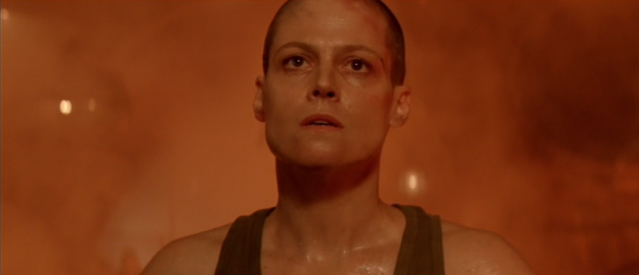
Sigourney Weaver as Ellen Ripley in Alien 3 (1992).

I assume that my feminist (that is, anti-sexist), anti-racist, anti-discrimination views are quite clear by now, but it occurred to me in light of some Facebook responses to my Terminator post that maybe I should provide a bit of back story and explanation for my deep commitment to social equality.

My journey toward feminism began when I was quite young, in the context of my extended family. My parents are originally from central Indiana, though they moved to the West Coast once my dad got his first professional job just after I was born. Growing up, I was always told -- and saw with the evidence of my own eyes -- that my maternal grandmother was an exceptionally intelligent woman, who could have been an excellent lawyer had the gendered assumptions of her time and place been different. She worked as County Clerk of her home county for approximately seven years in the early 1950s, and as Court Reporter for the county judge for four to six years after that. Yet it is my understanding that it would have been somewhat unthinkable for her, a farmer's wife in 1950s Indiana, to seek the bar and work as a full-blown lawyer. This always made me feel sad, baffled, and (ultimately) angry.

Mind you, I do not know how my grandma actually felt about this, and I don't recall ever talking with her about it. But the oft-repeated tale that "your grandma would have made a great lawyer" resonated deeply with me and provided me with my first lesson in the reality of structural sexism.*

Once I got to college in 1989, it wasn't long before I took a women's studies course, "Introduction to Feminist Theory and the Women's and Men's Movements," taught by Gloria Orenstein at USC during Spring Semester 1991. This course, in which we read key works like Simone de Beauvoir's The Second Sex and learned about the history of women's liberation, was a key turning point for me. It gave me terms, language, and concepts with which to articulate my deep discomfort and anger toward our patriarchal, sexist society. And it set me further on the path toward becoming an academic feminist.


That path led me, some years later, to graduate school at the University of Oregon, where I became a student of feminist film scholar Kathleen Rowe Karlyn. I highly recommend Karlyn's work to anyone interested in issues relating to women, feminism, and popular film and television. Her early work on female comedians and the romantic comedy genre -- encapsulated in her first book, The Unruly Woman (1995) and her really great article "Comedy, Melodrama, and Gender: Theorizing the Genres of Laughter"** -- is absolutely essential stuff. Her latest book, Unruly Girls, Unrepentant Mothers (2010) is just flat-out superb, and I teach from it all the time. Karlyn is obviously an academic, but her background is in journalism, which lends her jargon-free writing style a clarity and directness not always found in scholarly publications.

Anyway, during my graduate school training under Karlyn, my feminism found its voice and I started writing about issues of gender and sexuality in popular and independent films. I still do, and I also teach courses in feminist approaches to understanding film and popular media.

One thing I teach my students is that sexism isn't ONLY Hollywood's fault, yet the images and ideas circulated by mainstream films certainly perpetuate the bigger societal problem of gender inequality. This is why it's called structural sexism -- it is built into the infrastructure, institutions, and assumptions of our culture.

Want some evidence? Try this:

This chart found on page 11 of this 2012 U.S. Census Report.

That is a sobering chart whose data gives the lie to anyone who thinks women are treated equally to men in our society or that feminism in no longer needed. Even in such a simple matter as equal pay for equal work, we still have a long way to go.

And things may actually be worse in Hollywood than they are in American society writ large. Check out this interesting article about USC media scholars who are working to concretely quantify what feminist analysts and savvy laypeople have known for years about unequal gender representation in film.

The article presents statistical data showing that "in 2013, only 29 percent of characters [in the top 100 grossing Hollywood films] were female, and a mere 28 percent of the films had a female lead or co-lead." Sadly, this comes as no surprise to those of us who study Hollywood for a living. Nor does the even more discouraging data about women working in production jobs in Hollywood: "When it came to the people behind the camera — in the roles of director, writer and producer — only 16 percent were women."

Source: This article by Walt Hickey.

This saddens me greatly because (obviously) I love movies and I do not like that the industry responsible for making some of the best and most influential films on planet Earth is so pervasively and unrepentantly sexist, on both sides of the camera.

Furthermore, I am in complete agreement with this post about the need to reject the horrible, demeaning concept of "strong women" characters -- we need well-rounded female characters, NOT "strong" ones -- and this related post about the Trinity Syndrome, i.e., the tendency for seemingly powerful female characters to be marginalized by male ones in the movies in which they appear. I also urge my readers who are interested in these matters to see Anita Sarkeesian's sharp rundown of the Bechdel Test, which is a quick and handy (if somewhat limited) guide to sexism in the film industry:


So what can I do about these sobering statistics? What can I do about structural sexism in movies?

Well, on the scholarly side, my anti-sexist, anti-racist beliefs have led me to write (or co-write) articles like this one and this one, exposing the implicit sexism and racism of the rise of geek culture. (The short version: popular geekdom is a guise assumed by white masculinity in order to keep itself front and center in American culture, as it always has been. Onscreen geeks think of themselves as more sensitive and progressive than more traditional, manly, jock-ish males, when in fact they are every bit as sexist and male-centered as the jocks they have replaced as the central male figures of our current cultural moment.) I am proud of this work and only hope more folks will read it and understand its frightening implications.

On a personal level, my progressive beliefs have, over time, caused a subtle and gradual shift in my film tastes -- though I think that the change in my movie preferences is also a simple result of my getting older. That is, I think it is developmentally appropriate that, as a man in my mid-forties, I should find most of today's superhero films to be too simple-minded and adolescent in their themes, and that I should instead prefer films whose content is aimed at adults my age. In terms of my feminism, I can still enjoy a fun, mindless blockbuster, but as I have written here before, I find it increasingly difficult to enjoy terrible, two-dimensional, insultingly bad screenwriting, and I really cannot stomach watching many more films that blatantly celebrate how great white men are at the expense of women, people of color, extraordinarily bodied persons, etc.*** I think I have more or less reached my limit on throwing down ticket money for blatantly sexist crap.

As for what ALL of us can do, I think we can be more cautious about which films we spend money to see, and we can at the very least become aware of the sexist (and racist, and other discriminatory and damaging) stereotypes so commonly and unthinkingly circulated by our popular films and media. I am NOT saying we should boycott or avoid all films that star white men, or cast aside films we might enjoy just because they contain damaging stereotypes and messages. We ALL have films we love that are ideologically questionable. Like it or not, we live in a world where Hollywood is globally dominant, and Hollywood is very much invested in maintaining the cultural status quo.† I think the key to resisting this pervasive ideological conditioning is KNOWING that we are seeing racist / sexist / imperialist stereotypes, watching out for them in the media we consume, and not buying into those retrograde messages unthinkingly. To me, awareness is the key, for awareness empowers choice. And we are all still free to make our own choices and, ultimately, to enjoy what we enjoy.

--
* I emailed my mother to learn some of the finer details about my grandmother's legal career, and even in that email response my mom reiterated the story I grew up hearing: "I believe in another day and age she would have been a lawyer. She was so smart and loved all the things pertaining to law." She also added that "Mom always made comments how she would have liked to go to college but that didn't happen in her time. Only a few were that lucky and her family was not into education nor did they have any money."
** "Theorizing the Genres of Laughter" is anthologized in Classical Hollywood Comedy (1995, ed. Karnick and Jenkins) pp. 39-59.
*** "Extraordinarily bodied persons" is my preferred term for folks commonly referred to as "the disabled" -- I prefer the term "extraordinarily bodied" or "differently abled" and I believe I learned both of these terms from Rosemarie Garland-Thomson's terrific book Extraordinary Bodies.
† Hollywood doesn't support the status quo because of some deliberate, evil plot to keep women and other non-white, non-male groups down (though there is a great deal of cultural and historical momentum behind centralizing white men). Hollywood studios do this because they think it is profitable not to rock the boat or upset people too much. Most Hollywood films are in fact rife with internal ideological contradictions -- that is, they contain both liberal/progressive AND conservative/retrograde ideas that coexist side by side. This is so that folks from all over the political and social spectrum can enjoy these mass media products and see what they want to see in them -- and keep paying money for the privilege. Capitalism (heavily influenced by patriarchy) drives Hollywood.  

Saturday, August 9, 2014

Why The Terminator Kicks Terminator 2's Stupid Ass

The Terminator (1984) is better than its sequel, largely (but not entirely)
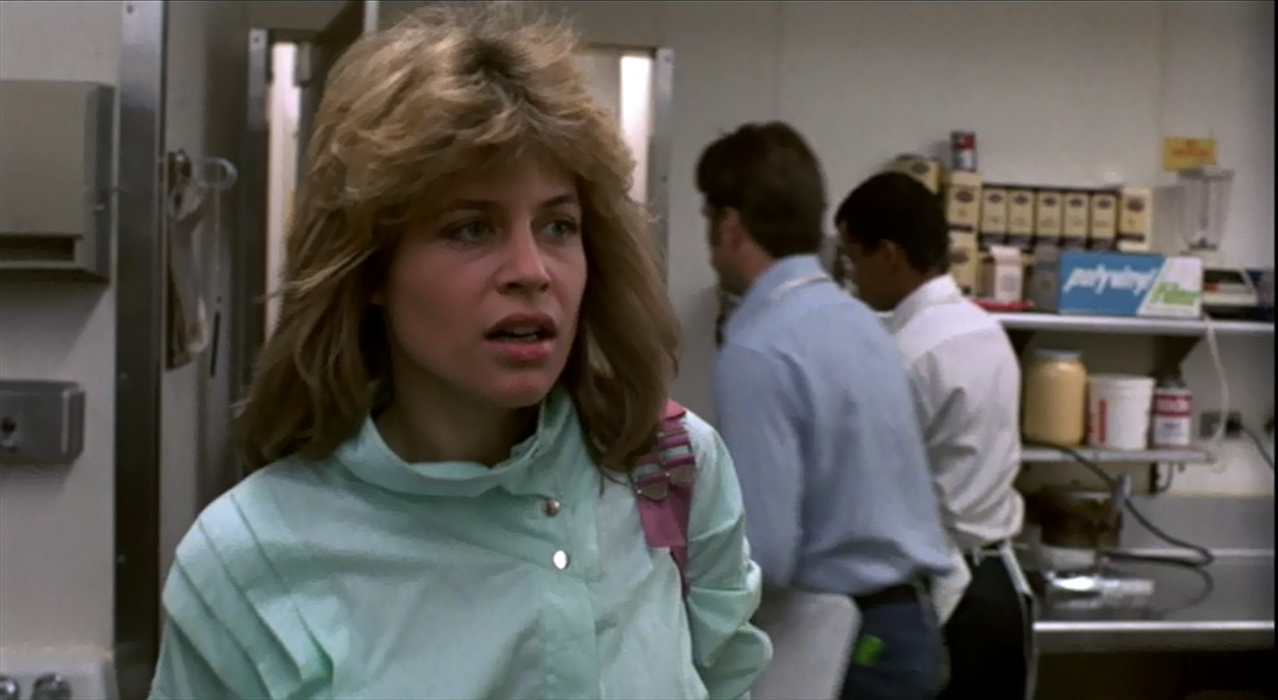
 due to the role played by this lady right here.

Okay, this time my use of the adjective "stupid" in the post title is not fully warranted: Terminator 2's ass is not completely stupid. In fact, Terminator 2: Judgment Day (1991) is actually a good movie that I enjoy. I admit outright that my main reason for using that post title is to create a sense of uniformity with my last post in this series.

However, I am here to tell you that the original 1984 film, The Terminator, is definitely much better than its fun but problematic sequel. As enjoyable as that sequel is, it is not nearly as tight on the filmmaking front as its predecessor, nor is it the pro-feminist work that many uninformed persons believe it to be. In fact, the first Terminator is both a better film and a more feminist film than Terminator 2.*

Let's start with that main ideological issue: sexism. In The Terminator, Sarah Connor is an average twenty-something woman living in L.A., who happens to get targeted by an invincible killer cyborg from the future. While she seems frightened and somewhat in shock when she first realizes she is being stalked, she makes several smart moves -- staying in public places and calling the cops ASAP. Then, once she learns about the whole time-travel thing from Reese, she adapts quickly to her new circumstances and responds quite well to Reese's elementary lessons in survival and weapons training. She does make one crucial error -- calling her mother to tell her where she is -- but even this blunder can be explained by her naivete about the full capabilities of the Terminator, and needn't be read as some kind of feminine weakness or hysteria. In fact, the Sarah Connor of The Terminator practically never gets hysterical, nor, ultimately, does she need to be saved by a man, except right at the outset. She shows resilience and depth throughout, and by the end, after Reese dies, Sarah manages to save herself and to destroy the Terminator all on her own.

"You're terminated, fucker!"  

By contrast, in Terminator 2, despite (or perhaps to chauvinistically compensate for) her badass muscles and paramilitary training, Sarah Connor gets sold out; she loses agency and power relative to the first film. While the early scene in which the mental institution staffer is shown erotically licking her face against her will is gratuitous and humiliating for her character  -- I have never understood the necessity of that moment -- the main way in which Connor's agency is undermined is via the ascendancy of her adolescent son. As John Connor slowly comes of age in this film -- under the tutelage of the gendered-male Terminator, NOT Sarah herself, mind you -- he also becomes her surrogate parent, bossing her around and preventing her, with the help of his new cybernetic daddy/buddy, from making the horrible errors she plans to make by assassinating Dyson. And the film wants us to sympathize with young John in this, showing Sarah's actions to be badly thought out, rash, histrionic, even outright crazy. This character who supposedly has the mental fortitude to withstand the first Terminator attack, the loss of Reese, her own subsequent institutionalization, and the appearance of yet another (and more powerful) Terminator in her time, suddenly loses it, requiring her tweener son to not only rescue her but to counsel -- no, order -- her back into a state of relative mental stability. Which she never quite regains, because she spends the whole last third of this movie taking orders from this kid, who SHE should in fact be training!

This is a progressive, well-rounded depiction of a heroic female character.

This isn't. 

Now I totally get that one should not be too nitpicky about blockbuster action movies making too much sense -- otherwise, NONE of them would be any fun. Yet I do ask for a certain basic level of adherence to THEIR OWN internal rules, and on these grounds I find the inconsistencies created by second Terminator film to be distractingly bad for the franchise.** For example, see item #3 on this list, in which the author notes that the main rule for time travel established by the first Terminator film -- "The time machine can't transport non-living matter" -- is flagrantly broken by the second one:
Now, technically, the first Terminator is a machine with living tissue layered over its endoskeleton, so it gets a pass, we guess. Enter the T-1000, the second film's liquid metal Terminator that can take nearly any shape and recover from nearly any wound. Oh, and it can turn its arm into a knife.  
The problem is, this Terminator is composed entirely of liquid metal. No living tissue, no flesh, just 100% mimetic-poly alloy (thank you, James Cameron). That means, according to the rules clearly established in the first movie, it cannot travel back in time.
Indeed. This has always bothered me, since no such flagrant problems exist in the first, tightly scripted and well-thought-out film.

Sure, the first Terminator movie does create a kind of temporal paradox by revealing (SPOILER!) that the time-traveling Kyle Reese is the unborn John Connor's father, which means that none of the future events of the film would have happened at all if he hadn't come back in time in the first place -- but this I write off as one of the inevitable results of ANY time-travel scenario. Paradoxes arise and exist. I don't have a problem with this twist because it doesn't fundamentally undermine the premises set up by the film. It just fucks with our heads a bit because time-travel scenarios are ALWAYS illogical and paradoxical.

Reese finds shoes --  a great moment from a superbly shot and edited chase sequence 
early in the first Terminator film. 

And who cares about the occasional temporal paradox when the action is this good? With only one major exception I can think of -- the truck-and-motorcycle chase along the L.A. River in T2 -- I argue that the action sequences in the first Terminator are uniformly better than those of its sequel. Sure, those exciting bits in the sequel are more over-the-top and quite pleasurable, but I urge you to take a careful look at the opening cops-chase-Reese sequence in The Terminator, or the final showdown of the first movie from the point where Reese and Sarah leave the hotel room and end up at the factory. The editing and cinematography (not to mention the great soundtrack) are all so effective in these sequences, so pulse-poundingly exciting and suspenseful, that they generate a cumulative intensity that cannot be matched by Judgment Day, good as it is.

The L.A. River chase = the best action sequence in T2, and the only one 
that matches the intensity of those seen in The Terminator. 

Lastly, one of the biggest flaws in T2 is that there's no Michael Biehn -- Reese is one of the most badass parts of the first movie. Instead, we get a somewhat annoying 10-year-old kid. Cracked.com calls the young John Connor (Edward Furlong) the flaw that nearly ruins Terminator 2, lambasting the film for "giving us a 10 year old John Connor who, upon repeated viewing, is so obnoxious that you spend most of the movie wanting to see him shot in the face, fate of humanity be damned." Taken together with my feminist critique about how grating it is to have such an immature kid bossing his mom Sarah around, I am inclined to agree with this point. I don't hate young John Connor per se, but he's no Kyle Reese.

The Terminator's Reese sez: "I'm a badass --  AND Sarah's driving the car right now!"

To conclude, while I am not here to disabuse anyone of their love for T2 -- let me reiterate that on the whole, I enjoy the film -- I would urge all my readers to take another serious look at The Terminator, and see if you can tap into the crazy intensity, tight direction, and more satisfying character arc for Sarah Connor that leads me to champion this film over its (perhaps undeservedly) more popular follow-up.

T2's Sarah Connor sez: "Get me out of this hysterical role in this sexist movie -- NOW!"


UPDATE 5/26/2015: This guy is even tougher on T2 than I am; he accurately claims in item #2 on this list that the actions of the T-1000 at the end of the sequel are "baffling," concluding simply that "robots are pretty dumb sometimes."

--
* This same logic applies to the first two Alien films: while falsely believed to be as good as if not better than Alien (1979), and also supposedly more feminist, James Cameron's Aliens (1986) is in fact no better than Ridley Scott's Alien from technical standpoint and is actually more sexist than its 1979 predecessor. But that is a subject to return to later.
** As one of the guys in this funny video puts it, "James Cameron is like: 'Shut up and watch this badass thing I made but don't you dare fuckin' think about it!'"

Wednesday, July 30, 2014

EW #9: Nashville (1975)

Henry Gibson as Haven Hamilton in Robert Altman's masterpiece Nashville. 

Although this entry once again emphasizes the strong bias of the EW staff in favor of 1970s American cinema, Nashville, Robert Altman's 1975 epic about the music industry and American politics, is truly a masterpiece worthy of very high placement on any Top 100 Films List. For Altman himself and for 1970s Hollywood cinema writ large, it just doesn't get much better than Nashville. 

Nashville is one of my very favorite films, bar none -- it appears on my "Top 40 Films" list of last November and is one of only nine movies to place on my personal Top 40 and on EW's 100 Best Films list.*

Film critic Robin Wood identifies Nashville as essential Altman, stating that
Everything in Altman so far -- the good and the bad -- comes together in Nashville. Its great scenes -- Gwen Welles' enforced striptease, Ronee Blakley's onstage breakdown, everything involving Lily Tomlin -- are all centered on the characters' exposed vulnerability and realized with painful intensity. At the other extreme are the embarrassingly Cutie-pie uncredited guest appearances of Elliott Gould and Julie Christie as Themselves.
Unlike me, Wood is none too keen on these latter moments of meta-textual wit; for him, they disrupt or lessen Nashville's potential political impact. He concludes:
The film's total effect -- for all the marvelous local successes -- is to engulf the spectator in its movement of disintegration, making intellectual distance impossible. The ironic force of the ending, with the crowd confronting catastrophe by singing "It don't worry me," a communal refusal to think, is weakened not simply by the inability to offer any constructive alternative but by a perverse rejection of the possibility.**
Wood claims to feel "somewhat sick and depressed" at the end of Nashville, and that, I think, is a proper response (though I typically respond with schadenfreude-laced elation). The film's dead-on accurate portrayal of how American jingoism blinds us to the real machinations of capitalism should indeed disturb and, to some extent, sicken us.

However, I disagree with Wood that intellectual distanciation is rendered impossible by Nashville. In some ways, the film's very mythic/allegorical dimension, the way so many of its characters, while being very particular, feel like stand-ins for classic American types, encourages us to read the film symbolically and intellectually. Nashville's darkly ironic use of the American flag and that closing song surely provoke me to respond thinkingly to the film, to consider it as an eerily accurate mythic summation of the contradictions inherent to American character and culture.

This prominently placed American flag freights the final sequence of Nashville 
with mythic -- if deeply ironic -- layers of meaning.

No, I instead prefer Jonathan Rosenbaum's succinct assessment of Nashville from his book Essential Cinema:
In point of fact, the film celebrates as much as it ridicules -- often doing both the same time -- while giving both its brilliant cast and its audience too much elbowroom to allow for any overriding thesis.***
That's just it. If my post thus far makes Nashville sound like some sort of pedantic manifesto or overt "social statement," that is not an accurate portrait. Altman's great talent lies in creating films that feel "lived-in" and real. His heavy dependence upon his actors and his insistence that they improvise and go off-script keeps his work from ever feeling too artificial or "writerly."† So even if, in the broad strokes, Nashville resonates on political, mythic, and satirical levels, it nevertheless feels so real and alive and delightful in all its interactive particulars that it never feels heavy handed or false. If anything, its ability to draw the viewer in, to involve us in its wonderfully human textures, may be exactly what makes Wood feel so disturbed by the ending of it -- it is difficult, once one is immersed in such a believable, nuanced, and enjoyable onscreen world, to extricate oneself from the darker, more violent implications of that world's underlying logic.

As Rosenbaum puts it,
The difference between conventional methods and Altman's is one between directness and indirectness, actions and interactions -- the actors', the characters', the director's, the scriptwriter's, and our own. It is decidedly a group endeavor, and, as such, one that lives and breathes in an intangible no-man's-land between "thinking" and "playing" for the filmmakers, "thinking" and spontaneous "reacting" for the audience: the relative strengths of both values are held. ††
To sum up, Altman's films, and perhaps especially Nashville, are difficult to describe or assess in words; to see them is to experience something quite ethereal and magical and particular to the workings of (Altman's) cinema.

Yet I can say a few words about why Nashville is particularly essential viewing. Besides the fact that it is one of Alman's most assured and "unified" films (if that word is even appropriate when describing a filmmaker like Altman), Nashville is also an important historical film, one of a group -- including The Parallax View, All The President's Men, The Conversation, Taxi Driver, and The Deer Hunter -- that accurately characterize the vibe of post-1960s, post-Watergate America. Nashville's assassination plot and ironic use of anthemic-sounding music tie it formally to this group of films, while its downbeat, relaxed, even humorous tone make it stand out uniquely among this otherwise heavy menagerie.

Further, what Nashville achieves that few other Hollywood films of any era do is to stage an effective critique of the insidious and cruel nature of consumer capitalism. Every single musician or aspiring musician we see in the film has been co-opted and used in some way. Haven Hamilton is a pawn of the Nashville promotional scene and of local politics; Barbara Jean and Tommy Brown are token minorities who are used and then thrown aside; and poor Sueleen Gay is an aspiring singer whose very American dreams expose her to humiliations of the worst kind.

Aspiring musicians perform at a deafeningly loud racetrack, ignored by 
an indifferent crowd. Their plight reflects the fate of all the musicians we see in the film: 
the capitalist system lets them climb toward fame and fortune but gives them nothing in return, killing them metaphorically and (in some cases) literally. 

Indeed, one of Nashville's great strengths is its relentless exposure of the commodification and exploitation of women that lies at the heart of patriarchal (popular) culture. Although Wood argues that "Altman's identification with a female (never feminist) position is extremely problematic: it is limited almost exclusively to the notion of woman-as-victim, to sensations of pain, humiliation, and breakdown," I assert that this strategy is very effective and is aligned with the tradition of melodrama, which foregrounds and ennobles female suffering.††† For me, the heartbreaking scene in which Sueleen (Gwen Welles) does a striptease under duress is one of the most excruciating scenes in all American cinema -- as it should be. Far from exploitative, this scene, like most of the scenes involving the convalescing (recovering?) Barbara Jean, serve to highlight the ways in which the patriarchal entertainment industry -- which has clear ties to our patriarchal political leadership -- vampirically exploits women's bodies and talents in order to make more profit and further its oppressive ends. If everyone is exploited under capitalism, Nashville seems to say, women are exploited most of all, and suffer for it the most painfully.

Ronee Blakley as Barbara Jean, one of the most moving and heartbreaking 
characters in Nashville. 

Finally, I take it as significant that the song the crowd sings together at the end -- "It Don't Worry Me" is actually a hit radio song composed (in the world of the film) by callow folk-rocker Tom Frank and heard in snippet form on his album and requested by fans at a pub before we finally hear it sung in full by all in the denouement. In other words, far from being a grassroots anthem, this song of "resistance" -- or is it compliance? -- that the crowd spontaneously sings is actually itself a commodity, a song marketed to them by the same Nashville music industry that set the stage for the film's climactic tragedy. The crowd is simply reproducing what the exploitative system has already sold to them. In this way the film interweaves the political and the pop-cultural, showing us that what counts as "culture" in America is a for-profit, totalizing network of systems -- fully encompassing party politics -- that only requires our docile participation in order to maintain its awful, exploitative momentum.  Nashville thus incisively exposes how supposedly "apolitical" performers and activities are anything but.

Yet there I go again, harping on Nashville's political themes, when I should be emphasizing how well-acted, cleverly constructed, witty, touching, and fun this film is to watch. There are many films I consider to be socially or politically important, but few that I return to nearly as often as Nashville for the sheer pleasure of it. I give this film my highest endorsement and urge all of my readers to check it out.

Arnold Schwartzenegger and Elliott Gould in The Long Goodbye.

Bonus Afterthought: Despite my deep appreciation for the Altman films I have seen -- about nine altogether, and a few of those so long ago I don't remember them well -- I have not seen a great many and am no expert on the director. Sure, nine films sounds like a respectable number, but Altman is prolific and that count does not include crucial entries like California Split (1974) and 3 Women (1977). Plus my memories of the seminal McCabe & Mrs. Miller (1971) are rusty at best.

Nevertheless I can point you toward a few of the other Altman features I have enjoyed most: Gosford Park (2001), Short Cuts (1993), and The Long Goodbye (1973).

A bit less ambitious but no less well-crafted than his mid-career epics, Gosford Park is a delightful treat that any moviegoer should enjoy. One of Altman's few films set outside the U.S. context -- in Great Britain -- this comedy of manners/whodunit will surely appeal to fans of the hit BBC series Downton Abbey, particularly since its screenplay was penned by Downton creator Julian Fellowes.

The Long Goodbye and Short Cuts are both exemplary L.A. films, the former a parodic riff on film noir, the latter another lengthy "tapestry" film of interweaving stories similar to Nashville. I have a hard time choosing which of these two films I like better -- they are tied for my second-favorite Altman film after Nashville. I recommend Goodbye to fans of film noir and offbeat comedy, but would probably have to consider Short Cuts more essential viewing if you have the time to invest in it -- at just over three hours, it is twenty-five minutes longer than Nashville.

--
* The nine films appearing on both lists are: The Wild Bunch [#83], 2001: A Space Odyssey [#25], Blade Runner [#81], Chinatown [#31], Double Indemnity [#40], Nashville [#9], Psycho [#5], Rules of the Game [#39], and Night of the Living Dead [#79].
** Wood, Hollywood From Vietnam to Reagan . . . and Beyond, p. 36.
*** Rosenbaum, Essential Cinema, p. 92.
† The exception to this rule is Altman's debut feature, MASH, which, as Rosenbaum points out, is a relatively focused "thesis film" quite different from all of Altman's subsequent work (Essential Cinema pp. 81-2).
†† Rosenbaum, p. 81.
††† Wood, p. 38. For more on melodrama, see Linda Williams' "Melodrama Revised" and/or Kathleen Karlyn's Unruly Girls, Unrepentant Mothers.