Showing posts with label thriller. Show all posts

Saturday, December 17, 2016

Review: The Handmaiden (2016)


The Handmaiden, the latest thriller from Korean director Park Chan-wook, is a remarkable film that may not be for everyone, but is well worth seeing if you can withstand some graphic sexuality.

For those unfamiliar with Park's earlier films like Oldboy (2003), the non-Park film The Handmaiden most closely resembles is Guillermo del Toro's Crimson Peak. Both are Gothic thrillers centered on an outsider entering the home of some perverted weirdos. However, whereas del Toro's film, though beautifully constructed and visually sumptuous, is relatively straightforward narrative-wise -- most viewers will see the ending coming a mile away -- The Handmaiden is full of delicious, shocking twists and turns. It's like Crimson Peak filtered through the multiple perspectives of Kurosawa's Rashomon and infused with the narrative urgency and edgy sexuality of the Wachowski's Bound.

Yet even these comparisons do not capture the exact tone and visual aesthetic of The Handmaiden. Park is a world-class auteur with a sensibility all his own. I admit that Oldboy is the only other Park film I've seen (sorry, Thirst and Stoker!) yet I can truly say it is unlike any other movie I know. Park's Handmaiden is similarly unique, a really terrific thriller, a visually brilliant cinematic adventure, and a searing love story all at once.

The story begins with Sook-Hee (Kim Tae-ri), the titular handmaiden, who arrives at the sprawling, picturesque, yet forebodingly creepy estate of Uncle Kouzuki (Jo Jin-woong). 

I really cannot say more without revealing spoilers, which I do not wish to do. Suffice to say that none of the principal characters is quite what they appear to be at first. The method by and pace at which Park gradually reveals layers of the truth is indeed Rashomon-like in its brilliance and elegance. Each new revelation changes not only what we know of the unfolding plot but also what we know -- and more importantly, how we feel -- about the characters and their relationships to each other.

The Handmaiden is propelled by the intensity of its eroticism as well as its brilliant reveals and plot twists. It is like a vastly more nuanced and interesting version of what Gone Girl more clunkily attempts. As The Atlantic's David Sims notes,
more than anything, The Handmaiden is just pure cinema, a dizzying, disturbing fable of love and betrayal that piles on luxurious imagery, while never losing track of its story’s human core.
Yes indeed. I was frankly amazed at The Handmaiden's ability to provide so many chills, thrills, and horrors while preserving the beautiful, touching romance that lies at its center. In this sense it is superior to the aesthetically masterful yet less emotionally gripping Crimson Peak, a film I champion and love a lot.

Like most thrillers, The Handmaiden is about surveillance -- about watching, spying, and (correctly and incorrectly) perceiving. This is a motif that Park and his cinematographer Chung Chung-hoon convey especially well. Like Alfred Hitchcock, Park is particularly adept at placing and moving the camera in such a way as to reveal just enough to keep the viewer on the hook. Like many of Hitchcock's works (e.g., Rear Window, Psycho), The Handmaiden is a "puzzle film" in which what we see is frequently misleading because it is only one character's subjective take on events.*

The Handmaiden's most wonderful scene, which really sums up everything I love about this movie, takes place under a certain tree that figures heavily in the plot. It is a darkly comic scene in which two characters reveal deep inner truths to one another while caught in a strangely precarious and life-threatening situation. I would almost recommend that folks see the film just for this remarkable, touching, hilarious sequence alone.

Again, The Handmaiden will not appeal to everyone, focused as it is on explicit sexuality, some of which leans toward the perverted and unusual. To take just one example, one early scene depicts the most erotic use of a thimble I have ever seen. And Uncle Kouzuki's interests -- and the various ordeals to which he subjects Lady Hideko (Kim Min-hee) -- are quite disturbing to say the least. There is also some third-act violence that, while restrained next to that seen in Oldboy, may be too explicit for some viewers.

Nevertheless, The Handmaiden is a fine Gothic thriller that Leah Greenblatt accurately describes as "a historical romance that is to Merchant Ivory what Molotov cocktails are to tea cozies." Well said. Despite its sexual edginess that may place it outside the tastes of some viewers, I agree with Greenblatt's conclusion that The Handmaiden constitutes "the most twisty, audacious, and wildly sexy 145 minutes of cinema this year." Highly recommended.

Kim Tae-ri as Sook-Hee in Park Chan-wook's gripping Gothic thriller The Handmaiden.

UPDATE 12/17/2016: Since posting this review earlier today some folks have correctly pointed out that it doesn't acknowledge The Handmaiden's status as an adaptation of Sarah Waters' Gothic novel Fingersmith (2002). This is true -- I didn't discuss it because I am unfamiliar with the book, but I agree that I should have at least mentioned its existence. Plus I have it from reliable authorities that the film is a fairly faithful adaptation of that source novel, with a few incidents condensed and fewer characters made the central focus. I am also told that that amazing, erotic thimble scene I mention comes from the original novel.

---
* The connection between Hitchcock and Park is made explicit in Stoker (2013), a thriller that borrows plot elements and character names from Hitch's Shadow of a Doubt (1943). A.O. Scott describes Stoker as depicting "a world of lurid, saturated colors; languorous camera movements; temporal displacements; and jagged shards of sound." This reminds me of The Handmaiden actually. And while Scott expresses mild disappointment with Stoker's third act, I still plan to see it due to its references to the Hitchcock film and on the basis of my friend AJ's positive recommendation. As Peter Travers puts it,
Some will find it too much. Screw them. Park's goal is to bust form, not conform to it. Take Stoker for what it is: a thriller of savage beauty.
Sounds good to me! I am also reminded of fellow Korean Bong Joon-ho's delightfully twisty Mother in this context.

Friday, September 18, 2015

Three Wonderful Recent-ish Movies


Over the past couple of months, I have seen a few films that stand out in a special way. These three -- What We Do in the Shadows, Nightcrawler, and The Skeleton Twins (all 2014) -- are, of the several films I have watched lately, the ones that gave me the most pleasure as I watched them and stuck with me most poignantly afterward.*

What We Do in the Shadows is a mockumentary comedy about a group of vampires living together as flatmates in Wellington, New Zealand. It is the outright funniest film I have seen all year (beating out Spy). The filmmakers really understand the classic tropes of the vampire genre. They skewer them all brilliantly. Furthermore, there are some delightfully unexpected twists, as when the newest member of the vampire clan brings his human "best mate" Stu over to meet his undead roommates -- and Stu ends up becoming the most popular member of the group.

Vladislav, Deacon, and Viago jam out in What We Do in the Shadows.

What We Do in the Shadows really nails the drily witty mockumentary form, standing alongside the Christopher Guest-directed classics Waiting for Guffman (1996), Best in Show (2000), and A Mighty Wind (2003) as an all-time great of this particular comedic subgenre. Like the Guest films that I assume inspired it, Shadows culminates in a big event that brings all the key characters together, in this case the annual Unholy Masquerade Ball. The events that transpire during and after that sequence alone are worth seeing the movie for, as are the flatmates' occasional run-ins with the local police.

Shadows contains a few moments of graphic blood and gore, though (to my eye anyway) these come across as more excessively Monty Python-esque than truly horrific. No, the dominant tone here is laugh-out-loud funny -- there is one sequence in the film, when  neat-freak vampire Viago is laying down newspapers to protect his couch before he attacks a victim, that had me belly laughing for quite some time.

Viago is a bit of a neat-freak. 

Despite its mild use of horror elements (in addition to the blood, there is one vampire attack that is rather sudden and unexpected), I would recommend What We Do in the Shadows to practically anyone. If you like comedy in general and/or witty mockumentaries in particular, you will find plenty to enjoy in Shadows.

Writer/director Dan Gilroy's Nightcrawler is also something of a comedy, serving as a bleak satire of the news production business. However, despite its darkly satirical tone and many absurdist moments, it probably has more in common with the urban noir thriller than with any other genre. It is more pulse-pounding than laughter-producing.


As A.J Snyder writes in his capsule review of Nightcrawler, "While much has been said about the intensity of [Jake] Gyllenhaal's performance, and rightfully so, I feel like the single greatest strength of the film is its allegory for capitalism's current mode of racing to the bottom-most line." That's it exactly. While Gyllenhaal's central performance is intense and intriguing and delightful, the whole film -- including Rene Russo's superb costarring turn -- is so cleverly put together and expertly paced that I was completely on the edge of my seat the whole time through.


Furthermore, the film has a clearly articulated central theme about the cruelty and inhumanity that lie at the heart of media consumerism which it conveys quite efficiently via what you see and experience, without undue expository dialogue. (Thematically it reminded me a bit of Sofia Coppola's underrated The Bling Ring.) 

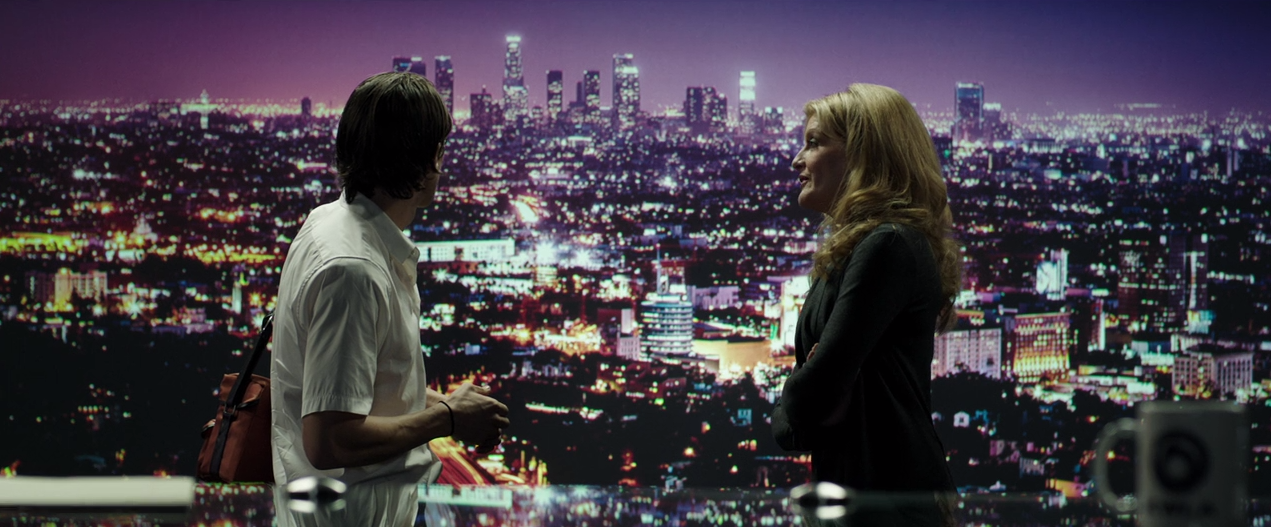
Lastly, there is cinematographer Robert Elswit's (There Will Be Blood) sublimely photographed setting: the city of Los Angeles. Nightcrawler is an exemplary "L.A. film," joining the ranks of such classics as Chinatown, Shampoo, Heat, Collateral, Short Cuts, and Boyz n the Hood in taking full advantage of the particular way L.A. sprawls around its various disparate neighborhoods, crisscrossed by freeways. It's a weird place (both geographically and vibe-wise) that I always enjoy seeing depicted poetically on screen. Nightcrawler captures its unique qualities about as well as any film I've seen.


Iconic L.A. images captured by cinematographer Robert Elswit for Nightcrawler. 

Yes, Nightcrawler is one of the finest thrillers and one of the sharpest satirical dark comedies I have seen in quite some time. Packed with uniformly great performances, a tight, compelling script, and haunting L.A. cinematography, it will surely loom large in my End-of-Year reflections.**

Kristen Wiig and Bill Hader in the touching, heartful dramedy The Skeleton Twins.

Set in an unspecified small town ("near Woodstock") in upstate New York, The Skeleton Twins is a film that, like Nightcrawler, I intended to see in the theater but ended up seeing on Netflix streaming. The movie is a somewhat dark yet ultimately heartwarming dramedy about an estranged twin brother and sister coming back into each other's lives after a ten-year hiatus.

The Skeleton Twins' dark side comes in part from its engagement with the topic of suicide. The film opens with Milo (Bill Hader) making a suicide attempt, and when that fails, the hospital calls his sister Maggie (Kristen Wiig) to come pick him up just as she is about to make an attempt on her own life the very same day. The film treats this remarkable coincidence with dark humor, yet it also reveals later in the proceedings that the twins' father successfully killed himself when they were young, adding dramatic weight to the suicide theme. Unraveling why both siblings find themselves so unhappy with their lives, and how and why they drifted apart from each other for ten years, becomes the film's raison d'etre.

Milo and Lance get to know each other, with mixed results. 

Part of the problem on Maggie's side is her inability to remain faithful to Lance, her upbeat, kindly, yet dimwitted husband (played to perfection by Luke Wilson, always my favorite of the two Wilson brothers). Lance wants to have children but Maggie doesn't, and rather than confront him him with this, she has flings behind his back. Meanwhile, Milo rekindles an old relationship that causes major problems for himself and reopens old wounds between he and Maggie. All of this conflict is so well scripted and performed, and the casting (including Ty Burrell as Milo's sexually conflicted old flame) so spot-on, that the film is simply a delight to watch. Both Wiig and Hader deliver nuanced characterizations that allow us to feel great empathy for these two lost souls even as we watch them make repeated mistakes. And the moments in which they laugh and get along together are very natural, believable, and warm.

Kristen Wiig delivers a downbeat yet empathetic and lived-in performance as Maggie. 

Ultimately, The Skeleton Twins is a carefully sketched portrait of strained yet loving sibling relations, and while the film's climactic episode may feel a wee bit contrived to some viewers, it is emotionally correct, and the film ends on a lovely note of reconciliation, as comedies should.

Plus, any movie with an unruly kid flipping adults the bird automatically gets my vote:

Cullen flips the bird. 

--
* I almost included a fourth film, Azazel Jacobs's Terri (2011), in this post, but despite its many delights and pleasures, that indie masterpiece is more offbeat and less plot-driven than any of the three I have included. I decided that it might be hard to recommend Terri to readers who don't enjoy meandering yet well-observed slice-of-life films about socially alienated weirdos quite as much as I do. You will be able to read my capsule review of Terri in this year's forthcoming End-of-Year Roundup.
** Here are links to my 2013 and 2014 End-of-Year Roundups. Yee-haw!