Showing posts with label film noir. Show all posts

Tuesday, October 17, 2017

Review: Blade Runner 2049 (2017)


I fucking love Blade Runner. I first saw the original 1982 theatrical cut on VHS in the mid-1980s. That version intrigued me a lot, and haunted me, even though I didn't like the clumsy Harrison Ford voice-overs and weirdly upbeat ending. To be fair, I first came at Blade Runner with little understanding of film noir. Instead, I'd recently seen other fast-paced Ford vehicles like Raiders of the Lost Ark and The Empire Strikes Back. In contrast to these, Blade Runner felt slow and weird, but I still liked it. Its three principal characters -- Deckard, Roy, and Rachel -- stuck with me.

I happened to be living in Los Angeles in 1992 when the so-called "Director's Cut" of Blade Runner was discovered in a vault and screened at the Nuart Theater. That's when my true Blade Runner fandom began. That new version appeared just at the right time for me as a developing cinephile. I had started watching independent cinema, stuff like Do the Right Thing, Slacker, Reservoir Dogs, and sex, lies and videotape, so I was ready for a visually arty, downbeat, science-fictional neo-noir to sweep me away. Indeed, that cut of Blade Runner (and the essentially identical 2007 "Final Cut") remains one of my all-time favorite movies, even though I am made uncomfortable by the coercive nature of Deckard and Rachel's sex scene. I realize the dynamics of the scene are complicated by their both being replicants -- or maybe only Rachel being a replicant -- but it disturbs me. Nevertheless, I love Blade Runner. (I also love the Alien universe, so Ridley Scott has pulled me in twice.)

So I looked forward to seeing Denis Villeneuve's Blade Runner 2049. I went last weekend assuming I would like it and I did, very much. In my recent review of It I state that film is about 80% what I would want to see in an It movie. I mean that as high praise. I would say that Blade Runner 2049 is about 94% what I would want to see in a Blade Runner sequel.

The film often -- but not always -- touches on the mesmerizing quality that makes Ridley Scott's original so special. As with the noir-inspired original, Blade Runner 2049's main strengths are its beautifully lit visuals of grimy, lived-in settings and its overall melancholic tone.

Sure, Alex Garland's Ex Machina (2014) is a more compelling thematic follow-up to Blade Runner and is its true "spiritual sequel" ideas-wise. But Villeneuve's 2049 gets the tone and visuals dead right and introduces the reproducing replicant motif, a logical next step for the franchise that takes the story in an interesting, Pinocchio-like direction. And 2049 ends really well -- both its blade runners get superb final scenes and shots.

Although it ends with a haunting close-up of Deckard, 2049 features minimal -- just enough -- Harrison Ford. It's the new characters' show. Ryan Gosling is pitch-perfect as protagonist "K" aka Joe -- a strong silent type who is nevertheless more emotionally vulnerable than Deckard ever was (or is). Supporting cast members Sylvia Hoeks as Luv, Ana de Armas as Joi, and Robin Wright as Lieutenant Joshi (who I really thought was going to pull one more trick out of her hat before getting brutally murdered -- alas) are also especially good.

2049 does right to stay focused on Joe's present-day story, only bringing in Deckard when he becomes relevant to the mystery Joe is trying to solve. Indeed, too much emphasis on legacy characters weakens Star Wars and accounts for 2049's most awkward and least necessary scene: Niander Wallace's unsuccessful tempting of Deckard with Rachel 2.0.

There is no point to the Rachel 2.0 scene -- we know Deckard would never go for this ruse, and the use of computer generated imagery (CGI) to re-create a circa-1982 Sean Young looks, as CGI Peter Cushing in Star Wars Rogue One looks, uncanny, cheap, and (therefore) jarring.

Rachel sez: "Sorry folks, I should never have been in this sequel." 

2049's other main weak point is its almost comically underdeveloped depiction of an underground replicant revolutionary force. That scene only takes place to "explain" how Joe escapes Las Vegas, and there's a million other ways to do that -- he could just hijack some other vehicle from around Deckard's lair. Or the Wallace mercenaries could haul Joe back to L.A. along with Deckard, and Joe could escape at that point. Or he could be taken in the very same airport transport as Deckard, and would end up at the same climactic fight. The thing the rebellion leader tells Joe about his origin is something he could realize on his own -- he already suspects it before that dumb scene.

Deckard being tempted and Joe being rescued by an anonymous replicant resistance movement are stupid and unnecessary scenes. 2049 should just cut from Deckard being taken away in Vegas to "K" commandeering a new vehicle and pursuing him. No Ford / Leto meeting needed. The CGI Sean Young reveal is hackneyed in the film world and the real one.

I have been a Blade Runner fan since 1992 and was likely to want to see this sequel in any case. Yet the stellar track records of Denis Villeneuve, 2049's director, and Roger Deakins, its cinematographer, strongly contributed to my anticipation to see it. Villeneuve has made several excellent films over the past several years, including Prisoners (2013), Sicario (2015), and my favorite, his recent science-fiction film Arrival (2016). Deakins has worked with the Coen brothers since 1997, when he shot Fargo. He shot Prisoners and Sicario for Villeneuve. He also lensed the James Bond film Skyfall in 2012. He utterly rocks.

Is Blade Runner 2049 slow paced? Yes, of course it is. Like the original, 2049 is a bleak, moody, science-fiction film noir -- it is NOT an action film. There are basically two fights, two swift stabbings, and one extremely brief flying car chase. That's it -- the rest of 2049's two hour forty minute running time is people talking to each other on amazingly-lit and -designed sets. Don't expect much action, but expect a visually stunning, fully developed world of the future.

And expect me to crush people.  


UPDATE 10/28/2017: After reading my review, one of my friends noted on Facebook that she enjoyed Blade Runner 2049 too but had "some questions about Joi." Indeed, I share her concerns over the sexism of both the original Blade Runner -- the roughness of the Deckard-Rachel love scene has always disturbed me -- and its sequel. Honestly, I agree with everything Lauren Jernigan says in her penetrating article about the pervasive sexism of 2049. She writes: 
Joi has very little, if any, true agency as a character. She’s a programmed hologram that will be whatever K needs her to be, so he has his perfect fantasy woman. She is a literal product designed for the happiness of men.
Agreed. Like Jernigan, I find the sex scene with K, Joi, and her hired body double to be quite unnerving. Is this the film's way of critiquing this situation by making me feel unnerved and uncomfortable with it? Or is the film simply reinforcing the role of women as objects of desire for men? It's hard to tell. 

In defense of my Blade Runner fandom I can only say that film noir presents a strange case: it is so highly stylized and hyperbolic that I think it is possible to read the genre's abysmal treatment of women as a critique of patriarchal violence. But it is an ambivalent, ambiguous case, and there is no doubt that noirs like the Blade Runner films portray women as "only there to help move the story of men forward, rather than act as protagonists in their own right in a story very much about oppression against them," as Jernigan correctly asserts.

UPDATE 11/8/2017: I also found this piece by Joseph Aisenberg to offer an insightful interpretation of Blade Runner 2049. "Morose and morbidly meditative in tone, it gnaws around the edges of the assumptions underlying its plot mechanics, giving viewers time to think through the fakery in its themes about fakery versus authenticity."

Saturday, April 9, 2016

German Expressionism and its Descendants


"As has often been noted, it is sometimes very difficult to distinguish between horror and science fiction. Not only that, it can at times be difficult to distinguish between horror and the crime film, and science fiction, adventure and fantasy as well."
-- Steve Neale, Genre and Hollywood p. 85.

Expressionism is an artistic movement that began in Germany around the turn of the twentieth century. Expressionism at first emerged in poetry and painting before moving into theater and, eventually, film. The style eschews realism in favor of a more intensely subjective point of view. It favors oblique angles, forced perspective, heavy lines, and distorted and grotesque imagery. With its roots in Germany's trauma of losing World War One and subsequently plummeting into a recession, Expressionism tends to depict exaggerated / extreme emotional states, especially grim, negative ones like terror, fear, pain, sadness, disorientation, loss, etc.

Though it predates German Expressionism proper, Norwegian painter Edvard Munch's The Scream (1893, 1910) is considered exemplary of Expressionist aesthetics and was itself influential on twentieth-century Expressionism.

The interwar period of German film production, lasting from 1919-1933, is known as “Weimar Cinema.” It is named after the Weimar Republic, Germany’s first democratic government. The tumultuous, unstable Weimar period coincides with the emergence of German Expressionist cinema -- that is, Weimar cinema and Expressionism are somewhat synonymous. Noting that "German’s cultural strength in the 1920s stood in marked contrast to its political and military weakness," historian of German film Stephen Brockmann describes Weimar Expressionism as
characterized particularly by the use of chiaroscuro (an Italian word containing the words for light and dark and indicating sharp contrasts between light and shadow), by jagged and bizarre sets that indicate an otherworldly or inhuman space, or that reflect the torments of the individual soul, and by stylized, unnatural acting.* 
I would add that many Expressionist films use mise-en-scene to simultaneously indicate otherworldly, uncanny spaces AND individual torment, as in Count Orlok's castle and surroundings in Nosferatu (1922), or the Moloch sequence when Freder first visits the underground factory in Metropolis (1927).

Austrian Expressionist painter Egon Schiele's Living Room in Neulengbach (1911). . . 

. . . features weird angles, heavy lines, and a distorted sense of perspective similar to what we see in this shot from The Cabinet of Dr. Caligari (1920). 

The first German Expressionist film was The Cabinet of Dr. Caligari (1920), directed by Robert Wiene. Caligari tells the story of Cesare (Conrad Veidt), a homicidal somnambulist controlled by the evil Dr. Caligari (Werner Krauss). As part of an attraction at a traveling carnival, Cesare tells people's futures, which usually involve impending death -- then at night, in a trance, he goes into town and murders them. Brockmann calls Caligari the "quintessential example of German Expressionist cinema" and suggests that, via the psychological instability of its onscreen protagonists, the film unnervingly depicts an "entire world that is possibly out of balance" (pp. 59, 62).**

High-contrast lighting is one of the most pronounced aesthetic properties of German Expressionism, horror films, and films noir, as these stills from Caligari, Dracula (1931), and The Third Man (1949) respectively demonstrate.


German Expressionist cinema had run its course by about 1930 with The Blue Angel or 1931 with M. Yet its techniques, style, and thematic tendencies have been enormously influential on many subsequent film cycles and genres.

Specifically, Expressionist cinema gives rise to the sound horror film (predominantly a rural genre, descended mainly from Caligari and F.W. Murnau's Nosferatu) and, later, to film noir (predominantly an urban genre, descended from Caligari and most other Expressionist films). German Expressionism (especially Fritz Lang's Metropolis) also exerts a strong influence on the development of science fiction, horror's generic cousin. No Metropolis = no Bladerunner.

The Replicants in Bladerunner . . .

. . . are cinematic descendants of the Maria robot from Metropolis . . .

. . . as is this guy.

Speaking of Bladerunner, observe how film noir and science-fiction blend together so organically in that film. Same with stuff like Dark City (1998) and the Christopher Nolan Batman trilogy (2005-12). I think these genres and styles intermix well because of their shared Expressionist heritage -- its aesthetic strategies and dark, grisly themes. Along this same line, there's Tim Burton's excellent Batman duology (1989, 1992), especially the criminally underrated Batman Returns, which mixes noir and sci-fi and horror and gothic melodrama all in one. It's a veritable Expressionism-descendant feast!

"Holy genre mash-ups, Oswald Cobblepot!"

In his historically grounded book Genre and Hollywood, Steve Neale refuses to split apart cinematic sci-fi and horror, treating them as "related, but also as distinct" intertwined genres (p. 85). One only need consider obvious examples like Alien (grotesque body horror meets hard sci-fi) and Bladerunner (with its Metropolis-like "evil robot run amok" plotline plus raw frozen eyeballs and graphic head squeezings) to see the truth of this conception. Also note how certain monster movies, especially 1950s ones like The Thing from Another World (1951), Gojira, Them! (both 1954), and even the slightly more "hard" sci-fi thriller Forbidden Planet (1956) tread a super-fine, nearly indistinguishable line between horror and science-fiction.

However, despite their inherent messiness and tendency to hybridize, film genres have specific histories. The sound horror film begins with the Universal monster-movie cycle launched by Dracula and Frankenstein in 1931. The American film noir starts with The Maltese Falcon in 1942 though I've heard Julien Duvivier's Pepe Le Moko (1937) and even Fritz Lang's M (1931) put forward as credible candidates for the "first" film noir.*** In any case, as we've seen, both horror and noir share an antecedent: German Expressionist cinema of the 1920s.

Film horror is a fusion of Expressionism (twisted psychology, high-contrast lighting, dark shadows) with the literary Gothic (or romantic gothic, including Dracula, Frankenstein, etc.) and the grotesque (the explicit blood, gore, graphic monstrosity, and gross-out stuff).


Film Noir is a fusion of Expressionism (twisted psychology, high-contrast lighting, dark shadows) with hardboiled detective fiction and the police procedural film genre.† Film noir is extremely male-centered due to its ties to the hardboiled tradition, the police procedural, and the gangster film.

Like the melodrama or weepie, film noir favors style and sensationalism over complex character psychology. But unlike the melodrama, which uses elevated style to convey heightened (usually female) emotions and to evoke viewer pathos, film noir uses its distinct stylistic repertoire to reflect (primarily) white, male subjectivity and to achieve a disorienting, alienating effect.

As Raymond Borde and Etienne Chaumeton argue in "Towards a Definition of Film Noir,"
the moral ambivalence, the criminality, the complex contradictions in motives and events, all conspire to make the viewer co-experience the anguish and insecurity which are the true emotions of contemporary film noir.††

At first glance, this alienating strategy would seem to be at odds with the attempt to generate pathos, but the more I think about it, maybe it isn't. After all, Borde and Chaumeton describe the "anguish and insecurity" central to the viewer's experience of film noir as "emotions," which are the traditional domain of melodrama.

Furthermore, both noir and melodrama use highly stylized mise-en-scene to achieve their effects, so there is always a tension between the intensity of the subjective emotions being evoked and one's distanciating awareness of stylistics and surface aesthetics. It may be most accurate to say that classic film noir is a form of highly stylized male melodrama, a violent precursor to the male weepies of the 1950s starring method actors like Marlon Brando, Montgomery Clift, and James Dean.

That said, despite its ventures into the realm of male melodrama, I'm pretty sure the film noir has more in common with the action film and the horror film (distanciating genres) than with the weepie or the Gothic romance (emotional genres). Or does it? Paul Schrader says it favors compositional tension over action . . . crap. Hard to pin down.

Anyway, to conclude, I'll say a few words about some must-see German Expressionist (and related) films:


Subtitled "A Symphony of Horror," F.W. Murnau's Nosferatu (1922) is probably my favorite German Expressionist movie. Unusual for its being shot outdoors in real wilderness locations, Nosferatu is the main progenitor (along with Caligari) of the sound horror film. The influence is direct: Nosferatu is an unauthorized adaptation of Bram Stoker's Gothic novel Dracula (1897). which also provides (legally obtained) story material for Universal Studios' Dracula (1931) starring Bela Lugosi.

Plus legendary Expressionist cinematographer Karl Freund, who lensed The Last Laugh for Murnau and Metropolis for Fritz Lang, was Tod Browning's cinematographer on Dracula.

Count Dracula sez: "I may be Transylvanian, but my cinematographer is a German Expressionist!"

Either The Last Laugh (1924) or Faust (1926) could stake a legitimate claim to being F.W. Murnau’s greatest German Expressionist film masterpiece. (His greatest film ever, Sunrise, was made in Hollywood so I'm not counting it here.)

Of the two, Laugh is more intimate, the tale of one humble (yet proud) doorman's downfall into old age and despair. Laugh's dynamic camera work and insistence upon the visual -- it uses a mobile, "untethered" camera style and eschews intertitles -- makes it stand out in the German Expressionist film canon. (Again, you'll have to see Sunrise if you want to see Murnau top himself in this area.)

Then there's Faust, the highest-budgeted Expressionist film Murnau worked on, grandiose in scale and breathtaking in its use of lighting and special effects. Frankly, for its startling imagery alone, and for Emil Jannings' insane performance as Mephisto, Faust might be my tied-for-favorite Murnau film.  In any case, if you want a succinct one-two punch of some of the most provocative, dark, and beautiful German Expressionist cinema ever made, you can hardly go wrong with either of these mid-career Murnau masterpieces.

Mephisto sez: "Watch German Expressionist cinema or I'll incinerate your SOUL!!"

Fritz Lang's Metropolis (1927) is the one other German Expressionist film -- besides The Cabinet of Dr. Caligari and at least one of Murnau's -- that I urge everyone to see. Metropolis is a grand, dystopian adventure story, told on a big canvas with lots of eccentric weirdness to enjoy along the way. All the Dr. Rotwang stuff is great, as is the havoc wreaked by the Maria robot once she's set loose. Metropolis is the ur-text of urban sci-fi / dystopian horror -- pretty much all later science-fiction owes a debt to Lang's epic film. So carve out some time -- Metropolis is long, two hours and thirty three minutes -- and see the damn thing. Hell, we're lucky to even be able to see it in its (mostly) complete form at all.

Sunrise (1927), subtitled "A Song of Two Humans," was made in Hollywood but still rivals (and possibly surpasses) any of the Expressionist masterpieces Murnau made in Germany. Released in the year "silent films reached perfection and then disappeared," Sunrise, according to Roger Ebert, "was not a box-office success, but the industry knew it was looking at a masterpiece." Turner Classic Movies' Bret Wood goes even further, boldly claiming that Sunrise "represents the artistic pinnacle of the cinema as a purely visual medium." In other words, go see Sunrise.


M. (1931) is Lang’s proto-noir masterpiece about a manhunt for a serial killer. The suspenseful, spooky, brilliantly edited and sound-designed M incepts the serial-killer thriller, and is the most obvious Expressionist antecedent to Hitchcock's 1930s work and to film noir in general.

Scarlet Street (1945), a classic Hollywood film noir directed by Lang.

Nosferatu (1979), Werner Herzog’s amazing color and sound remake of Murnau’s original, silent Nosferatu. I highly recommend Herzog's uniquely updated take on the vampire myth, with a freakishly edgy Klaus Kinski playing the title role. (I discuss Herzog's version glancingly here.) 

Orson Welles' Macbeth (1948).

German Expressionist Cinema also inspired Jean Vigo's Poetic Realism, Dreyer, Hitchcock, Welles, and possibly Gordon Willis' low-exposure work on The Godfather. Not to mention Batman's most enduring nemesis, the Joker.

German Expressionist film star Conrad Veidt sez: "I'm the original inspiration for the Joker, Batman fans!"

--
* Brockmann, A Critical History of German Film (Camden House, 2010) p. 43, 50. Brockmann's introductory overview of Weimar Cinema on pp. 43-57 is essential reading if you are interested in the history of Expressionist cinema.
** Intriguingly, Brockmann also mentions Caligari as example of the cinematic uncanny (p. 65), a subject I will take up at length in a separate, forthcoming post.
*** It dawns on me that I will need to write a whole separate post (or two) on film noir, perhaps in conjunction with Entertainment Weekly's #27 film, The Maltese Falcon (1941).
† Fritz Lang is a key figure here -- the great Expressionist director left Germany for Hollywood after Hitler took power and subsequently made several American noirs including Ministry of Fear (1943) and Scarlet Street (1945). Indeed, Brockmann calls Lang "one of the transmission mechanisms by which German Expressionist sensibilities influenced American film noir" (p. 84).
†† Borde and Chaumeton's 1955 essay is reprinted in Alain Silver and James Ursini's Film Noir Reader (Limelight Editions, 1996) pp. 17-25.

Wednesday, March 9, 2016

EW #12: The Searchers (1956)

The Searchers' Ethan Edwards is "rootless, homeless. Like the Indian corpse whose eyes he shoots out, 'he travels between the winds.' There is no starting over for Ethan, no erasure of the past, no reinvention of self, no America." 
-- Jim Kitses, Horizons West pp. 94, 97

John Ford's The Searchers is one of the best Hollywood Westerns ever made, and also one of the best and most culturally significant American films ever made.* It well deserves high placement on any "Top Films" list including Entertainment Weekly's. It makes sense to me that The Searchers would be EW's (or anyone's) highest-ranked Western. As Owen Gleiberman explains, "That John Ford’s dark Western The Searchers (#12) ended up as high as it did testifies to our feeling that the film’s darkness was ahead of its time – that the movie now seems front and center in the culture more than many older Westerns."

Set in "Texas 1868," The Searchers tells the story of Ethan Edwards (John Wayne), a Confederate veteran who returns to the frontier homestead of his brother, Aaron (Walter Coy), Aaron's wife Martha (Dorothy Jordan), and their children, Lucy, Ben, and Debbie. A young man of mixed blood named Martin Pawley (Jeffrey Hunter) also lives with the family. We learn that Ethan rescued the infant Martin from a massacre, but now he doesn't like to talk about it and seems uneasy around him. Martin calls Aaron "uncle" and Martha "aunt" but Ethan insists the young man address him as "Ethan" rather than "uncle."

Martha's marriage to Aaron is passionless. Several early scenes -- hell, the film's opening shot! -- clearly show that it is she and Ethan who are truly in love, though this is not (verbally) acknowledged. "Is Ethan punished for his covetousness. or for a sin of omission?" Jim Kitses asks. The film never answers this question or explicates the Ethan and Martha backstory, but Kitses is correct to assert that "this wrong marriage [between Martha and Aaron] inflects the tragic action of The Searchers." **

Soon after Ethan's return, Aaron, Martha, and Ben are massacred and Lucy and Debbie kidnapped by a Comanche war party led by Scar (German-American actor Henry Brandon). Thus the titular search begins as Ethan and Martin spend the whole movie -- seven years -- looking for Lucy and Debbie, tracking the elusive Comanche war band who took them.

I won't reveal details of the film's plot twists or ending, but suffice to say that Ethan goes further and further off the rails as events of the film progress. He is a violent, ruthless man to begin with then actions like barging impatiently out of a funeral service, shooting out the eyes of a dead Comanche, and luring a minor profiteer to a brutal shooting death reveal Ethan to be borderline psychotic.

Scenes depicting community rituals like dances, weddings, and funerals hold a place of special importance in John Ford's westerns . . . 

. . . therefore when Ethan Edwards abruptly storms out of this one, it signifies that he is a lost soul, beyond redemption or recuperation, a quality rare to find in a Ford protagonist.

Ford biographer Joseph McBride calls The Searchers "a film of warring dualities" that "gets to the heart of many of the unresolved contradictions that make the Western genre such a rich field for exploring American history and mythology." I think The Searchers gets at the core of those mythological and historical contradictions partly because it occupies the cusp between the Hollywood western's classical and revisionist phases.

You see, most genres or film cycles move through a succession of three broad phases: the formative, the classical, and the revisionist. (Some theorists like to add a fourth phase, the parodic, but I see the mode of parody as already integrated into the revisionist phase, so screw that.)

The formative phase is when the genre does not yet fully exist -- it is being shaped by a process of certain types of films being released, certain patterns and combinations becoming popular, and more of those types of films being made. Westerns have a long history: since some of the first 1890s Edison actualities were of wild west show stars like Annie Oakley, one could say the western genre was nascent in motion pictures from their earliest inception. The Great Train Robbery (1903), one of the first widely seen multi-shot narrative films, is also a western. Therefore one could say that the western's formative phase was also the formative period of Hollywood narrative cinema writ large.

The classical phase of the Hollywood western coincides with the rise of the sound western. Synchronized sound arrived in Hollywood right at the dawn of the '30s, and John Ford's Stagecoach (1939) is usually cited as the inaugural movie of the western's classical period, which lasts through the '40s and into the '50s.  

John Wayne as the Ringo Kid in Stagecoach (1939), the film that launched him to stardom. Stagecoach inaugurates the Hollywood western's "classical" phase. 

Released in 1956, The Searchers is one of the first revisionist westerns -- or at least a proto-revisionist one.

Many film critics and historians cite Ford's own myth-deconstructing The Man Who Shot Liberty Valance (1962) or Sergio Leone's A Fistful of Dollars (1964), the first major "spaghetti" western, as the tipping point between the sound western's classical and revisionist phases. I can get behind that. Yet revisionist tendencies are present in certain 1950s westerns including The Searchers, Johnny Guitar (1954), and Anthony Mann's Winchester '73 (1950), The Furies (1950), and The Naked Spur (1953).

Revisionist westerns explicitly refer back to, satirize, rework, deconstruct, and/or sometimes radically break with the conventions established in the genre's classical phase. In revisionist westerns, the protagonists' motives get darker, more ambiguous, and less heroic (as in The Searchers, The Naked Spur, and The Wild Bunch). In revisionist westerns, the callous and brutal treatment of indigenous people is at least sporadically questioned (as in The Furies, Cheyenne Autumn, and Little Big Man). Sometimes women play unexpectedly non-traditional or non-domestic roles (as in The Furies, The Naked Spur, and Johnny Guitar). Most revisionist westerns play the classical conventions knowingly or for laughs in ways designed to parody, question, and/or critique them.

In the end, The Searchers walks a fine line between classical and self-reflexive tendencies. Broadly speaking, I would say it is classical in its aesthetic choices (artfully constructed visual tableaux, beautiful Monument Valley scenery, a symphonic musical score) but revisionist in its deconstruction of the character of Ethan Edwards.

McBride describes as "subversive" the particular way in which The Searchers
turns the concept of Western heroism inside out, showing the lone gunman who acts in the name of nascent civilization as a warped, destructive force. Martin gains in stature as the search progresses, becoming a truly modern man, whereas Ethan is diminished, trapped in the destructive patterns of the past. The man with mixed blood, not the white supremacist, is the 'intrinsic-most' American.† 
White supremacist though he may be, Edwards represents both a career high performance for John Wayne and an important iteration of the American frontiersman archetype. This type originates with James Fenimore Cooper's Natty Bumppo, best known as protagonist of The Last of the Mohicans. He is a white character who "goes native," appropriating an indigenous ethnicity with which he identifies. He traverses the boundaries between the indigenous culture he appropriates and the dominant, Euro-American culture to which he also belongs. The American wilderness hero is, in ecocritic David Ingram's words, "close to wild nature and to the naturalized values of force and violence it represents" but at the same time functions as "an agent of the commercial development of that wilderness." †† That is, he travels and identifies with indigenous people but sells them out to the white man anyway.

In his appropriation of indigenous culture, his tracking skills, and his ambivalence toward Euro-American civilization, The Searchers' Ethan Edwards resembles Natty Bumppo, James Fenimore Cooper's woodsman hero.

Joan Dagle writes specifically of The Searchers' complex protagonist that
Ethan's knowledge of Indian culture, including Comanche culture, is extensive and allows him to stay on Scar's trail. More interesting, however, is his identification with Indian culture, an identification which complicates the reading of Scar and Ethan as racial antagonists. [Ethan's] intimate knowledge of Indian beliefs is hard to account for. How does he come to know so much, including religious beliefs, about a people he hates? †††
For a guy who hates the Comanche so damn much, Ethan Edwards sure knows a lot about their customs, beliefs, and funerary practices.

By acting out his racially motivated vengeance, Ethan Edwards shows us the ugly, imperialistic violence that underlies the very notion of the Western protagonist, the very notion of John Wayne. Edwards is both the apotheosis and the deconstruction of the Wayne persona.‡ By contrast, Wayne's role as John T. Chance in Howard Hawks's Rio Bravo, while beautifully nuanced, is a nostalgic return to the good old days; his Tom Doniphon in The Man Who Shot Liberty Valance is a ghost, the last of a dying breed, an elegy for the Wayne/Edwards archetype and its foundational role in building the myth of the West.

I have written before of the "depth and beauty" of John Ford's work. Ford is a director of surprising subtlety and tenderness when it comes to the depiction of human emotions. For all his long affiliation with the western, Ford is fundamentally a melodramatic director interested in the emotions of longing, nostalgia, sadness, and loss (unlike Hawks, who is more action-adventurish and bromance-y). Ford is mainly a visual director and is finely attuned to the nuances of love, affection, and relationships, especially when played out compositionally and gesturally. Hence the tenderness of his love scenes, and the real payoff of any well-made John Ford film: for all their superficial formality, they are emotionally resonant and deeply satisfying.

Beautifully composed shots like this one exemplify John Ford's show-don't-tell style of filmmaking. For me, this composition suggests that for Ethan, finding Debbie (who is running down the hill in the background) is a matter of the head, but for Martin it's a matter of the heart and guts.

I understand that for some of my readers, The Searchers' status as a western and/or the presence of John Wayne in the lead role dampens your interest in seeing it. Yet if I were to recommend only one western for the non-fan to check out, it would be this one, Rio Bravo, or The Naked Spur. So The Searchers is in my top three westerns -- I cannot recommend it highly enough.

UPDATE 5/19/2016: BFI's Christina Newland calls The Searchers the "Best Place to Start" if you want to explore the 1950s psychological western, a grouping that also includes Mann's The Naked Spur and Nicholas Ray's Johnny Guitar.

Bonus Afterthought: There is an explicit link between The Searchers and Taxi Driver (itself #42 on EW's Top 100 list). Martin Scorsese famously claimed that The Searchers should have included a scene in which we see Scar and Debbie together during their “married” life. When he and Paul Schrader were making Taxi Driver, which borrows many structural and tonal elements from Ford's influential western, they included such a scene between Sport and Iris. Their Taxi Driver "Scar scene" stands out as one of the few in the film that doesn't unfold from Travis Bickle's point of view.

Martin Scorsese discussing Taxi Driver circa 1997.

Film critic Robin Wood says of The Searchers' missing "Scar scene," which would have spelled out "Debbie's relationship to Scar and Comanche life," that
It is a scene Ford could not conceivably have filmed, and Scorsese and Schrader are quite right in implying (I presume) that its absence definitively highlights the cheating, evasion, and confusion that characterize the last third of his movie.  
Wood calls The Searchers an archetypal "incoherent text," a film that does not quite know what it wants to say, a work "in which the drive toward the ordering of experience has been visibly defeated." Yet as Wood says of Taxi Driver and other "incoherent" films of the 1970s, The Searchers is a much more interesting movie precisely because of its ambiguities, abrupt turns, confusions, and contradictions.‡‡

Analogously, Joan Dagle sees The Searchers' circling, non-linear plot structure as integral to the whole point the film is trying to make: that hate and vengeance are inward-focused and self-destructive. Indeed, The Searchers documents Ethan's racism- and rage-fueled spiral into his own personal hell. It ends with him cast adrift, left with nothing once his fury is spent. Ethan -- and the film -- go nowhere.

Yet of course it goes somewhere: deep into the dark recesses of the psyche of a racist, reactionary white man and the community he both saves and plagues. Head-on into the contradictions and incoherences at the heart of the violent American frontier myth. Head-on into America's bloody, racist past (and present).

This guy, whose analysis is otherwise pretty sharp, feels comfortable comparing The Searchers with Taxi Driver in order to declare the latter "simply a better film" than Ford's masterpiece. For me, these two films, while structurally and thematically similar, are far too different -- in period of release, in genre, in tone -- to be comparatively evaluated.

--
* My short list of most essential Hollywood westerns includes Stagecoach, My Darling Clementine, High Noon, Rio Bravo, The Naked Spur, The Wild Bunch, and Unforgiven. I would also include "spaghetti" westerns like The Good, The Bad, and the Ugly and Once Upon a Time in the West, plus postmodern / revisionist entries El Topo, Dead Man, The Tracker, Meek's Cutoff, and, from what I hear, Slow West.
** Kitses, Horizons West: Directing the Western from John Ford to Clint Eastwood (New Edition) (BFI, 2007) p. 94.
*** McBride, Searching for John Ford (Univ. Press of Mississippi, 2001) p. 558.
† McBride p. 560, 564.
†† Ingram, Green Screen: Environmentalism and Hollywood Cinema (U. of Exeter Press, 2000) p. 74. Ingram offers an extended discussion of the American wilderness hero type on pp. 74-77 of Green Screen, acknowledging his debt to Richard Slotkin's work in Gunfighter Nation:The Myth of the Frontier in Twentieth-Century America (Atheneum, 1992).
††† Joan Dagle, "Linear Patterns and Ethnic Encounters in the Ford Western" in John Ford Made Westerns, ed. Gaylyn Studlar and Matthew Bernstein (Indiana Univ. Press, 2001) p. 122.
‡ In terms of film noir, the comparable performance, the one that goes to such extremes that it exposes the grim, paranoid, ideologically retrograde conventions and assumptions underpinning its genre, is probably Ralph Meeker as Mike Hammer in Kiss Me Deadly (1955).
‡‡ Wood, Hollywood from Vietnam to Reagan and Beyond (Columbia UP, 2003) pp. 47, 42.

Monday, November 30, 2015

On The Big Lebowski and The Coen Brothers

John Goodman and Jeff Bridges star in The Big Lebowski, the Coen Brothers' great 1998 neo-noir / male buddy comedy. 

It is strange that I have made it over two years into my film-blogging career without discussing the work of the Coen Brothers at length. I love the Coens' films and regard the fraternal filmmaking duo as one of the greatest American writer-director-producer teams working in the contemporary era.

Earlier this year, a friend asked me on Facebook to comment on The Big Lebowski (1998), doubtless the most cultishly favored film in the Coens' ouvre. While I have seen Lebowski so many times that I am perhaps too familiar, even bored with it, on the whole I love it very much and rate it as one of the Coen Brothers' top three or four movies. I will therefore use Lebowski, a movie I know well, to launch a discussion of the Coens' work more generally.

Like Alfred Hitchcock, the Coens are known for meticulously planning and extensively storyboarding their films, engaging in a labor-intensive pre-production process that allows them to keep production costs down and to produce consistently excellent-quality films. The brothers, Joel and Ethan, have one of the best track records in all U.S. cinema history, cranking out only a very few pictures (The Hudsucker Proxy, The Ladykillers, Burn After Reading) that have been less than jubilantly received.

The Big Lebowski, like all Coen Brothers movies, is a postmodern work, which means that it conveys most of its meaning via references to other, earlier films, film genres, and literary traditions. As Lee Weston Sabo writes, "the Coen brothers have [spent] the bulk of their career turning proud American genre films — the western, the film noir, the gangster thriller, the screwball comedy — into dark, ironic mockeries." In the case of Lebowski, the most important referents are hardboiled detective fiction and film noir, with some elements from Westerns and buddy movies -- and one Busby Berkeley dance number -- tossed in for good measure.

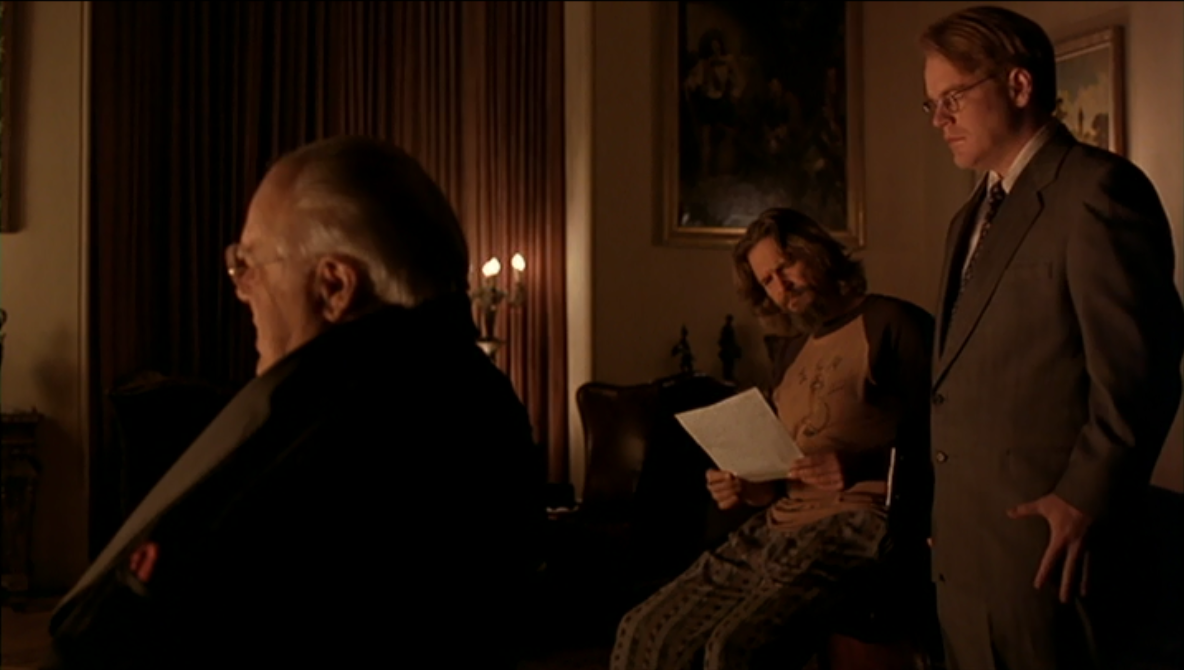
Despite its light, comedic tone and its bearing little aesthetic resemblance to a film noir or neo-noir, Lebowski nevertheless abounds in noir tropes, character types, and plot structures. The Dude (Jeff Bridges) is our morally ambiguous detective-protagonist, working to solve a mystery that ultimately has more to do with his personal life than the case at hand. Walter (John Goodman) is Moose Malloy from Murder. My Sweet, the likeable if dimwitted "muscle" who helps our detective out of as many jams as he creates.

"You're not wrong, Walter, you're just an asshole!"

The Big Lebowski's title is a riff on The Big Sleep, the 1939 Raymond Chandler novel whose 1946 Howard Hawks-directed film adaptation looms large in the cycle of classic films noir.* Indeed, many of Lebowski's key characters are direct homages to extremely similar characters in The Big Sleep.

The Big Sleep's wheelchair-bound millionaire Mr. Sternwood . . . 

. . . is the inspiration for The Big Lebowski's Mr. Lebowski (though not visible in this shot, the two characters even wear similar lap blankets). 

Similarly, The Big Sleep's Vivian Rutledge . . .

. . . provides a general analogue for the Coens' Maude Lebowski. 

Besides the film's titular allusion and various structural parallels to The Big Sleep, the Coens slip in some not-so-subtle yet highly amusing winks toward film noir just to make sure we know The Big Lebowski's parodic intentions. One example is The Dude's increasing self-awareness of his "detective" role, evinced in his discussions of "the case" with Lebowski and Brandt in the back of the limousine and later in the film with Maude.

The most overt (and entertaining) inter-textual film noir element in Lebowski is Da Fino (Jon Polito), a sort of parallel figure to The Stranger (Sam Elliott), who represents the Western genre. Da Fino is a 1940s-ish noir gumshoe (though his 1970s Volkswagen is a reference to Blood Simple) who follows The Dude around, ostensibly to track down Bunny Lebowski on behalf of her distraught midwestern parents. But his more significant function is to remind us that The Big Lebowski knows the genres from which it draws and is having a grand old time messing about with and satirizing film noir conventions.

"Brother Shamus" Da Fino (Jon Polito) expresses his admiration for The Dude's detective work. Da Fino "visits" the 1990s world of The Big Lebowski from a 1940s noir, as the music playing on his car radio during this scene makes clear.  

What finally makes The Big Lebowski great fun to watch is not necessarily its witty inter-textual references or deft bricolage of the conventions of several prevalent film genres -- though, as I say, the Coens' genre mashups in Lebowski are, as nearly always, extremely elegant and artful. No, the deepest pleasure to be had from Lebowski or any Coen Brothers film is the incredibly high level of cinematic craft on display, the attention to detail and nuance on every level, the excellent characterization, the obvious love of movies and of the foibles of humanity that shine through even some of their darkest films.

As one of the Coens' lightest and funniest films, The Big Lebowski repeatedly demonstrates their ability to make the technically difficult look natural and effortless. Of course it doesn't hurt that starting one film earlier, with Fargo, the brothers began working with Roger Deakins, one of the greatest living cinematographers. Yet Joel and Ethan, who write, produce, edit, and direct all their films as a collaborative team, are meticulous and extremely well-thought out in how they stage and shoot scenes. There are several long-take three shots of conversations between Dude, Donny, and Walter at the bowling alley that are a marvel to behold. The length of the takes, the fluidity of the camera work, and the sheer confidence of the film's stellar performances really make these scenes shine, but in a way you might not notice at first. The Big Lebowski rewards repeat viewings on the level of formal film craft alone. It is also quite funny and delightful.


If The Big Lebowski has anything "serious" to say, it may be about what kind of masculinity is most needed in troubled times like "the early '90s." In this sense the film belongs to the slacker cycle of buddy comedies that swept through the 1990s, stuff like Bill and Ted's Excellent Adventure (1989), Dazed and Confused (1993), Clerks (1994), Mallrats (1995), Swingers (1996), Dude Where's My Car (2000), and arguably the commercial apex of them all, American Pie (1999).** These comedies centralize white masculinity, which is problematic, yet they do celebrate slackerish values such as being sensitive to others and favoring peaceful negotiation over violence. "The Dude abides."

Along with Lebowski itself, I would nominate these other films as being among the Coens' very best, maybe approximately in this order (though that's hard to decide):

Steve Buscemi gives a career-topping performance as Carl Showalter in Fargo.

Fargo (1996) is my all-around favorite Coen Brothers film at present, or else it is tied for that honor with A Serious Man. On one level, Fargo is simply a deliciously twisted and darkly comic rural film noir. Yet it is so beautifully realized, and so rich in its characterizations, that it comes across as one of the Coens' most mature, profound, and humanistic works.

Fargo
has the best soundtrack of any Coen Bros. film -- in fact, Fargo's is one of the great film scores of all time, period. Along a similar line, moments like Marge Gunderson's (Frances McDormand) discussion with Gaear Grimsrud (Peter Stormare) in her police cruiser and Marge and Norm's quiet talk that closes the film represent the Coens at their warmest and most soulful. When they want to, the Brothers Coen can really land scenes like this. Both the "Donny's funeral" scene at the end of The Big Lebowski and Fargo's concluding Marge-Norm conversation make me tear up every time.


In short, Fargo is probably the Coen Brothers' objectively best film, so if you only see one Coen picture, make it this one or one of the noirish ones like Lebowski or Blood Simple.

Michael Stuhlbarg as Larry Gopnik in A Serious Man.

I love A Serious Man (2009) for many of the reasons discussed in Lee Sabo's article about its Jewish-centered humor. Man is one of the Coens' funniest yet most sincere films, a more personal, absurdly sublime work than any other Coen film to date. As Sabo writes,
Fear and laughter are close cousins. I find Friday the 13th unintentionally funny and the lightweight documentary Spellbound positively horrifying, and I know people who thought Fargo was hilarious but stifled their laughter the first time they saw it because other people in the room thought it was “serious.” The Coens hardly see a difference between horror and farce, and if they do, A Serious Man has them in such balance that it’s impossible to separate them.
Indeed. Its near-perfect balance between dark comedy and truly horrific tragedy make A Serious Man the most refined example of the Coens' cinematic worldview. Bleak yet humanistic, alternately hilarious and heart-wrenching, Man is an absurdly Kafkaesque comedy. Indeed, Sabo accurately identifies A Serious Man's Larry Gopnik as a
Kafkan hero, a man who, for reasons never explained, suddenly has horrible things happen to him one after another, with everything getting worse and worse until his life is destroyed. In Kafka’s novels — and the finest adaptation of one of them to the screen, Orson Welles’s The Trial — this typically involves a descent into a surrealistic nightmare world that’s not only as hysterically funny as it is unbearably frightening, but funny precisely because it’s frightening. This is the basic format of A Serious Man (Barton Fink is Kafkaesque, but not as wholly).
Yet all this serious talk does not capture the wry and zany humor that pervades A Serious Man. Ultimately it is a very funny and humanistic film.

Nevertheless, much as I love A Serious Man, I must limit my recommendation of it to viewers who have checked out some of the Coens' other genre pieces first. Serious is a nuanced and ambivalent work, and it is easier to appreciate once one has some familiarity with the Coens' absurdism and dark-comic vibe. Sabo captures this essence when he writes that "the Coens are individualists to the point of eccentricity, but the blunt honesty of A Serious Man makes their earlier work seem insecure and slightly neurotic."

[UPDATE 5/31/2016: Jim Emerson's "Accept Mystery" video, in which the critic explains how "actor Steve Park's single-scene appearances" in Fargo and A Serious Man "provide the keys to those films," is a must-watch for those interested in the Coen brothers and these two films in particular.]

M. Emmet Walsh delivers a standout performance in Blood Simple as unscrupulous private detective Visser. His presence hails back to Walsh's role as the police chief in Bladerunner and his Volkswagen Beetle foreshadows Da Fino's in The Big Lebowski. 

Blood Simple (1984) is one of my very favorite Coen Brothers movies, a lean and mean neo-noir set in rural Texas. John Getz is fine in the male lead, and Frances McDormand rocks as always, but the real scene-stealers are Dan Hedaya as sleazy club owner Marty and especially M. Emmet Walsh as the delightfully unscrupulous Visser. The great cast, plus razor-sharp plotting and striking use of visual motifs (Dead fish! Lighters! Ceiling fans!) make Blood Simple a pulse-pounding noir thrill ride. Most highly recommended.

[UPDATE 11/24/2016: Especially now that it's been given a Criterion Collection release.]


No Country for Old Men (2007) is a powerful late-career work from the Coens, a darker spiritual successor to Blood Simple. I like No Country's bleak Texas setting. The first half of the film is amazing and, despite some draggy parts once Llewelyn Moss crosses the Mexican border, the movie retains pretty high re-watch value for me. Yet a lot of what makes No Country work is its remarkably chilling central performance by Javier Bardem. I love Josh Brolin's and Kelly Macdonald's work here, but Bardem's portrayal of Chigurh is the greatest highlight of this movie.

Chigurh's narrative centrality in No Country for Old Men is like if Fargo was reworked to focus mainly on Peter Stormare's Geaer Grimsrud. And if the psychopathic Chigurh is Grimsrud 2.0, then similarly, No Country's Ed Tom Bell (Tommy Lee Jones) is our Marge Gunderson figure. No Country can be seen as a reworking of Fargo in which Grimsrud wins and Marge Gunderson loses.

"What business is it of yours where I'm from, friend-o?"

Tonally, No Country is more brutally violent and less well-rounded than Fargo. I highly recommend No Country, but I place it just a nudge behind first-ranked Coen Brothers films like Blood Simple, Fargo, The Big Lebowski, and A Serious Man.

John Turturro as Barton Fink in Barton Fink. 

Barton Fink (1991) is one of the Coens' most abstract and arty films, yet it also captures their spooky Gothic side better than any other effort. Visually, Barton Fink is most like Miller's Crossing or possibly True Grit, featuring a rich and dark period setting with lots of grit and grotesquerie. Ostensibly about a New York playwright (John Turturro) who moves to L.A. to work as a screenwriter in Golden-Age Hollywood, Fink and the decaying hotel in which it is principally set are both metaphors for something else entirely. By the third act, when an unusual acquaintance of Barton's (John Goodman) goes on a rampage, the line between narrative reality and pure visual symbolism gets very blurry indeed. It is a hard film to explain. But it is also one of the Coens' very best movies, kind of like their Vertigo, a haunting, perfectly interwoven masterpiece that only they could have made. Barton Fink may not be for everyone and probably isn't an ideal first Coen Brothers film to see, but it is an essential one. I highly recommend it to anyone with more than a passing interest in the Coen Brothers' work.

If the films discussed so far constitute the top rung of the Coens' films, the next-highest rung consists of Raising Arizona (1987), Miller's Crossing (1990), and O Brother Where Art Thou? (2000).

Gabriel Byrne as Tommy in Miller's Crossing, the Coen Brothers' darkly comic 1990 gangster film. 

Miller's Crossing was the first Coen Brothers film I ever saw, in the theater no less, and so it will always hold a special place for me. Despite a noirishly convoluted plot, Miller's is at heart a gangster movie, with larger than life characters and outrageous violence. The cast is all simply terrific, with Gabriel Byrne, Marcia Gay Harden, and Jon Polito as particular standouts.

Raising Arizona is clever and funny and even touching at a couple points, yet it is not, for me, among the first tier of the Coens' work. Arizona, a screwball comedy about various folks contending over a kidnapped baby, features uniformly excellent performances, a very amusing soundtrack, and lots of audacious camera work, some of which will remind the Sam Raimi-savvy viewer of the kinetic camera movement in key shots of Evil Dead and Evil Dead II.*** Yet I have never placed this one very high on my personal list of faves. I recognize its greatness and can say nothing concrete against it, it just doesn't speak to me as much as some of the others.


Along similar lines, I enjoy O Brother Where Art Thou? well enough but find it to be less nuanced and interesting than the films that immediately precede it, Fargo and The Big Lebowski. The soundtrack's great, the cinematography is great, and Clooney is fun, but O Brother is not a personal favorite for me.

Then there are the two strangest entries in the Coen ouvre, The Man Who Wasn't There (2001) and True Grit (2008). The thing that makes these two films so unusual is that they are more or less straightforward examples of the genres to which they belong, the film noir and the western respectively. The usual Coen Brothers tendency to mash-up and even parody the genres in which they work is more or less absent in these two films. They are very well made and enjoyable but are the least overtly Coen-esque films the brothers have made (that I've seen).


Lastly, while every Coen Brothers film is surely worth watching at least once, the titles that have recieved the least repeat viewing from me include The Hudsucker Proxy (1994) and Burn After Reading (2010). I appreciate what they're going for in the former yet the upbeat, Capra-esque vibe of Hudsucker just doesn't mesh as well with the Coens' dark-comic style, and its Moses figure (Bill Cobbs), a magical negro, is extremely racist. Burn After Reading is funny and fun and contains some great individual performances by Frances McDormand, Brad Pitt, and George Clooney, but overall it's a little too thinly developed and ultimately unmemorable. Sabo calls Burn the Coens' "worst film," arguing that it is not funny or humanistic enough:
Burn After Reading chucks [the screwball comedy's] gleeful optimism out the window in favor of the brothers’ more typical penchant for watching their idiotic characters suffer hopelessly. When Burn After Reading‘s plot does a tumble, it falls off the boat and dies horribly.
I might enjoy horrific, bleak comedy more than the average viewer, but I cannot disagree with Sabo's assessment or place Burn After Reading any higher than third-tier in the rankings.

I have never seen Intolerable Cruelty (2003), The Ladykillers (2004), or Inside Llewyn Davis (2013). I don't plan to see either of the former two, but the critically beloved Llewyn Davis is one I plan to see in the (near) future.

Brandt sez: "That had not occurred to us, Dude."

UPDATE 12/11/2016: Check out this philosophical overview of the Coens' filmography.

--
* There is much debate over what exactly counts as film noir, some even suggesting that it is, at this point, less a film genre than a mode or style that exists not only (or primarily) in film but across what James Naremore calls the "noir mediascape." (More than Night p. 255). However, there is credible consensus around the idea that the "classic" American film noir cycle begins with John Huston's The Maltese Falcon in 1942 and ends with Orson Welles' Touch of Evil in 1958. Anything made after that is referred to as neo-noir (Naremore p. 262). Probably the best succinct rundown of what constitutes film noir (historically and aesthetically) is Paul Schrader's short article "Notes on Film Noir." For those who want a more in-depth treatment, I highly recommend Naremore's terrific More than Night (U. California Press, 2008) -- one of my favorite books!
** Those readers interested in the historical rise and ideological consequences of the geek/slacker comedy cycle should check out "Postmodern Geekdom as Simulated Ethnicity" (co-authored by me and Kom Kunyosying) and my follow-up article "Team Apatow and the Tropes of Geek-Centered Romantic Comedy."
*** A direct line of influence extends from Raimi to the Coens: Joel Coen worked with Raimi as an assistant editor on Evil Dead (1981) and Raimi is said to have helped out on the set of the Coens' Blood Simple.