Showing posts with label sequel. Show all posts

Tuesday, October 17, 2017

Review: Blade Runner 2049 (2017)


I fucking love Blade Runner. I first saw the original 1982 theatrical cut on VHS in the mid-1980s. That version intrigued me a lot, and haunted me, even though I didn't like the clumsy Harrison Ford voice-overs and weirdly upbeat ending. To be fair, I first came at Blade Runner with little understanding of film noir. Instead, I'd recently seen other fast-paced Ford vehicles like Raiders of the Lost Ark and The Empire Strikes Back. In contrast to these, Blade Runner felt slow and weird, but I still liked it. Its three principal characters -- Deckard, Roy, and Rachel -- stuck with me.

I happened to be living in Los Angeles in 1992 when the so-called "Director's Cut" of Blade Runner was discovered in a vault and screened at the Nuart Theater. That's when my true Blade Runner fandom began. That new version appeared just at the right time for me as a developing cinephile. I had started watching independent cinema, stuff like Do the Right Thing, Slacker, Reservoir Dogs, and sex, lies and videotape, so I was ready for a visually arty, downbeat, science-fictional neo-noir to sweep me away. Indeed, that cut of Blade Runner (and the essentially identical 2007 "Final Cut") remains one of my all-time favorite movies, even though I am made uncomfortable by the coercive nature of Deckard and Rachel's sex scene. I realize the dynamics of the scene are complicated by their both being replicants -- or maybe only Rachel being a replicant -- but it disturbs me. Nevertheless, I love Blade Runner. (I also love the Alien universe, so Ridley Scott has pulled me in twice.)

So I looked forward to seeing Denis Villeneuve's Blade Runner 2049. I went last weekend assuming I would like it and I did, very much. In my recent review of It I state that film is about 80% what I would want to see in an It movie. I mean that as high praise. I would say that Blade Runner 2049 is about 94% what I would want to see in a Blade Runner sequel.

The film often -- but not always -- touches on the mesmerizing quality that makes Ridley Scott's original so special. As with the noir-inspired original, Blade Runner 2049's main strengths are its beautifully lit visuals of grimy, lived-in settings and its overall melancholic tone.

Sure, Alex Garland's Ex Machina (2014) is a more compelling thematic follow-up to Blade Runner and is its true "spiritual sequel" ideas-wise. But Villeneuve's 2049 gets the tone and visuals dead right and introduces the reproducing replicant motif, a logical next step for the franchise that takes the story in an interesting, Pinocchio-like direction. And 2049 ends really well -- both its blade runners get superb final scenes and shots.

Although it ends with a haunting close-up of Deckard, 2049 features minimal -- just enough -- Harrison Ford. It's the new characters' show. Ryan Gosling is pitch-perfect as protagonist "K" aka Joe -- a strong silent type who is nevertheless more emotionally vulnerable than Deckard ever was (or is). Supporting cast members Sylvia Hoeks as Luv, Ana de Armas as Joi, and Robin Wright as Lieutenant Joshi (who I really thought was going to pull one more trick out of her hat before getting brutally murdered -- alas) are also especially good.

2049 does right to stay focused on Joe's present-day story, only bringing in Deckard when he becomes relevant to the mystery Joe is trying to solve. Indeed, too much emphasis on legacy characters weakens Star Wars and accounts for 2049's most awkward and least necessary scene: Niander Wallace's unsuccessful tempting of Deckard with Rachel 2.0.

There is no point to the Rachel 2.0 scene -- we know Deckard would never go for this ruse, and the use of computer generated imagery (CGI) to re-create a circa-1982 Sean Young looks, as CGI Peter Cushing in Star Wars Rogue One looks, uncanny, cheap, and (therefore) jarring.

Rachel sez: "Sorry folks, I should never have been in this sequel." 

2049's other main weak point is its almost comically underdeveloped depiction of an underground replicant revolutionary force. That scene only takes place to "explain" how Joe escapes Las Vegas, and there's a million other ways to do that -- he could just hijack some other vehicle from around Deckard's lair. Or the Wallace mercenaries could haul Joe back to L.A. along with Deckard, and Joe could escape at that point. Or he could be taken in the very same airport transport as Deckard, and would end up at the same climactic fight. The thing the rebellion leader tells Joe about his origin is something he could realize on his own -- he already suspects it before that dumb scene.

Deckard being tempted and Joe being rescued by an anonymous replicant resistance movement are stupid and unnecessary scenes. 2049 should just cut from Deckard being taken away in Vegas to "K" commandeering a new vehicle and pursuing him. No Ford / Leto meeting needed. The CGI Sean Young reveal is hackneyed in the film world and the real one.

I have been a Blade Runner fan since 1992 and was likely to want to see this sequel in any case. Yet the stellar track records of Denis Villeneuve, 2049's director, and Roger Deakins, its cinematographer, strongly contributed to my anticipation to see it. Villeneuve has made several excellent films over the past several years, including Prisoners (2013), Sicario (2015), and my favorite, his recent science-fiction film Arrival (2016). Deakins has worked with the Coen brothers since 1997, when he shot Fargo. He shot Prisoners and Sicario for Villeneuve. He also lensed the James Bond film Skyfall in 2012. He utterly rocks.

Is Blade Runner 2049 slow paced? Yes, of course it is. Like the original, 2049 is a bleak, moody, science-fiction film noir -- it is NOT an action film. There are basically two fights, two swift stabbings, and one extremely brief flying car chase. That's it -- the rest of 2049's two hour forty minute running time is people talking to each other on amazingly-lit and -designed sets. Don't expect much action, but expect a visually stunning, fully developed world of the future.

And expect me to crush people.  


UPDATE 10/28/2017: After reading my review, one of my friends noted on Facebook that she enjoyed Blade Runner 2049 too but had "some questions about Joi." Indeed, I share her concerns over the sexism of both the original Blade Runner -- the roughness of the Deckard-Rachel love scene has always disturbed me -- and its sequel. Honestly, I agree with everything Lauren Jernigan says in her penetrating article about the pervasive sexism of 2049. She writes: 
Joi has very little, if any, true agency as a character. She’s a programmed hologram that will be whatever K needs her to be, so he has his perfect fantasy woman. She is a literal product designed for the happiness of men.
Agreed. Like Jernigan, I find the sex scene with K, Joi, and her hired body double to be quite unnerving. Is this the film's way of critiquing this situation by making me feel unnerved and uncomfortable with it? Or is the film simply reinforcing the role of women as objects of desire for men? It's hard to tell. 

In defense of my Blade Runner fandom I can only say that film noir presents a strange case: it is so highly stylized and hyperbolic that I think it is possible to read the genre's abysmal treatment of women as a critique of patriarchal violence. But it is an ambivalent, ambiguous case, and there is no doubt that noirs like the Blade Runner films portray women as "only there to help move the story of men forward, rather than act as protagonists in their own right in a story very much about oppression against them," as Jernigan correctly asserts.

UPDATE 11/8/2017: I also found this piece by Joseph Aisenberg to offer an insightful interpretation of Blade Runner 2049. "Morose and morbidly meditative in tone, it gnaws around the edges of the assumptions underlying its plot mechanics, giving viewers time to think through the fakery in its themes about fakery versus authenticity."

Sunday, March 12, 2017

Review: Kong Skull Island (2017)

Bearing in mind that I am the guy who re-watches The Lost World more often than I do the original Jurassic Park, I saw Kong Skull Island over the weekend and got exactly what I expected: a brainless, action-packed good time.

Is the film thin on the ground plot-wise and character development-wise? Yes, quite.

Are the only characters who can be said to have any personality or character arc Samuel L. Jackson's Packard and John C. Reilly's Marlow? Yes.

Indeed, Entertainment Weekly's Chris Nashawaty is correct to note that "there are about a half dozen too many characters to keep track of once the film gets underway." True -- I remember almost none of them except the two already mentioned plus John Goodman's Randa. Most egregiously, superb actors Tom Hiddleston and Brie Larson are especially underused here -- they get barely any lines and are mainly around to pose attractively in the foreground of tableaux shots.

As David Palmer writes in his negative review,
If ever there was a blockbuster that was the definition of "studio picture" it’s this. Everything feels been there/done that, and even the scenes where Kong is Gronk-spiking helicopters manage to feel lifeless and almost completely devoid of joy. Slow-mo is overused to the point of eye-rolling and [director Jordan] Vogt-Roberts doesn’t seem to give any character direction to his actors.
I agree with all this and yet, unlike Palmer, I thoroughly enjoyed Kong Skull Island. I knew what I was in for and had no expectation that the film would be anything more than what it is: a big, dumb, action movie in which a giant gorilla beats hell out of a bunch of stuff. Nashawaty calls Skull Island "a big, loud, and kinda silly monster mash that feels like a throwback to the late-‘90s Bruckheimer era of gung-ho, budgets-be-damned macho adventure" and I agree.

Skull Island's soundtrack is riddled with hackneyed, over-used Vietnam-era classic rock tracks: The Chambers Brothers' "Time Has Come Today," Jefferson Airplane's "White Rabbit," and of course CCR's "Run Through the Jungle." As Nashawaty remarks, the film's song choices evince "lack of care" and "have as much imagination as a Time-Life Songs of the ‘70s set." I found these choices annoying.

Yet the movie's weirdest musical choice -- which constitutes my single biggest complaint about Kong: Skull Island overall -- is its use of Vera Lynn's "We'll Meet Again" right near the end. That song forever belongs to the apocalyptic montage at the end of Kubrick's Dr. Strangelove (1964). To use it in any other movie -- especially as used here, as a straight-faced piece of WWII nostalgia -- ends up feeling macabre and off-putting due to that unavoidable intertextual reference. These filmmakers should have known better.*

My other big problem with Skull Island is its bald-faced Orientalism in portraying the native tribe with whom Reilly's Marlow coexists. Between Marlow's Heart of Darkness-evoking surname and the decision to have the natives never speak -- they just silently nod and gesture throughout -- the filmmakers obviously mean to signal that they are "in on the joke," that they are re-hashing these racist, imperialist tropes knowingly, with a nudge and a wink. Yet the tropes are still damaging, and the film's racist, one-dimensional depiction of the 1970s Skull Islanders is distractingly offensive. They could have been done so differently.

In conclusion, I do not know if I will ever watch Kong Skull Island again, but there is a vastly greater chance of that happening than me ever watching Peter Jackson's overlong, draggy, bombastic, and boring King Kong remake again (believe me, I've tried). The difference lies in aspiration, not execution. Both 2005's Kong and 2017's Skull Island are well-executed blockbusters. But the 2005 film is trying too hard to be an "epic," serious homage to the 1933 original, so despite its great casting and better script, it is, for the most part, slow-paced and mind-numbingly boring.

Skull Island, in contrast, wastes no time getting to the island and the Kong fight scenes, so is a much more worthwhile investment of my time and entertainment dollar. I recommend it for what it is: blockbuster thrills held together with a stupid plot and flat characters -- but with the common decency not to pretend to be otherwise. Its honesty in this regard, which reminds me of Pacific Rim (2013), is refreshing.  

King Kong sez: "Eat my shorts, Peter Jackson."

--
* Unless, of course, they were misguidedly trying to "steal the song back" from Kubrick on purpose, a hubristic and futile attempt which utterly backfires. How can anyone who has ever seen Strangelove forget that sequence and song?

Wednesday, May 25, 2016

Periodizing the Blockbuster Era


The above diagram schematizes some of the factors influencing the transition from the Hollywood Renaissance period (1967-1980) to the early decades of the Blockbuster Era (1975-present).

In the middle part of the chart (with the "synergy" arrow), I draw a boundary at about 1981, walling off the Hollywood Renaissance from the Blockbuster Era. Going solely by the content, tone, and look of the films, it's easy to impose that gap, with Raging Bull (1980) the last barbaric yawp of the European-influenced Hollywood Renaissance period and Raiders of the Lost Ark (1981) the herald of the big-budget Blockbuster Era.*

You can even see the difference between these cultural and industrial moments -- Renaissance and Blockbuster -- in the two (successful) Spielberg films that straddle the turn of the decade. Close Encounters of the Third Kind (1977), for all its third-act spectacle, is a film of the Hollywood Renaissance, or as close as Spielberg ever gets to directing one barring The Sugarland Express (1974). Close Encounters is an auteurist passion project for Spielberg, based on one of the few screenplays (outside of Sugarland and Poltergeist) he ever wrote himself. It features French New Wave icon Francois Truffaut performing in the movie, his presence a direct nod to Renaissance-era auteurism. More surprisingly for Spielberg, Close Encounters ends ambivalently: an emotionally unbalanced man abandons his earthbound family to fly away with aliens.

And then there's Raiders of the Lost Ark, a tightly episodic, sequel-spawning, consciously "calculated" action blockbuster.

However, at the infrastructural level, and as the short line at the bottom of my chart indicates, the transition between Renaissance and Blockbuster starts well before 1980. Disney is already lucratively synergizing their various product lines (live-action films, animated films, TV shows, theme parks, toys, etc.) by the 1950s, and TransAmerica buys United Artists in 1967. Disney and UA are the corporate harbingers of the post-1970s era of multinational corporate takeovers, corporate mergers, and the dominance of the synergistic business model built around "tentpole" summer blockbusters.

Film historian and political economist Thomas Schatz claims that 1974-5 represents the "peak and, as it turned out, the waning" of the Hollywood Renaissance period, its last hurrah consisting of films like Nashville, Night Moves, Chinatown, and The Conversation.** Indeed, film historians Kristin Thompson and David Bordwell tell us that the multinational corporate takeover of the major studios was more or less complete by 1982, at which point "all the Majors except 20th Century Fox had become wings of diversified conglomerates" like Gulf + Western, MCA, and Coca-Cola.†

Popeye Doyle sez: "We better enjoy this Hollywood Renaissance thing while we can, Cloudy -- it ain't gonna last."

Yes, certain artsy, downbeat, auterist films continue to be made into the late 1970s and early 1980s: The Deer Hunter, Coming Home (both 1978), Apocalypse Now, Being There (both 1979), Raging Bull, Reds (1981), and even First Blood (1982).

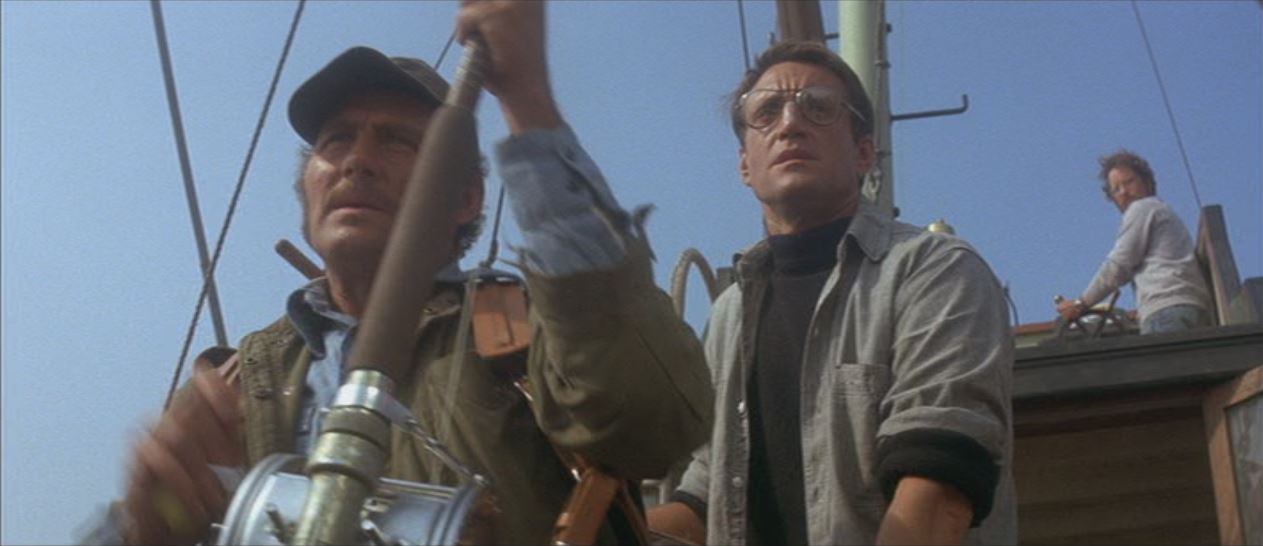
But despite all these promising late entries, there's no denying the implications of 1975's Jaws, "a social, industrial, and cultural phenomenon of the first order, a cinematic idea and cultural commodity whose time had come" (Schatz p. 26). Jaws is extremely well-made entertainment by super-genius director Steven Spielberg -- it's a totally badass movie, even according to Mark Kermode. Furthermore, it establishes the broad template for all subsequent blockbusters via its postmodern genre-mixology:
Jaws was essentially an action film and a thriller, though it effectively melded various genres and story types. It tapped into the monster movie tradition with a revenge-of-nature subtext (like King Kong, The Birds, et. al.), and in the film's latter stages the shark begins to take on supernatural, even Satanic, qualities a la Rosemary's Baby and The Exorcist. And, given the fact that the initial victims are women and children, Jaws also had ties to the high-gore "slasher" film, which had been given considerable impetus a year earlier by The Texas Chainsaw Massacre. (Schatz p. 25)
Genre-wise, then, the post-1975 blockbuster is nearly always an action-adventure film, even when hybridized with or superficially "skinned" to resemble another genre. Usually set "in the romantic past or in an inhospitable place in the present," the action-adventure typically features "a propensity for spectacular physical action, a narrative structure involving fights, chases and explosions, and in addition to the deployment of state-of-the-art special effects, an emphasis in performance on athletic feats and stunts." As Steve Neale, quoting Michael Nerlich, writes:
the ideology of adventure in its modern sense -- its association with the active seeking out of such events -- was developed in conjunction firstly with the medieval cult of the courtly knight, secondly with merchant adventuring (and state-sponsored piracy) in the early modern period, and thirdly with the spread of empire during the course of the nineteenth century. Hence its links with colonialism, imperialism and racism, as well as with traditional ideals of masculinity, run very deep.††
By defaulting to action-adventure pastiche, rather than artfully revising or reworking specific genres like many Renaissance films do, and by "recalibrating the profit potential of the Hollywood hit" to new, astronomical levels, Jaws and Star Wars toll the death knell of the auteurist Renaissance. Schatz writes that "the promise of Jaws was confirmed by Star Wars" -- its "emphasis on plot over character" solidifies the still-dominant action-blockbuster template (Schatz 24, 31, 29).

In 1981, Lucas and Spielberg's Raiders of the Lost Ark confirms the successful formula and sets the tone for the biggest hits of the coming decade:

Top Grossing Movies of the 1980s (adjusted for inflation) according to Box Office Mojo
1. E.T. the Extra-Terrestrial (1982)
2. The Empire Strikes Back (1980)
3. Return of the Jedi (1983)
4. Raiders of the Lost Ark (1981)
5. Ghostbusters (1984)
6. Beverly Hills Cop (1984)
7. Batman (1989)
8. Back to the Future (1985)
9. Indiana Jones and the Temple of Doom (1984)
10. Indiana Jones and the Last Crusade (1989)
My favorite sequence from Raiders of the Lost Ark, 1981's highest grosser and the film that sets the template for the summer blockbuster. 

Quoting Richard Schickel, Schatz notes that blockbusters from this point forward all belong to one of two "metacategories," either the comedy (e.g., Beverly Hills Cop, Ghostbusters) or the action film (e.g., all the other films on the above list). Schatz describes Star Wars in particular as the key proto-"high concept" summer blockbuster. For him, Star Wars exemplifies the tension between story and spectacle that characterizes the summer popcorn movie writ large:
One the one hand, the seemingly infinite capacity for multimedia reiteration of a movie hit redefines textual boundaries, creates a dynamic commercial intertext that is more process than product, and involves the audience(s) in the creative process -- not only as multimarket consumers but also as mediators in the play of narrative signification. On the other hand, the actual movie "itself," if indeed it can be isolated and understood as such (which is questionable at best), often has been reduced and stylized to a point where, for some observers, it scarcely even qualifies as a narrative. (39)
I agree with this account and have myself written about the recent blockbuster's trend toward spectacle over narrative.

What I want to do with the rest of this post is to try to break down the Blockbuster Era (so far) into smaller constituent periods, mainly derived from the chronological sketch given by Mark Harris in his must-read 2014 piece "The Birdcage":
The revolution of George Lucas’s game-changer — in purely financial terms — was that it confirmed what the James Bond series had suggested a decade earlier: There was no ceiling on how much money the right kind of series with the right kind of potentially escalating fan obsession could take in. Over the 25 years that followed Star Wars, franchises went from being a part of the business to a big part of the business. Big, but not defining: Even as late as 1999, for instance, only four of the year’s 35 top grossers were sequels. 
That’s not where we are anymore. In 2014, franchises are not a big part of the movie business. They are not the biggest part of the movie business. They are the movie business. Period. Twelve of the year’s 14 highest grossers are, or will spawn, sequels. A successful franchise is no longer used to finance the rest of a studio’s lineup; a studio’s lineup is brands and franchises, and that’s it.
To continue where Harris leaves off, I turn to Pamela McClintock's recent piece "Hollywood's Obsession with the 'Requel'" for its succinct definition of the latest transmogrification of the blockbuster: the requel. A requel is "a movie that's both a reboot and a sequel, blending old with new in an effort to extend the life of a franchise and, in the best cases, reinvent it for a 'universe' of follow-up movies."

The most successful requel so far.

Whereas the "hard" reboot usually retells an origin story, as with Star Trek (2009) or The Amazing Spider-Man (2012), the requel, according to McClintock, is different from either the reboot or the pure remake "in that it nods to and exploits goodwill toward the past while launching a new generation of actors and stories." It is, in essence, a thinly veiled remake in which the same basic stuff, with slight new variations, happens all over again to a new generation of characters. I like to describe it as "strangely similar things happening to slightly different people."

It's appropriate that Jurassic World should lead the (successful) charge into the Requel period, since it is so transparently a remake of Jurassic Park (Lee Sabo calls it "fan-fiction story-telling"), which in 1993 was already hyper-aware of its status as a global commodity.

The most important shot in Jurassic Park: Jurassic Park's gift shop. 

To sum up: origin-story-retelling reboots include Batman Begins (2005), Star Trek (2009), and The Amazing Spider-Man (2012).

Recent "pure remakes" include King Kong (2005), Cinderella, and Pan (both 2015).

Our requels category is so far inhabited by Terminator Genisys, Jurassic World, and Star Wars: The Force Awakens (all 2015), and Batman v. Superman: Dawn of Justice (2016).

I propose the following Periodization of the Blockbuster Era so far:

1975-85: Marking the inception of the Blockbuster Era proper with Jaws and Star Wars, these are the "Ten years that shook the industry" (J. Hoberman), the inception of the mega-blockbuster era. Schatz notes the increase in sequels and remakes from 1974 onward, writing that "From 1964 to 1968, sequels and reissues combined accounted for just under 5 percent of all Hollywood releases. From 1974 to 1978, they comprised 17.5 percent" ("New Hollywood" p. 27).

1986-99: The period of international conglomeration, worldwide release, and global synergy. The period during which Schatz's "calculated Blockbuster" -- calculated to be a major hit, produce sequels and spinoffs, and synergize with a larger product line and brand -- becomes the driving force behind the Hollywood film industry. As Thompson and Bordwell write,
The first wave of film studio acquisitions, from the 1960s through the early 1980s, had been initiated largely by conglomerates who wanted to diversify their holdings, to add a movie company to a menu of bowling alleys, parking lots, soft-drink bottling, or funeral parlors. The wave that began in the mid-1980s was more narrowly targeted, aimed at synergy -- the coordination of several compatible business lines to maximize income. (p. 664)
This period includes the Michael Eisner regime at Disney -- he's CEO 1984-2005. Eisner focuses on synergy and developing branded content, placing "special emphasis on activities and services that went beyond moviegoing or TV viewing" (T&B p. 696).

1989 is a key year, the starting point for the "dark" and "adult" interpretation of Batman on film. As Eileen Meehan documents, a dark interpretation of Batman was test-marketed beforehand by the release of Frank Miller's comic The Dark Knight Returns into mainstream bookstores.‡

Neale notes that in the 1990s Hollywood "conglomeration and synergy tended to accelerate on a national and international scale, as some of the mini-majors disappeared and as others were absorbed by the majors, and as the costs of making blockbusters and routine features alike continued to rise" (p. 230).

This period sees the wholesale onset of computer generated imagery (CGI) with pioneering effects-driven blockbuster films The Abyss (1989), Terminator 2: Judgment Day (1991), and of course Jurassic Park (1993).

Jurassic Park (1993) is perhaps the key film of this period -- a landmark in computer-generated effects, synergistic product lines, and global release strategies (Thompson and Bordwell p. 697).

Michael Keaton in 1989's Batman, another key film of the 1986-99 period.  

2000-14: I am tempted to call this the "Pointlessly Serious Superhero Movie" period. Fox's X-Men franchise launches eponymously in 2000, setting the general tone for the period. Disney's Marvel Cinematic Universe, which starts with Iron Man in 2008, goes a bit lighter in tone than X-Men, whereas Christopher Nolan's Dark Knight trilogy (2005-12) and Zack Snyder's Watchmen (2009), Man of Steel (2013), and Batman v Superman all go darker and more pretentious.

Speaking of Nolan and Snyder, Kevin Tsujihara becomes Time Warner's chairman/CEO in 2013 and announces a slate of ten Warner Bros. movies based on DC Comics characters to be released between 2016 and 2020. Of Tsujihara, Harris writes:
He has never produced a movie; in fact, he is the first studio head to rise in the ranks purely through brand extension and ancillary divisions, and brand extension is what he’s all about. Besides the DC announcement, his big accomplishments have been to nail down those three additional [J.K.] Rowling movies to add to the studio’s portfolio of eight, and to turn one Lego movie into four.
Tsujihara's counterpart at Universal is Jeff Shell, who becomes CEO in 2013 and about whom Variety's Peter Bart and Claudia Eller write that "Shell’s background and management style is strictly corporate and solidly Comcast." Significantly, Shell rises through the corporate ranks on the television side. Writing in 2014, Mark Harris suggests that by making seven- and ten-year plans for interlocking franchises a la Disney's Marvel Cinematic Universe, contemporary movie franchises replicate formulas that have been honed to perfection on and by television:
TV looms large over this new movie lineup. How could it not? TV is everything. TV is how people see movies; TV is where people want to watch movies, on demand and on their own terms; TV is what Twitter wants to talk about. Most of all, TV knows how to keep people coming back, which is its job, every day and every week, and is a quality that, above all others, the people who finance movies would dearly love to poach.
2015: The Requel period begins. In addition to the McClintock piece referenced above, see also Adam Sternbergh's recent essay on the studio as auteur and the "Marvel movie" as prototypical blockbuster. Analyzing directorial duo Joe and Anthony Russo's successful run of MCU films, Sternbergh writes:
As TV becomes more cinematic in its execution (multiple locations, expensive FX), and films become more TV-like in their storytelling (single chapters in an ongoing story), the decision to employ TV directors on Marvel films starts to make sense. Which is why directors like the Russos — talented, proficient, flexible, and instinctually collaborative — are perfectly suited to flourish.
If the release of Jaws marks the beginning of the Blockbuster Era, then it's been forty-one years since then. We are over forty headlong years into this Era, it is barreling along, we are just beginning the Requel period, and there's no end in sight. We don't even really know what we're in for yet. As Harris concludes,
What we are witnessing is not stability but transition — the evolutionary moment of overlap in Hollywood when the old way and the new way transiently coexist. Ten years from now, the old way will be gone. The new way will simply be the way.
The way of the endless requel and its mutant spawn.

Hi, I'm Mark Harris. I'm so goddamned smart about movies and a fine writer, too. Carter is quite impressed with me.

--
* You'll notice that I call the Hollywood Renaissance a period and the Blockbuster Era an era. That's because the former is a short transitional period bridging the stretch between the decline of the Studio Era (and it is surely in decline by the 1950s) and the rise of the Blockbuster Era. The Hollywood Renaissance years constitute the tail end of a longer period that begins circa 1948 when the Paramount Decree critically alters the makeup of the Golden Age Studio System. Thomas Schatz describes the 1947-60 period in the later chapters of his The Genius of the System (Pantheon Books, 1988).
** Schatz, "The New Hollywood," in Movie Blockbusters, Ed. Julian Stringer (Routledge 2003),  p. 27.
† Thompson and Bordwell, Film History: An Introduction (Third Edition, McGraw-Hill, 2009) p. 664.
†† Neale, Genre and Hollywood (Routledge, 2005) pp. 49, 46, 51.
‡ Meehan, "Holy Commodity Fetish, Batman!" in The Many Lives of the Batman (Ed. Roberta E. Pearson and William Uricchio, Routledge 1991) p. 53.

Wednesday, December 23, 2015

On the Jurassic Park Sequels


As my fandom of movies like The Reef (2010) makes clear, I take much pleasure from films that fit perfectly and snugly in the gooey center of their genres rather than those that innovate too much or get too serious in an effort to "rise above" their genre's usual conventions.* There is something fun, unpretentious, and wholesome about enjoying a well-made genre film that hits all the expected marks and not much more. In varying ways, every Jurassic Park film after the 1993 original fits this description.

That is, if Jurassic Park is the Jaws of dinosaur movies -- the greatest entry in its subgenre and the film against which all other dinosaur films measure themselves -- then The Lost World: Jurassic Park (1997), Jurassic Park III (2001), and Jurassic World (2015) all belong to the "distant second" category. Their relationship to the original Jurassic Park mirrors that of The Reef, Open Water, Deep Blue Sea, and the Jaws sequels to the original Jaws. Like its seagoing predecessor, Jurassic Park is an amazing summer blockbuster, a great monster movie, and one of Steven Spielberg's greatest directorial achievements.

While the same cannot exactly be said of The Lost World, I am going to open this rundown with a warning. In terms of pure re-watch value and number of times I've actually watched it, my favorite of all the Jurassic Park films is in fact the second one, the unjustly overlooked The Lost World. Mind you, I'm not saying that the second JP film is actually better than the first, but it is quite good and my weirdo tastes have led me to watch the second one more times than any other. There you go, confession over.

Pete Postlethwaite and Vince Vaughn in the cinematically and thematically dark 
The Lost World.

The Lost World: Jurassic Park (1997)
I will attempt to explain in detail why I love The Lost World in what follows, but first let me reiterate that I really do know that the original Jurassic Park is by far the best of all these movies. I can leave it to others to explain why. Let me only say that the main reason I watch The Lost World more often than I do the original is due to its tone -- Lost World is by far the darkest of the Jurassic Park films, and is one of Spielberg's darkest and most brutal movies in general. The Lost World has more in common tonally with Minority Report (2002), Munich, and War of the Worlds (both 2005) than anything that came before it in the Spielberg filmography. In this sense, it is a movie that looks forward to Spielberg's mature style, despite the director's reluctance about returning to helm this "familiar"-feeling sequel.**

Crucial in this regard is cinematographer Janusz Kaminski, who shot Schindler's List in 1993, The Lost World in 1997, and pretty much every Spielberg-directed film since.

One of the best dinosaur attack sequences in The Lost World. 

At the wheel is Eddie Carr (Richard Schiff), a perfectly nice guy who, as you might guess from the implications here, meets a gruesome, terrible end. 

This shot from the same sequence shows off cinematographer Janusz Kaminski's handheld camera work, which he would deploy to great effect and critical acclaim in Spielberg's next film, Saving Private Ryan (1998).

Despite a slightly slower build-up, there is no fucking around in The Lost World, just lots of dinosaurs and brutal dinosaur attacks. (JP III will take this action-centric principle to the next level.) The dual T-rex shit is awesome, the raptors in the tall grass is one of the best sequences in any JP film, and the San Diego T-rex rampage, if implausible at many points, is nevertheless extremely fun. John Williams' The Lost World score is superb, easily the best of any Jurassic Park film and one of Williams' all-time best efforts.***

Beyond all that, Jeff Goldblum is great. His presence allows The Lost World to take its more dark and cynical turn. It also facilitates the inclusion of snarkily wonderful one-liners like "Where we're going is the only place in the world where the geese chase you!" and "While you're at it you might smear yourself with a little sheep's blood." And my favorite, "Taking dinosaurs off this island is the worst idea in the long, sad history of bad ideas." Goldblum's delivery of these lines is hilarious, and I like having Ian Malcolm as our protagonist this time around. As Simon Columb writes, Goldblum "is the primary reason I'd watch the film again."

Goldblum's snarky protagonism allows brilliant visual gags like this one to land.

Okay, sure, the gymnastics vs. raptors battle is dumb, as are most of the points the film tries to make about parenting, but the environmentalist main plot really works for me. And The Lost World is chock full of great supporting performances, such as Richard Schiff as beleaguered gadgets man Eddie Carr, Peter Stormare as vile outdoorsman Dieter, Arliss Howard as even more vile InGen executive Ludlow, and especially Pete Postlethwaite as safari guide Roland.

Pete Postlethwaite as Roland: "I believe I've spent enough time in the company of death."

Lastly, as I've suggested, the San Diego section works for me. I especially like the sequence when the Venture (a nod to Denham's ship from King Kong) crashes into the InGen harbor facility -- it is totally unrealistic yet a thrilling and effective homage to similar "death ship" sequences from Nosferatu (1922, 1979). The sense of poetic justice at play when Ludlow meets his doom makes The Lost World's one of the best demises of a villain in any film, ever.

If you pause The Lost World at the right moment (1:59:46 on the DVD) you can see director Steven Spielberg's face reflected in the TV screen. 

It is significant that Steven Spielberg, who essentially never appears in his own movies, makes one of his only onscreen cameos in The Lost World. In the film's final sequence, when Ian and Sarah sleep and Kelly eats popcorn on the couch while a news report plays, Spielberg's reflection can be seen in the shot of the television depicting the tanker at sea. He is just sitting on the couch between the actors. I take this to possibly mean that Spielberg truly loves this film and wants us to know he's proud of it. Or maybe that he just doesn't give a shit. 

In any case, say it loud and say it proud: The Lost World: Jurassic Park rocks!

Jurassic Park III (2001)
Sam Adams calls JP III "a perfectly fine little exploitation movie" and that's exactly what it is. The plot is contrived and improbable, the stakes are not super high, yet there is an island full of dinosaurs out there and it is fun to watch people get chased and flee for their lives for ninety minutes.

Though it is a bit lowbrow, thin on the ground plotwise, and lacking that magical "Spielberg touch," Jurassic Park III is nevertheless well-crafted and well worth watching if you like to see dinosaurs attacking things. On that front, it really delivers, staging its first major dinosauric bloodbath at just past the twenty-minute mark and refusing to pause for much quiet reflection the rest of its running time.

One thing you won't find much of in JP III is camp comedy. The movie has a light, unpretentious tone but it does not transform into parody or indulge much unintentionally campy earnestness. If you are looking for something to laugh at for its knowing or unknowing excesses, try instead Transformers: Age of Extinction or Sharknado. No, JP III isn't over-the-top campy but it instead goes for being mostly pretty good. It's not great, but it's too well-made to be laughable.


JP III ain't Shakespeare, it's a B movie, but if you are going to watch a B movie, it doesn't hurt to have acting talents like William H. Macy, Tea Leoni, Sam Neill, and Laura Dern (back for a cameo as Ellie) assaying the parts. Even the lost kid, Eric (Trevor Morgan), is pretty good. I basically like him, though -- SPOILERS! -- I don't understand how a resourceful young fellow like him can survive on raptor-infested Isla Sorna for eight weeks but can't kick a bunch of little baby pterodactyls' asses during the act two climax.

Speaking of inexplicable improbabilities, Jurassic Park III joins the ranks of fine films like Jaws: The Revenge and Spielberg's own War of the Worlds in resurrecting a character who, in any sane universe, would be dead. Billy (Alessandro Nivola) pops up at the end of the movie alive in a helicopter after being last seen getting drowned and pecked to death by several bloodthirsty pterodactyls. Billy should be dead or at least mangled beyond all recognition but what the hell, it's Jurassic Park III!

Jurassic Park III's Billy belongs to the "shouldn't be alive" club of movie characters who miraculously return from apparent death. 

[END SPOILERS]

However, if JP III skimps on sensible plot developments, it delivers the goods visually. There may not be as many dynamic Spielbergian camera moves nor as much Janusz Kaminskian high-contrast lighting compared to a bona fide Spielberg picture, but JP III's island environment and its dinosaur inhabitants look quite good and high-budget for the most part. Probably the film's biggest visual weakness stems from its over-reliance on computer generated imagery (CGI) -- there are some animatronics used but there seems to be more CG imagery used than in previous installments. (In this way JP III harbingers its belated successor, Jurassic World.) This was doubtless done for economic reasons but those raptors who retake the eggs near the end of JP III look clown-shoes.

All that said, JP III is a rip-roaring good time, ninety minutes of unpretentious monster-movie fun. If you like seeing people get hunted down and attacked by vicious prehistoric carnivores, then Jurassic Park III is definitely for you.

And come on, guys, this dinosaur kicks ass. 

Jurassic World (2015)
I wasn't planning to write a review of Jurassic World, because I basically enjoyed the movie in the theater but didn't feel I had anything particularly interesting to say about it. I got my money's worth, I had a good time, and I will likely watch the film again someday because I generally love dinosaur movies -- end of story.


But in the heady days since its record-shattering opening weekend, there has been a barrage of interesting articles, reviews, and think pieces about the film and its cultural and economic significance in 2015. I have probably had more fun reading these essays than I actually had during most of the movie, which probably says more about me than it does the movie, but so be it.

One like-minded fellow, Matt Singer at ScreenCrush, speaks for me when he writes in the aptly-titled "Stop Telling Me to Turn My Brain Off During Movies" that
The only argument I automatically reject on principle is “turn off your brain.” If the only way to enjoy something is to turn your brain off, then it probably isn’t very good.
I tend to agree. I can be "mindlessly" entertained almost as easily as anyone, yet I need to be drawn in, to be invited to care about the action and/or the stakes and/or the characters. I do not need all my films to be "art" films or character-driven emotional masterpieces, but I need to feel like the writers and filmmakers understand the basic principles of filmmaking and have at least a vague notion of how human feelings and motivations work. I suspend disbelief incredibly easily; I am the very last guy in the world to notice continuity errors or illogical plot holes -- UNLESS I am completely uninvolved with the film in the first place. As Singer further explains,
Turning your brain on in the midst of a dumb movie isn’t an act of sabotage; it’s a defense mechanism against boredom. If the movie did its job, it wouldn’t happen.
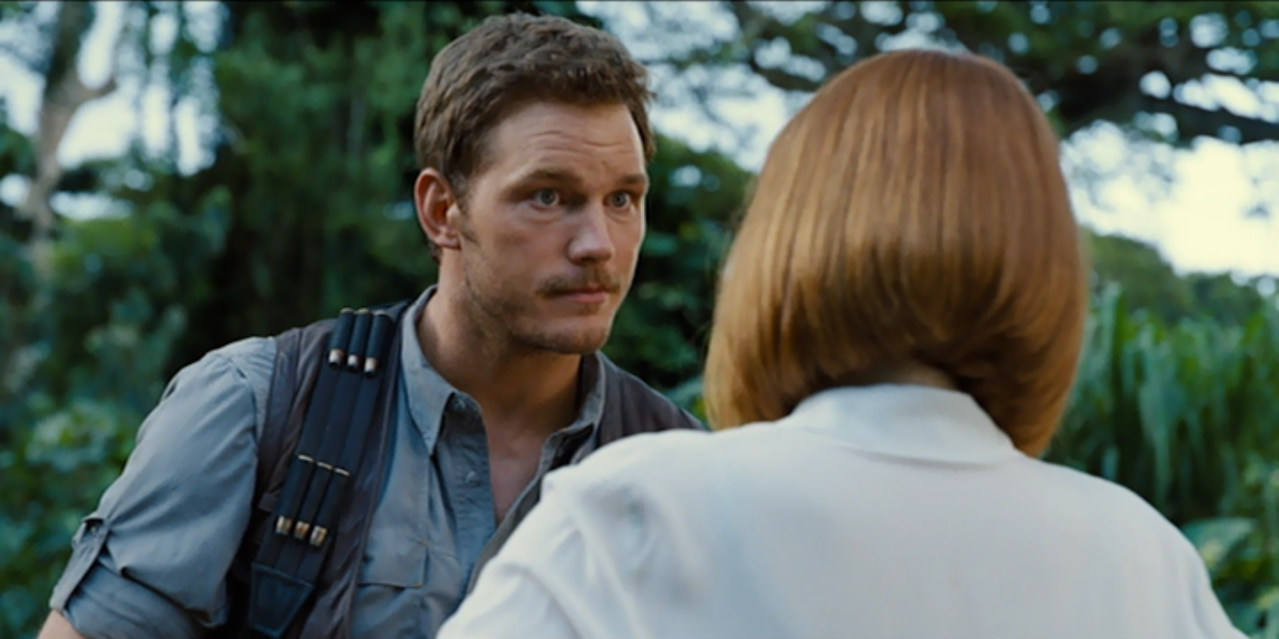
Quite so. Mind you, I only tuned out sporadically during Jurassic World -- mostly, I was so enraptured by the nonstop dinosaur action that I barely noticed how stupid the characters are. Conversely, I confess that I didn't truly care about very many of the characters in Jurassic World. I very much wanted to like Claire, and mostly did. I didn't much like Owen, which is saying something since I usually love Chris Pratt. Truly, Jurassic World's biggest crime is its underuse of / attempt to muffle Chris Pratt's comedic persona. As a naturally funny actor trying to be serious, Pratt comes across as somewhat parodic of himself -- Burt Macklin, Pratt's FBI-agent alter-ego from Parks and Recereation, inadvertently shines through many of his Jurassic World line deliveries, making the film unintentionally hilarious at several points.

That said, I truly liked and enjoyed the crazy park owner (Irrfan Khan), though I did think it odd when he headed off in that helicopter to do something (I truly don't remember what) at the pteranodon aerodome.

What in the FRIGG??!!

In general, where Jurassic World falls flat is in depicting its human characters in an involving way. I genuinely find myself caring more deeply what happens to the characters in Jurassic Park III than I do the ones in Jurassic World with the possible exception of Bryce Dallas Howard's Claire. But even in her case I cannot tell if I empathize with her because of her character's plight or as a reaction against the sexist stereotyping (as an emotionless ice queen) to which she is subjected. I was unnerved by some of the misogynist "humor" in the film and I think I agree with this author when she says that JW is the "most sexist film in the franchise."†

Another niggle I have is Jurassic World's over-reliance on computer generated imagery (CGI). As the three previous entries in the series have shown, using just a few practical, animatronic dinosaur models on set could have helped certain of World's moments, like one in which a random little kid hugs the neck of a baby dinosaur or the times Owen interacts with his trained raptors up close, come more vividly to life.

But in this and so many ways Jurassic World is very much a sign of our times. To take one example, the retirement of practical creature effects legend Rick Baker this year signals that the non-digital effects era has officially ended for Hollywood studio films. That this has taken place in the same year as Jurassic World's release seems no coincidence.

In a broader sense, and as Lee Weston Sabo argues, contemporary blockbuster sequels like Jurassic World
no longer produce iconic images or catchphrases that enter the pop culture lexicon; they merely reproduce what’s already been made. [While] you may not remember the details of the plot in Jurassic Park, you definitely remember the water rippling in the cup as the T. rex approached. Jurassic World not only fails to create such memorable images, it doesn’t even try, and once a film gives up on originality, it immediately descends into nihilism. Whatever sensory pleasures such a film may offer, the underlying assumption is that the entire experience is empty and meaningless.
Sabo concludes that "the new Hollywood blockbuster doesn’t want to make you watch it again; it wants to make you watch the next one." This feels an accurate assessment of how Jurassic World made me feel. 

All in all, Jurassic World totally delivers on the dinosaur action and I like the concept and execution of the new "big bad" dinosaur, the Indominus Rex, very much. However, the movie is surprisingly superficial-feeling given the caliber of its talent and its budget, and I wish its screenplay had been given one more dialogue polish and that its actors had been given more leeway to bring their characters to life. The movie is fun but it could have been a lot more fun.

This guy should have been allowed to go full Burt Macklin. 

In the end, I would rate Jurassic World ahead of Jurassic Park III but behind the original Jurassic Park and The Lost World. So, ranked:

1. Jurassic Park (1993, dir. Spielberg)
2. The Lost World: Jurassic Park (1997, dir. Spielberg)
3. Jurassic World (2015, dir. Trevorrow)
4. Jurassic Park III (2001, dir. Johnston)

My Jurassic Park Adventure Pack, containing the first three Jurassic Park DVDs, all of which I watch regularly. 

--
* There are exceptions. I tend to admire films that REALLY twist or fuck with genre expectations, "riffing" on a genre to do something else, like Nicholas Winding Refn's Drive (2011) and Only God Forgives (2013) or like Harmony Korine's Spring Breakers (2013) or like basically every Stanley Kubrick film.
** See "A World Apart," Peter Biskind's interview with Spielberg, reprinted in Steven Spielberg: Interviews (University Press of Mississippi, 2000). The whole interview deals with The Lost World but the section where Spielberg discusses his feelings about coming back to the JP franchise are on p. 198.
*** Strangely, Williams does some of his best soundtrack work for lesser movies -- his scores for the shitty Star Wars prequels are especially memorable.
† My friend AJ sees this differently: he argues that Jurassic World is "just showing the sacrifices [Claire] had made to get her very lofty, responsibility-laden position. I would agree that Claire shows highly antisocial traits through at least half of the movie, but then that wouldn't be far off the mark from most male protagonists--even Grant from the first Jurassic Park." AJ adds that "Pratt's character wanes substantially as the film goes on. I would even say he's revealed to be almost completely ineffectual by the end, all while Claire begins to use intellect, not just waif fu, to save him and her nephews." This is a compelling argument and I hope he'll write it up in full on his blog.

Sunday, July 20, 2014

In Defense of the Jaws Sequels

"SURPRISE!!!"

While the original Jaws (1975) is by far the greatest film to carry that name, I am a staunch defender of the many pleasures to be had in the three Jaws sequels, particularly Jaws 2 (1978) and the much-maligned Jaws: The Revenge (1987). Allow me to briefly explain why.

Tina Wilcox screams: "A . . . SHARK!!!" in Jaws 2.

Jaws 2 (1978)
Sure, Jaws 2 is basically a rehash of the first Jaws movie with a less stellar cast. There is a shark out there off Amity Island, Chief Brody knows it's there, and Mayor Vaughn and the townspeople don't believe him. And with Quint dead and Hooper not present, the amazing character dynamics that drive the last third of the original Jaws simply don't exist in the sequel.

But Jaws 2 makes up for this lack on two fronts:

(1) It substitutes in an ensemble cast of sailboating teenagers, and those teen actors are in fact quite good. In a way, we actually care more about the victims in this installment because we get to know them better than, say, Chrissy the night-swimmer or Alex Kintner from the first film. Tina Wilcox (Ann Dusenberry) is a particularly great and pivotal character in Jaws 2.

(2) The actual shark attacks in Jaws 2 are more grandiose and badass than in the first film. Knowing he cannot replicate Spielberg's slowly-built suspense and delayed reveal of the shark from the original, Jaws 2 director Jeannot Szwarc just says "Fuck it" and lets the viewer see the shark more or less right away.* The attack on the waterskier and her friend is flat-out awesome -- it concludes with a motorboat exploding in flames, one of the film's greatest moments. Even greater is the shark's incredible takedown of a Coast Guard helicopter (!) late in the film.

So Jaws 2 is a winner. The destruction of the Jaws 2 shark by electrocution is almost as badass as its being blown up in the original. The remainder of the supporting cast -- Murray Hamilton, Lorraine Gary, Jeffrey Kramer -- is top-notch as well and the film takes Chief Brody's storyline seriously despite the ludicrousness of the overall premise (i.e., that ANOTHER shark has come to Amity). After the original, Jaws 2 is my next most favorite Jaws film.

Dennis Quaid and Bess Armstrong anchor a solid cast in the somewhat boring Jaws 3-D.

Jaws 3-D (1983)
Despite its clever premise -- the Jaws shark runs amok in SeaWorld -- I think Jaws 3 is the weakest of the Jaws sequels, for two reasons: (1) the film is played a bit too seriously, with too few cool shark attacks and not enough campy humor to sustain a Chief Brody-less installment, and (2) it was made to be exhibited in 3D so many parts look stupid and shitty when watched today on home video.

This 3D shot of the shark looks really fake-o and dumb on DVD.

That said, what are the good points? The cast is good, especially Bess Armstrong, Lou Gossett Jr., and a terrific Simon MacCorkindale as a roguish undersea photographer and adventurer. The premise is good, if it is executed with little flair or panache. 

Probably the best scenes in Jaws 3 are the character development parts in which the Brody brothers and their girlfriends hang out at a bar or go frolicking in the sea. I also like the subplot wherein a SeaWorld worker goes missing (killed by the shark of course) and his brassy girlfriend shows up demanding answers. But there just isn't enough decent shark action to really carry this thing off -- it's essential viewing for Jaws completists only.

Michael Caine and Lorraine Gary are great in the so-bad-it's-good Jaws: The Revenge.

Jaws: The Revenge (1987)
After Jaws 2, the much-misunderstood Jaws:The Revenge is my next-most-favorite Jaws sequel. This film is rightfully criticized for being ridiculous and shoddily constructed -- this latter point surely applies to its ending, which intercuts newly shot footage with recycled images from the climax of the 1975 original. Yet I truly do not understand why more people do not champion this film as one of the great "so bad its good" delights of the cinema. For me, Jaws:The Revenge stands up with films like The Room in terms of the sheer quantity of unfettered pleasure it delivers via its campy badness.

The movie's premise is one of the most absurd premises ever committed to film. Having driven Chief Brody to a fatal offscreen heart attack, the Jaws shark is now systematically hunting down the surviving members of the Brody family, and it is up to the Chief's widow, Ellen (Lorraine Gary) to protect her children and granddaughter. After the death of her younger son Sean in Amity, Mrs. Brody travels to Florida to be with her older son Michael and his family, and -- of course -- the shark follows the family south!

The shark sez: "This time it's PERSONAL, muthafucka!"

Despite the craziness of this concept, and the film's cheap recycling of original Jaws images (the climactic shark explosion, Martin's interactions with young Michael at the kitchen table as Ellen looks on), I nevertheless maintain that Jaws: The Revenge is well-scripted and well-constructed from a purely structural point of view. Unlike many of today's blockbusters, the film makes sense given its premise. It is actually better scripted and acted than any of the Star Wars prequels or any Michael Bay Transformers movie.

Much of the pleasure of Jaws:The Revenge stems from (1) its unabashed, over-the-top commitment to its absurd concept, and (2) its cast. Regarding the latter, Lorraine Gary is great in the lead, and the always-entertaining Michael Caine gives a standout performance as Hoagie, the charming pilot / gambler / ne'er-do-well who develops a romantic interest in the widow Brody. His one-liners during the final shark battle are totally priceless. And speaking of one-liners, Mario van Peebles is another welcome comic addition to the supporting cast, serving as the somewhat dull Michael Brody's marine biologist sidekick.

In conclusion, don't be a hater: check out the Jaws sequels. There is a lot of fun to be had in these unpretentious, if somewhat uneven, cinematic works.

Michael Caine says: "Come fly with me in Jaws the Revenge!"

--
* Szwarc's actual words, taken from the making-of documentary on the Jaws 2 DVD, are: "I kept saying from the beginning: we must show the shark a lot. Because that image of the shark coming out of the water for the first time, it's already happened in the first one. That is never gonna happen again."