Sorry guys: this post explains why Goodfellas (1990), which Entertainment Weekly placed at #68 on this list of 100 all-time great films, is actually one of Martin Scorsese's least interesting, most overrated works.
As I have already stated in my post about Mean Streets (1973),
Contrary to its title, Mean Streets is not mean-spirited at all. It is upbeat, funny, and centrally about friendship and loyalty between a bunch of variously incompetent yet basically good-hearted "mooks."
Goodfellas replaces Mean Streets' humanness and nostalgia with cleverness and cynicism. Everyone in Goodfellas is out to screw each other and derives perverse pleasure from doing so. Goodfellas glamorizes brutality and violence, not friendship. And while I have no problem with films that depict how barbaric and misdirected groups of men can be, it is Goodfellas' patina of smug, self-congratulatory cleverness, a wit that pretends to be ironic and deconstructive but actually isn't, that puts me off this film. The film is so in love with its fucked-up characters and its own sense of humor that it cannot achieve a point of view outside of either, the way Heat does or Aguirre, Wrath of God does or even Funny Games does. Goodfellas celebrates and glorifies that which (I think) it means to parody. This is not good.*
When my undergraduate film students write papers about Goodfellas, they discuss it straightforwardly as a "great gangster film," not as a parody of one. Of course, part of that reading is bound up in (most of) those students' ignorance of the long tradition of gangster films upon which Scorsese is drawing here. Yet I argue that the film's rhapsodic tone and love of its despicable characters contributes strongly to this impression as well. As AV Club's Ryan Vlastelica fairly recently put it: "The film is like the cinematic version of a Ferrari: so fun to ride along with that you barely think about the sophisticated workings under the hood." He means that comment as praise, yet I see it as the source of the film's ideological danger.
Unlike Scorsese's own earlier works such as Taxi Driver, Raging Bull, and Mean Streets, Goodfellas does not make it clear that we should be critical of Henry Hill's way of life. A key difference between Goodfellas and its superior predecessor Mean Streets is from whose point of view the story gets told. In Mean Streets, it is Charlie (Harvey Keitel), the more mature aspiring wiseguy through whose eyes we see the reckless Johnny Boy (Robert de Niro) inexorably sow the seeds of his own destruction. This allows us to see Johnny Boy -- and by extension, this whole group of wiseguys -- for the cocky, violent idiots they really are.
Conversely, in Goodfellas, we see everything first person, via Henry Hill (Ray Liotta), this film's reckless Johnny Boy figure. Of course, Joe Pesci's Tommy DeVito is thrown in so that there is another even more psychotic and reckless individual around to make Hill seem more measured, but the point stands: Goodfellas transpires from the point of view of the idiot himself, rather than the smarter character who is trying to manage the idiot. This makes a big difference. It also doesn't help that Goodfellas lacks the sinister, tragic, discomfiting tone of, say, Raging Bull. It is, frankly, too much of a good time to effectively function as social critique.
That said, I know this is a subtle matter involving tone and point of view, and I acknowledge the potentially valid counterargument put forward by Matthew Eng, in which he argues that
[Scorsese] doesn’t warrant the blame for the chauvinistic vein in which Goodfellas’ bad fans have appropriated the film’s legacy to fit the superficially cool story they’d like it to be. (And between Taxi Driver and The Last Temptation of Christ, Scorsese has infamously seen his share of director-shaming misinterpretations.) Scorsese is, quite simply, far too talented and too intelligent a filmmaker to have made the movie Goodfellas is labeled as.
Is he really? I mean, I see this argument, and I agree that Scorsese is both enormously talented and highly intelligent, yet there is no reason he couldn't have slipped over the line on this film, accidentally lionizing the forms of masculinity he so effectively deconstructed in those other films Eng and I have mentioned. Eng continues:
Even as Goodfellas coats a glittering sheen over most of Michael Ballhaus' marvelously multilayered images, Scorsese delves pretty deeply into the foolishly warped mind of Henry Hill, whom he pegs almost instantly as a craven, class-A manipulator. [. . .] Henry’s relentless pursuit of criminal aims allows him to become the type of made man he deified as a boy, a transformation that is firmly rooted in the heroic images of his departed youth, when he was initially recruited into mob society. In many ways, Henry is the prototypical Goodfellas bad fan.
From there, Scorsese and co-writer Nicholas Pileggi are ultimately less interested in creating heroes than in deconstructing Henry and his friends.
It's that "glittering sheen" I worry about. The tone of Goodfellas encourages us to enjoy Hill's madcap ride through his wiseguy fever dream, and ultimately to sympathize with him. Compare this to Raging Bull, in which whatever sympathy we might be able to muster for Jake La Motta (de Niro) is surely undermined by what a colossal, corrupt asshole he has been throughout the entire film. Sure, Bull makes La Motta's time in the ring look "glittery," epic, and aesthetically beautiful -- those fight sequences are some of the very best scenes of Scorsese's entire career -- yet anytime Jake steps out of the ring, he acts like a despicable, violent, antisocial asshole. Raging Bull makes very clear the ironic, even disgusted distance we are meant to impose when looking in on La Motta's disastrous life.
I am just not sure Goodfellas achieves that same ironic distance, despite Eng's noble defense of the film's deconstructive potential. I just don't see it that way, and that's why I find it hard to enjoy it.
Goodfellas is doubtless a technical masterwork, as this video -- which also foregrounds how intensely the film aligns the viewer with Hill's subjective point of view -- demonstrates:
But in the end, despite its high level of cinematic craft, I just find Goodfellas to be:
(1) Too clever in a self-satisfied way to function as a sufficiently deconstructive ideological critique of the violent masculinity it displays,
and
(2) A less interesting, less clever, less raw rehashing of characters, ideas, and themes Scorsese already explored with much more finesse in the truly great Mean Streets.
So fuck Goodfellas -- give me Mean Streets. Or give me Michael Mann's crime film masterpiece Heat (1995), which is fifty quadrillion times better than Martin Scorsese's vastly overrated gangster comedy.
--
* Kubrick's A Clockwork Orange has the same problem. I think -- I hope! -- it means us to be critical of Alex's antisocial behavior, yet it makes him so likeable and amusing and hard to censure that it may ultimately fail as satire, at least of anything other than the state apparati that attempt to condition the violence out of Alex via torture.
Over the past couple of months, I have seen a few films that stand out in a special way. These three -- What We Do in the Shadows, Nightcrawler, and The Skeleton Twins (all 2014) -- are, of the several films I have watched lately, the ones that gave me the most pleasure as I watched them and stuck with me most poignantly afterward.*
What We Do in the Shadows is a mockumentary comedy about a group of vampires living together as flatmates in Wellington, New Zealand. It is the outright funniest film I have seen all year (beating out Spy). The filmmakers really understand the classic tropes of the vampire genre. They skewer them all brilliantly. Furthermore, there are some delightfully unexpected twists, as when the newest member of the vampire clan brings his human "best mate" Stu over to meet his undead roommates -- and Stu ends up becoming the most popular member of the group.
Vladislav, Deacon, and Viago jam out in What We Do in the Shadows.
What We Do in the Shadows really nails the drily witty mockumentary form, standing alongside the Christopher Guest-directed classics Waiting for Guffman (1996), Best in Show (2000), and A Mighty Wind (2003) as an all-time great of this particular comedic subgenre. Like the Guest films that I assume inspired it, Shadows culminates in a big event that brings all the key characters together, in this case the annual Unholy Masquerade Ball. The events that transpire during and after that sequence alone are worth seeing the movie for, as are the flatmates' occasional run-ins with the local police.
Shadows contains a few moments of graphic blood and gore, though (to my eye anyway) these come across as more excessively Monty Python-esque than truly horrific. No, the dominant tone here is laugh-out-loud funny -- there is one sequence in the film, when neat-freak vampire Viago is laying down newspapers to protect his couch before he attacks a victim, that had me belly laughing for quite some time.
Viago is a bit of a neat-freak.
Despite its mild use of horror elements (in addition to the blood, there is one vampire attack that is rather sudden and unexpected), I would recommend What We Do in the Shadows to practically anyone. If you like comedy in general and/or witty mockumentaries in particular, you will find plenty to enjoy in Shadows.
Writer/director Dan Gilroy's Nightcrawler is also something of a comedy, serving as a bleak satire of the news production business. However, despite its darkly satirical tone and many absurdist moments, it probably has more in common with the urban noir thriller than with any other genre. It is more pulse-pounding than laughter-producing.
As A.J Snyder writes in his capsule review of Nightcrawler, "While much has been said about the intensity of [Jake] Gyllenhaal's performance, and rightfully so, I feel like the single greatest strength of the film is its allegory for capitalism's current mode of racing to the bottom-most line." That's it exactly. While Gyllenhaal's central performance is intense and intriguing and delightful, the whole film -- including Rene Russo's superb costarring turn -- is so cleverly put together and expertly paced that I was completely on the edge of my seat the whole time through.
Furthermore, the film has a clearly articulated central theme about the cruelty and inhumanity that lie at the heart of media consumerism which it conveys quite efficiently via what you see and experience, without undue expository dialogue. (Thematically it reminded me a bit of Sofia Coppola's underrated The Bling Ring.)
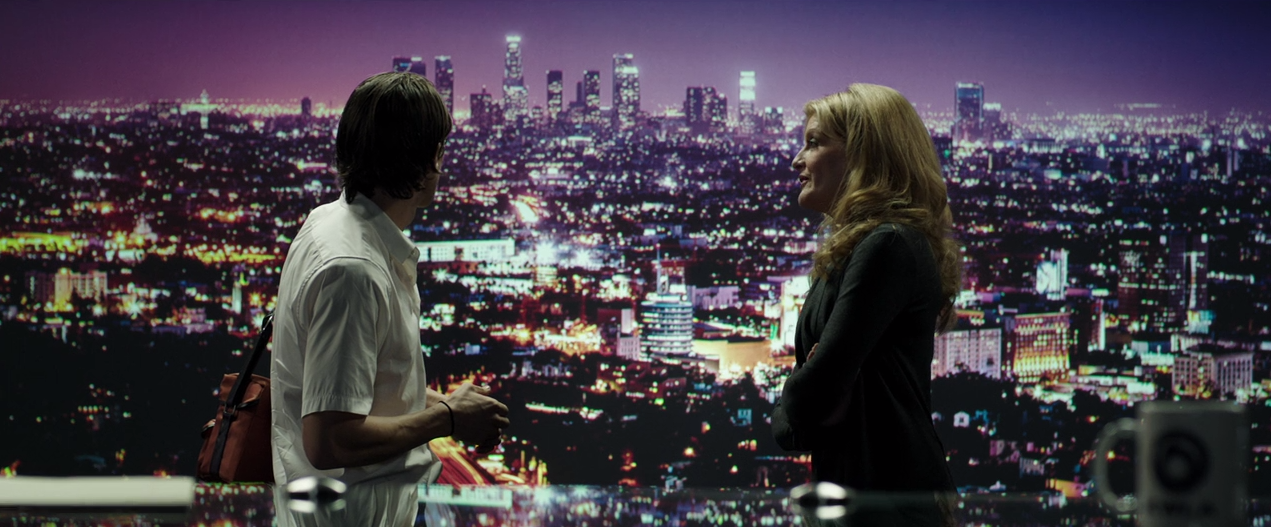
Lastly, there is cinematographer Robert Elswit's (There Will Be Blood) sublimely photographed setting: the city of Los Angeles. Nightcrawler is an exemplary "L.A. film," joining the ranks of such classics as Chinatown, Shampoo, Heat, Collateral, Short Cuts, and Boyz n the Hood in taking full advantage of the particular way L.A. sprawls around its various disparate neighborhoods, crisscrossed by freeways. It's a weird place (both geographically and vibe-wise) that I always enjoy seeing depicted poetically on screen. Nightcrawler captures its unique qualities about as well as any film I've seen.
Iconic L.A. images captured by cinematographer Robert Elswit for Nightcrawler.
Yes, Nightcrawler is one of the finest thrillers and one of the sharpest satirical dark comedies I have seen in quite some time. Packed with uniformly great performances, a tight, compelling script, and haunting L.A. cinematography, it will surely loom large in my End-of-Year reflections.**
Kristen Wiig and Bill Hader in the touching, heartful dramedy The Skeleton Twins.
Set in an unspecified small town ("near Woodstock") in upstate New York, The Skeleton Twins is a film that, like Nightcrawler, I intended to see in the theater but ended up seeing on Netflix streaming. The movie is a somewhat dark yet ultimately heartwarming dramedy about an estranged twin brother and sister coming back into each other's lives after a ten-year hiatus.
The Skeleton Twins' dark side comes in part from its engagement with the topic of suicide. The film opens with Milo (Bill Hader) making a suicide attempt, and when that fails, the hospital calls his sister Maggie (Kristen Wiig) to come pick him up just as she is about to make an attempt on her own life the very same day. The film treats this remarkable coincidence with dark humor, yet it also reveals later in the proceedings that the twins' father successfully killed himself when they were young, adding dramatic weight to the suicide theme. Unraveling why both siblings find themselves so unhappy with their lives, and how and why they drifted apart from each other for ten years, becomes the film's raison d'etre.
Milo and Lance get to know each other, with mixed results.
Part of the problem on Maggie's side is her inability to remain faithful to Lance, her upbeat, kindly, yet dimwitted husband (played to perfection by Luke Wilson, always my favorite of the two Wilson brothers). Lance wants to have children but Maggie doesn't, and rather than confront him him with this, she has flings behind his back. Meanwhile, Milo rekindles an old relationship that causes major problems for himself and reopens old wounds between he and Maggie. All of this conflict is so well scripted and performed, and the casting (including Ty Burrell as Milo's sexually conflicted old flame) so spot-on, that the film is simply a delight to watch. Both Wiig and Hader deliver nuanced characterizations that allow us to feel great empathy for these two lost souls even as we watch them make repeated mistakes. And the moments in which they laugh and get along together are very natural, believable, and warm.
Kristen Wiig delivers a downbeat yet empathetic and lived-in performance as Maggie.
Ultimately, The Skeleton Twins is a carefully sketched portrait of strained yet loving sibling relations, and while the film's climactic episode may feel a wee bit contrived to some viewers, it is emotionally correct, and the film ends on a lovely note of reconciliation, as comedies should.
Plus, any movie with an unruly kid flipping adults the bird automatically gets my vote:
Cullen flips the bird.
--
* I almost included a fourth film, Azazel Jacobs's Terri (2011), in this post, but despite its many delights and pleasures, that indie masterpiece is more offbeat and less plot-driven than any of the three I have included. I decided that it might be hard to recommend Terri to readers who don't enjoy meandering yet well-observed slice-of-life films about socially alienated weirdos quite as much as I do. You will be able to read my capsule review of Terri in this year's forthcoming End-of-Year Roundup.
** Here are links to my 2013 and 2014 End-of-Year Roundups. Yee-haw!
As a lover of horror and monster movies, Merian C. Cooper and Ernest B. Schoedsack's masterpiece King Kong (1933) is one of my all-time favorite motion pictures.
Although there are a few silent monster movies that came before it (The Lost World [1925], The Golem [1920]), and although Universal Studios' 1931 Dracula rightfully takes principal credit for launching the horror film boom of the early Hollywood "talkie" era, Cooper and Schoedsack's King Kong nevertheless stands as the most popular and influential monster movie of all time. Even Ishiro Honda's brilliant Gojira (1954) owes a debt of influence to Kong's groundbreaking horror extravaganza. Fusing an action/adventure film with a terrifying "monster on the loose " rampage in New York City, King Kong sets the narrative template and production standard for all monster films ever made in the wake of its release.
To start with, Willis O'Brien's animation work on King Kong is enormously influential and quite magical. 1933's Kong (the creature) is still, for me, the most convincing one. As Entertainment Weekly's short blurb for their Top 100 Films List says, King Kong's "stop-motion effects retain every bit of their magic as Kong the giant gorilla awes, terrifies, and breaks your heart." I couldn't agree more. It is no coincidence that the EW writers and I both use the word "magic" to describe the monster effects in the 1933 Kong. This is an example of "movie magic" at its absolute creative and affective pinnacle.
Willis O'Brien's "performance" of Kong is an amazing feat of special effects artistry.
Another reason why the 1933 Kong is so great is that it does not waste time. Its hallmark is narrative tightness, smooth flow, and excellent pacing. It runs a lean and mean 104 minutes in total (including a pre-credits musical overture). No subsequent version has really gained anything by being longer. Twenty-five minutes into the 1933 Kong, our protagonists have reached Skull Island and are preparing to go ashore. In Peter Jackson's overlong 2005 version, at twenty-five minutes Denham et. al. are still fucking around in New York City and the Venture hasn't even left the harbor yet. Yawn!
King Kong is also particularly effective (and historically significant) thanks to Max Steiner's innovative musical score. While the singular importance of King Kong's soundtrack has been disputed (or at least complicated) by some film historians (see Michael Slowik's superb article "Diegetic Withdrawal and Other Worlds" in Cinema Journal 53.1), it nevertheless marks a watershed moment during which the cinematic score came into its own in Hollywood.* Especially distinctive in Kong are the ceremonial drums our protagonists hear as they approach Skull Island, which signal to them that the supposedly uninhabited island is anything but. As film critic James Snead writes, those drums serve as a form of subtle (and influential) aural coding that clue us into the identity of the islanders: "Steiner's coding of blackness by 'the drum' founds (in the relatively youthful art of synchronized movie sound) a longstanding cinematic device" which will be used again and again whenever blacks -- especially 'native' ones -- hereafter appear in popular film.**
Mentioning those drums raises the biggest problem I have with King Kong. Like Gone with the Windand so many other Hollywood classics, Kong is unabashedly racist, sexist, and imperialist. As Snead argues,
In all Hollywood film portrayals of blacks, the political is never far from the sexual, for it is both as a political and a sexual threat that the black skin appears onscreen. And nowhere is this more plainly to be seen than in King Kong. There are very few instances in the history of Hollywood cinema in which the color black has been writ so large and intruded so powerfully into the social plane of white normality.***
Kong's main threat, then, is a sexual one that is coded black. He stands in for the frightening black bogeyman/rapist that has haunted the white imagination for so much of its cultural history. Kong's abduction of Ann (Fay Wray) makes the stakes of King Kong clear: it is a struggle between white masculinity and black masculinity for the erotic possession of the white woman's body (and by extension her reproductive power). Spoiler: In all three versions of King Kong, as in the vast majority of Hollywood films, the white men win.
In case there was any question about the sexual dimension of Kong's obsession with Ann, the scene in which he half undresses her and sniffs his fingers after caressing her body should clarify this point.
Protecting his highly prized white woman, King Kong pulverizes the shit out of a pterodactyl.
What is colossally unfair about all this is that Denham (Robert Armstrong) deliberately provokes Kong's abduction of Ann. He brings her to the island with the express intention of placing her in mortal danger for the sake of his adventure film. Writing about the ending, and insisting that King Kong is ultimately "about the motives and effects of Carl Denham's deeds," Snead tells us that
The relationship between Ann and Jack survives only at the cost of an execution. The narrative pleasure of seeing the (white) male-female bond re-established at the end tends to screen out the full meaning of the final shot: the accidental (black) intruder lies bloody and dead on the ground, his epitaph given glibly by the very person [Denham] who has trapped him."†
In essence, Denham stages a spectacular show in which Kong's kidnapping of Ann justifies white male retribution against the creature, who represents blackness. Thereby, the responsibility for Kong's capture and subsequent death is deflected back onto Kong himself, instead of being laid at Denham's feet where it belongs. This is a classic example of very effective "blame the victim" rhetoric.
Denham: "It was beauty killed the beast." LIAR!!
Denham's explicit role as a film director and cinematographer drives home King Kong's dominant thematic message: that we are all implicated in his visual colonization, capture, and killing of Skull Island's most noteworthy black denizen. AsSnead puts it,
[it is difficult to resist] our gradual implication in Denham's optical colonialism. Even a viewer repulsed by Denham's many negative qualities would have difficulty resisting the pull of his powerful voyeurism [. . .]. The political ideology of the film soon becomes inextricable from the pleasure we take in the very act of seeing. The power of staging a 'show' (watching a 'girl' scream or 'natives' dancing) is no longer Denham's alone. King Kong, by a rather devious movement, makes us cheer him on. ††
Carl Denham, visual colonizer, capturer, and killer of black bodies.
All that said, if we disqualified racist films from EW's list, it would contain practically no films at all. We live in a structurally racist and sexist society, and so of course our popular media reflect that back to us, both in the historical past and in the present day. King Kong stands as an example of both Hollywood's ubiquitous pro-white-maleness and as a singular apex of its ability to produce narrative, cinematographic, musical, and special effects artistry. Kong is a terrifically fun film and, despite its ideological shortcomings, well deserving of its high placement on this "Top Films" list.
Bonus Afterthoughts: In my view, the 1933 version of King Kong is the best version by a long shot. For me, the versions get steadily worse as they go: the much-maligned 1976 version starring Jeff Bridges and Jessica Lange is second-best, and Peter Jackson's overlong, bombastic 2005 remake is the worst of the three. Having already extolled the many virtues of the original, let me briefly explain why I rank the 1976 version above Jackson's dull, over-inflated remake.
Jeff Bridges, Charles Grodin, and Jessica Lange in the 1976 remake of King Kong.
First, let me confess to two biases regarding the 1976 Kong: (1) it is the first version of King Kong I ever saw, so doubtless it created a stronger impression on me than it would have if I had seen the superior 1933 version first, and (2) I am generally predisposed to like 1970s cinema (as, for example, my reviews of Nashville and The Fogshould make abundantly clear).
One of the biggest complaints I've heard regarding the 1976 Kong is about the monster itself: rather than an animated creature, the 1976 version utilizes a man in a gorilla suit. Not only is this choice perceived as a failure of special effects innovation in general, the performance of that guy in a suit is considered to be unconvincing and not very gorilla-like. Indeed, the 1976 embodiment of Kong walks upright rather than hunched forward, making no real effort to conceal his very human gait and posture. Yet, despite my recognition of its cheapness, that guy in a gorilla suit actually works for me -- after all, King Kong is supposed to be a unique creature, "neither man nor beast," so why should he necessarily behave and move exactly as a real gorilla would? Maybe I was just too young and impressionable when I saw this version of the film, but the creature never struck me as unconvincing -- indeed, I always found him scary and, at times, quite sympathetic.
That brings me to one of the greatest triumphs of the 1976 Kong: its overtly environmental message. Perhaps unsurprisingly, the 1976 version is the most ideologically progressive version of King Kong. Bridges plays an animal rights hippie who sneaks aboard an oil company ship heading to Skull Island to exploit it. He spends the whole movie critiquing Fred Wilson (Grodin) and his corporation's motives in capturing and crassly exploiting King Kong. Most remarkable in the 1976 version is an extended set of scenes taking place on the ship's return voyage from the island for which there is no analogue in the 1933 or 2005 versions. This sequence depicts Kong entrapped and miserable in the cargo hold of the ship, generating unprecedented pathos for his unjust fate and heavily underscoring Kong's moral superiority to his captors.
The 1976 Kong may just be a guy in an ape suit, yet scenes like this one generate strong viewer sympathy for the unjustly incarcerated creature.
This progressivism extends (somewhat) to the 1976 Kong's treatment of its indigenous Skull Island tribespeople. Bridges's anthropologist Driscoll says of them that "when we took Kong, we took their god." Sure, this is still a privileged white man speaking on behalf the indigenous "Other" whose point of view we never truly know, yet it is more voice or agency than the Skull Islanders get in any other version of the movie. In 1933 they are infantile idiots to be laughed at, and in 2005 they are murderous horror-film monsters to be reviled. Here, at least, their sufferings are acknowledged.
The 1976 Kong does run a bit long, 134 minutes in total. One especially feels this length in the film's third act, during the New York City sequences, which go on a wee bit longer than they need to. Yet the film does not drag nearly as badly as does Jackson's 2005 remake (187 mins long!), and at least it extends certain portions (as in the return voyage sequences just discussed) in order to bring fresh, new ideas to the table.
As for the 2005 version, Jackson gets the digital design of Kong just right, but then animates him very badly as he moves through cinematic space (scroll down to item #2 on this list). Despite some inspired casting (Naomi Watts and Jack Black are especially good) and a cool-looking gorilla (as long as he sits still), the film is just too long, too slow-paced, and too overstuffed with unnecessary crap that it diffuses any power the film might have over its viewer. 2005 Kong is a prime example of sloppy, over-indulgent filmmaking of the kind late-career Jackson seems to favor. It is boring. No thanks.
Rene Auberjonois sez: "You'd get better mileage filling up your Cadillac with mule piss!"
--
* Slowik's fascinating article works to complicate the idea that Max Steiner's Kong score single-handedly "paved the way for the
Golden Age of film music (roughly 1935 to 1950)" (p. 1). Obviously, I highly recommend his article. For additional reading, Slowik offers some afterthoughts about his essay here and film composer David Allen offers historical and musical insights into the scores for both the 1933 and 2005 versions of Konghere.
** James Snead, White Screens, Black Images (Routledge, 1994) p. 19.
*** Snead p. 8.
† Snead pp. 16, 15.
†† Snead pp. 25-6.
Back in August 2010, a friend lent me a DVD of Cthulhu (2007), a not-so-great low-budget ($1 million) horror film whose main claims to fame are that Tori Spelling plays a small but tantalizing role in it, and that it features possibly THE BEST DVD COMMENTARY TRACK EVER!
While many director's DVD commentaries are all but useless, consisting primarily of self-congratulatory chatter and vapid anecdotes about what happened to a certain prop or costume AFTER the film wrapped, Cthulhu's commentary, featuring Director Dan Gildark and Screenwriter/Executive Producer Grant Cogswell, is a rich collection of technical making-of insights accompanied by hindsightful ruminations about why the project failed. And while this may sound silly at first -- listening to a commentary track for a bad movie, wherein that commentary only confirms that the movie I'm watching is indeed bad -- it has been, in fact, one of the most instructional and gripping 100 minutes I've spent in a long time. First-time filmmakers Gildark and Cogswell are extremely frank about what went wrong on Cthulhu, and speak in detailed fashion about what could have been done to improve the end product and make their lives easier during production. For example, screenwriter Cogswell (who reveals that he sunk a staggering $175,000 of his own money into the project!!) states early on that his biggest mistake was writing way too many locations into the film, and that that factor cut into their budget and their time (what with extensive travel between locations all up and down the West Coast) in disastrous ways. Both he and Gildark emphatically urge other first-time filmmakers to begin their projects with solid scripts set in relatively few locations -- a single location if possible (e.g., Tape, Clerks). This is crucial advice from people who, sadly, had to learn it the hard way.
Cogswell and Gildark both stress the importance of having a very good script, noting that Tori Spelling came on board the Cthulhu project on the basis of its script. All actors, even famous ones, are on the lookout for meaty roles in good scripts, so the quality of a film's script is all-important to attracting stars, as well as ensuring a smooth production process. Further, a script can limit or even to some extent dictate the pacing of the finished film, so revising the screenplay for pacing is key: Gildark states that Act One of Cthulhu (introducing the characters and the film's main narrative conflict) does not end until the 49-minute mark, awfully late in a film for the heightened conflicts, juicy narrative twists, and increased pacing of Act Two to get underway. Another hard lesson learned, after it was too late to significantly change the film, even in editing. The filmmakers attempted rewrites and post-production re-shoots to tighten the first act, but to no avail: the film is just really slow for almost the entirety of its first hour. Beautifully shot in many scenes, and well-acted throughout, but draggingly slow nevertheless.
Cthulhu screenwriter Cogswell is fairly unforgiving of his own mistakes, and while he may be correct in his assessment that the Cthulhu script was too ambitious for its budget, at least in terms of locations, I had the feeling listening to the commentary and watching the film that these two guys set out to make a horror movie that was true to the spirit of its source material (Lovecraft's novella The Shadow Over Innsmouth) while incorporating thought-provoking new ideas, including a homosexual main character. This is bold stuff, and is the kind of risky territory that low-budget, independently produced cinema can and should venture into as frequently as possible, since the studios won't go near it. As the Cthulhu commentary progressed, I found myself really admiring these two geeks who set off to make a potentially audacious, meaningful, smart horror film, yet who lacked the skill and experience to pull it off even to their own satisfaction (let alone the critics' or audiences').
But their DVD commentary may be Gildark and Cogswell's actual magnum opus. Alongside the Hooper-Pearl-Hansen commentary on the original 1974 Texas Chainsaw Massacre DVD (which the Cthulhu filmmakers specifically mention during their commentary!), Gildark and Cogswell's feature-length commentary on Cthulhu is one of the most informative such things I have ever heard, offering insight into how to make low-budget films correctly precisely via the candor with which it reveals how to do it incorrectly. Only the Alien 3 special features or the documentary film Lost In La Mancha even come close to Cthulhu's commentary track in terms of accurately documenting a troubled production with such admirable honesty. I would consider buying the Cthulhu DVD expressly for its commentary and I would make it assigned listening for future students of low-budget filmmaking practices and production.
Vivien Leigh and Thomas Mitchell in Gone with the Wind.
Film fandom is a changeable, ever-morphing thing. It is a dynamic process that unfolds over a potentially long stretch of time (i.e., a filmgoer's lifetime). Films I revered quite highly in my youth may not resonate as much with me as I get older. As I change, and as the world changes, my perception of and feelings about films I've loved transmogrify and shift, sometimes quite dramatically.
One example of this is my changing relationship to the James Bond films. I grew up loving those movies, especially the Sean Connery ones. My god, I watched the shit out of those things. Yet as I have aged, the politics of those films -- their flagrant racism and sexism -- have become harder and harder for me to bracket aside or reconcile or feel okay about. As I get older and as I deliberately pursue learning all I can about cinema and its aesthetic and thematic possibilities, I find that my appetite for good ol' male-centered action films of all kinds (be they Bond films or superhero films or what have you) has diminished significantly. This is not a judgment about the genre, I know that action films can be great (hell, check out my gushy review of Mad Max: Fury Road) but it is certainly a genre from which I have drifted away over time. I may drift back. Who knows?
My point is that we longtime film fans often find ourselves in a position of loving a thing -- or starting to shift away from loving a thing -- that we do not wish to utterly repudiate or disown, but that makes us uncomfortable as we (and our movie tastes) mature. Gone with the Wind is just such a movie for me. As an exemplar of its genre (period melodrama), as an amazing aesthetic achievement, and as an absolute high water-mark in Hollywood film history, I love this film dearly. Put Gone with the Wind on in a room and I am absolutely glued to it. It is one of the best Technicolor films ever made and from an overall aesthetic point of view probably one of the best Hollywood studio films ever made, bar none. It is female-centered (a plus) and its performances (particularly by Vivien Leigh, Clark Gable, Hattie McDaniel, Thomas Mitchell, and Olivia de Havilland) are uniformly superb, in many cases outright iconic. In terms of its historical importance, artistic superiority, and overall yield of viewing pleasure, I would place Wind higher on Entertainment Weekly's Top 100 List than Casablanca, which is romantic and well-crafted and chock full of great performances, yet not actually as good as many other great black and white films of the same period in my view.*
All that said, Gone With the Wind is, like many popular Hollywood mega-hits, morally reprehensible. Like its earlier cinematic forebear, Birth of a Nation (1915), Wind is brazenly racist throughout. The movie views slavery with benevolent nostalgia, and it endorses (or at least excuses) domestic violence and rape as well. So my love of Gone with the Wind as an aesthetic object is at odds with my disgust over the film's ideological messages.
This brings me to a deeper question about "best of" lists like EW's. If one includes Gone with the Wind on the list despite its overt racism and misogynistic endorsement of domestic abuse, why not include Birth of a Nation? Alternately, if one brackets out Birth on moral/ethical grounds, then why include the equally conservative, reactionary, racist, and sexist The Dark Knight (2007)? I don't have ready answers to these questions but I wonder about them.
In any case, for me, Gone with the Wind goes into the same category as the James Bond film Thunderball (which, despite my recognition of its retrograde morality, I love as a perfect piece of action cinema)or George Miller's recent masterwork Mad Max: Fury Road. I know there are some serious ideological (or in the case of Fury Road, environmental) problems with it, yet I love the film itself with all my cinephile's soul.
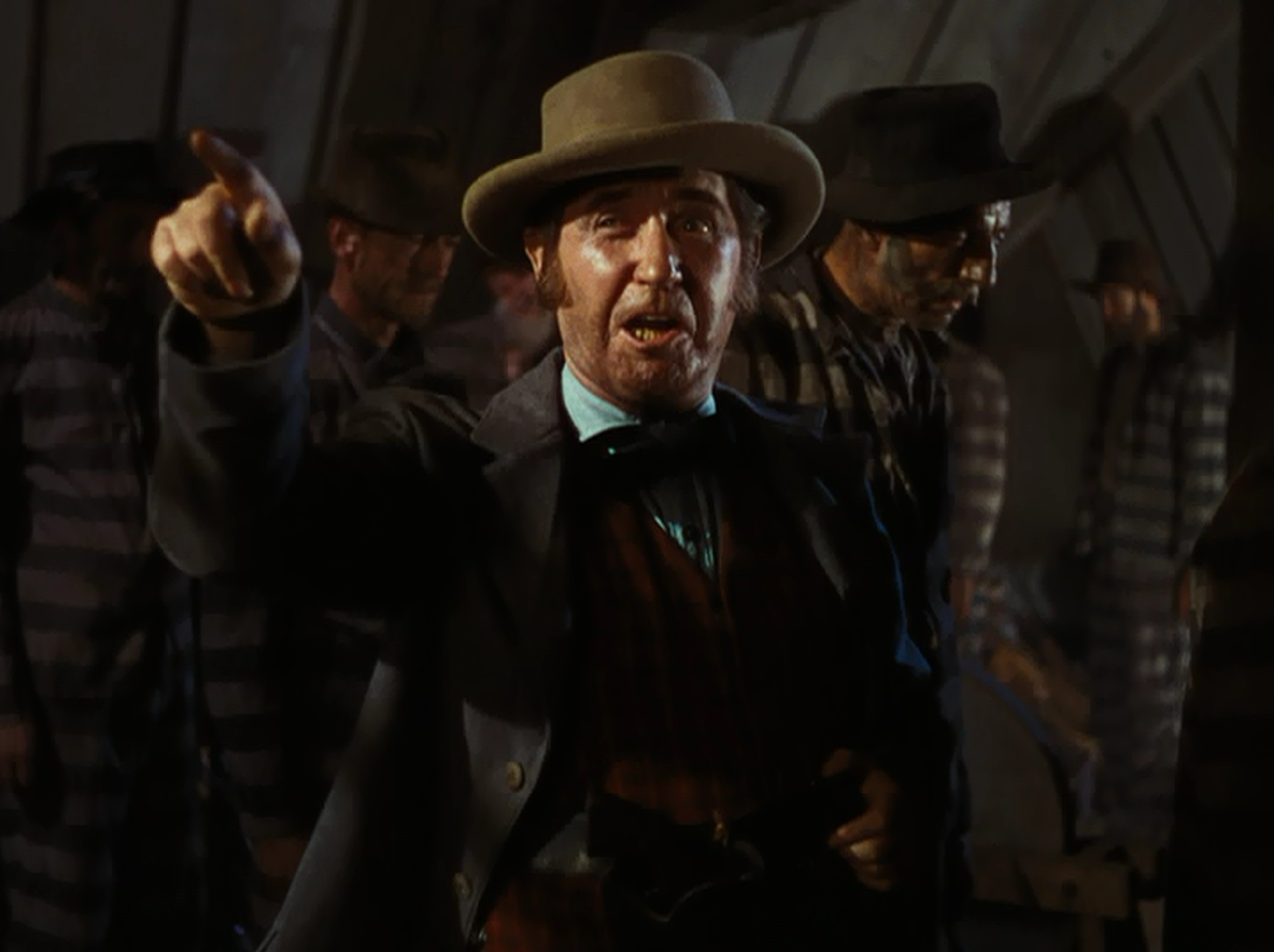
Particularly given that the white population of the U.S.A. is still largely in denial about the structural racism that pervades our society, it is hard to write about Wind without calling it out for its discriminatory ideas. So let us begin with the film's most subtly sinister scene, the one I call the "Scarlett as benevolent slaver" scene. This comes halfway through the film, when, after the Civil War, Scarlett O'Hara (Vivien Leigh) is running her own mill and chooses to lease some convicts as laborers. After looking at a lineup of convicts for hire, Scarlett's longtime friend and business partner Ashley Wilkes (Leslie Howard) raises an objection to her plan, saying:
I do wish you'd let me hire free darkies instead of using convicts. I do believe we could do better.
Scarlett protests, accusing Ashley of being too soft on such people. Then this dialogue ensues:
Ashley: Scarlett, I will not make money out of the enforced labor and misery of others.
Scarlett: You weren't so particular about owning slaves.
Ashley: That was different, we didn't treat them that way.
Oh, I get it now. Slavery was totally fine in Ashley's mind because, at least in his imagined version of it, whites never mistreated their slaves the way Scarlett's foreman whips and starves her newly hired convict labor force. So long as we enslave people NICELY, it's okay, is it? Thanks for explaining that one, Ashley.
An extremely strange and morally backward sequence in which Ashley (Leslie Howard) explains why slavery was actually really good for black people -- so long as it was conducted nicely.
Ashley's swift glossing over of the multitude of cruel horrors visited upon blacks during the transatlantic slave trading years is not the only way in which Gone with the Wind offends. The even bigger lie here is that the film shows us a line of mostly white convicts. As has been extensively documented in Slavery by Another Name, what actually happened after Reconstruction is that white authorities arrested black folks in great numbers on virtually any pretense, placing them into the prison system, thereby allowing them to be contracted out to various industries for essentially no wages. This was how the practice of slavery was continued even after the formal institution of slavery was abolished in the U.S.
Mill foreman Johnny Gallagher displays his line of white convicts for lease as hard laborers. This sequence glosses over the reality that the majority of leased convicts were black men.
Oddly, then, Gone with the Wind suggests that blacks are somehow better off being slaves than they are being free. Taken together with the film's depiction of blissfully loyal plantation blacks including Hattie McDaniel's famous "mammy" character, plus the deep, melodramatic pathos the film asks us to lavish upon the whites of the postbellum South, the film's pervasive racism is undeniable.
This shot of the tattered Confederate flag flying over the South's war dead succinctly conveys Gone with the Wind's racist ideological sympathies. On the other side of the coin, this shot concludes a breathtaking and technically masterful crane shot involving hundreds of extras, illustrating why Wind was such an enormously popular blockbuster.
All that said, one of the great strengths of Gone with theWind, as with so many other classic women's pictures, is its foregrounding of an unrepentant, hard-charging heroine who takes command of her own destiny.** Indeed, it is the figure of Scarlett O'Hara that keeps me watching this lengthy film every time. Gone with the Wind is Scarlett's story, and she is one of the greatest screen heroines in Hollywood history, surviving war and impoverishment to rise again via strength of will and commitment to the land (helped by her loyal black servants, of course).
Scarlett's general greatness makes Rhett Butler's (Clark Gable's) callous rape of her in the last act of the film all the more marring and egregious. Presented as a jilted husband's attempt to get his due, the scene in which a drunken Rhett takes Scarlett by force is one of the most disturbing of the film. Maybe the scene is the film's attempt to show how corrupt masculinity is, even in the otherwise noble (if scoundrelly) Rhett, thereby strengthening Scarlett's motivation to press on without him. But I am not sure that reading is supported by what we see. Instead, I am left with the feeling that Wind wants us to view its intramarital rape scene as something Scarlett brought upon herself by rejecting her husband's sexual advances for too long, that her body was Rhett's to exploit and by god he was going to do it. This is a reprehensibly sexist and horrifying message.
Rhett Butler as acquaintance rapist. Like the recent film Gone Girl, Gone with the Wind implies that Scarlett provokes Rhett's violation of her, casting the blame for her rape back on her, the female victim, rather than on the rapist.
Whatever else it may be, Gone with the Wind will always stand as independent producer David O. Selznick's magnum opus and as one of the most popular and successful big-budget pictures of all time. It is a major landmark in Hollywood history and one of the greatest aesthetic and dramatic triumphs of the Golden Age. And, like it or not, it is accurately reflective of America's extremely conflicted history of race relations. Gone with the Wind may wish white America to feel better about itself by glossing over our ugly history with comforting romanticism presented in lush, three-strip Technicolor. What I hope the film does for us today -- besides enchanting us with its cinematic virtuosity and epic narrative sweep -- is to remind us how far we still have to go to achieve social justice and a discrimination-free society.
--
* Vaguely noirish and/or romantic black and white films of the 1940s I would place above Casablanca include Double Indemnity, Treasure of the Sierra Madre, To Have and Have Not, and probably even Hitchcock's Spellbound. If we include the early 1950s I'd also throw in From Here to Eternity, A Place in the Sun,and Night of the Hunter. I don't mean I would strike Casablanca from the Top 100 list, just that I would rank any of these films higher.
** More great examples of classic women-centered melodramas include the Bette Davis vehicles Now, Voyager (1942), Dark Victory (1939), and Jezebel (1938), Olivia de Havilland in William Wyler's The Heiress (1949), Joan Crawford in Mildred Pierce (1945), and Barbara Stanwyk's astounding turn as the title character in Stella Dallas (1937).
I saw Josh Trank's Fantastic Four movie last week and what surprised me most was that, while it wasn't outright
terrific, it actually wasn't all that bad. The critical and fan backlash against the film would have us believe
that it was one of the worst movies of all time, which clearly is not the case.
Yes, the film is a bit slow-paced, which works fine in the opening 30-40 minutes as characters are being
introduced, but dampens the fun in the back half. Yes, there is a devastating lack of witty banter of the sort one
expects from the FF -- Johnny Storm and Ben Grimm do not flip each other any shit until the very last scene of the
film, and that is a major problem. In general, Trank's take on the FF is a bit too serious in tone, which works well in
the horrific segments depicting how the individual characters react to their newly acquired powers, but kills the buzz
when it comes to the group's interpersonal dynamics. Omitting the traditional witty banter between the
members of the FF is the biggest crime this film commits.
On the other hand, the movie's overall plot is well thought out; the idea that the military would try to control and
exploit the FF really works for me. Furthermore, the film's portrayal of Victor Von Doom is absolutely spot-on,
one of the best things about Trank's version. The darker tone really suits that particular character, and the
parts where he starts wreaking havoc are terrific, although arguably they come along a bit late in the proceedings.
Toby Kebbell as Victor Von Doom -- the best part of Josh Trank's Fantastic Four movie.
In other words, the FF film is flawed but not a disaster. As the Red Letter Media guys tell us, there are many
good things about it, enough to keep it from being an outright failure. I personally enjoyed the film about as
much as I enjoyed Marvel's Thor (2011), which had some good parts (its Asgard sequences) and, like the middle third of Trank's FF movie,
just as many parts that dragged lifelessly and bored me (in Thor's case, pretty much everything that takes place on Earth).
Yet the Marvel movie fanbase seems to think that all Marvel Studios movies are somehow better than any other superhero
action films these days and are rooting for Fox to hand the rights to the FF to Marvel Studios in the wake of Trank's reboot's under-performance. Bracketing aside that for economic reasons alone, that will never
happen, I am not actually sure that is such a great idea. I think having different studios
producing different "takes" on Marvel properties is probably a good thing, and I am not convinced that the Marvel
Studios-produced films are really as consistently good as their brand-loyal fans think they are.
I am not saying that Marvel Studios isn't good at what they do. I enjoyed the first Iron Man and the first
Avengers movies and thought the first Hulk and Thor movies were at least watchable. But the second Iron Man movie was a
hot mess, and there is a kind of formulaic sameness that infects all Marvel's films that is getting really boring to me at this late stage in the game.*
And my critique here reveals my own bias, doesn't it? I still tend to trust the individual director more so than I
trust the larger Studio-as-auteur model now dominating Hollywood (just as it did in the Golden Age of the 1930s
and '40s). To be fair, my preference for the individual director over the "house style" of a studio like Marvel
(which is really Disney) is surely misguided. As Thomas Schatz writes in his brilliant book The Genius of the System,
the closer we look at Hollywood's relations of power and hierarchy of authority during the studio era, at its division of labor and assembly-line production process, the less sense it makes to assess filmmaking or film style in terms of the individual director -- or any individual, for that matter. [. . .] The quality and artistry of all these films were the product not simply of individual human expression, but of a melding of institutional forces. [. . .] The chief architects of a studio's style were its executives***
While it is not entirely accurate to compare today's Hollywood, dominated by unit-production and run by multinational conglomerates, to the vertically integrated major studios of the Golden Age, there are nevertheless some illuminating parallels to be drawn when discussing Marvel Studios in Schatz's terms.† Mark Harris has recently argued that studio executives like Marvel's Kevin Feige are the new power brokers in a Hollywood addicted to franchises and "live-action trailers" such as Feige's attention-getting 2014 reveal of the MCU's Phase 3. Indeed, Marvel Studios' Feige is surely the contemporary analogue to those executives to whom Schatz refers, and it is Feige, along with his corporate overlords at Disney, who chart the course of the MCU and make the final decisions about the tone, style, and content of each Marvel film.
No wonder idiosyncratic directors like Edgar Wright and Josh Trank, used to working in the somewhat more freewheeling indie sector, chafe at the dictates handed down by Disney/Marvel and Fox Studios.
Embattled director Josh Trank.
All that said, perhaps the most noteworthy thing to me about Trank's Fantastic Four is its refusal to objectify or diminish Kate Mara's Sue Storm -- yes, amazingly, the film avoids the sexism that has so far pervaded the "official" Marvel Cinematic Universe. Marvel Studios' ongoing refusal to give Black Widow her own movie is only the best-known instance of this problem, dubbed "The Black Widow Conundrum" by Entertainment Weekly's Darren Franich.†† Franich writes:
isn’t it weird that, by the final action sequence [of Avengers 2], Black Widow’s main role is the same role as
Pepper Potts in Iron Man, or Jane Foster in Thor: The lady who helps her man become a hero? “I adore you,” she
tells Bruce Banner, right before she forces him to Hulk out and save the day. He also saves her life, and then
makes the executive decision to disappear—To protect her, I guess? Even though the last time they talked, she made
it pretty clear that she didn’t need to be protected?
There is absolutely no reason why [Hope] shouldn’t have been the hero of the story. She’s relegated to being mad at her father and to training Scott, who in reality, has no real reason [for] being Ant-Man in this narrative aside from the fact that the larger narrative in the Marvel cinematic universe needs him to be. Hope is skilled in fighting, wildly intelligent and knows the lay of the company they will be infiltrating, and she continuously tells her father that she should be the one putting on the suit.
Indeed. Sadly, Ant-Man's Hope Van Dyne is just the latest female action hero to fall prey to what Tasha Robinson calls Trinity
Syndrome, in which a female character initially presented as an ass-kicker is given very little to do in
the film's narrative besides support the male protagonist. According to Robinson, this increasingly common
character type ends the films she appears in as "the hugely capable woman who never once becomes as independent,
significant, and exciting as she is in her introductory scene."
Kate Mara as Sue Storm.
Fantastic Four's Sue Storm does not suffer this same fate. Hell, she does not even become Reed Richards's love interest in any palpable way during this film! She does become the target of Victor Von Doom's inappropriate affection/vengeance, but the film makes clear that she never encourages this. Furthermore, she never "uses" her feminine sexuality as a weapon or trap and the film never visually objectifies her. She simply plays her capable role on the team and that's that. What a refreshing breath of fresh air that was, believe me.
So in the end, I guess I am somewhat invested in keeping some of these Marvel characters in the hands of other studios and other directors. Trank's film may have been something of a noble failure, but for its casting, tone, refusal to objectify Sue Storm, and a few other nifty ideas, I respect it. While taking nothing away from Marvel Studios and what they do so well, I would rather see a few more of these offbeat attempts at something different than the same formulaic and predictable product Marvel/Disney seems intent on pumping out until the turn of the next millennium.
UPDATE 8/30/2015: Here is a list from Cracked.com that addresses the sexism of the MCU in an amusing yet accurate way.
---
* In truth, I have not actually seen any Marvel Studios film since The Avengers in 2012.
** Harris updated his comments in this 2015 follow-up, written after Jurassic World's release.
*** Schatz, The Genius of the System (Pantheon Books, 1988), pp. 5-7.
† Unit production, which has been the dominant way of making Hollywood films since the 1950s, is when a unique constellation of creative and technical personnel (the "unit") are assembled to make each individual film. As Schatz documents, while some studios flirted with unit-production methods during the studio era (1920s-1940s), the dominant mode of production back then was to have one supervising producer in charge of several films at a time at a given studio. The authority of this creative studio executive, who usually reported only to the studio boss, was so great that key personnel on individual films, even directors, were considered interchangeable. These producers (Irving Thalberg at MGM, David Selznick at RKO, Darryl Zanuck at Warners) were indeed the auteurs of the films they supervised, and they frequently mixed and matched directors, writers, cinematographers, etc., as each project required, thereby diffusing the creative control of those adjuvant personnel.
†† As io9's Meredith Woerner and Katharine Trendacosta have noted, Marvel/Disney's disservice to Black Widow extends beyond the films: they cite Jeremy Renner's public slut-shaming of the character and the lack of Black Widow merchandise as evidence of the structural sexism surrounding her at Disney/Marvel. Of course, they also note the unfortunate sexism of her "forced sterilization" back story in Avengers 2: "Instead of wading into the 'red ledger' of a complicated person who did seriously heinous acts and is trying desperately to buy redemption with good deeds, we get the character who feels ruined by her barren womb." Much of my diminishing interest in Marvel movies is due to crap like this.
I saw Disney's John Carter movie early in its run in summer 2012 and, while acknowledging that it ain't Shakespeare, I nevertheless thoroughly enjoyed it. As a fan of the Edgar Rice Burroughs novels upon which it is based, it was great fun to see the world of Barsoom (Mars) brought to vivid life, and I would single out the film's depiction of the green martian Tharks, its portrayal John Carter's faithful "hound" Woola, and its casting of Lynn Collins as Dejah Thoris as particular high points. The airships were killer too. I wasn't totally sold on Taylor Kitsch as John Carter at first -- I agree with Al that he could have been characterized as more of a "chivalrous gentleman," as in the ERB books -- but he grew on me over the course of the movie.
As you may know, there has been a ton of press circulating about how the film is a colossal box-office flop, sunk due to the studio's overindulgence of director Andrew Stanton and a seriously botched marketing campaign.* That all makes fascinating reading, and I am especially interested in (and, having seen the film, frustrated by) Disney's last-minute decision to change the film's title from the appropriately evocative John Carter of Mars to the blandly obtuse John Carter. This was a big blunder that, if corrected, may not have widened the actual audience for the film by a great margin, but as it stood surely didn't help the film's chances to accrue the following it deserves.
Much of the press about John Carter zeroes in only upon the tumultuous production and distribution circumstances that brought the film to the screen. Yet as a loyal Edgar Rice Burroughs fan who knew I wanted to see John Carter even if it was flawed in certain ways, I am more interested in the movie that actually made it to the screen. I want to judge the film on its own merits.
A Red Martian airship
On that score, John Carter is a total success. It is an engaging, thoughtfully crafted and very well made science-fantasy action epic. I would even say that it is superior, entertainment-value-wise, to many roughly contemporary superhero films including Thor and Iron Man 2. I personally had much more fun watching John Carter than I have practically any other big-budget movie since the first Iron Man.
For a really smart video review of the film itself, check out the Red Letter Media"Half in the Bag" Review, which begins at the 11:03 mark in the linked episode.
At around the 13:44 mark in that review, Jay (the light-haired guy on the right) calls John Carter a "1980's throwback," and that assessment may account for much of its appeal to me. I am forty years old, and my movie tastes are starting to become increasingly "old-fashioned" I think. I really enjoyed John Carter's fun spirit and straightforward, comprehensible action sequences. In fact, the editing of the action sequences in John Carter works for me in ways that the action-sequence cutting seen in Christopher Nolan's Batman films or Michael Bay's Transformers films does not. I find much of the action portions of those movies to be literally baffling; I cannot tell what the hell is going on from shot to shot. In addition to its general fidelity to source material I care about, John Carter moves more at my pace, editing-wise, and I like that.
To pick a couple of nits, I would say that John Carter's flashbacks to Carter's dead wife (??!) were totally unnecessary and did nothing for the story being told. The dialogue was a bit clunky and stilted at points, though no worse than what we get in most big-budget action films (clunkiness of dialogue is where Nolan's work leaps ahead of the competition). I also wasn't totally keen on the role the shape-shifting Therns played in the narrative -- I agree with Oliver Lyttelton's point #6, which states that:
"For all the many antagonists thrown at him in the first 90 minutes, John Carter finds out in the last third of the movie, it’s actually Matai Shang (played by Mark Strong) who's the villain. Pulling the strings behind Sab Than’s quest for power, he spends most of the movie keeping an eye on John Carter before they finally meet head to head late in the game, although he doesn't simply kill Carter, because he's a cliched movie bad guy." The Therns indeed seemed bad just for badness' sake, and I would have liked to see more actual development of the Sab Than character and a greater emphasis on the substance of the rivalry between John Carter and Sab Than.
In conclusion, I must admit that director Stanton's attention to the details of the original Burroughs concepts may alienate or confuse many viewers not already familiar with John Carter from ERB's books (Lyttelton makes this his point #4). Yet I also can't see how any moderately intelligent viewer wouldn't figure out what a"Jeddak" was once it is used three or four times in the course of the dialogue (which it is in rapid succession at the film's outset). Come on, folks, how much spoon-feeding is necessary? I admire Stanton for sticking to his guns and keeping Barsoomian language more or less intact -- it gives this movie flavor and uniqueness.
Jay of Red Letter Media captures this spirit when he remarks (starting around the 18:18 mark) that "I see this movie having the same fate as other big-budget movies that don't find an audience in the theater, like Tron or David Lynch's Dune, it finds its audience later, becomes more of a cult movie." This sounds right to me. I think John Carter -- which thankfully retains its full original title, John Carter of Mars, in the title card right at the end of the movie -- will age well, and will be regarded more highly once the hubbub over its big budget and small theatrical returns have died down. I myself have obtained the DVD version and am an avid member of the cult of John Carter of Mars.
Lynn Collins says: "Come see me as Dejah Thoris in John Carter -- I'm so good I practically steal the movie!"
UPDATE 5/22/2016: I recently tried a re-watch of John Carter, but was so bored I shut it off after half an hour. I must agree with Film Crit Hulk that the first twenty minutes is completely unnecessary, that the movie should start with JC being chased to the cave. But Hulk's also right about the stupidity of that late reveal of JC's back story. That is indeed a fatal flaw.
I am somewhat hesitant to use the term "great directors" at all because it suggests a kind of auteurism that favors the works of a few so-called "great" filmmakers over films made by lesser-known or less consistent talents. Despite my love of certain directors (Hitchcock, Hawks, Ford, Kurosawa, Korine, Soderbergh, Holofcener, etc.) and my tendency to seek out films by directors whose work I know I have enjoyed in the past, I am not ONLY interested in the work of directors I know by name nor do I believe that a "great" director is required to produce great work. However, I could not include this appreciation of David Fincher in my "Overlooked Directors" series because he is certainly not overlooked, not since 1999's Fight Club anyway.
I further acknowledge that greatness is always culturally determined and historically contingent. I recently wrote a piece about the lack of greatness I see in Quentin Tarantino's post-1997 output. In that piece I compare QT's late-career works both to his own earlier, better films AND to several other independent, studio, and non-U.S. directors and films with which I am familiar. To me, as a filmgoer with a fairly deep exposure to many of the same films from which Tarantino borrows his style, his post-1997 work seems derivative, two-dimensional, and not that interesting. By contrast, I assume his films must feel like an edgy, inventive breath of fresh air to someone who mainly only watches big studio blockbusters and other mainstream stuff.
In addition to a viewer's assumptions and background knowledge, time also changes how we view films and bodies of work. In 1997, Quentin Tarantino's work seemed lively, clever, amazing. In 2015, the novelty has worn thin.
Therefore I judge Fincher in his present moment and context: he is a commercial, studio director with an extraordinary degree of technical and artistic mastery who really really loves to make dark, noirish crime thrillers, often about serial killers.
Tony Zhou, the whip-smart narrator of that video, remarks of watching David Fincher's films that "it's great to watch someone who's actually great at their job." Zhou concludes that "even if you don't like Fincher, this is some of the best craft in directing right now and it is absolutely worth studying."* I couldn't agree more. I will state openly that I think Fincher is one of America's most talented and skilled directors, and he may sit very close to the top of the heap now that Steven Soderbergh has supposedly "retired" from filmmaking.
Let's look at a few of Fincher's best efforts -- chosen quite subjectively by me -- in an attempt to sum up what makes his work so consistently superb.**
"Its production history has usurped its impact." --Scout Tafoya on Alien 3
Alien 3(1992) Alien 3 is one of those films that it is fashionable to hate, probably due to the rock-solid construction, immense popularity, and lasting influence of its two precursors, Alien (1979) and Aliens (1986). Yet I have always liked Alien 3 and have never quite understood the outcry against it. When I first saw the extensive behind-the-scenes footage of how difficult this threequel was to make, I was surprised, for to me the finished film does not reveal the tumultuous struggle that brought it into being. Like this reviewer, I consider Alien 3 to be on par with the first two Alien films, and in fact I personally prefer it over James Cameron's Aliens.
Of course, much of my preference is surely attributable to genre: I categorically prefer horror films to action films. But like Mr. Constantine says in the review linked above, Alien 3 is a perfect capstone to the Alien trilogy (like him I deny the existence of the abysmal and, ironically, lifeless Alien Resurrection) and a superb stand-alone gothic horror film, especially in its extended version included in the Alien Quadrilogy boxed set:
While it’s admirable of James Cameron to do something different as opposed to a traditional sequel, I do feel that [in Aliens] the aliens became a bit less threatening by having so many of them. [. . .]
With Aliens, although there are some surprises, you’re pretty confident that Ripley, Hicks and Newt will all survive. But in Alien 3, like in Alien, it’s made very clear that no one is safe. We’re now in a situation that is just as desperate as the first film.
Indeed. To continue in this vein, let's check out this great video essay about the greatness of Alien 3:
As Scout Tafoya writes in the essay accompanying the video,
Because the third film revolves almost entirely around Ripley's desire to protect the integrity of her body—specifically her womb—"Alien 3" feels more purely feminist than the previous two movies, for all their innovative images of a badass heroine fighting bugs whose bodies fused male and female genitalia into a Freudian nightmare. In the first movie, she's fighting to save her crew. In the second, she's fighting to save a little girl, and in so doing, embracing her own latent potential for motherhood; the climactic action scene even brings her face-to-face with another mother, the alien queen, in an egg chamber. These are all engaging, relatable motivations, but they're culturally conservative, because they play on the traditional image of woman as potential victim or maternal protector.
In "Alien 3," Ripley is fighting for Ripley, period.
I agree with this assessment. I have always felt that, while Ripley is undeniably badass in Aliens, the feminist implications of her role in that film have tended to be overstated. I think she is a more progressive figure in the first Alien film, where her gender is barely even at play -- she just does her job as first officer of the Nostromo and her femininity and/or maternal instincts have nothing to do with it. In fact, I think that Alien makes clear that she is a better leader and officer than Dallas, since he makes the devastatingly bad call to insist she admit he and the alien-infested Kane back onboard ship, while she has the good judgment to refuse him. The only way the first film might be seen to "sell out" Ripley on the basis of her gender is when it depicts her in her underwear near the end, subjecting her to the objectifying, erotic masculine gaze germane to all Hollywood cinema.***
The one sexually objectifying series of shots that mars Ridley Scott's
All that said, and to broaden the scope here a little, we should ask: is David Fincher's work sexist? I admit that a couple of his recent works, The Social Network and The Girl with the Dragon Tattoo, have given me serious pause: the former is about an adolescent-minded guy who treats women misogynistically at every point along his rise to the top, and the latter depicts rape in ways that I find unnerving (especially compared to its Swedish antecedent).† Beyond that, I am inclined to read Gone Girl, Fincher's latest psychosexual thriller, as another of the director's works that leans too heavily in the misogynist direction.††
In this context, Fincher's work reminds me a great deal of Alfred Hitchcock's, both in terms of its technical perfection and in its tendency to be both woman-positive AND misogynist at the same time. Like Hitch, Fincher seems drawn toward stories featuring well-rounded and interesting women characters (e.g., Alien 3, The Girl with the Dragon Tattoo, and the Netflix TV series House of Cards) most of whom are dark, edgy, gender-bending, and sexually dangerous in ways reminiscent of the femme fatale of film noir. As such, Fincher's women characters, despite their complexity, often end up getting tortured, raped, and/or murdered at some point in their respective films or programs. I discuss Gone Girl at length elsewhere, but must note here that, despite its technical perfection and edge-of-your-seat thrills, it has drawn a substantial feminist backlash (e.g., here, here, and here) that I find difficult to downplay or refute.
But in any case Alien 3 is great and I strongly suggest that you lay your hands on a copy of the extended 1991 "Assembly Cut" and check it out.
Jodie Foster and a young Kristen Stewart star in David Fincher's somewhat under-appreciated thriller Panic Room.
The Game (1997) and Panic Room (2002)
I am quite fond of these two underrated gems, especially the latter. They are genre films, tightly made thrillers with few, if any, deep thoughts on their minds, yet they are so damn well directed and visually rich that they stand out purely for their level of craft.
One of the most remarkable shots in Panic Room is a digital "long take" in the film's first act, just before the 16-minute mark. The shot lasts about three minutes, tracking backward out of Meg's (Jodie Foster) bedroom, between two banister rails, down two stories, past the front window (seeing intruders outside) and into the front door keyhole, back past the front window (still seeing intruders), through the kitchen to the back door, up a story to see an intruder climbing up the fire escape outside, then up a few more to the skylight, then back down into the "panic room" on the house's top floor. What I like about this shot is that it is clearly an impossible shot to get via traditional means -- no camera could fit between those banister rails or inside that keyhole -- yet what Fincher and his team do here is create a mostly digital (computer-generated) shot that attempts to look like a traditional, analog camera move that achieves the physically impossible. I wish more directors and films took advantage of CGI to accomplish stuff like this rather than to overwhelm us with robots.
Aside from his general virtuosity and inventive use of cutting-edge digital effects techniques, I also like that Fincher clearly understands the roots of the genre in which he works, paying homage to other thrillers and noirs such as Kubrick's The Killing:
One of the last shots from David Fincher's Panic Room . . .
. . . pays homage to this famous, climactic shot from Stanley Kubrick's The Killing (1956).
Fincher's early thrillers and neo-noirs such as Se7en, The Game, and Panic Room ultimately pave the way for his greatest achievement in this area . . .
A beautifully lit and composed shot from the opening sequence of Zodiac,
David Fincher's 2007 neo-noir masterpiece.
Zodiac (2007) Zodiac is Fincher's hands-down best film in my view. I really don't know what to say about it except: see it. It may be that I am ill-equipped to speak critically about Zodiac because I am too close to it -- it is one of my all-time favorite movies. It is essentially a film noir (more precisely a neo-noir, that is, a noir-like film made after 1958), which is one of my very favorite film genres / styles. Briefly glossed, film noir is a style that emerged as part a cycle of crime films starting in the late 1930s or early 1940s. Structurally, the noir is an offshoot or adaptation of the crime thriller, especially the police procedural. What makes the film noir distinct from its antecedents is its high-contrast lighting style, its rain-soaked nighttime city streets, its morally ambiguous characters, and its focus on the process of an investigation as opposed to its outcome (a great many noirs end ambiguously or with the real culprit uncaught). According to French film theorists Raymond Borde and Etienne Chaumeton,
the moral ambivalence, the criminality, the complex contradictions in motives and events, all conspire to make the viewer co-experience that anguish and insecurity which are the true emotions of contemporary film noir. All films of this cycle create a similar emotional effect: that state of tension instilled in the spectator when the psychological reference points are removed. †††
This applies oh so well to Zodiac, in which everyday guy Robert Graysmith becomes obsessed with the case of the Zodiac Killer and utterly loses touch with his family life in the process. He finds the killer, but does he catch him? Watch the movie to find out.
Note Zodiac's noir-like high contrast lighting that plunges
Robert's (Jake Gyllenhaal) face into shadow.
For those of you who have read my American Hustle review, you will recall that I critiqued that film for over-doing its "70s-ness," going too far over the top, creating something that felt off-putting, hyper-real, and historically wrong. Zodiac is my positive counter-example for how to get a 1970s period piece exactly right. Zodiac represents neo-noir at its very best. Its aesthetics are a masterful mixture of neo-noir style and a perfectly rendered 1970s period piece -- kind of like the serial killer plot of Dirty Harry shot, lit, and paced as if it were Night Moves or Chinatown.
Mark Ruffalo walking in front of a bluescreen in San Francisco shooting Zodiac.
Equally interesting as what we see onscreen in Zodiac are the cutting-edge processes used to bring them about. I could attempt to explain in detail how Fincher and his associates created 1970s San Francisco via complex bluescreen technology etc., but why not once again defer to an informative video?
Deliciously twisted and sprawling, intelligently scripted, and (as always) boldly shot, lit, and edited, Fincher's Zodiac is a masterpiece for both Fincher and the neo-noir tradition writ large. Please see it.
Kate Mara and Kevin Spacey in season one episode two of House of Cards.
House of Cards (2 episodes, 2013)
Folks who know me will attest that it is difficult to win me over as a regular watcher of dramatic television shows (comedy is a different story). I am well aware of the "quality TV" revolution and have watched a few pivotal series, like Oz and The Shield, to completion, but I swear I've made several earnest efforts to get into The Sopranos and have never made it past season two. I made it three and a half seasons into Mad Men and got bored. Dramatic shows, no matter how well-produced, just don't typically seem to hold my attention for long.
Fincher's Netflix Original Series House of Cards is an exception. I don't even normally like Kevin Spacey -- I usually find him too "actor-y" and over-determined in his onscreen performances -- and yet I like him here. (I also basically like him in Se7en as well -- his hamminess meshes well with that somewhat fantastical / fanatical character.) I watched all of seasons one and two of Cards and enjoyed them both quite a bit.
That said, my interest in House of Cards has flagged a bit as it heads into its third season. Part of my issue is that I think Claire Underwood's (Robin Wright) story got compromised in season two. As Karen Valby's critique of Claire's season two story arc makes clear, she is such an awesome, compelling, uncompromising character to begin with that it is a major letdown to discover that a past sexual assault may be a motivating factor explaining her present-day edge. As Valby asks: "can’t we enjoy standing aghast in the face of Claire’s ruthlessness without saddling her with such an excruciating foundation?" I sincerely wish we could. I join with Valby in asking "quality" television shows to quit falling back on rape as a stock story device imposed upon otherwise extremely compelling and interesting female characters.
Robin Wright as Claire Underwood on House of Cards.
I guess that brings us back to the misogyny point, and it is an issue that continues to haunt Fincher's latest works. I must acknowledge Fincher as one of the greatest living American filmmakers. His mastery of his craft is exceptionally high, his films consistently superb, and even when he makes sexist missteps, his films are never anything less than emotionally and visually provocative. Even when I am troubled by some of their gendered implications, I nevertheless enjoy and marvel at (most of) Fincher's films. Yet that sexist vibe is palpably in there, perhaps nowhere more so than in Gone Girl. That troubles me and may, for me, somewhat diminish Fincher's cinematic achievements over time if it continues.
--
* Zhou has a Patreon site where he solicits financial support for his superb and essential "Every Frame a Painting" video essay series.
** Note that I am not discussing Fight Club (1999), because frankly, I don't like that film much. I find it thematically pretentious (with its false "anti-capitalist" message), and ideologically dangerous (striving to be a satire I think but presenting Edward Norton's character too sympathetically to work as a critique of his white, hypermasculine bullshittery). I am not discussing Se7en (1995) because, while I like it a lot, I think Zhou's video essay says enough about what makes this generally well-received film great.
*** Here I refer to the well-known feminist analysis of Hollywood cinema by Laura Mulvey, "Visual Pleasure and Narrative Cinema," which correctly points out that Hollywood objectifies women onscreen via sexist camera and costuming techniques Mulvey calls the "male gaze."
† For more on the sexism of the geeky protagonist of The Social Network, see my co-authored article, "Postmodern Geekdom as Simulated Ethnicity."
†† I capsule-reviewed Gone Girl in my 2014 end of year roundup, concluding that it is "an amazingly well-wrought thriller with an unfortunate, mile-wide misogynist streak."
††† Borde and Chaumeton, "Towards a Definition of Film Noir" in The Film Noir Reader (Ed. Alain Silver and James Ursini, Limelight Editions, 1996) p. 25.