Saturday, October 24, 2015

James Bond Franchise Review Part Two

This is the second of two posts reviewing the first twenty-one James Bond films. See also my introductory thoughts about James Bond.

THE MEDIOCRE JAMES BOND FILMS

Donald Pleasence as Blofeld in You Only Live Twice.

You Only Live Twice (1967)
I hate to put any Connery-as-Bond film on the mediocre list, and You Only Live Twice, the fifth entry in the franchise, almost deserves to be at the bottom of the Great list. It has one of the best theme songs ever, the very best villians’ lair (a hollowed-out volcano!), and one of the best fistfights in any Bond film (the fight in the Osato Chemical office building twenty-five minutes into the movie). Yet I am forced to agree with other critics who contend that the pacing of You Only Live Twice is a little slow. And perhaps Connery’s weariness of the Bond role is beginning to show here: by the time the shooting of this film was underway, Connery had announced that he would not star in another Bond picture. Indeed, he did not participate in the sixth Bond film, On Her Majesty’s Secret Service, though he was wooed back to Bond two more times: for Diamonds Are Forever in 1971 and again in 1983 for the Thunderball remake, Never Say Never Again.*

Live and Let Die (1973)
Although it is dated and/or marred by its Blaxploitation-influenced depiction of African Americans as heroin pushers and savage voodoo practitioners, Live and Let Die nevertheless counts as a fairly excellent Roger Moore James Bond film. It has one of the best Bond theme songs ever. The speedboat chase and the sequence at the alligator farm are thrilling and iconic Bond moments. In terms of its supporting cast, most notable is Yaphet Kotto as Kananga / Mr. Big, who is one of the best actors ever to play a Bond villain, although his onscreen motives in this film are a little ridiculous, hackneyed, and unclear. Maybe Live and Let Die's biggest weakness is its leading man: this film constitutes Roger Moore’s debut in the role of Bond, and Moore is still finding his way into the role. Thus the film is not as laden with slapstick humor as its immediate sequels, The Man with the Golden Gun and The Spy Who Loved Me, though it does successfully go for the laughs during the “flying lesson” sequence and when it introduces Louisiana Sheriff J.W. Pepper (Clifton James). Yet the pacing of the first half of Live and Let Die is surprisingly slow, picking up and staying lively only from the double-decker bus chase onward, after the one-hour mark. Nevertheless, this is a Bond film I return to with some regularity, and all in all, I am forced to call the imperfect Live and Let Die a worthwhile and largely entertaining Bond adventure.**

British comedian Rowan Atkinson joins Sean Connery in Never Say Never Again.

Never Say Never Again (1983)
While a bit lengthy and certainly no match for the film (Thunderball) of which it is a remake, Never Say Never Again is nevertheless pleasurable because Sean Connery is so damned good in the leading role. After twelve years of Moore’s parodic take on the Bond character, it is a treat to have the tough, believable Connery back as 007, and the film has many excellent sequences, most notably the clinic fight early in the film and the motorcycle chase midway through. Barbara Carrera particularly shines as villianess Fatima Blush, and I am a big Rowan Atkinson fan so enjoy his appearance here as bumbling government liason Nigel Small-Fawcett. All in all, a fun if imperfect farewell from the best Bond actor there ever was.

The Man with the Golden Gun's "duel between titans" -- Francisco Scaramanga (Christopher Lee) squares off against James Bond (Roger Moore).

The Man with the Golden Gun (1974)
Yes, The Man with the Golden Gun is a decidedly “cheesy” James Bond movie. The sequence where Bond fights an entire school of martial arts practitioners is flatly ridiculous, as are the stupefyingly silly antics of Bond’s “helper,” Agent Mary Goodnight (Britt Ecklund). However, I return to this film again and again for one central reason: Christopher fuckin’ Lee. There is a reason Lee played Count Dracula so successfully in the 1950s Hammer horror films, and the answer is that he is a fine actor with an awesome, deep voice, a scary onscreen presence, and thus he totally rocks as super-assassin Francisco Scaramanga in this film. Lee’s performance and the script’s framing of the conflict between Scaramanga and Bond as a duel between titans, two world-class professional killers with few peers to challenge them, brings a gravitas and excitement to the climactic duel between them that has never really been matched in other Bond films. As Lee himself put it, Scaramanga is “the dark side of Bond.” Further, The Man with the Golden Gun showcases superb location use, for Scaramanga’s island hideout — shot on location in Phuket Province, Thailand – is one of the most beautiful and memorable of all Bond villain hideouts, second only to Blofeld’s volcano lair in You Only Live Twice. Lastly, along with The Spy Who Loved Me, The Man with the Golden Gun qualifies as the rare Bond film where the writing and tone mesh well with Roger Moore’s gently parodic take on James Bond, thus producing a harmonious if somewhat campy whole. I find myself returning to this one again and again, not least to hear the film’s funky 70’s theme song. Check it out!

Drax and Jaws are friends in Moonraker.

Moonraker (1979)
Explicitly produced to capitalize upon the popularity of Star Wars (1977), this Roger Moore Bond film goes way over the top: it ends with a laser battle aboard Drax’s orbital space station. The producers knew they were risking making even Roger Moore look silly in this, yet it more or less pays off: Drax is one of the franchise’s most sinister villains, and who doesn’t love Jaws (Richard Kiel), the famous Bond assassin appearing here in his second and final appearance in the franchise? Further, the excesses of Moonraker led the Bond producers to tone down the gadgets and bombast for the next, much darker Bond movie, For Your Eyes Only. My biggest complaint about Moonraker is its pacing — it feels a bit slow and bombastic to me. But Drax and Jaws keep me coming back, at least once in a while.

The always delightful Robbie Coltrane as Valantin Zukovsky in the underrated Bond picture The World is Not Enough.

The World is Not Enough (1999)
Some people would disagree with me here, and rate The World is Not Enough below the other Brosnan Bonds, including Tomorrow Never Dies and the ridiculous Die Another Day. But there is something in the plot and tone of this well-directed Bond picture that really works for me. There is a depth of characterization and an intensity in the acting, particularly from Sophie Marceau (as oil heiress Elektra), Robert Carlyle, and even Brosnan himself. In fact, I think this film documents Brosnan’s best portrayal of Bond. Furthermore, the twisted relationship between Elektra and Renard, not to mention its impact on M (Judi Dench), is handled with a sophistication and pathos rare to see in James Bond films. Michael Apted’s direction and an ambitious script come together in a really coherent package, and while Denise Richards’ (Christmas Jones) acting may not be the greatest the Bond franchise has ever seen, it is not enough to seriously detract from this well-crafted and, dare I say, most thoughtful and emotionally rich of all the (pre-Daniel Craig) Bond films.

Tomorrow Never Dies (1997)
Stellar action sequences, particularly the Saigon building escape and motorcycle / helicopter chase that take place an hour and sixteen minutes into Tomorrow Never Dies, cannot save this second Brosnan outing from overall mediocrity. Despite an interesting premise, the villian Carver (Jonathan Pryce) is a bit too overplayed to be effectively scary, and Michelle Yeoh, who shines during the fight sequences, is pretty flat elsewhere and she and Brosnan lack chemistry. Two standout supporting performances include Teri Hatcher as the voluptuously alluring Paris Carver and the weird-looking Vincent Schiavelli as Dr. Kaufman, but neither of these two characters live long enough to provide much ongoing help. However, this is a very well-paced film overall, and the aforementioned motorcycle/helicopter chase is one of the most breathtaking and well-executed action sequences in the entire Bond oeuvre -- well worth a look!

Christopher Walken as Max Zorin in A View to a Kill.

A View to a Kill (1985)
This film is preposterous in large part due to Roger Moore’s tiredness in and with the role of James Bond. Moore wanted to quit the Bond cinematic franchise after For Your Eyes Only but the producers enticed him back two more times. And although the ever-chipper Moore gives it a good parting effort, you can kind of tell that he is finished with the role. However, it is A View to a Kill’s supporting cast that makes this film a stupidly delightful watch. Christopher Walken as Max Zorin, Grace Jones as May Day, and Patrick MacNee (of British “Avengers” fame) as Tibbett really bring their segments of this picture to life. I further admit that I really like the fire-engine / car chase through the streets of San Francisco that happens three-quarters of the way through the movie, and of course the Duran Duran title song fucking RAWKS! Hmm, is this movie so bad it’s good? I definitely enjoy this picture more than I feel I should given that I’m placing it so low on my list. I certainly watch it at least as often as I watch Moonraker.

THE REALLY BORING JAMES BOND FILMS***

Robert Davi and Benicio del Toro: two of the most entertaining elements of Licence to Kill. 

Licence to Kill (1989) 
I used to think this second and final Timothy Dalton Bond film was even worse than its predecessor, The Living Daylights, but upon reviewing it recently [in 2008] for this Guide, I have been forced to admit that it’s not as bad as I remembered it. In fact, it is far faster paced than The Living Daylights, and is chock full of lean-and-mean fights and well-orchestrated action sequences. There is also some good supporting cast here, like the very attractive Carey Lowell as CIA agent Pam Bouvier, Robert Davi as the diabolical if stereotypical villain Sanchez, and a very young Benicio del Toro as Sanchez’s twisted henchman Dario. The opening and closing theme songs, “Licence to Kill” and “If You Ask Me To,” are excellent as well. Yet I still have trouble sitting through the fucking ridiculous truck stunts near the end of the film (an 18-wheeler doing fucking side wheelies? Come on!), and ultimately it is Dalton’s somewhat strange fit in the role of Bond that keeps this film from rising above the level of dull and dumbshit. But Licence to Kill may be semi-decent dumbshit — occasionally enjoyable as a guilty dumbshit pleasure.

Die Another Day (2002)
This film exemplifies the furthest the Bond franchise has ever gone into the realm of high-tech gadgetry and science fiction-esque premises, barring Moonraker. But while Moonraker embraced its own over-the top silliness (recall that the notorious assassin Jaws finds true love — in space no less! — in Moonraker), Die Another Day seems to try way too hard to take itself seriously. So, despite breathtaking action sequences, such as the clinic raid, the fencing duel (wow!), and the climactic cargo plane fight, and despite semi-decent chemistry between Brosnan as Bond and Halle Berry as American agent Jinx, this film always feels too bombastic and over-determined to me, one I enjoy sometimes and cannot bear other times. I know some Bond fans defend this film and I admit that the first time I saw it in the theater I thoroughly enjoyed it and was more or less blown away. But on increasingly disappointing repeat viewings I digested the fact that there’s an invisible car in this movie, and hence its well-deserved placement in the “dumbshit” category.

This scene from The Living Daylights, set in Vienna, pays homage to iconic imagery from Carol Reed's film noir classic The Third Man (1949).

The Living Daylights (1987)
This one really earns the “boring” label. The worse of Timothy Dalton’s two contributions to the Bond series, this film is too serious in tone, too long in running time, and too desperately slow in pacing at points to be much fun as Bond films go. It’s not that the producers and Dalton himself don’t give this thing a good try, and some of the supporting cast in The Living Daylights — particularly Joe Don Baker as Whitaker and Maryam d’Abo as Kara — are really enjoyable. In the end, while I like Dalton and find him charismatic and I want him to succeed in the role, he nevertheless doesn’t quite feel like Bond to me. Maybe after six years of Reagan and Thatcher, etc., the Bond premise was just wearing a bit thin by the late 80s. Maybe the public so badly wanted Pierce Brosnan in the role that Timothy Dalton could never have fulfilled anyone’s expectations at that time. In any case, the whole Dalton-as-Bond business is an unfortunate mismatch; Dalton is simply not quite at home as Bond, despite his talent. And when Bond doesn’t work, the Bond film doesn’t work, especially when it's this damned slow and somber. So fuck The Living Daylights. (But on the Dalton-is-talented note, make sure to see him in the awesome 1980 Flash Gordon movie.)

Octopussy (1983)
The single worst James Bond film, Octopussy is slow-paced, convoluted, and full of boring characters. The film is so lackluster that even the usually high-spirited Roger Moore cannot breathe life into it. A shit-pile.


THE SEVEN BEST JAMES BOND THEME SONGS
1. “Nobody Does It Better” from The Spy Who Loved Me.
2. “You Only Live Twice” from You Only Live Twice.
3. “Diamonds Are Forever” from Diamonds Are Forever.
4. “Goldeneye” from Goldeneye.
5. “Live and Let Die” from Live and Let Die.
6. “Goldfinger” from Goldfinger.
7. “Licence to Kill” from Licence to Kill.

Ursula Andress as Honeychile Ryder in Dr. No (1962).

THE SEVEN BEST BOND WOMEN
1. Honey Ryder (Ursula Andress) from Dr. No: Honey Ryder is the first and best. Tough and statuesque, Andress made not just Bond history but film and cultural history when she walked out of the surf just over an an hour into Dr. No.
2. Carole Bouquet as the tough, revenge-driven Melina Havelock in For Your Eyes Only.
3. Domino (Claudine Auger) from Thunderball: Haunted and very empathetic, Domino feels subtly believable to me, and she doesn’t suddenly change her character 180 degrees by falling head-over-heels for Bond like Pussy Galore and other Bond leading women have by the last reel.
4. Pussy Galore (Honor Blackman) from Goldfinger: One of the few Bond women who really seemed close to being Bond’s equal, despite her capitulation to Bond’s charms (and selling out of Goldfinger) by the film’s climactic showdown.
5. Tracy Bond (Diana Rigg) from On Her Majesty’s Secret Service: an intense actress and the only leading woman Bond ever marries. . .
6. Agent XXX (Barbara Bach) from The Spy Who Loved Me: Bach is able to play this role with just the right amount of knowing humor so as to perfectly compliment Moore’s performance and the film.
7. Jinx (Halle Berry) from Die Another Day: though trapped in a shitbox of a film, Berry shines as American agent Jinx, almost (but not quite) rescuing this film from its overdetermined self-importance and excessive techno-gadgetry.

French actor Michael Lonsdale as Drax in Moonraker (1979).

THE SEVEN BEST BOND VILLAINS
1. Drax: The creepiest of them all, so aristocratic!
2. Donald Pleasence as Blofeld: The first and coolest Blofeld.
3. Goldfinger: The most iconic Bond villain, especially in the laser-beam scene.
4. Scaramanga: He’s Christopher fuckin’ Lee. Sinister and perverted!
5. Kananga: Rendered interesting because of Yaphet Kotto’s presence and performance.
6. Largo: His eye patch and love of sharks make him unforgettable.
7. Zorin: Come on, it's Walken.

Roger Moore as James Bond in For Your Eyes Only (1981).

JAMES BOND ACTORS RATED BEST TO WORST
1. Connery
2. Moore
3. Brosnan
4. Lazenby
5. Dalton

There's no doubt that Roger Moore’s ironic/parodic take saved the franchise from imploding — an earnest Bond never worked after the 1960s, as Dalton’s tenure emphatically proves. Regarding George Lazenby, I feel that had he had more time to grow into the role (and acquire more acting skills), Lazenby might have ranked higher on this list, but history was not kind to the Australian model-turned Bond: he was dismissed after one film, the rather excellent On Her Majesty’s Secret Service.


THE JAMES BOND FILMS LISTED CHRONOLOGICALLY

1. Dr. No (1962), starring Sean Connery, directed by Terence Young

2. From Russia With Love (1963), starring Sean Connery, directed by Terence Young

3. Goldfinger (1964), starring Sean Connery, directed by Guy Hamilton

4. Thunderball (1965), starring Sean Connery, directed by Terence Young

5. You Only Live Twice (1967), starring Sean Connery, directed by Lewis Gilbert

6. On Her Majesty’s Secret Service (1969), starring George Lazenby, directed by Peter Hunt

7. Diamonds Are Forever (1971), starring Sean Connery, directed by Guy Hamilton

8. Live and Let Die (1973), starring Roger Moore, directed by Guy Hamilton

9. The Man With the Golden Gun (1974), starring Roger Moore, directed by Guy Hamilton

10. The Spy Who Loved Me (1977), starring Roger Moore, directed by Lewis Gilbert

11. Moonraker (1979), starring Roger Moore, directed by Lewis Gilbert

12. For Your Eyes Only (1981), starring Roger Moore, directed by John Glen

13. Octopussy (1983), starring Roger Moore, directed by John Glen

14. Never Say Never Again (1983), starring Sean Connery, directed by Irvin Kershner

15. A View to a Kill (1985), starring Roger Moore, directed by John Glen

16. The Living Daylights (1987), starring Timothy Dalton, directed by John Glen

17. Licence to Kill (1989), starring Timothy Dalton, directed by John Glen

18. Goldeneye (1995), starring Pierce Brosnan, directed by Martin Campbell

19. Tomorrow Never Dies (1997), starring Pierce Brosnan, directed by Roger Spottiswoode

20. The World is Not Enough (1999), starring Pierce Brosnan, directed by Michael Apted

21. Die Another Day (2002), starring Pierce Brosnan, directed by Lee Tamahori

--
* Here I must add a flagrant racism alert. True, all James Bond films carry imperialist implications, what with their championing of a globe-straddling, white, British superspy who saves the Western world at every turn by besting and killing less-white foes and henchmen (and, in most cases, getting his own allies killed as well). But You Only Live Twice features some of the most overt Orientalism of the whole series, culminating in a shocking sequence in which Bond dons yellowface in order to blend in with a group of (gulp!) ninjas. Of course, the concept is ridiculous to the point of absurdity: no matter how you tape his eyes back or yellow his skin, a 6'2" Scotsman is simply not a ringer for a Japanese man. But silly or no, the Bond yellowface scene brings the franchise's racism (in the form of racist stereotyping and caricature) to the fore in a pointed and off-putting way.
** This is another place where my former self's Roger Moore-dislike clashes with my current appreciation for Moore-as-007. I would still call Live and Let Die an imperfect Bond film, but would move it up toward the bottom of the "Truly Great Bond Films" list despite its flaws (particularly Mr. Big's extremely foggy motives for doing whatever he's doing). Along the same line, today I would push The Man with the Golden Gun up a few slots to the very top of the "Mediocre" list or maybe to the very bottom of the "Great" one. I enjoy Golden Gun at least as much as You Only Live Twice -- probably more so.
*** When I originally wrote this review in 2008, I used the term "Dumbshit" to refer to this third, least favored category of James Bond films. However, I subsequently realized that "Dumbshit" wasn't an ideal moniker, since almost all James Bond movies, even really good ones, feature moments that qualify as over-the-top, ridiculous, and "dumbshit." In many cases, those dumbshit moments are some of the most pleasurable ones. No, the worst crime committed by the films on the third list are that they are dull; thus I have re-dubbed the third category “Boring” rather than the admittedly funnier but slightly less accurate “Dumbshit.”

Thursday, October 15, 2015

James Bond Franchise Review Part One

This two-part review of the first twenty-one James Bond films -- I am reaching twenty-one by including Never Say Never Again (1983), which was not released by Eon Productions and therefore is not considered canonical by them -- is, in a couple of senses, "old." For one, it deals only with the pre-Daniel Craig Bonds. You should read my earlier introduction to this post for the reasoning behind that exclusion, but the short version is: the Craig Bonds serve as a true “reboot” of the franchise, taking the Bond premise and feel in a wholly new direction. So while I really like Craig in the role and appreciate Casino Royale (2006) and especially Skyfall (2012) on their own terms (as contemporary action thrillers), they do not seem to fit in with the spirit of the Bond franchise in its Connery-through-Brosnan period.

More significantly, however, I use "old" here to designate that I originally wrote this review a fairly long time ago, in August 2008, over seven years ago.  Some of my opinions and thoughts on these terrifically entertaining (if racist, misogynist, and imperialist) films have shifted in that time, though I have continued to enjoy most these movies with some regularity on their "Ultimate DVD" editions released in 2006. (A notable exception is that I still tend to avoid Octopussy, a film I more or less despise despite my warm feelings toward many of its actors).

Therefore I propose to share the following Bond review as a starting point for a re-consideration of these films. I may one day follow up this "old" review with some newly posted revisions, amendments, and afterthoughts on the cinematic James Bond franchise. I may even get around to writing some stuff about those Daniel Craig "James Bond" films in due time, who knows?

[UPDATE 6/3/2016: Along this line, you simply must check out "HULK VS. JAMES BOND," Film Crit Hulk's four-part James Bond franchise analysis, which puts mine to shame. It's essential reading for Bond critics and aficionados alike.]


Carter’s Complete Guide to the James Bond Films!

Sean Connery as James Bond in You Only Live Twice (1967).

Yes, I admit it, I am something of a Bond junkie — though something of a selective junkie who wants the Bond films I watch to demonstrate some effort on the part of the producers, to really engage me, to have that spark of well, fun and well-crafted intensity that some of the best ones have.

Unfortunately, the economic juggernaut that is the James Bond cinematic franchise has certainly relied more than once upon momentum alone to keep itself going. There are some films in the series, like Octopussy and The Living Daylights, that are so goddamned bad it embarrasses me that their DVD versions are allowed to sit in the same boxed set as masterpieces like Dr. No and Thunderball. Yet it is the existence of the eight or so Bond films that are truly great that keeps me coming back again and again to these formulaic, sexist, frequently silly, often entertaining and almost always action-packed films.

So what follows is my guide to the first twenty-one James Bond movies: the great, the mediocre, and the really bad. In addition to ranking the films from best to worst, I also take the time, in true Entertainment Weekly-esque fashion, to present “sidebars” on a few of my favorite Bond villains, women, and theme songs.

On a technical note, I should mention that I did my “research” for this Guide by buying and then incessantly watching the digitally remastered and restored DVD versions of the first twenty James Bond films — from Sean Connery’s debut in the role, Dr. No, in 1962, to the final Pierce Brosnan extravaganza, Die Another Day, forty years later. (Note that the one Bond film that was not released by Albert Broccoli's Eon Productions, Never Say Never Again, is not included in this set. I bought that DVD separately.) Anyone who hasn’t seen these new versions should treat yourself — the colors just pop right out and the transfers are crystal-clear. This especially pays off when watching some of the 1960s Connery films — for example, Goldfinger fuckin’ glows!

But buyer beware. If you are a James Bond film aficionado and are thinking about acquiring the Bond remaster DVDs (called the “Ultimate Edition”) for yourself, note that to date, only the boxed set versions include a second DVD of Special Features with each film in the series. That’s right, the “Ultimate Edition” Bond DVDs that are sold singly include only one disc, i.e. the film itself, usually with one or more commentary tracks, BUT WITH NO EXTRAS DVD. (I discovered this the hard way before I finally capitulated and bought the whole damned set, the Bond fanboy in me secretly gleeful.) The four individual boxed sets that make up the “Ultimate” Bond collection are organized very trickily/shittily, NOT in chronological order but all mixed up willy-nilly: truly great films like the aforementioned Thunderball and the Roger Moore classic The Spy Who Loved Me are crammed onto the same set with crappy-but-enjoyable films like A View to a Kill and Licence to Kill, and, of course, the obligatory utter piece of shit, Die Another Day. Each box in the 4-box collection constitutes a similar strange managerie of the great and the dismal; this is how they trick schlubs like me into buying every last fucking film. But I grow repetitive.

One more thing before the list: A note on my preference for Sean Connery in the role of James Bond. Connery, the originator of the Bond role and star of seven Bond films, is the best actor ever to play the part. He has the most toughness, good looks, charm, and acting chops (with the exception of the classically trained Timothy Dalton) of any Bond actor, and when he plays Bond, it is, well, very tough and therefore very believable. He plays the role in earnest (not tongue-in-cheek like Moore) and it works. Anyone who thinks otherwise should be condemned to hell — i.e., watching only Moore, Dalton and Brosnan Bond films — forever. The litmus test: if someone forced me at gunpoint to watch only Connery Bond films to the exclusion of all others for the rest of my life, I could do so happily (of course, I’d argue with this imaginary armed ruffian to allow me to include on my “can watch” list the 1969 George Lazenby Bond film, On Her Majesty’s Secret Service, since it technically took place during Connery’s tenure and it’s damn good — see below).*

The best Bond: Sean Connery.

So now the list, roughly in order from best to worst, with my comments. Enjoy!


THE TRULY GREAT JAMES BOND FILMS

Adolfo Celi as Largo in Thunderball.

Thunderball (1965)
The best of the best. While many claim that 1964’s Goldfinger is the best of the Bonds since it established the formula for all its successors, I in fact favor Thunderball, which rides the momentum of its predecessor and takes the newly discovered Bond “formula” one step further, into more grandiose and exciting directions. The plot of Thunderball is one of the most believable and interesting in the Bond corpus, and the ambitious undersea sequences remain breathtaking from a technical and visual standpoint to this day. Thunderball’s villain, Emilio Largo (Adolfo Celi), may not be as dynamic or maniacal as Auric Goldfinger, but his eye patch and love of sharks establish him as one of the most iconic of all Bond villains, and there is a twisted side to Largo that really makes me fear him. Furthermore, Thunderball’s female lead, Domino (Claudine Auger), is one of the most haunting, (literally) tortured, and captivating of all the Bond women put on screen. I also nominate the musical score throughout the film as being one of the best in all the Bond films. Check this one out at all costs!

James Bond as he prepares to kill Professor Dent (Anthony Dawson) in Dr. No.

Dr. No (1962)
This is simply one of the most fast-paced, thrilling, and suspenseful Bond films made. It stands up to the test of time far better than most of its successors. The plot is lean and mean, and despite the obvious racism and sexism that are seemingly an inextricable part of the Bond universe to this day, Dr. No is well worth repeat watchings. In addition to displaying Connery at his youngest and brutally toughest, Dr. No also features the legendary Ursula Andress as Honeychile Ryder, plus the best Felix Leiter ever: Jack Lord. Fuck yeah!

The great Pedro Armendariz in From Russia With Love.

From Russia With Love (1963)
Graced with a bigger budget than Dr. No and featuring a perfect cast, the second Bond picture is truly special. It is more epic in scope than Dr. No and has not yet settled into the “formula” established by the third Bond film, Goldfinger. Hence, From Russia With Love feels fresh and fairly unique among all the films in the Bond corpus. And about that aforementioned perfect cast: Lotte Lenye as the dastardly dyke Rosa Klebb, Robert Shaw as the assassin Red Grant, and my favorite supporting character in the whole Bond filmography, Kerim Bey, played by Mexican actor Pedro Armendáriz in his final screen role (he died before From Russia With Love was released). And while Daniela Bianchi’s performance as Tatiana Romanova may not be the strongest in the Bond filmography, it suits the role — that of an inexperienced cryptology clerk — ideally. Further, the climactic brutal fight between Bond and Grant on the Orient Express sets the tone for many of the best Bond fistfights for years to come, such as the Osato Chemical fight in You Only Live Twice and the Bond/Peter Franks elevator fight in Diamonds are Forever. From Russia With Love is also an aesthetically beautiful film — especially the sequences in Istanbul and the gypsy camp. So forgive some occasional uneven pacing and dive into this lush Bond classic!

Oddjob (Harold Sakata) on the Fort Knox set in Goldfinger.

Goldfinger (1964)
This film will always be revered and remembered for its firsts: the first really larger-than-life villain, the titular Goldfinger (Gert Frobe), the first really memorable “weird evil henchman,” Oddjob (Harold Sakata), the first major Bond gadget, the Aston-Martin DB 5, and the first Bond picture to feature an opening sequence unrelated to the rest of the film — this latter to become a trope that would endure through much of the remainder of the franchise. Yes, Goldfinger cast the mold that would be followed for years, even decades, to come. And it is a brilliantly paced film with an exciting plot and a lot of very memorable photography, particularly the sequences of Bond driving his Aston-Martin in Geneva and the climactic battle with Oddjob inside Fort Knox. However, despite all this and a refreshingly capable female lead (Honor Blackman as Pussy Galore), this film has never entertained me quite as much as the films that bracket it, i.e., Thunderball, From Russia With Love, and Dr. No. Maybe I just like my Bond films a little rougher around the edges and Goldfinger director Guy Hamilton is too polished. Maybe it’s just not dark enough for me—its American settings and largely outdoor action makes it a bit too sunny and primary colored for my taste. Who knows? Still, while I may not love this one as much as many people do, I still acknowledge it as one of the best Bond films, and I certainly think that the final Bond vs. Oddjob fight inside the vault at Fort Knox is one of the best sequences in the entire Bond filmography — check it out!

An absurdly costumed guard protects Blofeld (Charles Gray) in Diamonds Are Forever.

Diamonds Are Forever (1971)
Diamonds Are Forever marks the return of Guy Hamilton (of Goldfinger fame) to the Bond director’s chair, and nowhere does Hamilton’s visceral style pay off more than in some of the fight sequences in this movie: for example, the fight between Bond and Peter Franks twenty minutes in is one of the best fistfights in Bond film history. Further, Connery seems to have a bit more enthusiasm for the role than he did four years earlier in You Only Live Twice. Diamonds Are Forever also features one of my favorite evil henchman duos in the whole Bond filmography: Mr. Wint and Mr. Kidd (Bruce Glover and Putter Smith). In fact, Mr. Wint delivers one of the funniest and best lines in all of Bond twenty minutes into Diamonds: “Won’t the children be excited?” Despite slow moments, lots of silly one-liners, and an outright ridiculous ending (check out the uniforms on Blofeld’s oil rig guards!), Diamonds Are Forever is a Bond film I return to again and again, and entertainment-wise, it rarely lets me down.

Blofeld’s Swiss mountaintop base in On Her Majesty’s Secret Service.

On Her Majesty’s Secret Service (1969)
George Lazenby may or may not have been the ideal choice for the role of post-Connery James Bond — as an inexperienced actor who was denied the chance to grow into the role over subsequent films, he never had the opportunity to prove it one way or the other — but he certainly played Bond with more seriousness and raw athleticism than Moore ever did, and hence wins my approval as a worthy successor to Connery. What’s more, this particular film, On Her Majesty’s Secret Service, is quite simply one of the best Bond films, in terms of both plot and aesthetics. The bulk of the action takes place in a snowy mountaintop fortress in the Swiss Alps, and Bond and his archenemy Ernst Stavro Blofeld (Telly Savalas) maintain a broiling tension between each other that is made all the more edgy by their isolated, near-claustrophobic conditions. The darkest of the Bond films (due in large part to its very grim ending) but one I return to again and again. Not to mention its menacing, pulse-pounding theme song. Check it out and decide for yourself!

The Spy Who Loved Me (1977)
The best of the Moore Bonds, arguably the only Roger Moore vehicle to harmoniously match its written dialogue and overall playful tone to the tongue-in-cheek stylings of its leading actor. The supporting cast here is pitch-perfect, including Barbara Bach, who plays her Agent XXX with the same gently parodic gusto that Moore brings to Bond, and the unforgettable Richard Kiel as series-favorite hired assassin Jaws. The climactic battle aboard Stromberg’s super-tanker is the best epic battle scene in a Bond film since the volcano base fight that ends You Only Live Twice. (In this sequence I particularly enjoy the American sub captain, played by Bond franchise regular Shane Rimmer.) Add to all this a wicked submersible hideout, sharks, and Bond’s second-most-iconic car ever, the Lotus, and you have one hell of a great James Bond film. And dig the Carly Simon theme song!

Goldeneye (1995)
The only Brosnan film to make the “great” list, 1995’s Goldeneye is a practically flawless James Bond movie. The opening sequence sets the pace, featuring one of the boldest opening stunts since The Spy Who Loved Me’s skiing parachute jump: Bond’s motorcycle plummet off a cliff to catch a diving airplane. Wow! This is followed by the “Goldeneye” theme song, sung by Tina Turner, which is one of the best Bond theme songs in the whole corpus. Further, Goldeneye features a near-perfect supporting cast, with great performances by Izabella Scorupco as Bond sidekick Natalya Simonova, Alan Cumming as Russian computer geek Boris, Sean Bean as the duplicitous Alec, Joe Don Baker (fuck yeah!) as CIA agent Jack Wade, Robbie Coltrane as Valentin Sukovsky, and especially Famke Janssen as the delightfully sadistic Onatopp. In fact, the only sequence in this well-paced film that doesn’t quite work for me is the tank chase through the streets of St. Petersburg — I think it goes a little goofily over the top in an otherwise more “realistic” feeling Bond picture — but that is a trifling concern in a Bond film this good. A great first outing for Brosnan as Bond; in fact, it would (unfortunately) be all downhill from here. But Goldeneye marks a golden moment in the Bond franchise, and always entertains.

Carole Bouquet as Melina Havelock in For Your Eyes Only.

For Your Eyes Only (1981)
It has been said that Roger Moore should have stepped down from the role of Bond after either Moonraker or For Your Eyes Only, and I would agree. Hell, Roger Moore himself agreed, and only reluctantly signed on for his last two films, the horrible Octopussy and the mediocre A View To A Kill, after the producers all but begged him to stay in the role. However, despite its lateness in Moore’s trajectory as Bond, For Your Eyes Only is a nice return to the basics, giving us a somewhat tougher Moore/Bond such as we haven’t seen since Live and Let Die. And despite Moore’s relative (ahem!) maturity and a fairly lackluster main villain (Julian Glover), For Your Eyes Only stands on its own as a solidly entertaining Bond flick, and some even maintain that it is the best Bond film to star Moore. While I can’t go that far, the film does feature superb performances by the magnetic Topol in the delightful role of Greek smuggler Columbo, and one of the best “leading ladies” in all of Bond, Carole Bouquet as the revenge-driven Melina Havelock. Furthermore, For Your Eyes Only’s central ski chase is not to be missed: alongside On Her Majesty’s “avalanche” ski chase it is one of the two best ski chases in Bond. Not to mention the breathtaking finale of For Your Eyes Only, which entails Bond scaling a sheer cliff face to reach Kristatos’s monastery hideout. Well worth checking out!

Topol sez: "I don't show up until an hour into For Your Eyes Only, but I'm well worth the wait, my friend!"

The Bond bonanza will continue in a forthcoming post discussing The Mediocre James Bond Films and The Really Boring James Bond Films.

--
* This is one of the main differences between the me of 2008 and the me of now: I have softened a great deal in my stance toward Roger Moore as Bond, and in fact would now name him the second-best Bond after Connery. But my reasons for loving Moore in the role are complex and deserve their own post. Furthermore, my love of Moore-as-Bond does not change the fact that most of the holistically best Bond films still belong to Connery's era.

Friday, October 9, 2015

My Thoughts on James Bond


With the new Daniel Craig "James Bond" film Spectre coming out later this fall, it seemed an appropriate time to share my thoughts about the James Bond film franchise. I have confessed before that Bond movies run deep in my cinephile DNA -- Thunderball (1965), the first Bond film I ever saw, was one of two films I screened at my 12th birthday party in 1983. I have been a devotee of the series from that point until the inception of the Daniel Craig era in 2006.

I don't wish impugn the quality of the recent Bond films and I actually think Daniel Craig is a superb choice for the lead role. But the franchise fundamentally changed in 2006, undergoing a reboot and a drastic shift in tone, so to my mind it is more accurate to refer to Casino Royale, Quantum of Solace (2008), Skyfall (2012), and the forthcoming Spectre as "James Bond" films (in quotation marks) so as to differentiate them from their more lighthearted and aesthetically distinct predecessors. I enjoy some of the new films okay, especially Skyfall, which brought some much-needed levity back to the franchise, but I am most truly devoted to the series' original run from Dr. No through the end of the Pierce Brosnan era.

Despite maintaining the same general lineup of recurring characters and even retaining Judi Dench (a holdover from the Brosnan films) as M, Casino Royale (2006) represents a complete reboot of the James Bond film franchise. Casino Royale tells (for the first time) part of Bond's origin story, adopting a different, more serious tone than any previous 007 film and even breaking with certain formal traditions that defined the series since the 1960s (more on the specifics of that in a minute).

Television scholar Jeremy Butler defines a series as
a narrative form that presents [. . .] episodes with a defined set of recurring characters. Each [. . .] episode is basically self-contained. [The] narrative of a series does not consistently continue from one [installment] to the next.
Conversely, a serial
expects us to make specific and substantial narrative connections between one episode and the next. In the series, the link between each [installment] is rather vague. In the serial, the connection is fundamental to its narrative pleasures.*
For forty years, from 1962 (Dr. No) until 2002 (Die Another Day), the James Bond movie franchise operated as a series. There were characters (Bond, M, Q, Moneypenny, Felix Leiter, Blofeld, Jaws, Quarrel, Valentin Zukovsky) and selected catch phrases and jokes ("Shaken, not stirred") that recurred, but each film stood alone with practically no acknowledgement of any events from other installments.**

In 2008 that all changed, when Quantum of Solace picked up right where Casino Royale left off, acknowledging Bond's love (!) relationship with Vesper Lynd (Eva Green) from the first movie of the rebooted franchise. At that point, the Bond movies became serialized, telling an ongoing story of Bond's adventures assumed to be in chronological order and with events from one film impacting what took place in the next. (See, for example, what happens to M and MI6 at the end of Skyfall.)

In addition to the adoption of the serial format and a generally grittier tone, the Daniel Craig reboots also did away with the traditional sequence of content that had opened all Bond films since From Russia with Love in 1963. (These conventions had not yet been solidified in Dr. No, the first Bond film, which has no pre-credits sequence.)

The famous James Bond "gun barrel" intro, designed by Maurice Binder.

In the original films from From Russia with Love onward, the sequence goes:

1. Circular "gun barrel" motif looking at a nonspecific location. Bond walks in from the right side of frame as the gun barrel "eye" follows him and the James Bond main theme plays. He suddenly turns and shoots the viewer. As blood drips down the screen, filling it, the circular gun barrel "eye" plunges toward the bottom of the frame, then cuts (From Russia with Love, Goldfinger) or irises (all subsequent films) into . . .
2. An opening vignette that sometimes does, sometimes doesn't bear any direct relationship to the main story of the film.***
3. Opening credits sequence, usually designed by Maurice Binder and set to a unique title song.†

Casino Royale's reworking of the "gun barrel" motif. 

With Casino Royale the sequence instead becomes:

1. Opening vignette -- in black and white no less! And including a flashback to an earlier fight!
2. The opening vignette ends in the bathroom location of the flashback. From within that specific location, Bond turns to face the camera and shoots the viewer with the "gun barrel" effect superimposed over the edges of the frame. [No James Bond theme is played.] Dripping blood fills the frame, becoming the red background for the . . .
3. Opening credits sequence accompanied by a unique title song.

It's a clever reworking and reordering of some of the old iconography, but that's exactly my point: it's a reworking. These changes to the order of and transitions between the traditional components clearly signal that Casino Royale is breaking with its past, modifying the opening sequence enough that the difference is noticeable, especially to a longtime fan of the franchise. I do not judge this, I merely note it and offer it as evidence supporting my claim that the pre-Casino Royale Bond films are quite different from the Daniel Craig ones. This distinction matters to me and is the reason why, in my overview of the James Bond films that will constitute a two-part sequel to this post, I will discuss and evaluate only the pre-Craig Bonds.

Stay tuned for the next installment!

"Yes, Ian, that's right, THIS is the spot at which Sean gets to slap around the ineffectual darky henchman. . . "

UPDATE 6/11/2016: See also Owen Gleiberman's recent rumination on where the Bond franchise might head after the departure of Daniel Craig.

--
* Jeremy G. Butler, Television: Critical Methods and Applications (Third Edition) (Routledge, 2006) pp. 34 and 40.
** I can think of exactly two exceptions to this: (1) In On Her Majesty's Secret Service, as Bond goes through his desk early in the film we see mementos from a few of his previous missions, and (2) In the opening moments of the For Your Eyes Only pre-credits vignette, Bond places flowers on Tracy Bond's grave, which is a reference to his short-lived marriage to her at the end of On Her Majesty's Secret Service.
*** Bond movies with opening vignettes that relate in some way to what comes after include On Her Majesty's Secret Service, Live and Let Die, The Man with the Golden Gun, The Spy Who Loved Me, Moonraker, The Living Daylights, Licence to Kill, and all four Brosnan films.  
† Binder designed every Bond title sequence from Dr. No to Licence to Kill (1989) EXCEPT From Russia with Love and Goldfinger, which were designed by Robert Brownjohn.

Monday, September 28, 2015

EW #68: Goodfellas (1990)

Sorry guys: this post explains why Goodfellas (1990), which Entertainment Weekly placed at #68 on this list of 100 all-time great films, is actually one of Martin Scorsese's least interesting, most overrated works.

As I have already stated in my post about Mean Streets (1973),
Contrary to its title, Mean Streets is not mean-spirited at all. It is upbeat, funny, and centrally about friendship and loyalty between a bunch of variously incompetent yet basically good-hearted "mooks."
Goodfellas replaces Mean Streets' humanness and nostalgia with cleverness and cynicism. Everyone in Goodfellas is out to screw each other and derives perverse pleasure from doing so. Goodfellas glamorizes brutality and violence, not friendship. And while I have no problem with films that depict how barbaric and misdirected groups of men can be, it is Goodfellas' patina of smug, self-congratulatory cleverness, a wit that pretends to be ironic and deconstructive but actually isn't, that puts me off this film. The film is so in love with its fucked-up characters and its own sense of humor that it cannot achieve a point of view outside of either, the way Heat does or Aguirre, Wrath of God does or even Funny Games does. Goodfellas celebrates and glorifies that which (I think) it means to parody. This is not good.*

When my undergraduate film students write papers about Goodfellas, they discuss it straightforwardly as a "great gangster film," not as a parody of one. Of course, part of that reading is bound up in (most of) those students' ignorance of the long tradition of gangster films upon which Scorsese is drawing here. Yet I argue that the film's rhapsodic tone and love of its despicable characters contributes strongly to this impression as well. As AV Club's Ryan Vlastelica fairly recently put it: "The film is like the cinematic version of a Ferrari: so fun to ride along with that you barely think about the sophisticated workings under the hood." He means that comment as praise, yet I see it as the source of the film's ideological danger.

Unlike Scorsese's own earlier works such as Taxi Driver, Raging Bull, and Mean Streets, Goodfellas does not make it clear that we should be critical of Henry Hill's way of life. A key difference between Goodfellas and its superior predecessor Mean Streets is from whose point of view the story gets told. In Mean Streets, it is Charlie (Harvey Keitel), the more mature aspiring wiseguy through whose eyes we see the reckless Johnny Boy (Robert de Niro) inexorably sow the seeds of his own destruction. This allows us to see Johnny Boy -- and by extension, this whole group of wiseguys -- for the cocky, violent idiots they really are.

Conversely, in Goodfellas, we see everything first person, via Henry Hill (Ray Liotta), this film's reckless Johnny Boy figure. Of course, Joe Pesci's Tommy DeVito is thrown in so that there is another even more psychotic and reckless individual around to make Hill seem more measured, but the point stands: Goodfellas transpires from the point of view of the idiot himself, rather than the smarter character who is trying to manage the idiot. This makes a big difference. It also doesn't help that Goodfellas lacks the sinister, tragic, discomfiting tone of, say, Raging Bull. It is, frankly, too much of a good time to effectively function as social critique.

That said, I know this is a subtle matter involving tone and point of view, and I acknowledge the potentially valid counterargument put forward by Matthew Eng, in which he argues that
[Scorsese] doesn’t warrant the blame for the chauvinistic vein in which Goodfellas’ bad fans have appropriated the film’s legacy to fit the superficially cool story they’d like it to be. (And between Taxi Driver and The Last Temptation of Christ, Scorsese has infamously seen his share of director-shaming misinterpretations.) Scorsese is, quite simply, far too talented and too intelligent a filmmaker to have made the movie Goodfellas is labeled as.
Is he really? I mean, I see this argument, and I agree that Scorsese is both enormously talented and highly intelligent, yet there is no reason he couldn't have slipped over the line on this film, accidentally lionizing the forms of masculinity he so effectively deconstructed in those other films Eng and I have mentioned. Eng continues:
Even as Goodfellas coats a glittering sheen over most of Michael Ballhaus' marvelously multilayered images, Scorsese delves pretty deeply into the foolishly warped mind of Henry Hill, whom he pegs almost instantly as a craven, class-A manipulator. [. . .] Henry’s relentless pursuit of criminal aims allows him to become the type of made man he deified as a boy, a transformation that is firmly rooted in the heroic images of his departed youth, when he was initially recruited into mob society. In many ways, Henry is the prototypical Goodfellas bad fan. From there, Scorsese and co-writer Nicholas Pileggi are ultimately less interested in creating heroes than in deconstructing Henry and his friends.
It's that "glittering sheen" I worry about. The tone of Goodfellas encourages us to enjoy Hill's madcap ride through his wiseguy fever dream, and ultimately to sympathize with him. Compare this to Raging Bull, in which whatever sympathy we might be able to muster for Jake La Motta (de Niro) is surely undermined by what a colossal, corrupt asshole he has been throughout the entire film. Sure, Bull makes La Motta's time in the ring look "glittery," epic, and aesthetically beautiful -- those fight sequences are some of the very best scenes of Scorsese's entire career -- yet anytime Jake steps out of the ring, he acts like a despicable, violent, antisocial asshole. Raging Bull makes very clear the ironic, even disgusted distance we are meant to impose when looking in on La Motta's disastrous life.

I am just not sure Goodfellas achieves that same ironic distance, despite Eng's noble defense of the film's deconstructive potential. I just don't see it that way, and that's why I find it hard to enjoy it.

Goodfellas is doubtless a technical masterwork, as this video -- which also foregrounds how intensely the film aligns the viewer with Hill's subjective point of view -- demonstrates:


But in the end, despite its high level of cinematic craft, I just find Goodfellas to be:

(1) Too clever in a self-satisfied way to function as a sufficiently deconstructive ideological critique of the violent masculinity it displays,

and

(2) A less interesting, less clever, less raw rehashing of characters, ideas, and themes Scorsese already explored with much more finesse in the truly great Mean Streets.

So fuck Goodfellas -- give me Mean Streets. Or give me Michael Mann's crime film masterpiece Heat (1995), which is fifty quadrillion times better than Martin Scorsese's vastly overrated gangster comedy.

--
* Kubrick's A Clockwork Orange has the same problem. I think -- I hope! -- it means us to be critical of Alex's antisocial behavior, yet it makes him so likeable and amusing and hard to censure that it may ultimately fail as satire, at least of anything other than the state apparati that attempt to condition the violence out of Alex via torture.

Friday, September 18, 2015

Three Wonderful Recent-ish Movies


Over the past couple of months, I have seen a few films that stand out in a special way. These three -- What We Do in the Shadows, Nightcrawler, and The Skeleton Twins (all 2014) -- are, of the several films I have watched lately, the ones that gave me the most pleasure as I watched them and stuck with me most poignantly afterward.*

What We Do in the Shadows is a mockumentary comedy about a group of vampires living together as flatmates in Wellington, New Zealand. It is the outright funniest film I have seen all year (beating out Spy). The filmmakers really understand the classic tropes of the vampire genre. They skewer them all brilliantly. Furthermore, there are some delightfully unexpected twists, as when the newest member of the vampire clan brings his human "best mate" Stu over to meet his undead roommates -- and Stu ends up becoming the most popular member of the group.

Vladislav, Deacon, and Viago jam out in What We Do in the Shadows.

What We Do in the Shadows really nails the drily witty mockumentary form, standing alongside the Christopher Guest-directed classics Waiting for Guffman (1996), Best in Show (2000), and A Mighty Wind (2003) as an all-time great of this particular comedic subgenre. Like the Guest films that I assume inspired it, Shadows culminates in a big event that brings all the key characters together, in this case the annual Unholy Masquerade Ball. The events that transpire during and after that sequence alone are worth seeing the movie for, as are the flatmates' occasional run-ins with the local police.

Shadows contains a few moments of graphic blood and gore, though (to my eye anyway) these come across as more excessively Monty Python-esque than truly horrific. No, the dominant tone here is laugh-out-loud funny -- there is one sequence in the film, when  neat-freak vampire Viago is laying down newspapers to protect his couch before he attacks a victim, that had me belly laughing for quite some time.

Viago is a bit of a neat-freak. 

Despite its mild use of horror elements (in addition to the blood, there is one vampire attack that is rather sudden and unexpected), I would recommend What We Do in the Shadows to practically anyone. If you like comedy in general and/or witty mockumentaries in particular, you will find plenty to enjoy in Shadows.

Writer/director Dan Gilroy's Nightcrawler is also something of a comedy, serving as a bleak satire of the news production business. However, despite its darkly satirical tone and many absurdist moments, it probably has more in common with the urban noir thriller than with any other genre. It is more pulse-pounding than laughter-producing.


As A.J Snyder writes in his capsule review of Nightcrawler, "While much has been said about the intensity of [Jake] Gyllenhaal's performance, and rightfully so, I feel like the single greatest strength of the film is its allegory for capitalism's current mode of racing to the bottom-most line." That's it exactly. While Gyllenhaal's central performance is intense and intriguing and delightful, the whole film -- including Rene Russo's superb costarring turn -- is so cleverly put together and expertly paced that I was completely on the edge of my seat the whole time through.


Furthermore, the film has a clearly articulated central theme about the cruelty and inhumanity that lie at the heart of media consumerism which it conveys quite efficiently via what you see and experience, without undue expository dialogue. (Thematically it reminded me a bit of Sofia Coppola's underrated The Bling Ring.) 

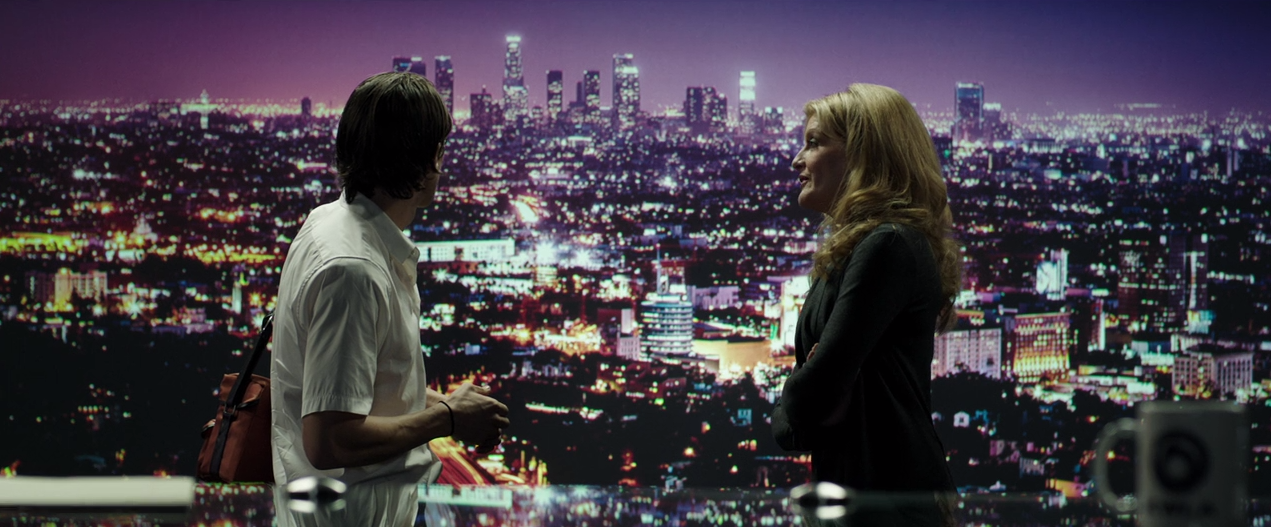
Lastly, there is cinematographer Robert Elswit's (There Will Be Blood) sublimely photographed setting: the city of Los Angeles. Nightcrawler is an exemplary "L.A. film," joining the ranks of such classics as Chinatown, Shampoo, Heat, Collateral, Short Cuts, and Boyz n the Hood in taking full advantage of the particular way L.A. sprawls around its various disparate neighborhoods, crisscrossed by freeways. It's a weird place (both geographically and vibe-wise) that I always enjoy seeing depicted poetically on screen. Nightcrawler captures its unique qualities about as well as any film I've seen.


Iconic L.A. images captured by cinematographer Robert Elswit for Nightcrawler. 

Yes, Nightcrawler is one of the finest thrillers and one of the sharpest satirical dark comedies I have seen in quite some time. Packed with uniformly great performances, a tight, compelling script, and haunting L.A. cinematography, it will surely loom large in my End-of-Year reflections.**

Kristen Wiig and Bill Hader in the touching, heartful dramedy The Skeleton Twins.

Set in an unspecified small town ("near Woodstock") in upstate New York, The Skeleton Twins is a film that, like Nightcrawler, I intended to see in the theater but ended up seeing on Netflix streaming. The movie is a somewhat dark yet ultimately heartwarming dramedy about an estranged twin brother and sister coming back into each other's lives after a ten-year hiatus.

The Skeleton Twins' dark side comes in part from its engagement with the topic of suicide. The film opens with Milo (Bill Hader) making a suicide attempt, and when that fails, the hospital calls his sister Maggie (Kristen Wiig) to come pick him up just as she is about to make an attempt on her own life the very same day. The film treats this remarkable coincidence with dark humor, yet it also reveals later in the proceedings that the twins' father successfully killed himself when they were young, adding dramatic weight to the suicide theme. Unraveling why both siblings find themselves so unhappy with their lives, and how and why they drifted apart from each other for ten years, becomes the film's raison d'etre.

Milo and Lance get to know each other, with mixed results. 

Part of the problem on Maggie's side is her inability to remain faithful to Lance, her upbeat, kindly, yet dimwitted husband (played to perfection by Luke Wilson, always my favorite of the two Wilson brothers). Lance wants to have children but Maggie doesn't, and rather than confront him him with this, she has flings behind his back. Meanwhile, Milo rekindles an old relationship that causes major problems for himself and reopens old wounds between he and Maggie. All of this conflict is so well scripted and performed, and the casting (including Ty Burrell as Milo's sexually conflicted old flame) so spot-on, that the film is simply a delight to watch. Both Wiig and Hader deliver nuanced characterizations that allow us to feel great empathy for these two lost souls even as we watch them make repeated mistakes. And the moments in which they laugh and get along together are very natural, believable, and warm.

Kristen Wiig delivers a downbeat yet empathetic and lived-in performance as Maggie. 

Ultimately, The Skeleton Twins is a carefully sketched portrait of strained yet loving sibling relations, and while the film's climactic episode may feel a wee bit contrived to some viewers, it is emotionally correct, and the film ends on a lovely note of reconciliation, as comedies should.

Plus, any movie with an unruly kid flipping adults the bird automatically gets my vote:

Cullen flips the bird. 

--
* I almost included a fourth film, Azazel Jacobs's Terri (2011), in this post, but despite its many delights and pleasures, that indie masterpiece is more offbeat and less plot-driven than any of the three I have included. I decided that it might be hard to recommend Terri to readers who don't enjoy meandering yet well-observed slice-of-life films about socially alienated weirdos quite as much as I do. You will be able to read my capsule review of Terri in this year's forthcoming End-of-Year Roundup.
** Here are links to my 2013 and 2014 End-of-Year Roundups. Yee-haw!

Saturday, September 12, 2015

EW #11: King Kong (1933)

King Kong.

As a lover of horror and monster movies, Merian C. Cooper and Ernest B. Schoedsack's masterpiece King Kong (1933) is one of my all-time favorite motion pictures.

Although there are a few silent monster movies that came before it (The Lost World [1925], The Golem [1920]), and although Universal Studios' 1931 Dracula rightfully takes principal credit for launching the horror film boom of the early Hollywood "talkie" era, Cooper and Schoedsack's King Kong nevertheless stands as the most popular and influential monster movie of all time. Even Ishiro Honda's brilliant Gojira (1954) owes a debt of influence to Kong's groundbreaking horror extravaganza. Fusing an action/adventure film with a terrifying "monster on the loose " rampage in New York City, King Kong sets the narrative template and production standard for all monster films ever made in the wake of its release.

To start with, Willis O'Brien's animation work on King Kong is enormously influential and quite magical. 1933's Kong (the creature) is still, for me, the most convincing one. As Entertainment Weekly's short blurb for their Top 100 Films List says, King Kong's "stop-motion effects retain every bit of their magic as Kong the giant gorilla awes, terrifies, and breaks your heart." I couldn't agree more. It is no coincidence that the EW writers and I both use the word "magic" to describe the monster effects in the 1933 Kong. This is an example of "movie magic" at its absolute creative and affective pinnacle.

Willis O'Brien's "performance" of Kong is an amazing feat of special effects artistry. 

Another reason why the 1933 Kong is so great is that it does not waste time. Its hallmark is narrative tightness, smooth flow, and excellent pacing. It runs a lean and mean 104 minutes in total (including a pre-credits musical overture). No subsequent version has really gained anything by being longer. Twenty-five minutes into the 1933 Kong, our protagonists have reached Skull Island and are preparing to go ashore. In Peter Jackson's overlong 2005 version, at twenty-five minutes Denham et. al. are still fucking around in New York City and the Venture hasn't even left the harbor yet. Yawn!

King Kong is also particularly effective (and historically significant) thanks to Max Steiner's innovative musical score. While the singular importance of King Kong's soundtrack has been disputed (or at least complicated) by some film historians (see Michael Slowik's superb article "Diegetic Withdrawal and Other Worlds" in Cinema Journal 53.1), it nevertheless marks a watershed moment during which the cinematic score came into its own in Hollywood.* Especially distinctive in Kong are the ceremonial drums our protagonists hear as they approach Skull Island, which signal to them that the supposedly uninhabited island is anything but. As film critic James Snead writes, those drums serve as a form of subtle (and influential) aural coding that clue us into the identity of the islanders: "Steiner's coding of blackness by 'the drum' founds (in the relatively youthful art of synchronized movie sound) a longstanding cinematic device" which will be used again and again whenever blacks -- especially 'native' ones -- hereafter appear in popular film.**

Mentioning those drums raises the biggest problem I have with King Kong. Like Gone with the Wind and so many other Hollywood classics, Kong is unabashedly racist, sexist, and imperialist. As Snead argues,
In all Hollywood film portrayals of blacks, the political is never far from the sexual, for it is both as a political and a sexual threat that the black skin appears onscreen. And nowhere is this more plainly to be seen than in King Kong. There are very few instances in the history of Hollywood cinema in which the color black has been writ so large and intruded so powerfully into the social plane of white normality.***
Kong's main threat, then, is a sexual one that is coded black. He stands in for the frightening black bogeyman/rapist that has haunted the white imagination for so much of its cultural history. Kong's abduction of Ann (Fay Wray) makes the stakes of King Kong clear: it is a struggle between white masculinity and black masculinity for the erotic possession of the white woman's body (and by extension her reproductive power). Spoiler: In all three versions of King Kong, as in the vast majority of Hollywood films, the white men win.

In case there was any question about the sexual dimension of Kong's obsession with Ann, the scene in which he half undresses her and sniffs his fingers after caressing her body should clarify this point. 

Protecting his highly prized white woman, King Kong pulverizes the shit out of a pterodactyl. 

What is colossally unfair about all this is that Denham (Robert Armstrong) deliberately provokes Kong's abduction of Ann. He brings her to the island with the express intention of placing her in mortal danger for the sake of his adventure film. Writing about the ending, and insisting that King Kong is ultimately "about the motives and effects of Carl Denham's deeds," Snead tells us that
The relationship between Ann and Jack survives only at the cost of an execution. The narrative pleasure of seeing the (white) male-female bond re-established at the end tends to screen out the full meaning of the final shot: the accidental (black) intruder lies bloody and dead on the ground, his epitaph given glibly by the very person [Denham] who has trapped him."† 
In essence, Denham stages a spectacular show in which Kong's kidnapping of Ann justifies white male retribution against the creature, who represents blackness. Thereby, the responsibility for Kong's capture and subsequent death is deflected back onto Kong himself, instead of being laid at Denham's feet where it belongs. This is a classic example of very effective "blame the victim" rhetoric.

Denham: "It was beauty killed the beast." LIAR!!

Denham's explicit role as a film director and cinematographer drives home King Kong's dominant thematic message: that we are all implicated in his visual colonization, capture, and killing of Skull Island's most noteworthy black denizen. As Snead puts it,  
[it is difficult to resist] our gradual implication in Denham's optical colonialism. Even a viewer repulsed by Denham's many negative qualities would have difficulty resisting the pull of his powerful voyeurism [. . .]. The political ideology of the film soon becomes inextricable from the pleasure we take in the very act of seeing.  The power of staging a 'show' (watching a 'girl' scream or 'natives' dancing) is no longer Denham's alone. King Kong, by a rather devious movement, makes us cheer him on. ††
Carl Denham, visual colonizer, capturer, and killer of black bodies.

All that said, if we disqualified racist films from EW's list, it would contain practically no films at all. We live in a structurally racist and sexist society, and so of course our popular media reflect that back to us, both in the historical past and in the present day. King Kong stands as an example of both Hollywood's ubiquitous pro-white-maleness and as a singular apex of its ability to produce narrative, cinematographic, musical, and special effects artistry. Kong is a terrifically fun film and, despite its ideological shortcomings, well deserving of its high placement on this "Top Films" list.


Bonus Afterthoughts: In my view, the 1933 version of King Kong is the best version by a long shot. For me, the versions get steadily worse as they go: the much-maligned 1976 version starring Jeff Bridges and Jessica Lange is second-best, and Peter Jackson's overlong, bombastic 2005 remake is the worst of the three. Having already extolled the many virtues of the original, let me briefly explain why I rank the 1976 version above Jackson's dull, over-inflated remake.

Jeff Bridges, Charles Grodin, and Jessica Lange in the 1976 remake of King Kong. 

First, let me confess to two biases regarding the 1976 Kong: (1) it is the first version of King Kong I ever saw, so doubtless it created a stronger impression on me than it would have if I had seen the superior 1933 version first, and (2) I am generally predisposed to like 1970s cinema (as, for example, my reviews of Nashville and The Fog should make abundantly clear).

One of the biggest complaints I've heard regarding the 1976 Kong is about the monster itself: rather than an animated creature, the 1976 version utilizes a man in a gorilla suit. Not only is this choice perceived as a failure of special effects innovation in general, the performance of that guy in a suit is considered to be unconvincing and not very gorilla-like. Indeed, the 1976 embodiment of Kong walks upright rather than hunched forward, making no real effort to conceal his very human gait and posture. Yet, despite my recognition of its cheapness, that guy in a gorilla suit actually works for me -- after all, King Kong is supposed to be a unique creature, "neither man nor beast," so why should he necessarily behave and move exactly as a real gorilla would? Maybe I was just too young and impressionable when I saw this version of the film, but the creature never struck me as unconvincing -- indeed, I always found him scary and, at times, quite sympathetic.

That brings me to one of the greatest triumphs of the 1976 Kong: its overtly environmental message. Perhaps unsurprisingly, the 1976 version is the most ideologically progressive version of King Kong. Bridges plays an animal rights hippie who sneaks aboard an oil company ship heading to Skull Island to exploit it. He spends the whole movie critiquing Fred Wilson (Grodin) and his corporation's motives in capturing and crassly exploiting King Kong. Most remarkable in the 1976 version is an extended set of scenes taking place on the ship's return voyage from the island for which there is no analogue in the 1933 or 2005 versions. This sequence depicts Kong entrapped and miserable in the cargo hold of the ship, generating unprecedented pathos for his unjust fate and heavily underscoring Kong's moral superiority to his captors.

The 1976 Kong may just be a guy in an ape suit, yet scenes like this one generate strong viewer sympathy for the unjustly incarcerated creature. 

This progressivism extends (somewhat) to the 1976 Kong's treatment of its indigenous Skull Island tribespeople. Bridges's anthropologist Driscoll says of them that "when we took Kong, we took their god." Sure, this is still a privileged white man speaking on behalf the indigenous "Other" whose point of view we never truly know, yet it is more voice or agency than the Skull Islanders get in any other version of the movie. In 1933 they are infantile idiots to be laughed at, and in 2005 they are murderous horror-film monsters to be reviled. Here, at least, their sufferings are acknowledged.

The 1976 Kong does run a bit long, 134 minutes in total. One especially feels this length in the film's third act, during the New York City sequences, which go on a wee bit longer than they need to. Yet the film does not drag nearly as badly as does Jackson's 2005 remake (187 mins long!), and at least it extends certain portions (as in the return voyage sequences just discussed) in order to bring fresh, new ideas to the table.

As for the 2005 version, Jackson gets the digital design of Kong just right, but then animates him very badly as he moves through cinematic space (scroll down to item #2 on this list). Despite some inspired casting (Naomi Watts and Jack Black are especially good) and a cool-looking gorilla (as long as he sits still), the film is just too long, too slow-paced, and too overstuffed with unnecessary crap that it diffuses any power the film might have over its viewer. 2005 Kong is a prime example of sloppy, over-indulgent filmmaking of the kind late-career Jackson seems to favor. It is boring. No thanks.

Rene Auberjonois sez: "You'd get better mileage filling up your Cadillac with mule piss!"

--
* Slowik's fascinating article works to complicate the idea that Max Steiner's Kong score single-handedly "paved the way for the Golden Age of film music (roughly 1935 to 1950)" (p. 1). Obviously, I highly recommend his article. For additional reading, Slowik offers some afterthoughts about his essay here and film composer David Allen offers historical and musical insights into the scores for both the 1933 and 2005 versions of Kong here.
** James Snead, White Screens, Black Images (Routledge, 1994) p. 19.
*** Snead p. 8.
† Snead pp. 16, 15.
†† Snead pp. 25-6.