Showing posts with label Pacific Rim. Show all posts

Wednesday, November 4, 2015

Review: Crimson Peak (2015)


Wow! Guillermo del Toro's Crimson Peak is one of the best films I've seen this year, deserving of placement alongside The Babadook and What We Do in the Shadows as one of the three best horror-themed releases I've seen recently.

I say "horror-themed" because Crimson Peak is really a gothic romance, just as Shadows is really a comedy-mockumentary despite some explicit gore and a few good scares. Peak is a creepy, supernaturally tinged family melodrama, so superior an example of the cinematic Gothic that it must be named alongside those other two standout films.*

Mia Wasikowska as Edith, the heroine of Crimson Peak.

Plot- and mood-wise, Crimson Peak is a lot like The Woman in Black (2012), only much much better. Peak is what Woman could have been if the latter film had trusted its story, actors, and creepy tone and relied less upon jump-scares accompanied by hamfisted musical stingers.

I am not completely against jump scares, but I do not like "horror" films that rely too extensively on the device. I especially dislike movies that emphasize and/or broadcast every scare with a heavy handed, too-on-the-nose musical cue of some kind. This is what Nigel Floyd and Mark Kermode call "cattle-prod cinema," and I find it dull, pointless, and nerve-wracking.

Nigel Floyd sez: "We like horror films that build up a sense of suspense that is built into the narrative."

No, give me instead what film scholar Daniel Martin calls "restrained horror," a subgenre consisting of films "more suggestive than graphic" that "treat their subject with utter seriousness, jettisoning the [overt] humor" that characterizes films like Scream.**

While the restrained horror films Martin talks about (like Ringu and The Blair Witch Project) are not exactly Gothic films like Crimson Peak, they may be close cousins. Both restrained horror and the Gothic prefer the slow burn over the easy scare. And the use of deliberate restraint to provoke sustained terror, what Nigel Floyd refers to as "cumulative dread" in the video, creates a tone central to the Gothic. As this excellent review explains,
part of what defines the gothic is how paradoxically trusting it is; it relies on audience familiarity for much of its atmosphere and emotional power. We know the girlish innocent will be terrified in the great dark house; we know the gentry are hiding a terrible secret; we know what happens when you unlock Bluebeard’s closet. The gothic isn’t a genre of surprises, it’s a genre of dread, and to dread something, you must first know what it is.
Of course, I would argue that all genres are "trusting" of their audiences and exploit our familiarity with certain tropes and traditions to generate pleasurable effects. But I agree that as an exemplary specimen of the Gothic, Crimson Peak marshals its generic conventions and intertextual references in order to cultivate dread, and that it does so brilliantly and effectively.

My girlfriend, an expert on the British Gothic, tells me that Crimson Peak falls into at least two related traditions. She calls the movie "Victorian gothic meets country house ghost story," a hybridization of elements from literary works including Mary Shelley's Frankenstein (1818), Wilkie Collins' The Woman in White (1859), Sir Arthur Conan Doyle's Hound of the Baskervilles (1902), Bram Stoker's Dracula (1897), Charlotte Bronte's Jane Eyre (1847), Edgar Allan Poe's "Fall of the House of Usher" (1839), and Jane Austen's Northanger Abbey (1817).***

Film-genre-wise, Crimson Peak belongs in a class of movie that includes The Others (2001), The Innocents (1961), The Shining (1980), and Rebecca (1940), as well as several film versions of the novels listed above. 

Crimson Peak's inquisitive detective-heroine Edith . . . 
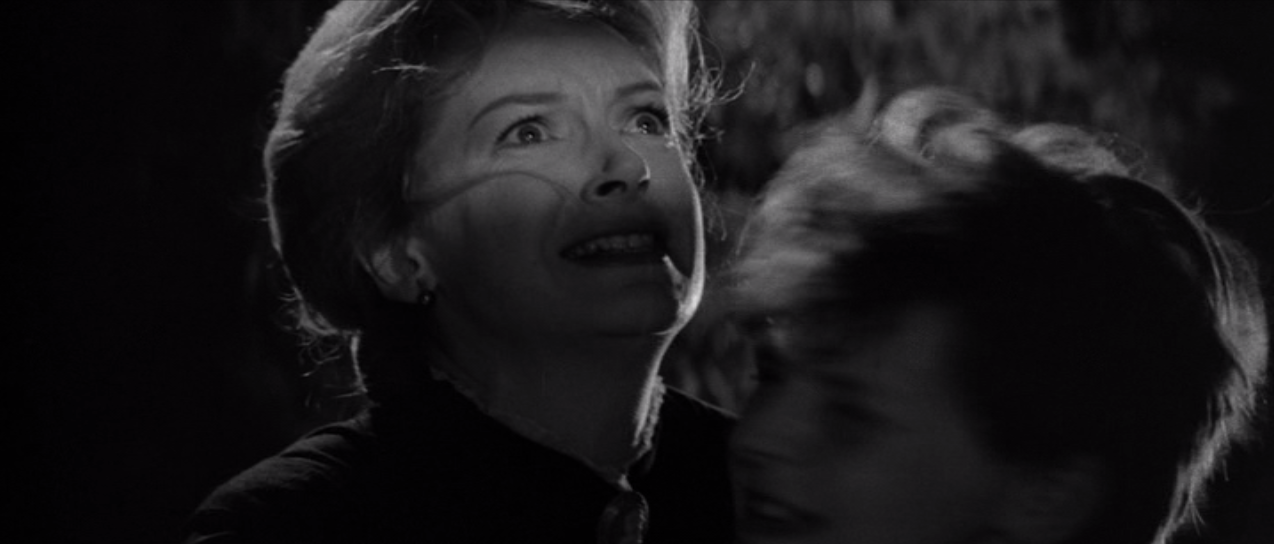
. . . is like Miss Giddens (Deborah Kerr) from The Innocents, one of the best gothic ghost-story movies you'll ever fuckin' see. 

Similarly, Peak's intense, enigmatic Lucille (Jessica Chastain) . . . 

. . . is a lot like Mrs. Danvers (Judith Anderson) from Hitchcock's Rebecca.  

I will not get into spoiler territory, but I must briefly mention Peak's breathtakingly lush sets and production design. The manor house to which Thomas takes Edith is an amazing feat of set design and construction. One of the most ingenious features of the house is a ragged hole in the roof that allows rain, mist, and snow to penetrate the very air of the main hall, enhancing the atmosphere of decay.†

The film's greatest visual achievement is probably its climactic snow scene, an amazing battle set among the various fixtures of Thomas' mining machinery. There isn't much graphic gore in Crimson Peak, but what violence occurs is brutal and believable, as this scene exemplifies.

And god, the performances. Mia Wasikowska is a particular favorite of mine, but all three principal cast members are superb here. I have never seen Tom Hiddleston, playing the mysterious pretty boy, do anything better. As I learned from this article, the original casting was going to be Benedict Cumberbatch as Thomas and Emma Stone as Edith. As I watched the film, I remembered this casting factoid and thanked the universe that the production instead landed Hiddleston and Wasikowska for these roles. And the supporting cast is great too, especially Charlie Hunnam as Alan and Jim Beaver as Edith's father.

This review sounds hazily disappointed that Crimson Peak isn't scarier, yet what does one expect from del Toro? Crimson Peak marks a return to the, well, peak works of the director's early career, the gothic masterpieces The Devil's Backbone (2001) and Pan's Labyrinth (2006).†† Maybe the more appropriate adjective to describe these films is unsettling -- yes, Crimson Peak is unsettling in a slow-burning, emotional, violent, twisted, and melodramatically satisfying way. Or, as AV Club's Genevieve Valentine puts it:
The film isn’t very scary, because it trades so carefully on scares we’ve come to expect. It isn’t very scary because its ghosts aren’t antagonists; they’re a manifestation of generational guilt, sure, but they aren’t here to haunt Edith—they’re here to save her. And the movie’s visual markers—so pristinely devoted to its ancestors in the opening acts—sidestep the ghosts altogether by the climax. Edith stands victorious in the snow, blood-red clay on her white hem and blood spattered across her gown. She’s closed the loop on the vampire narrative, all by herself.
All this plus amazing set design with lots of freaky red ooze. Definitely go see this movie.

Guillermo del Toro sez: "Okay guys, for this next take, both of you will be fully immersed in horrid red filth."

UPDATE 11/5/2015: As the last line of my closing Genevieve Valentine quotation suggests, Crimson Peak solves Dracula's "Mina problem." This past summer and fall, my girlfriend and I watched several film adaptations of Dracula, including F.W. Murnau's Nosferatu (1922), Tod Browning's Dracula (1931), Hammer Films' Horror of Dracula (1958), Werner Herzog's Nosferatu (1979), and even the "sexy" Dracula (1979) starring Frank Langella. One thing we noticed again and again is how every single film version of the tale sells out Mina, diminishing her role in what is, in the source novel, a victory brought about by her research, record-keeping, and diligence. In the novel, Mina is an investigator and a writer, like Crimson Peak's Edith. Yet no film version ever allows her to play that central a role, instead handing off the investigative and vampire-hunting functions to Van Helsing and/or Jonathan Harker.

The closest any film version comes to empowering Mina is Herzog's Nosferatu, in which she is the sole figure who recognizes Dracula's threat and takes steps to stop him. However, Herzog's film ends with Mina sacrificing herself to the vampire rather than destroying him through direct action. The movie ends with Harker, now a vampire himself, riding off across the plains in daylight, perhaps emphasizing the monstrously adaptable and therefore unstoppable nature of vampiric patriarchy but nevertheless doing the deceased Mina no favors.

While Werner Herzog's 1979 remake of Nosferatu ridicules the narrow-minded inefficacy of Harker and Van Helsing, positioning Mina as the only character who comprehends and takes action against the Count . . .

. . . it nevertheless kills Mina off, allowing Harker, himself now a vampire . . .

. . . to escape and presumably wreak havoc on the world. I read this as a critique of the relentless destructive power of patriarchy, yet the film makes this critique at the expense of its only significant female character's life.

As Valentine writes, "It’s notable that the blood-soaked ghosts of Crimson Peak are nearly all women, and all they ever do is communicate sins to help Edith avoid danger." Indeed, for Peak also tells the story of a battle between women for the love of a man. I am surprised I didn't think of this angle when I was initially writing this review because I am a feminist and I enjoy female-centered films. Yet there is so much going on in Crimson Peak from a genre perspective that I got lost in that aspect. I only later zeroed in on the "subversive," feminist implications of Edith's arc and the way in which the film "closes the loop on the vampire narrative" and solves the problem of Mina's longstanding cinematic defanging.

--
* Some of my readers may wonder why It Follows is not included in my brief list of top-notch horror of the past year. There is much pleasure to be had in It Follows, David Robert Mitchell's delightful retro homage to late-1970s and early-1980s horror. It Follows takes a Cronenbergian premise -- pretty much the same "sex-as-virus" metaphor that drives Shivers (1975) and Rabid (1977) -- and shoots and paces it like John Carpenter's Halloween (1978). Shot on location in Detroit, the movie has become something of a phenomenon in film-critical circles this year, earning the number two spot on AV Club's "The 25 Best horror films since 2000" list. I think it deserves all the acclaim it gets. It is a generally excellent horror film. But it just isn't as haunting, memorable, terrifying, or thematically audacious as, say, The Babadook or Crimson Peak. (In fairness, while film genius A.J. Snyder concurs with my feeling that It Follows is mainly "a collection of other people's ideas," this reviewer disagrees with me, arguing that "It Follows is no knockoff.")
** Daniel Martin, "Japan's Blair Witch: Restraint, Maturity, and Generic Canons in the British Critical Reception of Ring." Cinema Journal 48.3 (Spring 2009) pp. 39, 36.
*** The Jane Eyre connection is especially neat-o since Mia Wasikowska played the title role in a superb film version of Jane Eyre in 2011. And Peak's Dracula-ish vampiric themes take on additional resonance given that Tom Hiddleston starred in Only Lovers Left Alive in 2013.
† The sets, settings, and costumes are very important in a Gothic melodrama like this. One of the core concepts underpinning melodrama is that the emotions on display are too great to be captured in mere performances or words, so elements of the stetting including props, costumes, and nonverbal gestures do much of the symbolic work to convey meaning and feelings.
†† If I had to rank all the Guillermo del Toro films I've seen -- not easy since he moves between genres quite a bit -- then Pan's Labyrinth would surely be #1, and The Devil's Backbone would constitute a close second place. Next would be Crimson Peak, perhaps sharing the #3 spot with Hellboy (2004). Pacific Rim (2013) would be #4, and Hellboy II: The Golden Army (2008) #5. I have not yet seen his earlier films Cronos (1993) or Mimic (1997).

Saturday, July 5, 2014

Review: Snowpiercer (2014)


I saw Snowpiercer, South Korean director Bong Joon-ho's English-language debut, earlier this week, and was, as I expected to be, blown away. It is an epic, action-packed, beautifully made, perfectly paced blockbuster. Anyone who enjoys movies and has a stomach for some intense but not overly gratuitous violence will enjoy this film.

I have written before about how much I love Bong's work, and I knew going in that Snowpiercer was going to be well-shot, well-written, and -- most importantly -- character driven. In these areas the film does not disappoint. It is Bong's most grandiose, action-loaded, and spectacular film yet; it is much greater in scale than any of his previous films. For example, The Host (2006), whose action covers many areas across the city of Seoul, is still focused on the fate of one family in that one city.* By contrast, the train in Snowpiercer, despite its linear physical confinements, is literally global in scale: it traverses the world, its passengers encompassing all of surviving humankind. With its expanded, multinational cast and furious, frequently large-scale action sequences driving the plot relentlessly forward, Snowpiercer feels bigger and more kinetic than any previous Bong film. When we catch glimpses out the windows or pull back for a wide exterior shot, the titular huge train moves fast! 

I have previously outlined a schema for interpreting summer blockbusters:


According to this formula, I would place Snowpiercer in the "creative and complex" category, but only barely on the complex side of the line. That is, the film is visually unique and very creatively set-designed, costumed, and shot (i.e., "creative" on the vertical axis) yet actually adheres quite closely to the conventions of the action thriller and does not really allow its plot to twist overmuch -- there is a nice surprise or two near the end, but nothing too complex. No, the film actually earns its "(barely) complex" designation due to the way in which it reveals key plot and character information: slowly and gradually, in layers. The viewer is given certain visual or contextual clues early on, which pay off later when their full nature or importance is revealed. But the main thrust of the story and the action is made very clear from the get-go, and never wavers from its general course.**

This is one of Bong's great strengths as a filmmaker: his keen ability to know just how much to reveal and how much to withhold in order to keep his audience tantalizingly on the hook. Bong has always been good at this but Snowpiercer may constitute his most subtle and refined use of this technique yet. I will keep this review spoiler-free, but suffice to say that one of the best "reveals" in the whole film is a confessional speech made by protagonist Curtis (Chris Evans) just before the final climactic battle. What we learn about our "hero" and his relationships to some of the other key characters in that very effective (and affective) speech adds a whole new layer of complexity and pathos to all we've seen to that point, and brilliantly sets up what's at stake for the final showdown.

Along a similar line, since Snowpiercer is completely character-driven AND is deadly realistic in its depiction of the consequences of violence, there is much at stake here. Many characters perish during the course of this movie. Watching Snowpiercer made me realize that one of the biggest drawbacks of the current vogue for superhero blockbusters is that most superheroes cannot or do not die, so there is rarely a sense of mortal threat or the high stakes that come with risking one's life in those movies. Not so here. As in the Hunger Games films (which this one somewhat resembles tonally) characters we care about in Snowpiercer can and do meet terrible fates, and this only heightens the intensity of the action and our involvement in it. 

On top of all this, and most importantly, Snowpiercer is completely involving and entertaining the whole way through. Its running time is 126 minutes (actually fairly short by today's blockbuster standards) but it does not feel long or exhausting. I simply cannot recommend this movie highly enough, especially right now while it's still in theaters. If you enjoy dark, post-apocalyptic actioners like The Hunger Games films (2012 and 2013), The Book of Eli (2010), and Children of Men (2006), then you will surely find lots to enjoy in the tension-filled, visually stunning, and dramatically compelling Snowpiercer. ***

 Tilda Swinton plays one of the most interesting and creepy villains ever in Snowpiercer.

Bonus Afterthoughts: While the whole cast of Snowpiercer is quite good -- Chris Evans does a terrific job playing what could have been a very generic-feeling character in a way that makes us care without making him too vulnerable or sentimental, and Bong regulars Song Kang-ho and Ko Ah-sung are both excellent as well -- the real gem here is Tilda Swinton. She just blows her performance away, more or less stealing every single scene she's in. Her Mason is the best, most loathsome villain I have seen in a very long time; her performance alone is worth the price of admission. Also, in addition to several intertextual references to Bong's other films (especially The Host), watch for a very clever and subtle The Shining reference two-thirds of the way in.

Curtis sez: "Hey, I'm in a gold room!"

UPDATE 7/7/2014: A friend called my attention to this super-sharp review of Snowpiercer which not only calls the film "an exciting and well-constructed action movie, with more interesting characters and more legible cinematography than the chaotic visual gibberish of CGI and explosions that comprise most contemporary American blockbusters," but also claims that the film conveys a radical critique of capitalism -- a compelling argument I am inclined to agree with.

UPDATE 7/21/2014: Another friend of mine has written this smart review in which she claims, among other things, that "Snowpiercer is the first film I’ve seen since District 9 that takes the tropes of the blockbuster and transforms them into something so compelling that days after seeing it, you stop can’t thinking about it." Indeed!

UPDATE 8/4/2014: My friend A.J. has added his voice to the critical chorus in support of this great film. I urge you to check out his review, whose best line is: "Having recently been on a bus to Brooklyn, NY, I applaud Snowpiercer's attempt to resonate with just how diverse the world of long-distance public transportation really is." Bravo!

UPDATE 8/5/2014: Here is a link to a terrific, well-produced video offering a smart interpretation of Snowpiercer.

--
* Note that Bong's The Host is about a mutant monster who emerges out of the Han River in downtown Seoul and starts eating people, NOT to be confused with the recent U.S.-produced YA film of the same name.
** In this aspect -- the straightforwardness of its plot and the clarity of what's at stake -- Snowpiercer is a lot like last year's Pacific Rim, which I also enjoyed a great deal. The main difference between the two movies is that Snowpiercer's characters are more developed and therefore the stakes are higher when things happen to them. And Bong is probably a more artful and innovative visual stylist than Guillermo del Toro, though the latter is no slouch in these areas himself. I should add that the narrative economy and coherence of both these films -- their strict adherence to the conventions of cause-and-effect, setup and payoff -- place them both firmly in the blockbuster tradition that includes Steven Spielberg and owes a great pre-blockbuster-era debt to the work of Alfred Hitchcock.
*** One of my film-viewing friends also mentioned The Fifth Element during our post-Snowpiercer discussion, and while Besson's distinctive 1997 film is lighter in tone and more generally gonzo than Snowpiercer, I think this is an apt comparison. Another friend name-dropped Pandorum (2009) as being broadly similar in plot but said the latter film is far inferior to Bong's action masterpiece.

Saturday, June 21, 2014

Review: Godzilla (2014)


The recent remake of Godzilla is what I call a "noble failure." It tries hard to achieve many interesting things both visually and thematically, but it fails because it just isn't very entertaining or fun or, ultimately, coherent. To be clear, I (mostly) really enjoyed the film as it was unfolding before my eyes, and must state right away that I thought it was quite visually stunning. The MUTO attack at the foggy railroad trestle was one of the best paced and best looking scenes in this film or any action film I have seen in quite some time. The final showdown in San Francisco was beautifully lit and photographed, and most of the scenes of Godzilla -- even though they were too few and far between -- looked frikkin' awesome.

But the film is nevertheless a failure, if a noble one. It failings mainly stem from:

(1) Taking itself too seriously,

(2) Committing some of the worst characterization and character-arc blunders I have seen since The Dark Knight Rises, and

(3) Trying to do too much thematically (or at least not doing it clearly enough).

Going in, I gave this film a lot of benefit of the doubt due to the excellence of director Gareth Edwards' previous feature, the superb Monsters (2010). While I am not a rabid Godzilla fan in the holistic sense, I am a huge fan of the original 1954 Gojira and I have seen and enjoyed my share of other related films such as Rodan (1956), Mothra vs. Godzilla (1964), Gamera (1965), Godzilla vs. Hedorah (1971), Godzilla 1985, Godzilla Against Mechagodzilla (2002), and Roland Emmerich's 1998 "Godzilla" film. But most of my hopes walking into the 2014 Godzilla were pinned on Edwards, and at least in the visual sense, he did not disappoint.

Yet as Lee Weston Sabo puts it, the very skills which served Edwards so well on the low-budget Monsters were misapplied here, creating a distracting "identity crisis" at Godzilla's core:
Oddly enough, [Edwards] used the same techniques he used in Monsters to hide the poor CGI (which he reportedly did on his laptop) to hide the monsters in Godzilla, even though the budget was two hundred times larger, resulting in a lavish Hollywood production that is often obscured from view. Most distracting is a recurring motif where the monsters are shown on a television screen rather than in the flesh. The movie is so embarrassed by its giant monsters that it has to constantly show them on the news to make it seem real.
Agreed. Yet even these errors in judgment might not have seemed so egregious had it not been for the profound mistakes made simultaneously in the character department. Why on earth this film kills off Joe Brody (played compellingly by Bryan Cranston) a third of the way in is one of the most baffling decisions I've seen made in any film -- it is as bad and distracting a decision as the numerous similarly terrible choices made in The Dark Knight Rises.* Furthermore, once the film murders its best character and most logical candidate for protagonist, it subsequently utterly wastes the talents of Ken Watanabe as Dr. Serizawa, who, as the namesake of the original Gojira's protagonist, seemed to me the next best choice to step up and take the reins in Joe's deeply felt absence. But no, Serizawa stands around pointlessly while the straight-laced Admiral Stenz and Joe's boring son Ford get all the best lines and scenes.

Why, oh why, does the (potentially) interesting character on the left do nothing this whole movie while the boring character on the right is narratively centralized?

And, as Sabo points out, Ford's role in Godzilla is unmotivated and pointless: "there is no functional reason Dr. Brody could not have been the hero of the film – and, by extension, no reason why Ford Brody needed to exist as a character at all (for instance, even though he’s established as a bomb disposal expert in a plot that surrounds several nuclear bombs, it never actually comes into play)." So even though the main point in a monster movie is to enjoy the monster battles, Godzilla commits a dual sin by depriving us of the monsters AND providing us with a horribly lackluster, "droopy" human plot, as even this mostly positive review of the film admits.

Thus, despite its stunningly impressive visuals, the main problem with Edwards' take on Godzilla is its lack of compelling characters and its over-serious tone. To be fair, these problems are endemic to many contemporary blockbusters, as I have discussed before. In an Entertainment Geekly blog post titled "A Call for an End to Serious Blockbusters," Darren Franich writes that the new Godzilla film is disappointing precisely because it is "so, so serious. Aaron Taylor-Johnson’s mom dies and his dad dies and his wife is a nurse and his son misses his daddy. Godzilla is probably the first movie to not even have fun when it destroys Vegas."

Franich is well aware that this serious, boring, "dark" tone is not unique to Edwards' Godzilla but is a general trend in contemporary Hollywood filmmaking -- he writes that
this whole vogue for seriousness has become a tic: For the filmmakers, but also for the studios, for the marketing teams, for the whole apparatus behind Hollywood blockbusters. And for us, the audience, too. There’s a tendency to throw this seriousness on Christopher Nolan’s doorstep, but mainstream geekstuff was turning in that direction long before Batman Begins. You could start with Bryan Singer’s moody X-Men. Or you could point to Peter Jackson’s decision to de-Bombadilize Lord of the Rings. Maybe it’s George Lucas’ fault, devolving Star Wars from a fun-times space adventure to a mopey-faced parliamentary melodrama.
In any case, Franich bemoans this trend (in a very smart article I encourage you to read in full) and names Pacific Rim as a positive counter-example to this tendency, a view I wholeheartedly agree with.

Pacific Rim vs. Godzilla = fun vs. serious. 
As Darren Franich writes, "Godzilla wants so badly to make sense. 
Pacific Rim wants so badly for Ron Perlman to wear golden shoes."

Thematically, the new Godzilla appears to want to re-engage with the 1954 original's indictment of nuclear weapons, but seems confused about what its actual stance on this issue might be.** Is the 2014 version pro-nuclear or anti-nuclear? It is hard to tell. The film does not endorse Admiral Stenz's ruthless approach to detonating nukes in the San Francisco Bay, yet it is pro-military and does not seem all that troubled by the existence of nuclear weapons in general. Sabo labels this ideological muddle "a vague commentary on environmentalism" that ultimately means very little in the context of the film. And despite Robin L. Murray's contention that the film "provides a space in which to explore the complexities of a monstrous nature humanity both creates and embodies," conveying the message that "monstrous nature may also save us," I must agree with Sabo that the film carries self-contradictory and confusing messages along this line.

All that said, I look forward to Edwards' next attempt at the franchise -- he is currently contracted to direct Godzilla 2 and Godzilla 3 -- and hope he and his team will learn some valuable lessons from the mixed critical response to the 2014 Godzilla. If he can bring a bit more zip and fun to the next installment, if he can build upon his accomplished visual style to get us more invested in both his human and non-human protagonists, then he might overcome this noble failure and make the potential-laden Godzilla franchise so much better.

Bonus Afterthought: Though I understand why Godzilla purists despise it, I am not a hater of the Roland Emmerich Godzilla and am inclined to agree with Gabe Toro's claim that the much-maligned 1998 version is at least a rip-roaring good time.***

"Don't I seem more fun now, in retrospect?"

--
* That is, the utter pointlessness of Matthew Modine's character, the severe, plot-crippling under-development of Talia al Ghul, and the totally disastrous decision to have Michael Caine's Alfred, the only remotely believable and relatable human being to appear in the entire Dark Knight trilogy, vanish for the bulk of the film's run time.
** Sabo calls the 1954 original "ham-fisted" and criticizes its "audacity and crudity [in] trying to seriously represent the horror of Hiroshima and Nagasaki with a man stomping around in a rubber dinosaur suit." Yet I find that audacity somewhat admirable and compelling, and would add that the dark, gloomy tone of the 1954 version helps its theme to "land" with me despite the film's exploitative dimensions.
*** Anyone interested in reading a more detailed discussion of the merits of Emmerich's 1998 version should read this Vanity Fair piece, which makes the bold claim that "if you love the 90s, you pretty much have to love 90s Godzilla."

Saturday, July 13, 2013

Pacific Rim = A Great Blockbuster

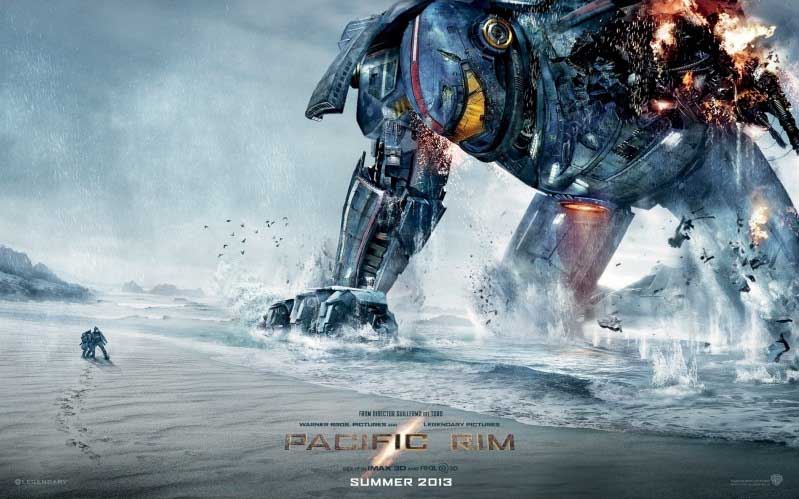
As the sense of scale here should make clear, Guillermo del Toro's 
superb blockbuster Pacific Rim is a film you should see in the theater.

I just saw Guillermo del Toro's Pacific Rim last night, and declare it to be one of the two or three best, most enjoyable blockbusters I've seen in the past two years. It is pretty much flawless, in terms of what I want out of a big summer popcorn movie: it is unpretentious, it delivers what it promises, and it even springs a few great surprises I didn't see coming. Most importantly, it is:

(1) Fun, and

(2) Visually stunning.

We mustn't underestimate the power of #1 up there, because my single biggest complaint about many recent blockbusters, particularly those of the Christopher Nolan stripe, is that they take themselves way too goddamn seriously. They get so bogged down in being "gritty" or "dark" or "serious" that they just aren't any fun anymore. This is why, for me, I rate Joss Whedon's The Avengers and Sam Mendes' Skyfall (both 2012) very highly among recent summer blockbusters, but have not yet been motivated to see this year's Man of Steel. To be fair, even without having seen it I would expect Zack Snyder's Superman movie to fulfill my criterion #2 -- I am sure it is visually stunning -- but personally I just have no interest in seeing a "gritty" or "realistic" Superman movie, especially one scripted by David S. Goyer, who I think is an extremely sloppy and inept screenwriter.

But I digress. What makes Pacific Rim so enjoyable and effective? Well, in order to let you know where I'm coming from, let's consult a chart and define a few terms:


First, complex vs. simple: complex plots twist and turn and rely upon narrative "reveals" or big surprises for their tension. Nolan's films are notoriously complex (some would even say convoluted) and I place Star Trek: The Motion Picture in here as another example of this trend.* The Trek film is quite heady and relies upon a mystery that is slowly revealed to the audience: what the hell is "V-ger" and what is it up to? As in Nolan's films, we (the audience) do not know the answer until/as the protagonists gradually figure it out. Die Hard is the same way: Hans Gruber's plan involves layer upon layer of embedded complexity, and not until very near the end do we understand the full scope of it. Sure, as genre films we know generally how these movies will end -- i.e., the good guys will win -- but we are not totally sure how they will win. Major salient facts are withheld along the way.

By contrast, simple blockbusters are those that make pretty clear from the get-go what is at stake; the plots do not depend upon mystery or surprise quite so much. Films like The Avengers and Pacific Rim are of this stripe: there is some major bad guy who needs to be clobbered, but the exact nature of his plans are not really all that important -- usually they can be summed up as "wants to end / rule the world." In Pacific Rim, we know what the film's climax will be about ten or twenty minutes into the movie: Marshal Pentecost (Idris Elba) tells us what the big mission is going to be, and the rest of the film involves our team of heroes fighting defensive battles until their moment arrives to execute that plan. There are a few minor twists but they do not sway us from (or materially change the circumstances of) that Big Battle scheduled for the end of the picture.

Now to the other axis. By "creative" I do not mean complex plots, but rather a visual style and/or tone that differentiates the film from other blockbusters of its type. I guess I mean authorial stamp to some extent, but remember that I am NOT talking about totally violating or hybridizing a genre either, just playing within a genre in a way that makes it appear fresh, e.g. Tim Burton's use of gothic sets and a carnivalesque tone for his two Batman films in 1989 and 1992. Nolan's recent films are also "creative" in this sense, he being the director widely credited with bringing a "gritty," "dark" tone to superhero blockbusters.

"Generic" means films that adhere more closely to the established parameters of their genre, with less evident authorial flourishes or deviations in tone or visual aesthetics.

Please note that I do not privilege "creative" over "generic" -- I have great admiration for films that hew closely to genre conventions but still make the viewing experience exciting. In fact, one of my favorite recent blockbusters, The Avengers, is extremely conventional with respect to plot and other conventions of superhero films, but it does its thing with such witty panache and delightful character interactions that it is completely successful even though it is visually and structurally unremarkable.

"We may not be complicated, but we're fun!"

In his rather scathing review of Pacific Rim, Buffalo-area author and filmmaker Greg Lamberson writes that "there is no real climactic fight that tops everything that came before it, but a corny finale that's telegraphed as soon as Elba comes on screen. Epic fail." However, as I argue above, Pacific Rim's ending is not an epic fail -- though perhaps it fails to be epic -- but rather is exactly what the film promises to deliver given its setup. I for one am rather tired of the notion that the final battle in a blockbuster has to be "bigger" or "more epic" than anything that came before -- I just want it to dramatically resolve the plot of the film. Epicness is overrated.**

Lamberson also states that "not one single character is interesting." Though I disagree with this, I think that in broad strokes it is an accurate statement if not a reasonable one, by which I mean that I would not personally expect del Toro to fully round out his characters and complicate his plots when making a superhero movie like Hellboy or a big summer action blockbuster like Pacific Rim. The generic ground rules and audience expectations here are totally different from those we would expect from artsy psychological thrillers like The Devil's Backbone and Pan's Labyrinth. And frankly, I enjoyed Pacific Rim's characters even though, like Lamberson, I did not find them to be psychologically complex. How many blockbuster protagonists truly are? None that I can think of.

Nevertheless, I accept as a valid critique the notion that some of the key characters in Pacific Rim are not well-rounded enough. Again, I think this is a function of the type of movie it is -- a "simple" blockbuster -- and this factor did not strike me as a major deficiency as I watched the film, yet I admit that would like to know more about the world in which Pacific Rim is set. Maybe, if we are fortunate, we will get a sequel and / or a prequel, as this reviewer suggests.

All that said, I agree with Lamberson that del Toro has set a very high bar for himself with his early films -- I love them a lot and would argue that Pan's Labyrinth definitely belongs on Entertainment Weekly's "100 All-Time Greatest Films" list. But my expectations for Pacific Rim were not directly informed by del Toro's amazing earlier works, except in one specific sense: I assumed the film would be a visual knockout, which it is. The world of Pacific Rim feels very lived-in and "real." With a great many scenes shot at night, Pacific Rim is visually evocative of Blade Runner or Hellboy II, and I love it for its noir-inspired cinematic richness.

Yet despite its dark lighting and post-apocalyptic mise-en-scene, the film's general tone is light, peppy, and fun. I appreciate this very much. While I TOTALLY agree with Lamberson's sentiment that in general, blockbusters these days are running way too long, Pacific Rim never dragged for me the way the second two Lord of the Rings films or the third Nolan Batman film did. Sure, there isn't much laugh-out-loud humor or witty inter-character verbal sparring as in The Avengers, but Pacific Rim does feature a few really fantastic visual gags -- my personal favorite of which involves one of these:


In his own lukewarm review, Entertainment Weekly's Chris Nashawaty says of Pacific Rim that "del Toro's monsters are so big, and shot in such unrelenting rainy darkness, that the audience never gets a chance to dissect and fetishize their monstrous anatomies and be swept away by their weirdness." Reading that, I think Nashawaty must have seen a different movie than I did.*** I felt like the film moved pretty quickly from set piece to set piece, spending most of its running time on those spectacular monster battles -- in sum, the film does not skimp at all on mind-blowing, beautifully choreographed and well-shot action sequences. And for that reason alone, I urge my readers to strongly consider seeing Pacific Rim while it is in theaters. It may not be perfect, and it obviously does not "hit the spot" for every (re-)viewer the way it does for me, but it is well worth your time to check out, as del Toro is head and shoulders above most other blockbuster directors in terms of the lushness and lived-in "reality" of his visual style.

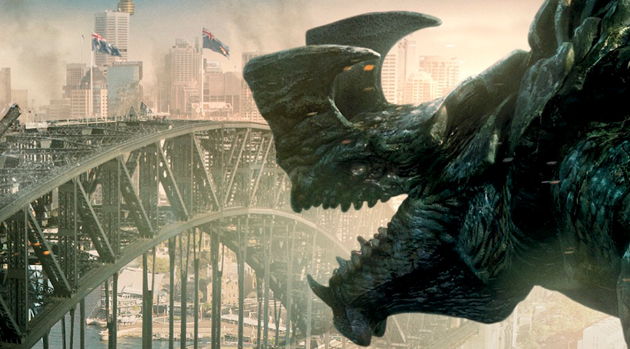
The kaiju sez: "Come see my movie or I'll crush your civilization!"

UPDATE 10/14/2014: British critic Mark Kermode agrees with me and has some very smart things to say about what makes Pacific Rim great in the linked video.

--
* I realize that this is a bit of a cheat on several levels. For one, Star Trek: The Motion Picture was not released in summer, but December; also, it is not an "action" film, as summer blockbusters, by definition, are. Yet it is a big-budget picture that was released "wide" in an attempt to cash in on the popularity of Star Wars, so I include it here as a representative of some of the trends I am attempting to illustrate.
** For a cheeky yet accurate discussion of this "epicness" problem in contemporary blockbusters, check out this video review of Man of Steel, especially the part near the end where the reviewers discuss the difference between Snyder's film and Superman II (1980).
*** UPDATE: Since writing this review I came across this article about possible Pacific Rim sequel ideas which includes this illuminating (ha, ha) comment: "My main issue with the dark visuals of Pacific Rim are probably the fault of the 3D projection at my cinema more than the cinematography." This may indeed explain a lot, including Nashawaty's review, assuming he saw the picture in 3D, which notoriously darkens the image. By contrast, I saw the film in 2D -- wearing 3D glasses always gives me headaches.