Showing posts with label Christopher Nolan. Show all posts

Thursday, December 1, 2016

"The Dark Knight" as Neoconservative War Propaganda

What follows is a transcript of a talk I gave in March 2010. In it, I argue that Christopher Nolan's 2008 blockbuster The Dark Knight is a form of mass-media pro-"War on Terror" propaganda, particularly in how it uses the tropes of melodrama to move audiences to sympathize with its vigilante hero. Since this was a live talk, it is somewhat unpolished -- even a bit melodramatic -- but the ideas are accurate and I stand by them.*

Christopher Nolan’s The Dark Knight (2008) as Neoconservative War Propaganda

Christopher Nolan’s hugely successful blockbuster The Dark Knight (2008) deploys the imagery and rhetoric of the War on Terror melodramatically in order to emotionally justify the actions and ideologies of the Bush Administration post-9/11.  As Linda Williams argues, melodrama is best understood as an American cinematic mode rather than a genre, since its conventions can be found in nearly every genre of American film and in American public discourse writ large: “[The] basic vernacular of American moving pictures [and culture] consists of a story that generates sympathy for a hero who is also a victim and that leads to a climax that permits the audience, and usually other characters, to recognize that character’s moral value.” The Dark Knight is a melodrama dressed up as a superhero action film, communicating the moral value of its titular hero through his prolonged status as a victim.**

Batman is well-suited to this task, since his back story is itself couched in family melodrama -- innocent parents killed by a cold-blooded criminal, traumatized orphan son left to fend for himself -- which, according to melodramatic logic, justifies his adult vigilantism: as Jonathan Lethem puts it, "Batman’s losing his parents to violent crime forever renews his revenger’s passport." Further, as Will Brooker has documented, Batman is a shifting cultural signifier that takes on different meanings at different historical moments: a fighter of Nazis during WWII, a pop art/camp icon in the 1960s, a dark vigilante since the late 1980s.† The Dark Knight obviously plays upon this latter iteration of the character, emphasizing Batman's angst-ridden suffering as Gotham's protector and thereby valorizing his existence and deeds, which include unethical anti-terrorist practices such as lack of public accountability, violent torture, and widespread surveillance of U.S. citizens.

As I will demonstrate, by concluding with and melodramatically emphasizing scenes of Batman’s unjust persecution as a criminal by an ignorant yet morally indignant public, The Dark Knight ultimately apologizes for the deeds of George W. Bush, downplaying the importance of public dissent and generating viewer sympathy for the pain and struggles of a right-wing vigilante who gets the job done at all costs. Despite a few key scenes in which Batman’s morality is briefly called into question, and its strong suggestion that Batman and the Joker are far more alike than they are different, the film ultimately undermines legitimate critiques of the War on Terror by foregrounding that, in the face of “agents of chaos” like the disturbingly apoliticized Joker and the easily corruptible Harvey Dent, we need “silent protectors” like Batman who will save us even when we may feel uneasy about their tactics. 

Many critics and academics agree that The Dark Knight has strong neoconservative themes, depicting torture, vigilantism, and violation of international law as the price Batman pays for bringing justice to Gotham city, but few commentators agree on the exact implications of how those timely themes play out in the film. Was the film a critique of those ideas, a neutral meditation on them, or, as I felt in my gut each time I walked out of the theater, an endorsement of them?

Of all the published responses to The Dark Knight I read, the most clarifying was a September 2008 Op-Ed piece in the New York Times by fiction writer Jonathan Lethem, who comments that "a morbid incoherence was the movie’s real takeaway, chaotic form its ultimate content." Lethem sees the film as having no particular argument or cohesive "endorsement" at all, but rather as a "cognitively dissonant milkshake of rage, fear and, finally, absolving confusion." The fact that Lethem uses terms like these -- rage, fear, absolving confusion -- to pinpoint the nature of the film's lasting impact reminds us that this film, like all mainstream blockbusters and the majority of American public discourse, is first and foremost a melodrama, intent upon activating viewer emotions regardless of the logic or illogic of its narrative claims.†† Lethem's "absolving confusion" refers to the excessive, victimized catharsis of melodrama. Reading Lethem's piece I became convinced that trying to make sense of Nolan's film made no sense -- unless I approached it from the point of view of analyzing its emotional impact on audiences, highlighting its use of melodramatic tropes to generate viewer sympathy for its suffering protagonists and their causes.

Film scholar Linda Williams’ explanation of the melodramatic mode is crucial to analyzing the cultural logic of melodrama and its ubiquity in American popular and public culture. As Williams argues in "Melodrama Revised," melodrama is best understood as a mode or loose collection of tropes rather than a specific literary or filmic genre, though it has strong historical ties to sentimental fiction like Uncle Tom's Cabin and women's films (or "weepies") like Stella Dallas (1925, 1937) and Terms of Endearment (1983). As Williams explains, “the mode of melodrama [. . .]  [moves] us to pathos for protagonists beset by forces more powerful than they and who are perceived as victims” (42). This set of structures -- heightened pathos, clear oppositions between good and evil by which we are made to identify and empathize with a suffering victim, and thus to yearn for narrative closure via the defeat of the victim's oppressor(s), is common to all genres of American film and, as Williams argues, to American popular narratives writ large. As she states, “melodrama has always mattered and continues to matter in American culture [. . .]  the sexual, racial, and gender problems of American history have found their most powerful expression in melodrama” (82).

One has only to give a cursory look at the post-9/11 rhetoric of the Bush Administration to see these principles at work. The televised footage of the attacks and their aftermath showed the American public images of suffering families of World Trade Center victims, aided by heroic (and also suffering) New York firemen, all beset by faceless, evil terrorists whose motives were seemingly incomprehensible to us. Melodrama activates the emotions as a means to arouse moral indignation over the plight of its suffering victims. In the case of 9/11, the heightened feelings of righteous victimhood generated by the melodramatic narratives peddled by mainstream news and the Bush Administration were used to foment acceptance of the Iraq War and to foreclose nuanced analysis of the root causes of the actions and political views of the real-life "terrorists."

We can see a similar deployment of melodramatic tropes in The Dark Knight, particularly in two key montage sequences that strive for maximum emotional impact via juxtaposition of music, image, and pathos-laden speeches delivered in voice-over. Note that the montage has long been used to express emotional states and arouse emotional responses: e.g., the "falling in love" montage or the "preparing for climactic battle or contest" montage. Music, usually present in montage sequences, is the melos of melodrama and plays a significant role in influencing viewer sympathies, as we shall see. Through close analysis of these short montage sequences, I will demonstrate how The Dark Knight uses melodramatic conventions to arouse viewer emotions at key moments in its story, which is ultimately structured as a domestic melodrama centered upon the suffering Gordon family and their need for protection against unquestionably evil "terrorists" like the Joker and Two-Face. I argue that the film's emotional focus and final sequence attempt to respond to the question: What kind of hero or protector does Jim Gordon's family need? The answer, of course, is Batman.

The first sequence I want to analyze, just to lay the groundwork for my melodramatic interpretation of the film's ending, is the one in which images of Batman mourning over the crater of a destroyed building (an obvious reference to Ground Zero) are accompanied by a "Dear John" letter to Bruce Wayne read in voice-over by the now-dead Rachel. Note that this sequence is preceded by a quintessentially melodramatic "nick of time" chase sequence, wherein the Joker places two victims in two separate locales with two separate ticking time bombs -- a variant on the classic damsel in distress setup germane to the earliest theatrical and cinematic melodramas.


CLIP: "BURNED DOWN" SEQUENCE (DVD Ch. 25, 1:36:48 - 1:37:54)

The death of Rachel and fall of Dent = unconsummated love, the "too little too late" of melodrama. The two bombs scene even includes a classically melodramatic last-minute confession of love from Rachel. This was the "proper" marriage that could have symbolically restored order to Gotham -- its "white knight" fulfilling his domestic / romantic goals. Of course, this same theme of suffering over lost opportunities applies to Bruce Wayne / Batman, and even more so, since he not only loved Rachel but could have done something to stop Rachel's death, but fails. In the "Burned Down" montage sequence, Batman's failure to stop the bombs in time is rendered in extremely personal terms -- he loved Rachel and is getting a classic "Dear Bruce" rejection letter, and also considered the now-disfigured Harvey his friend. Yet Bruce/Batman's personal suffering and grief are powerfully linked to the destruction of the building itself and the public efforts of the firefighters -- an obvious echo of post-9/11 images of the area around the WTC. Batman's grief is not just over his personal relations but his failure to protect Gotham City, and the deep bass drone of the music, suggestive of a dirge, accompanied by the late Rachel's voice reading the letter, connotes tragic loss, and heightens viewer sympathy for Batman, who suffers horribly (note his bowed posture in the montage) for his perceived failure to thwart the Joker's plans.

Now to move to the film's concluding montage, which unfolds to a voice over by Jim Gordon, recently returned from the "dead" after faking his death in order not to "risk my family's safety."  [Note that Gordon's wife has two lines in whole film but we see her weep plenty.] Indeed it is Gordon's family that takes center stage in the final act of The Dark Knight. The now homicidally insane Harvey Dent takes his revenge on Gordon's family, kidnapping and threatening to kill James Gordon Jr. (Nathan Gamble). Like Rachel, Gordon (and his family) directly suffers at the hands of a madman -- until luckily Batman shows up in time to save Gordon's son and defeat Dent. Immediately following this rescue, Gordon delivers the film's final soliloquy, which is framed as an explanation to his now-safe son about why Batman is necessary.


CLIP (start at 01:11): "DARK KNIGHT" SEQUENCE (DVD Ch. 38, 2:22:23 - 2:23:24)

Whatever questions the film may fleetingly raise about the morality of Batman's actions are swept away -- at least in the emotional register -- by the tenor of this closing sequence. Viewers like me, who are used to maintaining a certain critical distance even when we are to some extent being swept in by the film's emotional siren song, may still feel uneasiness at a moment like this. We may not respond in the exact way the film seems to want us to. Nevertheless, at the formal level, the last few minutes of The Dark Knight are a rousing battle cry to forgive and forget the specifics of what Batman has done, and to feel deep sympathy for this noble, suffering loner who agrees to be persecuted in order to maintain the facade that Harvey Dent was a good man. He and Gordon conspire to lie to the public to keep them safe, and this closing sequence diverts our attention from the political implications of these deeds and instead frames the issue in terms of lone white heroes doing what must be done to keep our children and families safe. That is melodrama: The Dark Knight’s conclusion celebrates Batman’s actions and melodramatically restores him to a place of heroism via his internal suffering and public victimhood.

It is on these grounds that I conclude that The Dark Knight is neoconservative war propaganda, for like all the most effective propaganda, its most potent sequences directly trigger the emotions without necessarily arousing too much critical thought -- perhaps even confounding some forms of critical analysis due to their seemingly deliberate obtuseness. As Lethem concludes, "In its narrative gaps, its false depths leading nowhere in particular, its bogus grief over stakeless destruction and faked death, “The Dark Knight” echoes a civil discourse strained to helplessness by panic, overreaction and cultivated grievance" (2). Like me, Lethem fears the power of melodramatic tropes to overwhelm viewer emotions at the expense of critical analysis and further discussion. He fears the "helplessness" of a public used to being swayed by gut feelings, used to knowing who the good guys and bad guys are, and used to accepting melodramatic self-sacrifice as a barometer of moral value. I fear these things and that is why I fear the overwhelming popularity of blockbusters like The Dark Knight, for it only affirms Slavoj Zizek's contention that "we feel free because we lack the very language to articulate our unfreedom.  [. . .]  [All] the main terms we use to designate the present conflict -- 'war on terrorism', 'democracy and freedom', 'human rights', and so on -- are false terms, mystifying our perception of the situation instead of allowing us to think it."‡ Think it, no. But feel it, yes.

--
* When I give live presentations I am a big improviser and digresser -- I feel that a certain amount of unplanned, spontaneous side talk helps me keep things lively and engaging for everyone. Therefore my written talks usually contain rough, bullet-pointy sections for which I "fill in the blanks" in the moment. This is especially true for clip analysis -- sometimes I will chat a little over the clip, etc.
** Linda Williams, “Melodrama Revised.” Refiguring American Film Genres: History and Theory.  Ed. Nick Browne. U California Press, 1998. p. 58.
† Will Brooker,  Batman Unmasked: Analysing a Cultural Icon.  London: Continuum, 2000.
†† If indeed the Gotham City of Nolan's Dark Knight is a version of the "closed world" of melodrama, then Batman's Batpod flight past the camera at the end of the film parallels Stella Dallas' purposeful stride away from the site of her daughter's wedding or Julie's march off to the yellow fever camp at the end of Jezebel. It is an act of self-sacrifice that is meant (in the film's melodramatic logic) to ennoble the victim-protagonist. See Thomas Elsaesser, "Tales of Sound and Fury" in Imitations of Life (Ed. Marcia Landy, Wayne State UP, 1995) pp. 78-9.
‡ Zizek, Welcome to the Desert of the Real!  Five Essays on September 11 and Related Dates. Verso, 2002. p. 2.


Friday, November 11, 2016

Review: Doctor Strange (2016)


I saw Marvel's Doctor Strange last weekend. With its focus on magic, astral projection, and alternate dimensions, I figured it would be visually impressive and might deviate from the usual, standardized Marvel movie look and feel. On that front I was pleased; despite its obvious visual redundancies with Batman Begins and Inception, I basically enjoyed Doctor Strange, especially visually. However, I found its Euro-American imperialism and white-male-centeredness to be so bald-faced as to be, at times, unfavorably distracting.

This is not new news -- well in advance of Doctor Strange's release, many commentators expressed concern over the whitewashing of Doctor Strange's the Ancient One, that is, casting a white woman to play a role established in the comics as Tibetan. Sadly, the film's Orientalism runs even deeper than Tilda Swinton's casting. As Charles Pulliam-Moore writes in his essential and insightful article about Doctor Strange the character,
While no reference is made to Strange’s race or ethnicity in his early stories, he’s consistently drawn with slanted eyes and dramatic, convex eyebrows . . . to argue that Strange was always white is to willfully ignore the visual language that comics use to tell their stories.
Pulliam-Moore concludes that "There’s no reason that this character has to be white and if canon is really as important as hostile fanboys make it out to be, then Strange should have simply been portrayed by an Asian actor." That is hard to imagine in today's Hollywood, but it's a compelling idea and a missed opportunity to diversify (rather than further whitewash) the MCU.

The Hollywood Reporter's Graeme McMillan notes that "the Ancient One role really could've/probably should've gone to an Asian actor" and much as I love Swinton, I must agree. Making the Ancient One white is an act of racism, just like Christopher Nolan's revealing the "real" Ra's al Ghul to be white in Batman Begins. This shit really needs to stop, as do the disingenuous, economically motivated protests of innocence

The other weird racial thing going on that Chiwetel Ejiofor's Mordo is yet another magical negro of the Morpheus variety here to assist and mentor his white Neo-figure to world fame. Interesting to note -- my girlfriend spotted this -- that the only other time Ejiofor and Strange star Benedict Cumberbatch appear onscreen together is as slave and master in 12 Years a Slave (2013). Yikes!


Further orientalizing Doctor Strange is its climactic third act battle, which takes place in Hong Kong, depicted, like Beijing in the Transformers 4 finale, in a mode I call "developing nation poverty porn." I knew we were in trouble as soon as one of the sorcerers training Strange revealed that the three magic portals in their Tibetan base lead to London, New York, and Hong Kong. "In these three cities lie the strongest concentrations of magical energy on Earth or whatever," explains Wong (Benedict Wong). I instantly noticed that these cities are the seat of the British Empire, the seat of the American Empire, and one of the greatest Asian colonies England ever possessed. Hubs of global commerce that speak more to the politics of the real world this minute than they do any narratively explicable layout of magical lay lines. Why do globally significant events only ever happen in the same four or five highly developed world cities in movies?

Of course, I know the real-world answer: money. Global box office. China and East Asia are huge market these days, so influential they can prevent some domestic "flops" from losing money, so by featuring Hong Kong in the climactic sequence and giving sorcerer Wong some of the movie's goddamn funniest lines, Disney (who owns and runs Marvel Studios) hopes to draw in that audience. But these are token gestures -- delightful though it is, Wong's speaking part is quite small, and Doctor Strange is a story about an American white man who learns magic from a Tibetan white woman and uses his newfound powers to defeat another white man.*

Doctor Strange also hedges its financial bets by going mainly where other popular movies have gone before. Its Tibetan mise-en-scene (especially the Kamar-Taj training facility) is identical to that seen in the first act of Batman Begins (2005), and the movie's overall look and visual effects bear striking similarities to Inception -- the sorcery in Strange is basically the same as the dreaming sequences in Inception.** Buildings and landscapes bend and warp, gravity and orientation flips around constantly, character walk (and run, and chase, and fight) on walls and ceilings, and then they use special rings to "wake up" and transport back to their home dimension (or elsewhere). I am not the only critic to notice Doctor Strange's highly derivative visuals.

"Hi, I'm Ducard -- I mean, the Ancient One -- dang, I mean, Ra's al Ghul."

That said, I appreciate that Doctor Strange keeps the number of principal characters low so we are able to (at least minimally) care about each the participants. Mads Mikkelsen's Kaecilius is a bit boilerplate, and his followers just anonymous goons without personalities, but the main "good guys" are fairly distinct and generally likeable. And it is fun to see effects like these and characters like these in a Marvel film, making jokes and having a good time (not usually Nolan's strong suit).

Sadly, Rachel McAdams' Christine is hardly worth mentioning because she is given so little to do in the movie. As Stephen Strange's medical colleague and ambiguously not-quite-love interest, Christine's main job is to stand around gawking amazedly once the titular doctor starts manifesting his magical powers. She performs one crucial surgery, but even then she is being directed by Strange himself. Like Natalie Portman in Thor, she is essentially a "babe scientist" who cannot influence events in the movie since
The extermination of the threat depends not upon scientific knowledge, which the babe scientist has in spades, but rather on brute physical force -- quick reflexes, and combat skills, characteristics only male protagonists possess.†
McAdams' Christine represents a variation on this formula since her medical prowess is found wanting next to Stephen Strange's magical powers rather than his raw brawn -- though magic in this universe seems to be used mainly for manipulating physical reality and for sorcerers to blast and stab each other with. That is, it could aptly be called "brute magical force" and substituted into the above quotation. Thus, Christine is yet another example of a female sidekick character who starts out seeming narratively significant but who is shoved into the background by the film's last act.

Christine sez: "Don't mind me, I'm just here to make you look more awesome." 

There are no other significant female characters in Doctor Strange besides the gender-ambiguous Ancient One played by Tilda Swinton.

David Palmer's well-written Doctor Strange review convincingly exposes several plot and character-development problems that ruin the film for him. I didn't mind these problems so much because I wasn't that deeply invested in the film or its characters to begin with. My expectations for Marvel Studios films aren't high these days so this was a low-stakes game for me and I got my entertainment dollar's worth out of Doctor Strange.

Palmer writes near the end of the review that his distaste for Doctor Strange aligns with his preference for what he terms Marvel's more "ambitious" films, by which he means Captain America: Winter Soldier and Age of Ultron. Curious though I am about James Spader as the (voice of the) villain, I am not interested in the superhero movie-as-baroque clusterfuck that Ultron is rumored to be.   

So I guess I don't really like the "ambitious" Marvel movies, but then again I don't see Winter Soldier as being very ambitious, just well-scripted and well-made. It's like the first Bourne movie: it strikes a very good downbeat tone and introduces a lived-in, contemporary-feeling world in which "the Captain's very goodness has given him the edge of an antihero," as Owen Gleiberman puts it. I agree with Gleiberman's and Peter Debruge's comments on their Variety ranking of the first fourteen Marvel Cinematic Universe movies (including Doctor Strange), for while I haven't seen enough MCU films to weigh in on their whole list, I surely agree with their top five picks: AvengersIron ManCaptain America: Winter SoldierDoctor Strange, and Guardians of the Galaxy.

As for Doctor Strange, I did enjoy it as entertainment. I would probably watch it again just to see the world-bendy visuals, enjoy the jokes, and see Mads Mikkelsen threaten Benedict Cumberbatch while wearing weird eye makeup. Strange's spectacular visuals and lively performances raise it a wee bit above the usual predictability of MCU films these days. However, despite its fine execution, Doctor Strange is not really all that innovative in any way, and certainly continues Marvel's / Hollywood's traditions of racism (see this and this), sexism (see this, thisthis, and this), and, of course, pro-American imperialism. I didn't expect the film to surprise me on these fronts but I do feel, as other critics and advocacy groups do, that there was a missed opportunity here.

--
* Whiteys still get all the plum roles in Hollywood because the domestic U.S. market is still quite crucial, especially in creating an initial perception of (the economic viability of) the film. White stars and actors also benefit (relative to, say, Asian ones) from the global economic and cultural dominance of Hollywood since the early twentieth century -- due to Hollywood's economic leverage, and through sheer momentum, whiteness continues to sell well worldwide.
** Of course, Inception itself borrows most of its visual ideas from the superior anime film Paprika (2006), which I highly recommend.
† Holly Hassel, "The 'Babe Scientist' Phenomenon" in Chick Flicks (Ed. Suzanne Ferriss and Mallory Young, Routledge 2008) p. 196.

Friday, March 25, 2016

EW #88: The Dark Knight (2008)

Eighty-eight is my very favorite number. I love the number eight to begin with, then eighty-eight doubles down on the lovely symmetry and orderly vibe of the numeral 8 while also taking the number eleven, another favorite, as a factor. So of course the universe would conspire to place Christopher Nolan's "serious" blockbuster The Dark Knight, a film about which I have decidedly mixed feelings, at the #88 position on Entertainment Weekly's summer 2013 Top 100 films list. Like the film itself, this coincidence, which surely is the outcome of several happy and unhappy accidents, nevertheless feels laden with portent.

My biggest problem with The Dark Knight is that I am not sure how morally responsible it is to make a superhero blockbuster film that purports to treat its subject "seriously," as if Batman existed in a world "grounded in realism," yet that seems so unthinking in its retrograde endorsement of conservative, pro-War on Terror, pro-vigilante ideologies.* It could be that the film's internally contradictory yet palpably right-wing messages are, as Jonathan Lethem puts it, simply a reflection of post-9/11 America's deep confusion about what or how to think about its own recent history:
In its narrative gaps, its false depths leading nowhere in particular, its bogus grief over stakeless destruction and faked death, “The Dark Knight” echoes a civil discourse strained to helplessness by panic, overreaction and cultivated grievance. No wonder we crave an entertainment like “The Dark Knight,” where every topic we’re unable to quit not-thinking about is whirled into a cognitively dissonant milkshake of rage, fear and, finally, absolving confusion.
I find these observations insightful. I agree with Lethem that "a morbid incoherence was the movie’s real takeaway, chaotic form its ultimate content" -- this rings true.

It's also true that, Batpod chase and Heath Ledger's performance aside, The Dark Knight is not much fun. As I have said before, I am a huge proponent of fun and comedy in blockbuster action movies, so all of Nolan's trilogy misses the mark for me on a certain fundamental level.

"Waaaahhh! They blew up my World Trade Cent-- I mean, my girlfriend!"

In his review of the recent superhero film Batman vs. Superman, A.O. Scott sums up another facet of the "serious blockbuster" problem:
Intellectual pretension, long an occupational hazard in the superhero business, has been elevated to a creative principle. Christopher Nolan is partly to blame. His “Dark Knight” entries in the Batman saga raised the genre’s allegorical stakes and dialed down the humor to an all-but-imperceptible whisper. Still, Mr. Nolan’s filmmaking skill — above all the coherence of his inky, cruel vision of Gotham City and environs — enabled those movies to carry at least some of their self-assigned thematic weight.
While some (including me) have questioned the coherence of Nolan's vision or at least of his editing and directing skills, I admit that on the level of production design and with respect to the overall look, feel, and tone of the world he evokes, his Batman trilogy is the most effective (if not affective) iteration of a "serious" (or, as Scott calls it, pretentious) superhero saga.* Nolan gets the broad-strokes, big picture stuff right.

In my original introductory post to the EW list, I described The Dark Knight as "as zeitgeist-y as it gets" and "surely culturally significant" but also noted that it is a technically and structurally pedestrian, even sloppy movie. I stand by that assessment. I think the film's two biggest weaknesses -- aside from its right-wing ideology** -- are:

(1) the technical failings, mainly the shittily staged, edited, and filmed fight sequences. I noticed that Nolan doesn't know how to stage satisfying fight scenes back in Batman Begins, where the shooting and editing of Batman's first battle at the docks is completely visually incomprehensible. The weird thing is, Nolan and co. actually got worse at producing these kind of sequences in The Dark Knight. The police convoy sequence has been eviscerated elsewhere by wiser critics than me, but I also nominate the final battle with Batman vs. the Joker and his dogs as being one of the lousiest, hardest to follow "action" sequences I have ever seen. Fuck that shitty sequence, except the part at the very end with the Joker hanging upside down, which is memorable and cool.

When I teach about chaos cinema to college undergraduates, students always ask "Couldn't this chaotic, fast-cutting, close-up-heavy aesthetic be intentional?" and surely it most likely is. The Begins dockside battle may be deliberately shrouding Batman in mystery, taking a subjective or expressionistic approach to the action, purposely never really letting us see him. I am theoretically okay with that, and appreciate it when, say, Kathryn Bigelow uses these subjective, incoherent techniques more sparingly in The Hurt Locker, but it feels out of place and disappointing in The Dark Knight. I want that convoy chase sequence to feel exciting and and look cool, but it's mainly a headache-producing hot mess. I want to see Batman, a superhero known for his martial arts prowess, fight. The climactic Dark Knight interior battle is so badly lit and incoherently staged and edited that I simply cannot tell what's going on at most points during that sequence. I hate that. To me, that's not expressively evocative, that's just bad filmmaking.

(2) the film's lack of pathos or humanity, its lack of emotional resonance. This is director Nolan's biggest Achilles' Heel, one that can be seen across his whole movie career. The Dark Knight tells a (mostly) well-crafted story -- except that inexplicable part when Batman goes out the window after Rachel, leaving the Joker behind in a room full of defenseless rich people, a scene the film never resolves nor explains. Beyond that, the film's deeper ideas are usually interesting, even or perhaps especially when they seem contradictory. For example, the Joker claims to be an agent of chaos and Alfred calls him a man who "just wants to watch the world burn" but in fact his plans are incredibly intricate, precision-timed, and depend upon several amazingly lucky coincidences to boot (such as figuring out the exact route the police convoy would take or, once imprisoned, knowing how to time his two bombs beforehand without knowing when he would be interrogated). Yet these contradictions remain cerebral concepts, stuff other people (like Alfred and Bruce) talk about but don't really emote anything about. The Dark Knight never gets me to feel much of anything about any of these people, except the Joker and possibly Alfred. As Lethem reports of his Dark Knight viewing experience, "after the tide of contradictions had receded behind me I wasn’t stirred to any feeling richer than an exhausted shrug." Same here.

Of course, most every critic, positive or negative, agrees about the excellence of Heath Ledger's portrayal of the Joker. Ledger's performance stands out so strongly in The Dark Knight not only because he was a world-class actor (see his moving performance in Brokeback Mountain if you don't believe me) fully committing to an interesting and entertaining interpretation of an iconic character. Unfortunately, it also stands out because so little of what happens in this film outside of the Joker carries any real emotional stakes. For example, we're supposed to accept that Bruce/Batman really loves Rachel (Maggie Gyllenhaal), but there's no real passion or romance there, just two characters reading letters in voice-over and insisting they love each other despite their lack of onscreen chemistry. (This was true when Katie Holmes assayed the role of Rachel in Batman Begins, too, though Bale and Holmes seemed to click a little better than Bale and Gyllenhaal do).

Anyway, all that said, if The Dark Knight possesses greatness, it is not only due to Ledger, though he is mainly responsible for making the film watchable. No, director Christopher Nolan deserves credit for committing to a vision for the world and character of Batman and then really delivering on that central premise, albeit at times clunkily. And if nothing else, The Dark Knight looks really good, and the opening bank heist sequence is just terrific, probably the best part of the whole movie.

I should add that I saw The Dark Knight three, maybe four times during its theatrical run in late summer 2008. Part of that is that the film was a major part of the cultural zeitgeist of that summer and fall -- it seemed to me like nearly everyone I knew (who were, admittedly, mainly English graduate students and Dungeons and Dragons nerds) saw and avidly talked about that movie then. It became a touchstone for discussing the meaning of 9/11 and the War on Terror, the fearful ramifications of the USA PATRIOT Act, the Bush Administration's dumbfounding invasion of Iraq and the lies Bush & co. told to provoke it.

I also saw The Dark Knight that many times because it maddened me, it bedeviled me, it bothered and unnerved me in ways I couldn't quite put my finger on. Despite my repeat viewings, I couldn't really figure out (until I analyzed it from a point of greater critical distance) what the film was actually saying about the War on Terror, the ethics of public surveillance, the role of torture in post-Abu Ghraib America, etc. I was puzzled. As Lethem says, "a morbid incoherence was the movie’s real takeaway."

But maybe "morbid incoherence" is an appropriate tone to set for depicting Bush's America in 2008. Maybe in the end I do not object to The Dark Knight going on a list of "Most Culturally Significant" or at least "Most Culturally Revealing" films of all time. But on a "Best" or "Top" 100 films list like EW's? Probably not.

Director Christopher Nolan on the set of The Dark Knight

--
* In a 2015 interview Nolan explains his Batman concept this way: "you had Superman in 1978, but they never did the sort of 1978 Batman, where you see the origin story, where the world is pretty much the world we live in but there’s this extraordinary figure there, which is what worked so well in Dick Donner’s Superman film." Actually it makes me like Nolan more that he gives props to the 1978 Donner Superman film, still one of the best superhero blockbusters ever.
** That said, don't get me started on the total failed pile of crap that was The Dark Knight Rises (2012). You owe me those two hours and forty five minutes back, Nolan!

UPDATE 3/26/2016: Check out Lee Weston Sabo's brilliant analysis of The Dark Knight Rises, in which he accurately notes that the Nolan Batman trilogy's
lessons in Bush era heroism are apparent: it is all right to lie to the public if it is for their own good (and as long as you feel sort of bad about it later); true heroes are willing to let everyone hate them if it means they do not have to suffer any consequences for their illegal actions; and faking self-sacrifice is as good as actual self-sacrifice, especially when it means you get to be loved as a martyr and live a life of unburdened luxury.
Indeed so! And if you want to read an even more nuts-and-bolts take on what's wrong with Rises, focused primarily on its shitty-assed writing and (lack of) story structure, check out this excellent review.
*** See also my forthcoming post on the sinister ideological meanings of The Dark Knight. The short version: the movie is ultimately pro-War on Terror and pro-fascist.

Saturday, July 13, 2013

Pacific Rim = A Great Blockbuster

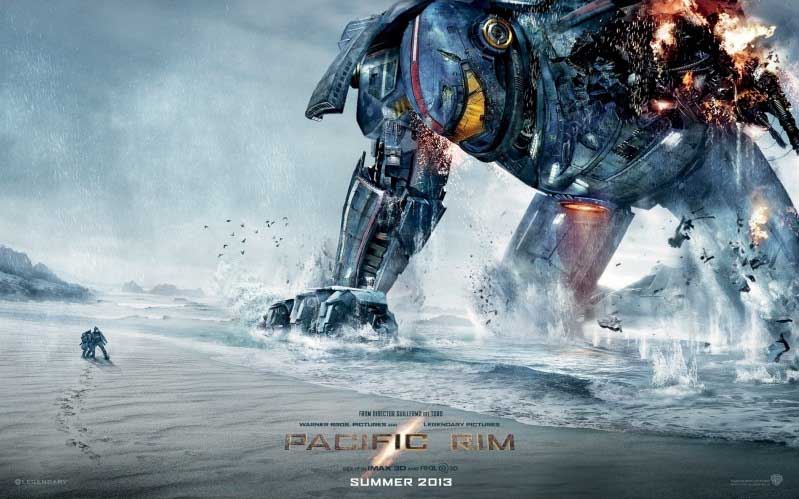
As the sense of scale here should make clear, Guillermo del Toro's 
superb blockbuster Pacific Rim is a film you should see in the theater.

I just saw Guillermo del Toro's Pacific Rim last night, and declare it to be one of the two or three best, most enjoyable blockbusters I've seen in the past two years. It is pretty much flawless, in terms of what I want out of a big summer popcorn movie: it is unpretentious, it delivers what it promises, and it even springs a few great surprises I didn't see coming. Most importantly, it is:

(1) Fun, and

(2) Visually stunning.

We mustn't underestimate the power of #1 up there, because my single biggest complaint about many recent blockbusters, particularly those of the Christopher Nolan stripe, is that they take themselves way too goddamn seriously. They get so bogged down in being "gritty" or "dark" or "serious" that they just aren't any fun anymore. This is why, for me, I rate Joss Whedon's The Avengers and Sam Mendes' Skyfall (both 2012) very highly among recent summer blockbusters, but have not yet been motivated to see this year's Man of Steel. To be fair, even without having seen it I would expect Zack Snyder's Superman movie to fulfill my criterion #2 -- I am sure it is visually stunning -- but personally I just have no interest in seeing a "gritty" or "realistic" Superman movie, especially one scripted by David S. Goyer, who I think is an extremely sloppy and inept screenwriter.

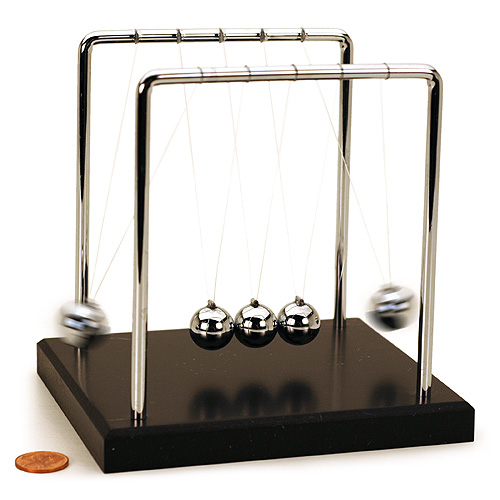
But I digress. What makes Pacific Rim so enjoyable and effective? Well, in order to let you know where I'm coming from, let's consult a chart and define a few terms:


First, complex vs. simple: complex plots twist and turn and rely upon narrative "reveals" or big surprises for their tension. Nolan's films are notoriously complex (some would even say convoluted) and I place Star Trek: The Motion Picture in here as another example of this trend.* The Trek film is quite heady and relies upon a mystery that is slowly revealed to the audience: what the hell is "V-ger" and what is it up to? As in Nolan's films, we (the audience) do not know the answer until/as the protagonists gradually figure it out. Die Hard is the same way: Hans Gruber's plan involves layer upon layer of embedded complexity, and not until very near the end do we understand the full scope of it. Sure, as genre films we know generally how these movies will end -- i.e., the good guys will win -- but we are not totally sure how they will win. Major salient facts are withheld along the way.

By contrast, simple blockbusters are those that make pretty clear from the get-go what is at stake; the plots do not depend upon mystery or surprise quite so much. Films like The Avengers and Pacific Rim are of this stripe: there is some major bad guy who needs to be clobbered, but the exact nature of his plans are not really all that important -- usually they can be summed up as "wants to end / rule the world." In Pacific Rim, we know what the film's climax will be about ten or twenty minutes into the movie: Marshal Pentecost (Idris Elba) tells us what the big mission is going to be, and the rest of the film involves our team of heroes fighting defensive battles until their moment arrives to execute that plan. There are a few minor twists but they do not sway us from (or materially change the circumstances of) that Big Battle scheduled for the end of the picture.

Now to the other axis. By "creative" I do not mean complex plots, but rather a visual style and/or tone that differentiates the film from other blockbusters of its type. I guess I mean authorial stamp to some extent, but remember that I am NOT talking about totally violating or hybridizing a genre either, just playing within a genre in a way that makes it appear fresh, e.g. Tim Burton's use of gothic sets and a carnivalesque tone for his two Batman films in 1989 and 1992. Nolan's recent films are also "creative" in this sense, he being the director widely credited with bringing a "gritty," "dark" tone to superhero blockbusters.

"Generic" means films that adhere more closely to the established parameters of their genre, with less evident authorial flourishes or deviations in tone or visual aesthetics.

Please note that I do not privilege "creative" over "generic" -- I have great admiration for films that hew closely to genre conventions but still make the viewing experience exciting. In fact, one of my favorite recent blockbusters, The Avengers, is extremely conventional with respect to plot and other conventions of superhero films, but it does its thing with such witty panache and delightful character interactions that it is completely successful even though it is visually and structurally unremarkable.

"We may not be complicated, but we're fun!"

In his rather scathing review of Pacific Rim, Buffalo-area author and filmmaker Greg Lamberson writes that "there is no real climactic fight that tops everything that came before it, but a corny finale that's telegraphed as soon as Elba comes on screen. Epic fail." However, as I argue above, Pacific Rim's ending is not an epic fail -- though perhaps it fails to be epic -- but rather is exactly what the film promises to deliver given its setup. I for one am rather tired of the notion that the final battle in a blockbuster has to be "bigger" or "more epic" than anything that came before -- I just want it to dramatically resolve the plot of the film. Epicness is overrated.**

Lamberson also states that "not one single character is interesting." Though I disagree with this, I think that in broad strokes it is an accurate statement if not a reasonable one, by which I mean that I would not personally expect del Toro to fully round out his characters and complicate his plots when making a superhero movie like Hellboy or a big summer action blockbuster like Pacific Rim. The generic ground rules and audience expectations here are totally different from those we would expect from artsy psychological thrillers like The Devil's Backbone and Pan's Labyrinth. And frankly, I enjoyed Pacific Rim's characters even though, like Lamberson, I did not find them to be psychologically complex. How many blockbuster protagonists truly are? None that I can think of.

Nevertheless, I accept as a valid critique the notion that some of the key characters in Pacific Rim are not well-rounded enough. Again, I think this is a function of the type of movie it is -- a "simple" blockbuster -- and this factor did not strike me as a major deficiency as I watched the film, yet I admit that would like to know more about the world in which Pacific Rim is set. Maybe, if we are fortunate, we will get a sequel and / or a prequel, as this reviewer suggests.

All that said, I agree with Lamberson that del Toro has set a very high bar for himself with his early films -- I love them a lot and would argue that Pan's Labyrinth definitely belongs on Entertainment Weekly's "100 All-Time Greatest Films" list. But my expectations for Pacific Rim were not directly informed by del Toro's amazing earlier works, except in one specific sense: I assumed the film would be a visual knockout, which it is. The world of Pacific Rim feels very lived-in and "real." With a great many scenes shot at night, Pacific Rim is visually evocative of Blade Runner or Hellboy II, and I love it for its noir-inspired cinematic richness.

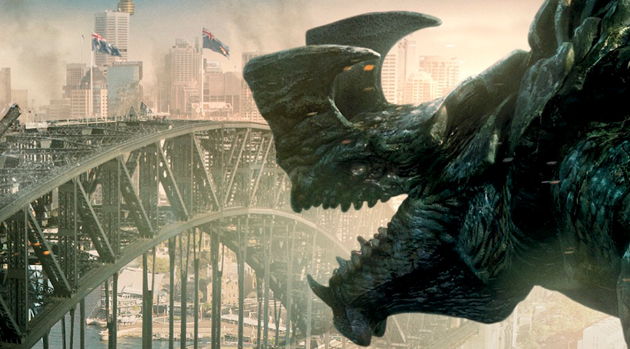
Yet despite its dark lighting and post-apocalyptic mise-en-scene, the film's general tone is light, peppy, and fun. I appreciate this very much. While I TOTALLY agree with Lamberson's sentiment that in general, blockbusters these days are running way too long, Pacific Rim never dragged for me the way the second two Lord of the Rings films or the third Nolan Batman film did. Sure, there isn't much laugh-out-loud humor or witty inter-character verbal sparring as in The Avengers, but Pacific Rim does feature a few really fantastic visual gags -- my personal favorite of which involves one of these:


In his own lukewarm review, Entertainment Weekly's Chris Nashawaty says of Pacific Rim that "del Toro's monsters are so big, and shot in such unrelenting rainy darkness, that the audience never gets a chance to dissect and fetishize their monstrous anatomies and be swept away by their weirdness." Reading that, I think Nashawaty must have seen a different movie than I did.*** I felt like the film moved pretty quickly from set piece to set piece, spending most of its running time on those spectacular monster battles -- in sum, the film does not skimp at all on mind-blowing, beautifully choreographed and well-shot action sequences. And for that reason alone, I urge my readers to strongly consider seeing Pacific Rim while it is in theaters. It may not be perfect, and it obviously does not "hit the spot" for every (re-)viewer the way it does for me, but it is well worth your time to check out, as del Toro is head and shoulders above most other blockbuster directors in terms of the lushness and lived-in "reality" of his visual style.

The kaiju sez: "Come see my movie or I'll crush your civilization!"

UPDATE 10/14/2014: British critic Mark Kermode agrees with me and has some very smart things to say about what makes Pacific Rim great in the linked video.

--
* I realize that this is a bit of a cheat on several levels. For one, Star Trek: The Motion Picture was not released in summer, but December; also, it is not an "action" film, as summer blockbusters, by definition, are. Yet it is a big-budget picture that was released "wide" in an attempt to cash in on the popularity of Star Wars, so I include it here as a representative of some of the trends I am attempting to illustrate.
** For a cheeky yet accurate discussion of this "epicness" problem in contemporary blockbusters, check out this video review of Man of Steel, especially the part near the end where the reviewers discuss the difference between Snyder's film and Superman II (1980).
*** UPDATE: Since writing this review I came across this article about possible Pacific Rim sequel ideas which includes this illuminating (ha, ha) comment: "My main issue with the dark visuals of Pacific Rim are probably the fault of the 3D projection at my cinema more than the cinematography." This may indeed explain a lot, including Nashawaty's review, assuming he saw the picture in 3D, which notoriously darkens the image. By contrast, I saw the film in 2D -- wearing 3D glasses always gives me headaches.

Saturday, July 6, 2013

EW #1: Citizen Kane (1941)

Welles as depicted on the cover of Simon Callow's superb biography, 
Orson Welles: The Road to Xanadu*

I am still in the process of learning about Orson Welles; I am surely no expert on the man or his work. But of course I have seen Citizen Kane many times, and have absolutely no objection to its being granted the #1 slot on Entertainment Weekly's "Greatest All-Time Films" list. Like the EW critics, I make this assertion NOT out of adherence to canonical tradition that says we must denote Kane as the Greatest Film Ever, but because it truly is one of the greatest films ever, and its existence is especially surprising given the historical circumstances under which it was made. A strange, perfect storm of factors led to its production: most notably, George Schaefer, RKO's soon-to-be-outgoing studio chief, granting the very young first-time director Orson Welles carte blanche to make whatever the hell movie he felt like making once the screenplay was approved.** Pretty much never, before or since, has a director had that much control over a project produced within the Hollywood studio system.

And much as Welles is an interesting figure in and of himself, I am not here to further glorify Welles. He was surely the driving force behind Kane and his considerable chutzpah played a crucial role in getting the film produced, but there would be no Kane without the vast resources of the studio system itself, particularly RKO's special effects technicians, whom Welles pushed to their circa-1940 limits during post-production on this film. As Simon Callow writes, "RKO had one of the most advanced special effects departments in the industry," run by back-projection expert Vernon Walker and including optical printing genius Linwood Dunn. According to Callow, Walker and Dunn's contributions to Kane are "immeasurable," though in at least one sense they can be quantified: roughly half of all the shots in Citizen Kane feature optical printing work by Dunn.***

For example, again quoting Callow:
[In] the sequence at the Thatcher Memorial Library [the] camera pans down a monumental statue of Thatcher onto the female guard. Both the statue and the pan are entirely the work of Dunn. As [cinematographer Gregg] Toland shot it, the scene started on the guard. Dunn made a miniature model of Thatcher and perfectly matched the base of the statue with what had been shot.

Movie magic: this miniature model shot created by Linwood Dunn . . . 

. . . blends seamlessly with this on-set footage shot by Gregg Toland.

Equally deserving of mention, among many others, is cinematographer Gregg Toland; the vainglorious Welles considered Toland crucial enough to the process and product of Kane to share screen credit with him. Also influential upon the look of Kane was director John Ford, whose 1939 masterpiece Stagecoach (conspicuously absent from EW's "Greatest Films" list) taught Welles (via approximately 45 repeat viewings) almost everything the fledgling director needed to know about how to compose and edit shots at this inceptual moment in his movie career.

The normally egotistical Welles shares Kane screen credit with 
legendary cinematographer Gregg Toland.

One critique I often hear from viewers of Citizen Kane is that it is too cerebral, that the viewer does not feel enough sympathy with protagonist Charles Foster Kane (played by Welles himself) to get truly immersed in the story of his life. I think this is a valid criticism; in many ways, Welles reminds me of Christopher Nolan, another cerebral director who often struggles to achieve emotionally resonant characterizations in his films.

Related to this, Callow says of Welles' acting style that his "great skills as an actor lay in the realm of the rhetorical, in which the actor is absolutely in command of himself and his material; when he touches the personal, which he does rarely, he seems to lose his judgement." Callow calls Welles a "King actor," well-suited to playing grandiose protagonists in an externally focused style, but not particularly suited to smaller supporting roles and internally focused gestures; Callow claims of Welles that that the "common touch was always to elude him."†

Yet my response to the "not enough beating heart in Kane" argument is that, in this case, it is the point of the film that we do not fully empathize nor identify with (the character) Kane; he is, in the end, a tragic figure and a bit of a monster. Where my heart connects with the movie is mainly through the cumulative effect of the events of Kane's life; by the time he is pushing his second wife to be a professional opera singer, or by the time she leaves him in the final reel, I am emotionally hooked. In the earlier sections of the film, it is the supporting cast, especially the affable Joseph Cotten as Jedediah Leland, who humanizes the unfolding tragedy of his closest colleague's narrative arc.

So ultimately, I agree with Owen Gleiberman and company when they say:
Welles didn’t just craft a great movie; he bottled what moviemaking would forever be — and therefore was, from the exhilarating moment that Kane existed. That’s not just an achievement, it’s a miracle, and it’s one we honor by recognizing that no great movie feels quite as alive when you’re watching it as Citizen Kane does.
Hear, hear.

In the capping tragedy of his life, Kane begs Susan to stay -- to no avail.

Bonus afterthoughts: While Touch of Evil, probably Welles' second-best film, will be discussed separately -- it is entry #75 on EW's list -- I want to take the time now to single out a few other Welles films of particular interest. Welles had a tumultuous film career, and a great many of his movies were either edited by studios without his compliance, or were never finished.††  Nevertheless, many of them, even the "butchered" ones, are quite good: gracing the top of my list is his 1947 film noir, The Lady from Shanghai, which is probably my personal favorite Welles film. I also strongly recommend It's All True (1993), The Stranger (1946), and his "visual essay" F for Fake (1973) -- which includes, on DVD 2 of the Criterion Collection edition, Orson Welles: One-Man Band (1988), a fascinating documentary about the director's unfinished projects. Welles also directed several Shakespeare adaptations, all of which are rumored to be at least interesting if not consistently great. I have seen his Macbeth (1948) and loved it; I have heard that 1965's Chimes at Midnight (which I have not yet seen) is probably the best of the lot.

Lastly, I also recommend Richard Linklater's Me and Orson Welles (2008), a warm-hearted little picture in which Christian McKay absolutely nails his portrayal of young Welles with uncanny accuracy. (Jonathan Rosenbaum reviews the film here.) Less accurate but pretty fun if you like dramatic reenactments of Hollywood behind-the-scenes shenanigans is RKO 281 (1999, dir. Benjamin Ross).

A rare still from a controversial scene cut from Citizen Kane.

--
* Callow is a truly gifted and entertaining writer whose Road to Xanadu constitutes only one-third of a proposed three-volume biography of Welles. Volume two, Hello Americans, was released in 2006; volume three is still forthcoming.
** Welles scholar James Naremore notes that "it would be a mistake to assume that Welles ever had total freedom" at RKO, since his stay at the studio "was littered with rejected or abandoned scripts" and even on Kane he had to adhere to the budget limitations imposed by Schaefer. (The Magic World of Orson Welles [SMU Press, 1989] p. 18)
*** Callow, The Road to Xanadu (Viking, 1995) pp. 521-3.
† Callow, Hello Americans (Penguin, 2006) pp. 21, 23-4, 248.
†† For a complete rundown of which films were completed to Welles' satisfaction and which ones were not, Jonathan Rosenbaum's post on Mr. Arkadin makes a good starting point.