
This year's grouping of top standout films, some of which were released late last year, includes Leviathan, Wild, Mr. Turner, Mad Max: Fury Road, The Babadook, Far From the Madding Crowd, What We Do in the Shadows, Crimson Peak, and Inside Out.
Leviathan is probably my all-around favorite film of the last year, even though Mad Max: Fury Road also stands out for me, albeit in a completely different way. What makes Leviathan so special, and why I think will endure for me for a very long time, is that it has just enough dark humor and existential bleakness to hit my sweet spot in those areas, yet it also has a very warm, human side that vaguely similar films like, say, Michael Haneke's The White Ribbon deliberately lack. If Haneke's films want us to keep some distance from their selfishly motivated characters and grim situations, Leviathan wants us to empathize more, to feel the characters' suffering even as we acknowledge its stultifying inevitability. If this film reminds me of any other recent film tonally, it might be Ida, one of last year's standouts. But where Ida maintains an even lighter, capricious tone, Leviathan splits the difference between Ida's comedic warmth and Haneke's films' jaded darkness.
Leviathan tells the story of Nikolay Kolya (Aleksey Serebryakov), a struggling working man trying to keep the local authorities (personified by Roman Madyanov as brutal mayor Mer) from evicting him from his beautifully located home. What transpires is a Kafkaesque tale of government corruption, obtuse and unfair bureaucracy, and some unexpected ties to organized religion. All of this is told from the point of view of an angry, fatalistic alcoholic working man, laced with warm, humanistic moments and absurd humor. If that doesn't sound like a rip-roaring good time to you, I just don't know what will satisfy you.

There's not much more I need to say about the amazing action movie Mad Max: Fury Road that I haven't already said in my review of the film. (Though I did find that this piece about the exposition-laden quality of many recent films agrees with my thoughts about the needless wordiness of recent blockbusters -- a point I make in my Fury Road review.) Suffice to say that I have seen Fury Road one more joyous time since writing that review and my enthusiasm for the movie is undiminished. It is simply one of the very best films of 2015 by any measure. Happily, according to director George Miller, there are two more Mad Max films coming! And in the meantime, we can only hope that this awesome black and white version of Fury Road comes to public light.

Similarly, I've not much to add about the hilarious and ultimately quite touching mockumentary What We Do in the Shadows except: go see it! If you like comedies and/or vampire movies, this is a surefire winner, the hands-down funniest film I saw last year and one of my top favorites overall. (My girlfriend and I have decided it would make a great double-feature with Jim Jarmusch's Only Lovers Left Alive, reviewed below.)
And once again: for a full explanation why I loved Crimson Peak, simply see my review.

While many of the year's biggest blockbusters, such as Jurassic World, have tended to lack any real spark of humanity or true "wow!" factor, conversely, as far as movie magic goes, Pixar's Inside Out is the most involving and touching film I saw all year. I cannot praise this wonderful, pitch-perfect film highly enough. Being a Pixar film, it is visually stunning and masterfully executed on all levels. Its script and story are that rare combination of something that makes sense to kids yet addresses adult issues with more forthrightness and courage than most "adult" dramas ever do. Alternately heartbreaking and uplifting, and a cleverly brilliant representation of how our minds and emotions work, develop, and grow, Inside Out is a girl's coming-of-age story that people of all ages and sexes should see and will enjoy. One of the very best films of this year or any year, Inside Out is by far my favorite Pixar film and one of my favorite animated films bar none. A magical, truthful triumph.

The Babadook is my favorite horror film of recent release. It holds this distinction for several reasons, one of which being that Crimson Peak is not technically a horror film, but more a Gothic melodrama. Another reason is that I was slightly less impressed with It Follows than many reviewers and fans seem to be. (Though I plan to re-watch David Robert Mitchell's low-budget slasher homage soon and may need to write a reassessment of the film after that viewing.)
Taken on its own merits, The Babadook is one of the best scripted, thought-out, performed, and executed films of any genre I have seen in a long time. It's a film that knows exactly what it wants to be and achieves it with a mastery and artistry that wows me, thrills me, and makes me think. In recent years, only this film and Nightcrawler feel as artistically confident, exhilaratingly paced, and harmoniously constructed. The Babadook is a straight-ahead scary story -- its most frightening element is a child's illustrated storybook that seems to be the source of all the trouble -- and counts as a horror film, albeit not a gory one. But the film is also a harrowing family drama and, like Inside Out, a brilliant metacommentary on the role certain emotions play in our lives. If you are a horror film fan, then The Babadook is your other must-see, along with It Follows, this year. (Though I haven't seen Severin Fiala and Veronika Franz's Goodnight Mommy yet, and there may be other contenders out there too.)
Mike Leigh's Mr. Turner is everything a biopic should be and much more. It tells the story of the last few decades of the life of British landscape painter J. M. W. Turner, doing so in an understated yet totally mesmerizing way. Eschewing many of the standard conventions of the biopic, Turner simply immerses the viewer into the last thirty years of the enormously influential and interpersonally gruff painter's life. Along with Far From the Madding Crowd, Mr. Turner is the most beautifully shot film of the year (though Leviathan, Sicario, and Nightcrawler deserve honorable mention in this area.) And Timothy Spall's performance as Turner is hands-down the best lead performance of the year -- see my discussion of lived-in vs. obvious performances below.

As just mentioned, Far From the Madding Crowd is one of the most visually beautiful films I saw this year. Shot in mostly outdoor locations in England by Danish Dogme 95 filmmaker Thomas Vinterberg, Madding Crowd is one of the most emotionally resonant works of the year, too. It tells the story of Bathsheba Everdene's (Carey Mulligan) journey through a decades-spanning love triangle, which takes some very dark and torturous turns yet continually reinforces our heroine's forbearance and integrity. Not as grim as I would expect from source material by Thomas Hardy, Madding is melodramatic but not bleak -- unlike Leviathan, Madding gives its villains appropriately satisfying comeuppances. And the chemistry between the two main leads, the superb Carey Mulligan and relative newcomer Matthias Schoenerts, is fucking fantastic. Far From the Madding Crowd is nothing short of a must-see. Indeed, as Ramin Setoodeh writes in item #6 on this insightful list, Madding Crowd is "easily one the year’s best films."
Other slightly less impactful (but still mostly good) stuff I saw this year includes Cinderella, It Follows, Jurassic World, Spy, The Martian, Sicario, Spectre, and Star Wars Episode VII: The Force Awakens.

Kenneth Branagh's live action adaptation of Disney's Cinderella is entertaining and well-made. I think that going in I was hoping for something as great as last year's Maleficent, which Cinderella, sadly, is not. It does contain uniformly standout performances, with Cate Blanchett and Helena Bonham Carter as particular standouts. The special effects are top-notch too, with the dis-enchanting of Cinderella's coach at midnight sequence an especial high point in that area. In the end, I would place Cinderella in the same general realm as Jurassic World or Guardians of the Galaxy: good fun while it lasted but not terrifically memorable afterward.
As film blogger A.J. Snyder correctly asserts in his excellent It Follows review, "I'm not sure there is a horror 'renaissance' at work just because a few cool, original movies with ties to old horror movements are coming out." Agreed, and in some ways this comment sums up how I felt in the weeks and months AFTER I saw It Follows last spring: I basically forgot about it. It was fun and enjoyable but mostly not that memorable. If I want to see a really compelling slasher, I'll go back to Halloween or Texas Chain Saw or some early Craven picture. If I want a film about the spread of a disease, I'll watch any Cronenberg film. And if I want a compelling swimming pool sequence, I'll switch on Let the Right One In.
Nevertheless, I really enjoyed It Follows while I was sitting in the theater, and found its device of having strangers walk into the background of shots and pursue our lead characters to be really effective and creepy. I kept watching the deep parts of the frame, trying to guess who the next homicidal pursuer might be.
But in the end It Follows is not as good as the many films it bricolages, nor is it quite as good as last year's much more scary and impactful The Babadook.

However, despite its truly awesome and enjoyable dinosaur battles, Jurassic World's script is thin and many of its main characters' lines are flat and corny rather than funny or entertaining. The two brothers, who Darren Franich aptly describes as "two suburban kids so typical that you’ll never even bother to learn their names," are so boring as to be unrelatable (director Trevorrow understandably lacks Spielberg's remarkable talent for directing child actors). As for the adults, it is completely baffling that Claire's sister (Judy Greer) so blatantly and condescendingly attempts to guilt Claire into admitting she might want kids someday, and even more incomprehensible is that "good sister" Greer and her husband are hiding the fact of their impending divorce from their youngest son. (What is this, the 1950s?) Lastly, as Franich writes, Irrfan Khan's park owner character only makes sense if we assume he is blowing lines of cocaine offscreen the entire film.

Irrfan Khan sez: "Gimme some blow!"
Along similar lines, Slashfilm's Germain Lussier opines of Jurassic World's human characters that "they’re cardboard cutouts of what real people are. Every character in this movie is begging for just a few more minutes of development and understanding." Agreed! Lussier additionally mentions the movie's "laughable dialogue."
As EW's Chris Nashawaty accurately sums up:
These days we don’t have much patience for coy cat-and-mouse games. We want to see our dinosaurs rampaging fast and furious over and over. In that sense, Jurassic World is a blockbuster of its moment. It’s not deep. There aren’t new lessons to be learned. And the film’s flesh-and-blood actors are basically glamorized extras. But when it comes to serving up a smorgasbord of bloody dino mayhem, it accomplishes exactly what it sets out to do beautifully.True. I enjoyed this film a lot while I was in the theater, and I will likely watch it again on home video -- more than once -- because, as I confessed earlier this year, I am a total sucker for films where vicious predators kill lots of people.
But I was unnerved by the subtly misogynist "humor" in the film, most of which centers on pointing out how odd it is that Claire actually might be able to fend for herself. Indeed, The Washington Post's Ann Hornaday argues that Claire's story arc consists entirely of "a painful pastiche of sexist tropes." Sadly, I must agree with that assessment and with The Mary Sue's Lesley Coffin when she writes that World is the "most sexist film in the franchise."
I wish the film could have toned down its sexism and made more of an effort to render its human characters more, well, human. I think Sam Adams may put it a bit too harshly when he writes that "Jurassic World's opening act is meant to serve as an inoculant against the flavorless blockbusterisms that follow, but there's no lampshade big enough to cover the movie's lack of a soul." A withering assessment, yet his criticism does accurately pinpoint the film's main weakness: unlike Spielberg's early blockbusters or Trevorrow's own Safety Not Guaranteed, Jurassic World lacks any real emotional impact. It lacks heart. As Franich puts it:
The last shot of Jurassic Park is a helicopter carrying the characters away from the land of marvels—back to the world without special effects. The subtle difference in Jurassic World’s final scenes speak volumes: The humans get an ending, but the dinosaurs get the glamour shot. The weird takeaway from all these movies is that there is no world without special effects now. The world belongs to the cool monsters. The humans are just breathing there, staring up in wonder.I'll say it again: I really enjoyed Jurassic World. But it doesn't need to be this way. Mainstream blockbusters can afford to be less sexist and more human. Mad Max: Fury Road proves it. So do the Hunger Games films.
Ultimately, I identify with Lussier's spot-on summation:
Jurassic World has problems. There’s really no denying it. And yet despite those problems, whenever my mind starts thinking about the movie, I immediately want to see it again. The sense of wonder and rush of adrenaline is so powerful that – for me – it covers all the bad and ugly things about the movie. At its very worst, it’s the best Jurassic Park sequel. At its very best, it gives you tiny glimpses at what may have been. Maybe that good will will go away as the film ages but, for now, I liked it just a little more than I didn’t.UPDATE 3/9/2016: Read James McConnaughy's sharp piece about learning to hate Jurassic World.
UPDATE 5/21/2016: And/or check out this insightful Jurassic World review by Film Crit Hulk, who says that "THE ENTIRE FILM IS A HALF-BAKED NIGHTMARE OF THE UNINTENTIONAL."

I enjoyed the Melissa McCarthy comedy Spy quite a bit. Much of what makes the film enjoyable is summed up in this A.V. Club review, to wit:
if the ensemble doesn’t fully gel as such, that’s because Spy isn’t a buddy comedy, no matter how well Statham, Byrne, and others pair with the star. Though Susan isn’t as arrogant as her male counterparts, she’s intended to be as singular a force, in her own way, as Bond, Bourne, or Jason Statham, and Feig does McCarthy the service of not weighing down the empowerment with extraneous lectures about teamwork or a time-consuming love story.Indeed, Spy is an ensemble piece, and while certain members of the ensemble -- especially Jason Statham, Rose Byrne, Miranda Hart, and Peter Serafinowicz -- are wonderfully hilarious, it is true that Spy suffers for not having one ever-present sidekick or buddy with whom McCarthy interacts. In the end, then, Spy is a fun comedy well worth seeing, but it's not as outright terrific and hilarious as the McCarthy - Sandra Bullock buddy cop comedy The Heat (2013).
The Martian is a solidly made, exciting, well-acted "hard" sci-fi thriller that delivers on its promises but not much more than that. As such, it is very satisfying and entertaining but maybe not terrifically memorable. In fact, despite its coherence and high entertainment value, I did not actually like The Martian as much as I liked Prometheus, another recent sci-fi thriller by director Ridley Scott. I know many folks dislike Prometheus, finding it anywhere from mildly to exceedingly disappointing, but for me it is a key example of a noble failure: a film that is incoherent in many of its particulars but falls short of the mark because it makes a bold attempt to be something truly distinct and thought-provoking. For all its imperfections -- which mainly boil down to a few erratically motivated characters, a derivative and predictable plot, and some confusing ambiguity about how exactly the black oil works -- Prometheus really sticks with me, and its highs -- like the initial foray into the facility and the automated surgery sequence late in the film -- reach much higher than anything in the much more tame The Martian.
Beyond that, there is this smart piece and its claim that The Martian may exhibit one jarring moment of sexism. I happen to agree with this interpretation, and also find the whole "Chinese rocket" plot twist a bit obviously shoehorned in (in order to appease the crucial Chinese exhibition market), but I generally enjoyed the film anyway.
[UPDATE 1/3/2016: A friend relates that Andy Weir's source novel includes the Chinese rocket subplot as well as sequences in China's space program. I haven't read the book and didn't know the Chinese rocket was in there. To me, that part definitely feels tacked-on and underdeveloped in the movie adaptation -- I actually wish the Chinese authorities had been more directly involved in the rescue effort from earlier in the film. Wouldn't they have been?]

Sicario is a thrilling, well made movie that has been getting a lot of awards-season buzz lately. I like the film very much and am a fan of its director, Denis Villeneuve of Prisoners (2013) fame. Yet I must agree with Christopher Orr, who sees the film as having a bit of a split personality. Orr writes that Sicario is "in effect two separate movies. One is terrific and one quite good, but the two coexist in uneasy tension." For Orr, this uneasy coexistence unravels by the film's third act:
What began as (apparently) a serious political film instead settles for the less demanding obligations of genre, as the plot becomes more far-fetched, edging toward fable. The narrative point of view mistakenly shifts from Kate to Alejandro, and what began as a critique of violence comes to resemble a stylish exercise in it. This second movie-within-the-movie is not a bad movie, merely a different one. But it does, to some degree, betray the extraordinary promise of what came before.I know that the film's dualistic nature and shift in focus is integral to the point it is trying to make, and that Entertainment Weekly's Chris Nashawaty loves it too. I am not sure that Sicario could or should be much different. Yet I couldn't help but feel as I watched that the movie needed to let us into the perspective and back story of Alejandro (Benicio del Toro) sooner and more extensively than it does. When he -- SPOILER! -- takes over the narrative in the third act, it comes as a surprise. That surprise is pleasurable in its own right but it doesn't allow us to feel the stakes of his actions as deeply, and it leaves us hanging about how presumed protagonist Kate (Emily Blunt) even fits in. I really enjoyed Sicario and would rate it very highly, but not quite as highly as my very favorites of the year.

The latest (and last) Sam Mendes James Bond film, Spectre, is a nice swan song for Daniel Craig in the role of Bond, and is at least as good if not better than Skyfall. While it may lack some of the zippy thrills of Skyfall, I think Spectre coheres far better than its predecessor. Its tone is a bit darker -- all the better for it -- and Spectre features better performances from Craig, Ralph Fiennes, and Ben Whishaw than any previous Bond outing. It may slightly under-deploy Christoph Waltz, but again, I say all the better for it. Leave them wanting more.
Of course Spectre also includes enjoyable homages to earlier James Bond films like Live and Let Die (the opening sequence), From Russia With Love (the fight on a moving train, the helicopter Bond steals from Oberhauser's Tangier base), Goldfinger (the Rolls-Royce), and Moonraker (Oberhauser's base, while earthbound, is visually similar to Drax's space station).
The only real flaw I find in Spectre is its lousy, lackluster opening theme song, one of the worst of any James Bond film. It reminds me (in a bad way) of the more easy listening type themes from the Moore/Dalton era, like Rita Coolidge's "All Time High" (Octopussy) or Patti LaBelle's "If You Asked Me To" (Licence to Kill end credits), except both of those latter examples are much better songs than Sam Smith's "Writing's on the Wall." Indeed, the song sucks so badly that Radiohead felt compelled to share their rejected Spectre theme song publicly after the film's release. (And subsequently, a fan transposed the Radiohead theme over the film's opening credits -- worth a look!)

Star Wars Episode VII: The Force Awakens was fun to watch in the theater. It is better (by far) than any Star Wars prequel and better (by less far) than Jurassic World. The dialogue is decent, the characterization (especially of the new characters, Rey, Finn, Kylo Ren and BB-8) is good, and the action sequences and overall narrative flow work really well. I agree with A.A. Dowd when he says that the film does not slow down and develop its characters and worlds quite enough and that it fails to land a couple moments (like the revelation of Kylo Ren's parentage) that could have been far more emotionally impactful than they are. Dowd also nails the fact that, like Jurassic World (but a bit more artfully), Episode VII mainly recycles and reworks imagery we have already seen in the original trilogy -- as Dowd puts it, Episode VII "borrows so much from the 1977 original that it often resembles a remake as much as a straight sequel." Nothing new or risky is being offered here. (Then again, as Forrest Wickman documents, the Star Wars franchise has always been about borrowing and bricolage.)
I must also totally agree with Tony Zhou that Ep. VII is a movie divided against itself due to its obligation to tie up one glaring loose end from Ep. VI: Return of the Jedi.
But all that said, I enjoyed The Force Awakens while it was happening. It looks great and feels like a real if somewhat lesser Star Wars movie. It's way better than any prequel but not as good as any original trilogy film, including Return of the Jedi -- Ewoks and all.
For whatever George Lucas' flaws may be, and they are many, he does have a unique vision for his universe and part of the fun with Lucas is taking in all the idiosyncratic details he sneaks in there: his settings, his creature and vehicle designs, etc. One of the many weaknesses of the prequels is that Lucas let that shit take over -- those films are like a series of amazingly interesting backgrounds with absolutely nothing of interest happening in the foreground.
Conversely, much as I deeply appreciate J.J. Abrams and crew's decision to diversify the Star Wars universe in Episode VII, I nevertheless feel that the film did not take quite enough time with that stuff. It never really let us sink into a setting or get to know its unusual background players. It's as if Lucas has had some of the rough edges of (what used to be) his universe sanded down a bit. This helps The Force Awakens' dualistic plot structure move along snappily but it does not leave much room for "movie magic" -- like that of Empire Strikes Back's Dagobah sequences, for example -- to happen. As Dowd writes, "The Force Awakens never reaches the heights of escapism Lucas once did, mostly because its pleasures are echoes." Yes, that's it exactly.
(Bonus Afterthought: While I might not go as far as Michael Hiltzik does when he calls The Force Awakens "depressingly unimaginative," I do find his analysis of the film to be generally spot-on. His L.A. Times piece serves as a kind of one-film case study of the trend Mark Harris so presciently documented just over a year ago for Grantland.)
[UPDATE 1/4/2016: Or, as Jay Bauman of Red Letter Media puts it, "I can't wait to finally watch Star Wars: The Force Awakens so I can say it was pretty good and then forget about it in a day!" As Bauman correctly opines a few minutes into the same video review,
this movie functions basically the same as Jurassic World where it's a semi-remake, a soft reboot-slash-remake that's meant to start up a new franchise, or start up a new series of films. I did not like Jurassic World, I thought it was too similar, and just felt hollow and phony with bullshit annoying boring characters. I also really, really liked The Force Awakens. It worked in all the ways that Jurassic World did not.Obviously I enjoyed J. World more than Jay did, but I agree with his assessment.
Along a different but related line, readers interested in the disturbing implications of our culture's widespread Star Wars fandom should read Lee Weston Sabo's insightful Bright Lights piece and/or Ryan Smith's even bleaker (but nevertheless accurate) analysis of "the infinite amount of attention, time, and money" our culture has committed to "this dopey fictional sci-fi universe." As Smith writes,
Our societal problems cannot all be pinned on Star Wars, but while we've been busy cheering on Jedi knights battling the Empire we let in the real evil: unjust and imperialist wars, climate change, the Wall Street d-bags who fostered the recession of 2008, subprime mortgages, predatory lending, Dick Cheney, skyrocketing income inequality, Fox News, the mass incarceration state, the loss of civil liberties for the sake of security, the rising police state that disproportionately murders young black men, indiscriminate spying by the NSA. These are forces that don't wear black capes and shoot lightning from their hands, but they are our Darth Vaders.In other words, escapism is fine, but isn't there a point at which escapism goes too far, becoming an all-consuming societal axiom rather than a temporary distraction from other, weightier matters that require our attention and energy?]
[UPDATE 1/6/2016: This is a super-smart, succinct assessment of how the release of Star Wars Episode VII has changed critical perception of George Lucas and his achievements. Well worth reading.]
Topping the list of films released in the past few years that I finally got around to seeing is Nightcrawler, a brilliant satirical thriller written and directed by Dan Gilroy and starring Jake Gyllenhaal. (Nightcrawler was released in October 2014, just eleven months before I saw it, yet it feels like I waited much longer -- way too long -- to see it.) You can read my extended comments about what makes this film so great here. Suffice to say that it is one of the very best films I saw this past year, up there with more recent releases like Leviathan and Mad Max: Fury Road.

Jake Gyllenhaal stars in the riveting neo-noir thriller Nightcrawler.
Coming in second on my "riveting year-old films" list is Whiplash, Damien Chazelle's harrowing, expertly crafted look at the inner workings of an intense teacher-student relationship at an elite New York City music school.

Miles Teller gives a bravura performance as Andrew in Whiplash, Damien Chazelle's debut feature.
My main critique of this intense, well-acted film is that it implies that Andrew and Fletcher will continue working together after its last scene and that this will likely be a good thing for Andrew's music career. Unfortunately, in addition to the disturbing fact of Fletcher's willingness to outright lie and commit acts of emotional and musical sabotage to achieve his pedagogical ends, the other problem here is that there is no concrete evidence that he truly knows how to properly mentor a world-class talent (a "Charlie Parker" in the film's parlance). Sure, he seems to have an amazing ear for music and clearly can, through drill-sergeantish bullying, inspire loyalty in his pupils. But can he actually deliver what he promises? Is he as good a teacher as he obviously thinks he is? Unknown. I think Whiplash wants us to believe that Andrew is on his way to a successful music career but the odds are 50-50 that he will simply wash out anyway, have a nervous breakdown, and/or commit suicide (as --SPOILER -- one of Fletcher's past pupils already has).
It may be that it is the film's purpose and point to leave things hanging with this disturbing ambiguity unresolved, yet there was a slightly triumphal tone to the very ending that made me uneasy about the film's point of view.

J.K. Simmons as Fletcher, the prevaricating, emotionally abusive teacher in Whiplash.
All that said, Whiplash is a very finely crafted movie. It had me on the edge of my seat from the get-go even though I saw most of its major plot points coming. (The only Whiplash plot twist that truly surprised me was what happens to Andrew as soon as he sits down at his kit for the film's climactic show. I knew -- SPOILER -- that Fletcher was going to screw him over for betraying him but I did not foresee exactly how that would happen.) J.K. Simmons has been rightfully lauded (and rewarded) for his compelling performance as Fletcher, even though he is basically rehashing his characters from Oz (1997-2003) and Party Down (2009-2010). However, the real standout here for me is Miles Teller as Andrew, and the film's young director Damien Chazelle. I will be watching those two's developing careers with great interest.

David Oyelowo gives an amazing lead performance as MLK in Selma.
So too David Oyelowo and Ava DuVernay. I saw Selma on home video over the summer, and was greatly impressed by it. It is a surprisingly restrained film, given its subject matter, and it has the courage to present Martin Luther King Jr. (Oyelowo) as a flawed human being -- even acknowledging his marital infidelities -- rather than a lionized legend.
Not that I trust Academy voters to single out the "best" of anything, except perhaps those Oscar campaigns which are most well-funded, but since we're doing the whole "year in review" thing I feel compelled to mention that Selma's David Oyelowo was likely robbed of his rightful Best Actor Oscar for 2014.* I have nothing against Eddie Redmayne and I have not seen The Theory of Everything, so I am somewhat groundlessly speculating here. I am sure Redmayne's performance as Stephen Hawking is impressive and moving. But I have observed that Academy voters usually go for the most obvious, noticeably "actorly" performances found in Oscar-bait films about weighty but not-too-risky topics.
As Chris Nashawaty puts it in his (otherwise unrelated) Southpaw review,
Film acting is a slippery art to discuss. When it’s done well, it involves nuance and the subtle sublimation of self—most of which is imperceptible and utterly mysterious. It’s why we mistake drastic weight fluctuations and Method stunts for a great performance.Yes. In a similar vein, as Kate Winslet, playing a fictionalized version of herself in the first episode of Extras, satirically explains:
If you do a film about the holocaust, you're guaranteed an Oscar. Schindler's bloody List, The Pianist -- Oscars coming out of their ass. [. . .] Seriously, think about it. Daniel Day Lewis in My Left Foot, Oscar. Dustin Hoffman, Rain Man, Oscar. John Mills, Ryan's Daughter, Oscar. Seriously. You are guaranteed an Oscar if you play a mental.

Kate Winslet (Kate Winslet) explains to Andy Millman (Ricky Gervais) which kinds of roles tend to win Academy Awards.
In contradistinction to Winslet's analysis, and like Bruce Dern in Nebraska the year before, Oyelowo gives an incredibly nuanced and subtle performance in Selma that the viewer barely registers as "acting." His portrayal of MLK is lived-in, finely measured, and therefore very believable and compelling without being flashy or overdetermined in any way. That Oyelowo achieved this understated, human portrayal of such a well-known, fiery personage as MLK is nothing short of a miracle. Or, rather, an extraordinarily high degree of craft on the actor's part.
This same principle explains why Dern's was really the "best" performance of 2013 -- sure, Matthew McConaughey was terrific in Dallas Buyers Club, and I have written before about my appreciation for that movie in general and McConaughey's performance in particular. Yet it is a slightly overdetermined performance of the kind Academy voters cannot resist. It is so obviously McConaughey skillfully assaying a role, McConaughey "acting," whereas Dern is so much more skillful and nuanced in the excellent Nebraska that the viewer forgets he is playing a role and simply accepts him as that character. To me, that feat is more impressive and more awards-worthy.

Domnhall Gleeson and Michael Fassbender in Frank.
Frank (2014) is a wonderful, slightly downbeat fish-out-of-water comedy starring Domnhall Gleeson as Jon, an aspiring keyboardist who joins an eclectic band led by Frank (Michael Fassbender), a creative genius who wears a plastic head over his own head at all times. I call Frank "slightly downbeat" because, while it starts out in a very lighthearted mode, with a twee tone that may remind some viewers of Wes Anderson's work, it gradually moves away from cuteness and toward something more substantial: a serious exploration of the relationships between the members of its weird ensemble, especially the central triangle of Frank, Jon, and Clara (Maggie Gyllenhaal). I can't say much more about this odd but heartful movie except: see it. Do not be put off by the "gimmick" of Frank's plastic head, dive in and see what this emotionally resonant dramedy has to say. (And note that it is very loosely based on a true story about the Frank Sidebottom Band.)

Jacob Wysocki and John C. Reilly in the wonderful, offbeat slice of life picture Terri.
Tonally similar to Frank and also to Chuck&Buck (2000), one of my perennial favorite films, is Azazel Jacobs's Terri (2011), a beautifully executed, wry, tender coming-of-age tale about likeable misfit Terri (Jacob Wysocki) and his unusual friendship with high school vice-principal Mr. Fitzgerald (John C. Reilly). This wonderful slice-of-life movie eschews big narrative events in favor of sensitively observing the daily life of its protagonist and his small circle of associates. While Terri has one uncomfortably vulnerable scene involving the fumblings of teenage sexuality, it is mostly a lighthearted buddy film whose offbeat comedy is less dark and squirmy than Chuck&Buck's. In sum, Terri is an under-seen, life-affirming gem that I recommend to everybody. It is now one of my favorite films.
Another indie-ish film that really resonated strongly for me this year is Only Lovers Left Alive (2013). While not as uproariously hilarious as What We Do in the Shadows, Jim Jarmusch's 2013 vampire movie is nevertheless every bit as enjoyable as the New Zealand-made mockumentary about undead life. Premise-wise, the two films are quite similar. Only Lovers takes Jarmusch's usual qualities -- dry wit and dark humor, a languid pace and rambling plot, and visually poetic use of location and setting -- and puts them to work telling the story of two vampires played by Tom Hiddleston and Tilda Swinton. Forced to keep a low profile in the contemporary world, these two live quietly in rundown areas of Detroit and London, respectively. The film mainly focuses on the mundane details of their everyday existence -- despite some plot developments set off by the intrusion of younger vampire Ava (Mia Wasikowska) into their world, Only Lovers is more interested in its two main characters and their ways of passing time than it is in telling any kind of typical horror story. There is some blood and a hunting sequence or two, but as is usual with Jarmusch, the focus is on the downbeat moments between the hunts and other typical "action beats," which the film mostly eschews.

Tilda Swinton, John Hurt, and Jim Jarmusch on the set of the wonderful, very Jarmuschian Only Lovers Left Alive.
Only Lovers is one of Jarmusch's very best and most assured films. The longtime independent director's lived-in style and dry wit lend themselves perfectly to relating the daily (nightly?) travails of ennui-afflicted eternal beings. It uses its main setting, Detroit, to great effect. I recommend Only Lovers Left Alive to anyone who likes vampire movies and/or the films of Jarmusch.
After seeing the Steven Knight-created Netflix series Peaky Blinders and being a fan of Tom Hardy in general, I enjoyed Locke (2013) a great deal. It ends anti-climactically but it is an entertaining ride, especially given its conceit: the whole film takes place in one car with one character.

By far the best documentary I saw all year was Laura Poitras' Citizenfour (2014), which delineates Edward Snowden's attempt to expose the NSA's illegal and unethical information gathering practices. This film not only reveals the vast extent of the NSA's violation of our rights, it also shows quite strikingly how much Edward Snowden sacrificed to bring this issue to light. Harrowing, timely, and an absolute must-see for any thinking American or world citizen.
Less directly relevant to our daily lives but no less compelling, Alex Gibney's Going Clear: Scientology and the Prison of Belief (2015) is a detailed, well-structured look at the confusing, bizarre, exploitative world of the "church" of Scientology.
Force Majeure (2014), described by A.A. Dowd as the kind of film Michael Haneke would make if he had a sense of humor, is a sharply observed portrait of a marriage and family put to the test by an unexpected accident. Mostly very funny and humanistic, the film ends quite ambiguously, in a way that left me feeling unsure about how it wants me to feel about its protagonist, ethically questionable father Tomas (Johannes Kuhnke). But the great cinematography and the care with which the minutia of family relations is handled -- in this the film reminds me of Nicole Holofcener's work -- make Force Majeure a must-watch for fans of adult-themed cinema. (Plus if you watch it you can maybe tell me what you make of that ending.)
Fruitvale Station (2013) is the poignant must-see film about the last day in the life of BART shooting victim Oscar Grant (Michael B. Jordan) . It also marks the inaugural team-up of director Ryan Coogler and star Jordan, who recently reunited to make this year's buzzy Rocky sequel Creed.
Enemy (2013) is a film I wanted to like more than I actually did. Directed by Quebecois director Denis Villeneuve -- yes, the same guy who directed Prisoners and Sicario -- Enemy is a mind-bendy film about a college professor (Jake Gyllenhall) who sees his exact look-alike in a low-budget movie then sets off to find him. Things get very weird from there. Though I love its mood and wit and jaundiced-yellow color palette, Enemy got so weirdly abstract and obscure by the end that I couldn't quite tell what, if anything, it was going for thematically. (Perhaps it warrants a careful re-watch.) Despite being more heavy handed and artsy, Richard Ayoade's The Double (2013) is more effective at making an emotional impression with similar subject matter.

Peter Capaldi gives one of the most outrageously funny performances in the brilliant political satire In the Loop.
In the Loop (2009) is a razor-sharp British political satire of the sort one doesn't often see made in contemporary Hollywood, Bulworth (1998), Wag the Dog (1997), and Bob Roberts (1992) notwithstanding. Loop is a breakneck-paced and darkly hilarious look at the political machinations behind the joint U.S. - British justification for invading Iraq. Highly recommended for those who enjoy dry, intelligent, socially relevant humor.
Lastly, I finally got around to seeing Marvel Studios' Guardians of the Galaxy (2014). I mostly enjoyed it while I was watching it, aside from its sexism and slightly bloated running time (that final climactic battle needs to be trimmed down by five or six minutes). I particularly appreciated its humor and of the five main characters, Rocket Raccoon and Drax the Destroyer were by far my favorites. Yet despite liking Chris Pratt in general, I found him to be a bit bland here, and was disturbed by the way the film set him up as a foully misogynist playboy: in the opening moments of the film, I did not find his "I forgot you were here" joke, made at the expense of a female character we never see again, to be at all funny. Even more shocking was Drax's later casual reference to Gamora as a "whore," which made no sense either in terms of who Gamora is nor in terms of how straight-laced Drax is. I didn't get it. It's bad enough that Gamora is stuck being the lone "Smurfette" in a male-dominated cast, but to be treated so chauvinistically for no good reason? Marvel, you can surely do better than this.

Corpsman Dey (John C. Reilly) explains to Drax the Destroyer (Dave Bautista) that murder is "one of the worst crimes of all" and therefore "illegal."
All that said, I did enjoy the humor in Guardians and particularly liked John C. Reilly's performance as Corpsman Dey.
Picnic at Hanging Rock (1975) tops the list of older films that I saw and want to say something about this year. Ostensibly a mystery film about the disappearance of a few Australian girls during a school outing at the turn of the twentieth century, Hanging Rock gets very weird and creepy very quickly. It is as much about its mood of impending doom and supernatural threat as it is anything else. Several possible solutions to the central mystery are put forward but none is definitively landed upon. Indeed, Hanging Rock is more about the impact of the girls' disappearances on the community, the interrelationships and hidden desires it drives into the open, the crises it catalyzes, than it is about offering a pat "solution."

John Jarratt as Albert in Picnic at Hanging Rock (1975), Peter Weir's haunting, melodramatic thriller.
Uniformly excellent performances and a superbly uncanny tone -- check out those weird montages and eerie lap dissolves! -- make Picnic at Hanging Rock a must-see for fans of artsy, supernatural, gothic cinema.
Along a similar line, I saw two great films by Nicolas Roeg: Don't Look Now (1973) and Walkabout (1971). The former is a superb, twisty, mind-blowing thriller that rewards the mindful viewer. But the earlier, rawer Walkabout stuck with me more poignantly afterward.
As the late Roger Ebert has noted, Weir's Picnic at Hanging Rock and Roeg's Walkabout kind of hang together thematically and tonally. Ebert writes:
The suggestion in both "Walkabout" and "Picnic'' is that aboriginal life cannot be sustained in cities, nor European-based life in nature, and it is intriguing that girls on the brink of maturity are the focal point in both films.Indeed. The films both delve into the uncanny, both in their "journey through the looking glass" plots and in their trippy visuals. Regarding the latter, Weir's film is more formally avant-garde, using abstract montages and interesting lap dissolves to suggest connections between the characters, the mysterious forces of nature, and the disappearances at the plot's center. Walkabout is a bit less visually provocative yet achieves an even more mesmerizing overall feel, its relative lack of dialogue drawing the viewer's attention to the subtlety of the outback mise-en-scene. Furthermore, Walkabout is more thematically impactful than Hanging Rock. Where Hanging Rock presents an "unsolvable mystery" plot as a means to explore pubescent sexuality and class issues, Walkabout is really an extended philosophical meditation on modern imperial "civilization" vs. a somewhat Edenic notion of wilderness and aboriginal existence. As Ebert's comment suggests, Walkabout's construction of the outback (and nature in general) may be a bit too Edenic and oversimple, yet the film's conclusion, which stunningly reveals that all we've seen originates in the schoolgirl's (Jenny Agutter's) memory and point of view, takes the whole film to another level -- much like the ending of Tarkovsky's Solaris, for example.

This shot, caught in mid-lap dissolve, makes clear the point of view and emotional stakes of Nicolas Roeg's haunting film Walkabout.
Other movies I saw at home this year include The Others (2001), The Innocents (1961), and The Uninvited (1944), all superb ghost stories. Also Letters from Iwo Jima (2006), which was somewhat Orientalist in its treatment of the Japanese soldiers but better than I expected, and Nicholas and Alexandra (1971), an epic, all-star telling of the last days of Tsar Nicholas II of Russia. I also saw Noah Baumbach's harrowing yet touching Margot at the Wedding (discussed here), Mike Leigh's Happy Go Lucky (2008), Billy Wilder's The Lost Weekend (1945), Doubt (2008), Ride Lonesome (1959), and Grand Hotel (1932).
Among these, Doubt is a standout. Going in, I was concerned that this film, based upon a play and adapted and directed by the playwright, might be too contrived or theatrical. But it mainly isn't, and its central conflicts and performances -- especially Meryl Streep's -- are absolute knockouts. Highly recommended.
The Lost Weekend is a very well made drama directed by Billy Wilder, about a struggling alcoholic (Ray Milland) and his loyal girlfriend (Jane Wyman). Though you can hardly go wrong with any Wilder film, I would rate the surprisingly expressionistic and moody Weekend slightly below the Golden Age auteur's great masterworks like Double Indemnity (1944), Sunset Blvd. (1950), Some Like It Hot (1959), and The Apartment (1960), placing it on par with second-tier Wilder films like Sabrina (1954), One, Two, Three (1961), and Stalag 17 (1953).

Ben Brigade (Randolph Scott) means business in the Budd Boetticher western Ride Lonesome.

The face of Garbo in MGM's Grand Hotel.
As may be obvious from my post on Josh Trank's Fantastic Four, I spent part of my summer reading Thomas Schatz's The Genius of the System. In that book, he calls MGM's Grand Hotel (1932), an all-star ensemble piece set in Berlin, "the consummate expression of the MGM style during [super-producer Irving] Thalberg's regime" (p. 108). Grand Hotel was MGM's biggest hit in 1932 and won the Academy Award for Best Picture for that year. As Schatz writes, Grand Hotel
emphasized glamour, grace, and beauty both in its polished setting and in its civilized characters. [But] its surface gloss and seemingly escapist fare belied deeper concerns. All its characters are doomed or desperate individuals, yet each suffers life's misfortunes with style; each manifests grace under pressure. [. . .] All have glanced into the abyss and been severely shaken, and all have recovered their poise. (p. 119)Indeed, Grand Hotel is a fine example of Golden Age Hollywood at its best, brilliantly produced, compellingly acted, and most highly recommended.
Dryden Theater Adventures I had this year include seeing rare 1970 gem Figures in a Landscape (dir. Joseph Losey), Peter Greenaway's The Falls (1980) and Prospero's Books (1991), Citizen Kane (1941) on Orson Welles' birthday, May 6th, and the amazing silents Within Our Gates (1920, dir. Micheaux) and Pandora's Box (1929, dir. Pabst). The latter two were accompanied by terrific pianist Phil Carli.
Speaking of the Dryden, in mid-September I attended two screenings on two consecutive nights: John Sayles' Eight Men Out (1988) and Alfred Hitchcock's Spellbound (1945). I had never seen Eight Men Out before and was really impressed -- it's a film about a topic I am not particularly invested in (professional baseball) and whose outcome is well-known (eight players get caught rigging the 1919 World Series). Yet I was on the edge of my seat, enjoying the sharp, well-balanced script and uniformly stellar performances the whole way through. Highly recommended.
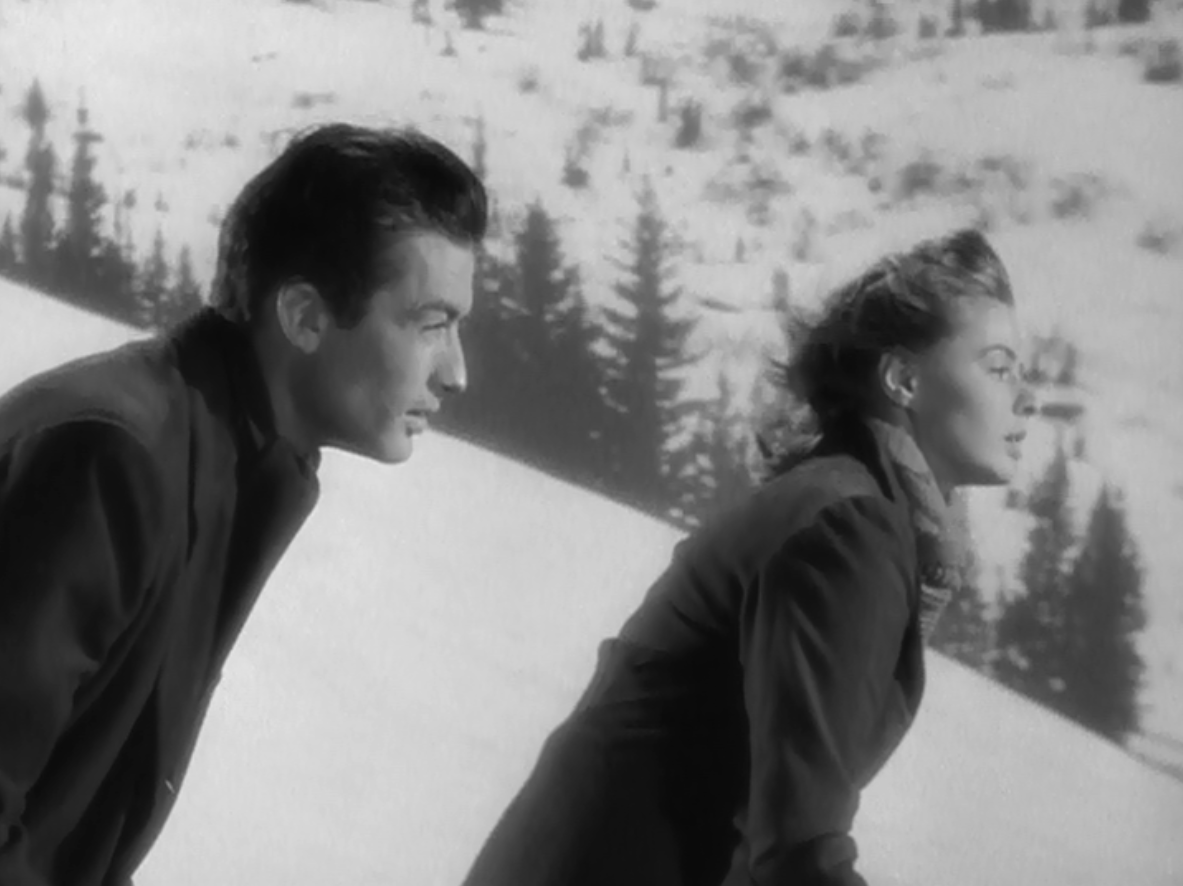
Gregory Peck and Ingrid Bergman ski in front of back-projected mountains in Spellbound.
Spellbound, on the other hand, is a Hitchcock film I know pretty well and like very much. Apparently, so do a lot of other people, because the Dryden Theater was pretty full the night I went. However, during the screening, I was surprised to hear certain folks laughing at the climactic back-projection scenes. Sure, I noticed the back-projection too, yet I have become pretty adept (or maybe always had a certain tendency to) immerse myself in the film I'm watching, suspending disbelief like a champ. Plus, the more older films I watch, the more I get used to the look of techniques like back-projection, which is essentially the pre-digital equivalent of green-screening. The actors are on a set, acting in front of a large screen onto which is projected a moving background, in this case, a ski slope as Gregory Peck and Ingrid Bergman ski down a mountain near the end of the film. To me, that back-projected action looks no less corny or unrealistic than, say, the digitally composited green-screen work in the Kong vs. T-rex battle in Peter Jackson's King Kong remake (discussed here). Maybe for some viewers, they feel a subconscious need (as Emily West documents in her account of a recent Magnificent Obessession screening) to show themselves to be above the tropes and techniques of the past. I do not judge these viewers nor do I deny that they surely take pleasure in their derisive laughter. I guess I simply prefer the pleasure of pretending that I am a 1945 audience member being taken in by the film and accepting its technical and aesthetic properties more or less at face value.

Ex Machina stands in the shadow (or on the shoulders) of Blade Runner, taking that kind of tale, about a wholly believable replicant, in exciting new gendered directions. The whole cast is good -- Oscar Isaac is the standout. The only problem I have with Ex Machina is that its final sequence, the last five minutes of the movie, is wholly unnecessary. The film should end with Ava getting on the elevator -- that is where the story ends, plus it is a brilliant if obvious reworking of the final shot of the Director's Cut of Blade Runner. (Maybe director Alex Garland is indirectly indicating his preference for the BR theatrical cut ending -- also wholly unnecessary and deflating.) But this is a small niggle about an otherwise well-acted, well-directed, suspenseful, and thought-provoking movie. Highly recommended!

While We're Young, written and directed by Noah Baumbach (The Squid and the Whale, Margot at the Wedding, Frances Ha) was even better. Ben Stiller and Naomi Watts play fortysomething Gen Xers (like me!) who meet a couple of offbeat, hipsterish millennials (Adam Driver and Amanda Seyfried) who happen to share the older couple's passion for documentary filmmaking. What ensues is hard to describe in detail without giving too much away, but this film feels to me like a more in-depth, better structured exploration of the issues Baumbach first explored in Frances Ha, his previous film. Both movies are about Gen Xers working through the last stages of their arrested development and "growing up" in some fashion or another. What makes Young so poignant is that we see this development take place in the context of an established couple, Stiller and Watts, both of whom deliver wonderful, funny, emotionally resonant performances here. Furthermore, the contrast between the Xer couple and the younger hipsters makes the struggles, miseries, and, in the end, triumphs of the former stand out all the more. We really feel for these two, much as we did Frances Ha's title character, but more so. I would probably say that While We're Young is now my second-favorite Baumbach film after The Squid and the Whale.
To sum up, then, my top movie recommendations this year would be Leviathan, Mad Max: Fury Road, Inside Out, Nightcrawler, Terri, Mr. Turner, Far From the Madding Crowd, The Babadook, and What We Do in the Shadows.
If I were to winnow that selection down to just three or four essential must-sees (acknowledging that Leviathan's bleakness, however humorously treated, places it outside many viewers' tastes), those would be Mad Max: Fury Road, Inside Out, and Far From the Madding Crowd.
As far as an essential documentary that every American should see, it's definitely Citizenfour.
Top films I still want to see include the Dardennes' Two Days, One Night, Peter Strickland's The Duke of Burgundy, Blue Ruin, End of Watch, Room, Carol, Sisters, Bridge of Spies, Spotlight, and The Revenant.
Happy New Year!
--
* Oyelowo thinks so too. He cites structural racism as a contributing factor to his Oscar snub. Ava DuVernay, Selma's director, says a similar thing, claiming that "[Hollywood] studios aren’t lining up to make films about black protagonists" or about "black people being autonomous and independent." Sadly, it is difficult to disagree with this assessment.
** Yes, I really enjoy and appreciate The Lost World: Jurassic Park, as I have noted twice before.


