Showing posts with label Hollywood Renaissance. Show all posts

Wednesday, May 25, 2016

Periodizing the Blockbuster Era


The above diagram schematizes some of the factors influencing the transition from the Hollywood Renaissance period (1967-1980) to the early decades of the Blockbuster Era (1975-present).

In the middle part of the chart (with the "synergy" arrow), I draw a boundary at about 1981, walling off the Hollywood Renaissance from the Blockbuster Era. Going solely by the content, tone, and look of the films, it's easy to impose that gap, with Raging Bull (1980) the last barbaric yawp of the European-influenced Hollywood Renaissance period and Raiders of the Lost Ark (1981) the herald of the big-budget Blockbuster Era.*

You can even see the difference between these cultural and industrial moments -- Renaissance and Blockbuster -- in the two (successful) Spielberg films that straddle the turn of the decade. Close Encounters of the Third Kind (1977), for all its third-act spectacle, is a film of the Hollywood Renaissance, or as close as Spielberg ever gets to directing one barring The Sugarland Express (1974). Close Encounters is an auteurist passion project for Spielberg, based on one of the few screenplays (outside of Sugarland and Poltergeist) he ever wrote himself. It features French New Wave icon Francois Truffaut performing in the movie, his presence a direct nod to Renaissance-era auteurism. More surprisingly for Spielberg, Close Encounters ends ambivalently: an emotionally unbalanced man abandons his earthbound family to fly away with aliens.

And then there's Raiders of the Lost Ark, a tightly episodic, sequel-spawning, consciously "calculated" action blockbuster.

However, at the infrastructural level, and as the short line at the bottom of my chart indicates, the transition between Renaissance and Blockbuster starts well before 1980. Disney is already lucratively synergizing their various product lines (live-action films, animated films, TV shows, theme parks, toys, etc.) by the 1950s, and TransAmerica buys United Artists in 1967. Disney and UA are the corporate harbingers of the post-1970s era of multinational corporate takeovers, corporate mergers, and the dominance of the synergistic business model built around "tentpole" summer blockbusters.

Film historian and political economist Thomas Schatz claims that 1974-5 represents the "peak and, as it turned out, the waning" of the Hollywood Renaissance period, its last hurrah consisting of films like NashvilleNight MovesChinatown, and The Conversation.** Indeed, film historians Kristin Thompson and David Bordwell tell us that the multinational corporate takeover of the major studios was more or less complete by 1982, at which point "all the Majors except 20th Century Fox had become wings of diversified conglomerates" like Gulf + Western, MCA, and Coca-Cola.†

Popeye Doyle sez: "We better enjoy this Hollywood Renaissance thing while we can, Cloudy -- it ain't gonna last."

Yes, certain artsy, downbeat, auterist films continue to be made into the late 1970s and early 1980s: The Deer Hunter, Coming Home (both 1978), Apocalypse Now, Being There (both 1979), Raging Bull, Reds (1981), and even First Blood (1982).

But despite all these promising late entries, there's no denying the implications of 1975's Jaws, "a social, industrial, and cultural phenomenon of the first order, a cinematic idea and cultural commodity whose time had come" (Schatz p. 26). Jaws is extremely well-made entertainment by super-genius director Steven Spielberg -- it's a totally badass movie, even according to Mark Kermode. Furthermore, it establishes the broad template for all subsequent blockbusters via its postmodern genre-mixology:
Jaws was essentially an action film and a thriller, though it effectively melded various genres and story types. It tapped into the monster movie tradition with a revenge-of-nature subtext (like King Kong, The Birds, et. al.), and in the film's latter stages the shark begins to take on supernatural, even Satanic, qualities a la Rosemary's Baby and The Exorcist. And, given the fact that the initial victims are women and children, Jaws also had ties to the high-gore "slasher" film, which had been given considerable impetus a year earlier by The Texas Chainsaw Massacre. (Schatz p. 25)
Genre-wise, then, the post-1975 blockbuster is nearly always an action-adventure film, even when hybridized with or superficially "skinned" to resemble another genre. Usually set "in the romantic past or in an inhospitable place in the present," the action-adventure typically features "a propensity for spectacular physical action, a narrative structure involving fights, chases and explosions, and in addition to the deployment of state-of-the-art special effects, an emphasis in performance on athletic feats and stunts." As Steve Neale, quoting Michael Nerlich, writes:
the ideology of adventure in its modern sense -- its association with the active seeking out of such events -- was developed in conjunction firstly with the medieval cult of the courtly knight, secondly with merchant adventuring (and state-sponsored piracy) in the early modern period, and thirdly with the spread of empire during the course of the nineteenth century. Hence its links with colonialism, imperialism and racism, as well as with traditional ideals of masculinity, run very deep.††
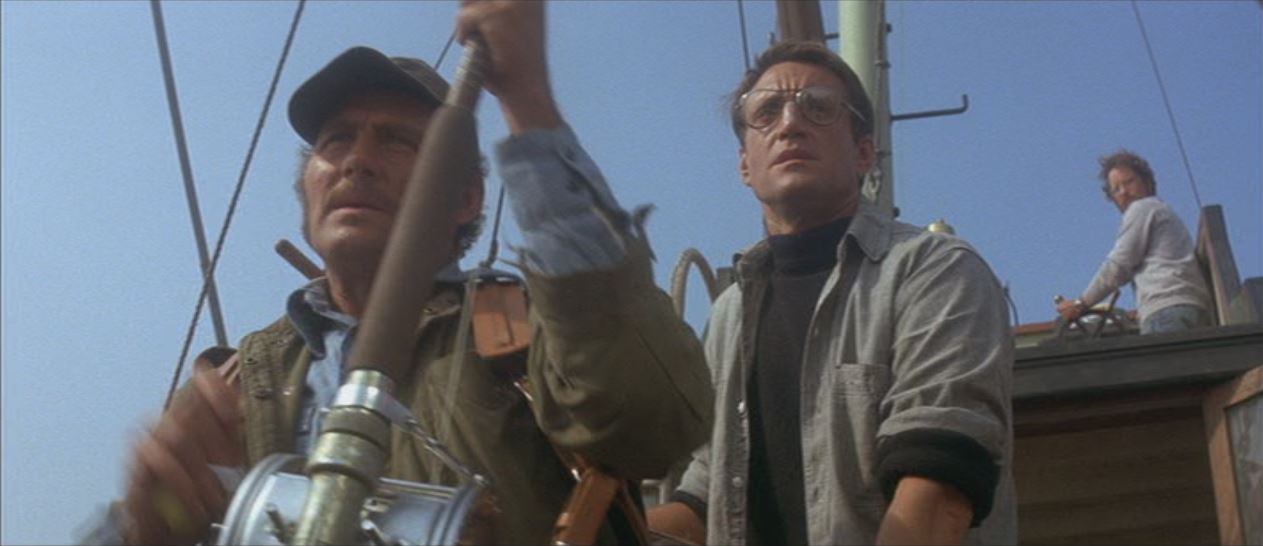
By defaulting to action-adventure pastiche, rather than artfully revising or reworking specific genres like many Renaissance films do, and by "recalibrating the profit potential of the Hollywood hit" to new, astronomical levels, Jaws and Star Wars toll the death knell of the auteurist Renaissance. Schatz writes that "the promise of Jaws was confirmed by Star Wars" -- its "emphasis on plot over character" solidifies the still-dominant action-blockbuster template (Schatz 24, 31, 29).

In 1981, Lucas and Spielberg's Raiders of the Lost Ark confirms the successful formula and sets the tone for the biggest hits of the coming decade:

Top Grossing Movies of the 1980s (adjusted for inflation) according to Box Office Mojo
1. E.T. the Extra-Terrestrial (1982)
2. The Empire Strikes Back (1980)
3. Return of the Jedi (1983)
4. Raiders of the Lost Ark (1981)
5. Ghostbusters (1984)
6. Beverly Hills Cop (1984)
7. Batman (1989)
8. Back to the Future (1985)
9. Indiana Jones and the Temple of Doom (1984)
10. Indiana Jones and the Last Crusade (1989)
My favorite sequence from Raiders of the Lost Ark, 1981's highest grosser and the film that sets the template for the summer blockbuster. 

Quoting Richard Schickel, Schatz notes that blockbusters from this point forward all belong to one of two "metacategories," either the comedy (e.g., Beverly Hills Cop, Ghostbusters) or the action film (e.g., all the other films on the above list). Schatz describes Star Wars in particular as the key proto-"high concept" summer blockbuster. For him, Star Wars exemplifies the tension between story and spectacle that characterizes the summer popcorn movie writ large:
One the one hand, the seemingly infinite capacity for multimedia reiteration of a movie hit redefines textual boundaries, creates a dynamic commercial intertext that is more process than product, and involves the audience(s) in the creative process -- not only as multimarket consumers but also as mediators in the play of narrative signification. On the other hand, the actual movie "itself," if indeed it can be isolated and understood as such (which is questionable at best), often has been reduced and stylized to a point where, for some observers, it scarcely even qualifies as a narrative. (39)
I agree with this account and have myself written about the recent blockbuster's trend toward spectacle over narrative.

What I want to do with the rest of this post is to try to break down the Blockbuster Era (so far) into smaller constituent periods, mainly derived from the chronological sketch given by Mark Harris in his must-read 2014 piece "The Birdcage":
The revolution of George Lucas’s game-changer — in purely financial terms — was that it confirmed what the James Bond series had suggested a decade earlier: There was no ceiling on how much money the right kind of series with the right kind of potentially escalating fan obsession could take in. Over the 25 years that followed Star Wars, franchises went from being a part of the business to a big part of the business. Big, but not defining: Even as late as 1999, for instance, only four of the year’s 35 top grossers were sequels. 
That’s not where we are anymore. In 2014, franchises are not a big part of the movie business. They are not the biggest part of the movie business. They are the movie business. Period. Twelve of the year’s 14 highest grossers are, or will spawn, sequels. A successful franchise is no longer used to finance the rest of a studio’s lineup; a studio’s lineup is brands and franchises, and that’s it.
To continue where Harris leaves off, I turn to Pamela McClintock's recent piece "Hollywood's Obsession with the 'Requel'" for its succinct definition of the latest transmogrification of the blockbuster: the requel. A requel is "a movie that's both a reboot and a sequel, blending old with new in an effort to extend the life of a franchise and, in the best cases, reinvent it for a 'universe' of follow-up movies."

The most successful requel so far.

Whereas the "hard" reboot usually retells an origin story, as with Star Trek (2009) or The Amazing Spider-Man (2012), the requel, according to McClintock, is different from either the reboot or the pure remake "in that it nods to and exploits goodwill toward the past while launching a new generation of actors and stories." It is, in essence, a thinly veiled remake in which the same basic stuff, with slight new variations, happens all over again to a new generation of characters. I like to describe it as "strangely similar things happening to slightly different people."

It's appropriate that Jurassic World should lead the (successful) charge into the Requel period, since it is so transparently a remake of Jurassic Park (Lee Sabo calls it "fan-fiction story-telling"), which in 1993 was already hyper-aware of its status as a global commodity.

The most important shot in Jurassic Park: Jurassic Park's gift shop. 

To sum up: origin-story-retelling reboots include Batman Begins (2005), Star Trek (2009), and The Amazing Spider-Man (2012).

Recent "pure remakes" include King Kong (2005), Cinderella, and Pan (both 2015).

Our requels category is so far inhabited by Terminator Genisys, Jurassic World, and Star Wars: The Force Awakens (all 2015), and Batman v. Superman: Dawn of Justice (2016).

I propose the following Periodization of the Blockbuster Era so far:

1975-85: Marking the inception of the Blockbuster Era proper with Jaws and Star Wars, these are the "Ten years that shook the industry" (J. Hoberman), the inception of the mega-blockbuster era. Schatz notes the increase in sequels and remakes from 1974 onward, writing that "From 1964 to 1968, sequels and reissues combined accounted for just under 5 percent of all Hollywood releases. From 1974 to 1978, they comprised 17.5 percent" ("New Hollywood" p. 27).

1986-99: The period of international conglomeration, worldwide release, and global synergy. The period during which Schatz's "calculated Blockbuster" -- calculated to be a major hit, produce sequels and spinoffs, and synergize with a larger product line and brand -- becomes the driving force behind the Hollywood film industry. As Thompson and Bordwell write,
The first wave of film studio acquisitions, from the 1960s through the early 1980s, had been initiated largely by conglomerates who wanted to diversify their holdings, to add a movie company to a menu of bowling alleys, parking lots, soft-drink bottling, or funeral parlors. The wave that began in the mid-1980s was more narrowly targeted, aimed at synergy -- the coordination of several compatible business lines to maximize income. (p. 664)
This period includes the Michael Eisner regime at Disney -- he's CEO 1984-2005. Eisner focuses on synergy and developing branded content, placing "special emphasis on activities and services that went beyond moviegoing or TV viewing" (T&B p. 696).

1989 is a key year, the starting point for the "dark" and "adult" interpretation of Batman on film. As Eileen Meehan documents, a dark interpretation of Batman was test-marketed beforehand by the release of Frank Miller's comic The Dark Knight Returns into mainstream bookstores.‡

Neale notes that in the 1990s Hollywood "conglomeration and synergy tended to accelerate on a national and international scale, as some of the mini-majors disappeared and as others were absorbed by the majors, and as the costs of making blockbusters and routine features alike continued to rise" (p. 230).

This period sees the wholesale onset of computer generated imagery (CGI) with pioneering effects-driven blockbuster films The Abyss (1989), Terminator 2: Judgment Day (1991), and of course Jurassic Park (1993).

Jurassic Park (1993) is perhaps the key film of this period -- a landmark in computer-generated effects, synergistic product lines, and global release strategies (Thompson and Bordwell p. 697).

Michael Keaton in 1989's Batman, another key film of the 1986-99 period.  

2000-14: I am tempted to call this the "Pointlessly Serious Superhero Movie" period. Fox's X-Men franchise launches eponymously in 2000, setting the general tone for the period. Disney's Marvel Cinematic Universe, which starts with Iron Man in 2008, goes a bit lighter in tone than X-Men, whereas Christopher Nolan's Dark Knight trilogy (2005-12) and Zack Snyder's Watchmen (2009), Man of Steel (2013), and Batman v Superman all go darker and more pretentious.

Speaking of Nolan and Snyder, Kevin Tsujihara becomes Time Warner's chairman/CEO in 2013 and announces a slate of ten Warner Bros. movies based on DC Comics characters to be released between 2016 and 2020. Of Tsujihara, Harris writes:
He has never produced a movie; in fact, he is the first studio head to rise in the ranks purely through brand extension and ancillary divisions, and brand extension is what he’s all about. Besides the DC announcement, his big accomplishments have been to nail down those three additional [J.K.] Rowling movies to add to the studio’s portfolio of eight, and to turn one Lego movie into four.
Tsujihara's counterpart at Universal is Jeff Shell, who becomes CEO in 2013 and about whom Variety's Peter Bart and Claudia Eller write that "Shell’s background and management style is strictly corporate and solidly Comcast." Significantly, Shell rises through the corporate ranks on the television side. Writing in 2014, Mark Harris suggests that by making seven- and ten-year plans for interlocking franchises a la Disney's Marvel Cinematic Universe, contemporary movie franchises replicate formulas that have been honed to perfection on and by television:
TV looms large over this new movie lineup. How could it not? TV is everything. TV is how people see movies; TV is where people want to watch movies, on demand and on their own terms; TV is what Twitter wants to talk about. Most of all, TV knows how to keep people coming back, which is its job, every day and every week, and is a quality that, above all others, the people who finance movies would dearly love to poach.
2015: The Requel period begins. In addition to the McClintock piece referenced above, see also Adam Sternbergh's recent essay on the studio as auteur and the "Marvel movie" as prototypical blockbuster. Analyzing directorial duo Joe and Anthony Russo's successful run of MCU films, Sternbergh writes:
As TV becomes more cinematic in its execution (multiple locations, expensive FX), and films become more TV-like in their storytelling (single chapters in an ongoing story), the decision to employ TV directors on Marvel films starts to make sense. Which is why directors like the Russos — talented, proficient, flexible, and instinctually collaborative — are perfectly suited to flourish.
If the release of Jaws marks the beginning of the Blockbuster Era, then it's been forty-one years since then. We are over forty headlong years into this Era, it is barreling along, we are just beginning the Requel period, and there's no end in sight. We don't even really know what we're in for yet. As Harris concludes,
What we are witnessing is not stability but transition — the evolutionary moment of overlap in Hollywood when the old way and the new way transiently coexist. Ten years from now, the old way will be gone. The new way will simply be the way.
The way of the endless requel and its mutant spawn.

Hi, I'm Mark Harris. I'm so goddamned smart about movies and a fine writer, too. Carter is quite impressed with me.

--
* You'll notice that I call the Hollywood Renaissance a period and the Blockbuster Era an era. That's because the former is a short transitional period bridging the stretch between the decline of the Studio Era (and it is surely in decline by the 1950s) and the rise of the Blockbuster Era. The Hollywood Renaissance years constitute the tail end of a longer period that begins circa 1948 when the Paramount Decree critically alters the makeup of the Golden Age Studio System. Thomas Schatz describes the 1947-60 period in the later chapters of his The Genius of the System (Pantheon Books, 1988).
** Schatz, "The New Hollywood," in Movie Blockbusters, Ed. Julian Stringer (Routledge 2003),  p. 27.
† Thompson and Bordwell, Film History: An Introduction (Third Edition, McGraw-Hill, 2009) p. 664.
†† Neale, Genre and Hollywood (Routledge, 2005) pp. 49, 46, 51.
‡ Meehan, "Holy Commodity Fetish, Batman!" in The Many Lives of the Batman (Ed. Roberta E. Pearson and William Uricchio, Routledge 1991) p. 53.

Wednesday, March 9, 2016

EW #12: The Searchers (1956)

The Searchers' Ethan Edwards is "rootless, homeless. Like the Indian corpse whose eyes he shoots out, 'he travels between the winds.' There is no starting over for Ethan, no erasure of the past, no reinvention of self, no America." 
-- Jim Kitses, Horizons West pp. 94, 97

John Ford's The Searchers is one of the best Hollywood Westerns ever made, and also one of the best and most culturally significant American films ever made.* It well deserves high placement on any "Top Films" list including Entertainment Weekly's. It makes sense to me that The Searchers would be EW's (or anyone's) highest-ranked Western. As Owen Gleiberman explains, "That John Ford’s dark Western The Searchers (#12) ended up as high as it did testifies to our feeling that the film’s darkness was ahead of its time – that the movie now seems front and center in the culture more than many older Westerns."

Set in "Texas 1868," The Searchers tells the story of Ethan Edwards (John Wayne), a Confederate veteran who returns to the frontier homestead of his brother, Aaron (Walter Coy), Aaron's wife Martha (Dorothy Jordan), and their children, Lucy, Ben, and Debbie. A young man of mixed blood named Martin Pawley (Jeffrey Hunter) also lives with the family. We learn that Ethan rescued the infant Martin from a massacre, but now he doesn't like to talk about it and seems uneasy around him. Martin calls Aaron "uncle" and Martha "aunt" but Ethan insists the young man address him as "Ethan" rather than "uncle."

Martha's marriage to Aaron is passionless. Several early scenes -- hell, the film's opening shot! -- clearly show that it is she and Ethan who are truly in love, though this is not (verbally) acknowledged. "Is Ethan punished for his covetousness. or for a sin of omission?" Jim Kitses asks. The film never answers this question or explicates the Ethan and Martha backstory, but Kitses is correct to assert that "this wrong marriage [between Martha and Aaron] inflects the tragic action of The Searchers." **

Soon after Ethan's return, Aaron, Martha, and Ben are massacred and Lucy and Debbie kidnapped by a Comanche war party led by Scar (German-American actor Henry Brandon). Thus the titular search begins as Ethan and Martin spend the whole movie -- seven years -- looking for Lucy and Debbie, tracking the elusive Comanche war band who took them.

I won't reveal details of the film's plot twists or ending, but suffice to say that Ethan goes further and further off the rails as events of the film progress. He is a violent, ruthless man to begin with then actions like barging impatiently out of a funeral service, shooting out the eyes of a dead Comanche, and luring a minor profiteer to a brutal shooting death reveal Ethan to be borderline psychotic.

Scenes depicting community rituals like dances, weddings, and funerals hold a place of special importance in John Ford's westerns . . . 

. . . therefore when Ethan Edwards abruptly storms out of this one, it signifies that he is a lost soul, beyond redemption or recuperation, a quality rare to find in a Ford protagonist.

Ford biographer Joseph McBride calls The Searchers "a film of warring dualities" that "gets to the heart of many of the unresolved contradictions that make the Western genre such a rich field for exploring American history and mythology." I think The Searchers gets at the core of those mythological and historical contradictions partly because it occupies the cusp between the Hollywood western's classical and revisionist phases.

You see, most genres or film cycles move through a succession of three broad phases: the formative, the classical, and the revisionist. (Some theorists like to add a fourth phase, the parodic, but I see the mode of parody as already integrated into the revisionist phase, so screw that.)

The formative phase is when the genre does not yet fully exist -- it is being shaped by a process of certain types of films being released, certain patterns and combinations becoming popular, and more of those types of films being made. Westerns have a long history: since some of the first 1890s Edison actualities were of wild west show stars like Annie Oakley, one could say the western genre was nascent in motion pictures from their earliest inception. The Great Train Robbery (1903), one of the first widely seen multi-shot narrative films, is also a western. Therefore one could say that the western's formative phase was also the formative period of Hollywood narrative cinema writ large.

The classical phase of the Hollywood western coincides with the rise of the sound western. Synchronized sound arrived in Hollywood right at the dawn of the '30s, and John Ford's Stagecoach (1939) is usually cited as the inaugural movie of the western's classical period, which lasts through the '40s and into the '50s.  

John Wayne as the Ringo Kid in Stagecoach (1939), the film that launched him to stardom. Stagecoach inaugurates the Hollywood western's "classical" phase. 

Released in 1956, The Searchers is one of the first revisionist westerns -- or at least a proto-revisionist one.

Many film critics and historians cite Ford's own myth-deconstructing The Man Who Shot Liberty Valance (1962) or Sergio Leone's A Fistful of Dollars (1964), the first major "spaghetti" western, as the tipping point between the sound western's classical and revisionist phases. I can get behind that. Yet revisionist tendencies are present in certain 1950s westerns including The Searchers, Johnny Guitar (1954), and Anthony Mann's Winchester '73 (1950), The Furies (1950), and The Naked Spur (1953).

Revisionist westerns explicitly refer back to, satirize, rework, deconstruct, and/or sometimes radically break with the conventions established in the genre's classical phase. In revisionist westerns, the protagonists' motives get darker, more ambiguous, and less heroic (as in The SearchersThe Naked Spur, and The Wild Bunch). In revisionist westerns, the callous and brutal treatment of indigenous people is at least sporadically questioned (as in The FuriesCheyenne Autumn, and Little Big Man). Sometimes women play unexpectedly non-traditional or non-domestic roles (as in The FuriesThe Naked Spur, and Johnny Guitar). Most revisionist westerns play the classical conventions knowingly or for laughs in ways designed to parody, question, and/or critique them.

In the end, The Searchers walks a fine line between classical and self-reflexive tendencies. Broadly speaking, I would say it is classical in its aesthetic choices (artfully constructed visual tableaux, beautiful Monument Valley scenery, a symphonic musical score) but revisionist in its deconstruction of the character of Ethan Edwards.

McBride describes as "subversive" the particular way in which The Searchers
turns the concept of Western heroism inside out, showing the lone gunman who acts in the name of nascent civilization as a warped, destructive force. Martin gains in stature as the search progresses, becoming a truly modern man, whereas Ethan is diminished, trapped in the destructive patterns of the past. The man with mixed blood, not the white supremacist, is the 'intrinsic-most' American. 
White supremacist though he may be, Edwards represents both a career high performance for John Wayne and an important iteration of the American frontiersman archetype. This type originates with James Fenimore Cooper's Natty Bumppo, best known as protagonist of The Last of the Mohicans. He is a white character who "goes native," appropriating an indigenous ethnicity with which he identifies. He traverses the boundaries between the indigenous culture he appropriates and the dominant, Euro-American culture to which he also belongs. The American wilderness hero is, in ecocritic David Ingram's words, "close to wild nature and to the naturalized values of force and violence it represents" but at the same time functions as "an agent of the commercial development of that wilderness." †† That is, he travels and identifies with indigenous people but sells them out to the white man anyway.

In his appropriation of indigenous culture, his tracking skills, and his ambivalence toward Euro-American civilization, The Searchers' Ethan Edwards resembles Natty Bumppo, James Fenimore Cooper's woodsman hero.

Joan Dagle writes specifically of The Searchers' complex protagonist that
Ethan's knowledge of Indian culture, including Comanche culture, is extensive and allows him to stay on Scar's trail. More interesting, however, is his identification with Indian culture, an identification which complicates the reading of Scar and Ethan as racial antagonists. [Ethan's] intimate knowledge of Indian beliefs is hard to account for. How does he come to know so much, including religious beliefs, about a people he hates? ††
For a guy who hates the Comanche so damn much, Ethan Edwards sure knows a lot about their customs, beliefs, and funerary practices.

By acting out his racially motivated vengeance, Ethan Edwards shows us the ugly, imperialistic violence that underlies the very notion of the Western protagonist, the very notion of John Wayne. Edwards is both the apotheosis and the deconstruction of the Wayne persona. By contrast, Wayne's role as John T. Chance in Howard Hawks's Rio Bravo, while beautifully nuanced, is a nostalgic return to the good old days; his Tom Doniphon in The Man Who Shot Liberty Valance is a ghost, the last of a dying breed, an elegy for the Wayne/Edwards archetype and its foundational role in building the myth of the West.

I have written before of the "depth and beauty" of John Ford's work. Ford is a director of surprising subtlety and tenderness when it comes to the depiction of human emotions. For all his long affiliation with the western, Ford is fundamentally a melodramatic director interested in the emotions of longing, nostalgia, sadness, and loss (unlike Hawks, who is more action-adventurish and bromance-y). Ford is mainly a visual director and is finely attuned to the nuances of love, affection, and relationships, especially when played out compositionally and gesturally. Hence the tenderness of his love scenes, and the real payoff of any well-made John Ford film: for all their superficial formality, they are emotionally resonant and deeply satisfying.

Beautifully composed shots like this one exemplify John Ford's show-don't-tell style of filmmaking. For me, this composition suggests that for Ethan, finding Debbie (who is running down the hill in the background) is a matter of the head, but for Martin it's a matter of the heart and guts.

I understand that for some of my readers, The Searchers' status as a western and/or the presence of John Wayne in the lead role dampens your interest in seeing it. Yet if I were to recommend only one western for the non-fan to check out, it would be this one, Rio Bravo, or The Naked Spur. So The Searchers is in my top three westerns -- I cannot recommend it highly enough.

UPDATE 5/19/2016: BFI's Christina Newland calls The Searchers the "Best Place to Start" if you want to explore the 1950s psychological western, a grouping that also includes Mann's The Naked Spur and Nicholas Ray's Johnny Guitar.

Bonus Afterthought: There is an explicit link between The Searchers and Taxi Driver (itself #42 on EW's Top 100 list). Martin Scorsese famously claimed that The Searchers should have included a scene in which we see Scar and Debbie together during their “married” life. When he and Paul Schrader were making Taxi Driver, which borrows many structural and tonal elements from Ford's influential western, they included such a scene between Sport and Iris. Their Taxi Driver "Scar scene" stands out as one of the few in the film that doesn't unfold from Travis Bickle's point of view.

Martin Scorsese discussing Taxi Driver circa 1997.

Film critic Robin Wood says of The Searchers' missing "Scar scene," which would have spelled out "Debbie's relationship to Scar and Comanche life," that
It is a scene Ford could not conceivably have filmed, and Scorsese and Schrader are quite right in implying (I presume) that its absence definitively highlights the cheating, evasion, and confusion that characterize the last third of his movie.  
Wood calls The Searchers an archetypal "incoherent text," a film that does not quite know what it wants to say, a work "in which the drive toward the ordering of experience has been visibly defeated." Yet as Wood says of Taxi Driver and other "incoherent" films of the 1970s, The Searchers is a much more interesting movie precisely because of its ambiguities, abrupt turns, confusions, and contradictions.

Analogously, Joan Dagle sees The Searchers' circling, non-linear plot structure as integral to the whole point the film is trying to make: that hate and vengeance are inward-focused and self-destructive. Indeed, The Searchers documents Ethan's racism- and rage-fueled spiral into his own personal hell. It ends with him cast adrift, left with nothing once his fury is spent. Ethan -- and the film -- go nowhere.

Yet of course it goes somewhere: deep into the dark recesses of the psyche of a racist, reactionary white man and the community he both saves and plagues. Head-on into the contradictions and incoherences at the heart of the violent American frontier myth. Head-on into America's bloody, racist past (and present).

This guy, whose analysis is otherwise pretty sharp, feels comfortable comparing The Searchers with Taxi Driver in order to declare the latter "simply a better film" than Ford's masterpiece. For me, these two films, while structurally and thematically similar, are far too different -- in period of release, in genre, in tone -- to be comparatively evaluated.

--
* My short list of most essential Hollywood westerns includes Stagecoach, My Darling Clementine, High Noon, Rio Bravo, The Naked Spur, The Wild Bunch, and Unforgiven. I would also include "spaghetti" westerns like The Good, The Bad, and the Ugly and Once Upon a Time in the West, plus postmodern / revisionist entries El TopoDead Man, The Tracker, Meek's Cutoff, and, from what I hear, Slow West.
** Kitses, Horizons West: Directing the Western from John Ford to Clint Eastwood (New Edition) (BFI, 2007) p. 94.
*** McBride, Searching for John Ford (Univ. Press of Mississippi, 2001) p. 558.
 McBride p. 560, 564.
 Ingram, Green Screen: Environmentalism and Hollywood Cinema (U. of Exeter Press, 2000) p. 74. Ingram offers an extended discussion of the American wilderness hero type on pp. 74-77 of Green Screen, acknowledging his debt to Richard Slotkin's work in Gunfighter Nation:The Myth of the Frontier in Twentieth-Century America (Atheneum, 1992).
 Joan Dagle, "Linear Patterns and Ethnic Encounters in the Ford Western" in John Ford Made Westerns, ed. Gaylyn Studlar and Matthew Bernstein (Indiana Univ. Press, 2001) p. 122.
 In terms of film noir, the comparable performance, the one that goes to such extremes that it exposes the grim, paranoid, ideologically retrograde conventions and assumptions underpinning its genre, is probably Ralph Meeker as Mike Hammer in Kiss Me Deadly (1955).
‡‡ Wood, Hollywood from Vietnam to Reagan and Beyond (Columbia UP, 2003) pp. 47, 42.

Saturday, June 13, 2015

Review: The Fog (1980)

Hal Holbrook as Father Malone in The Fog, John Carpenter's underrated 
supernatural revenge thriller.  

I am a major John Carpenter fan. He is an enormously talented and consistent genre filmmaker whose string of 1970s and 1980s films, including Assault on Precinct 13 (1976), Halloween (1978), Escape From New York (1981), The Thing (1982), Starman (1984), Big Trouble in Little China (1986), and They Live (1988), establish him as one of the key figures of the Hollywood Renaissance. However, due to his somewhat lower budgets and propensity to stick to "low" genres like horror, action, and science fiction, he often gets short shrift in accounts of this uniquely fertile period in American filmmaking.*

Carpenter's revenge-of-ghosts thriller The Fog was a somewhat troubled production, requiring extensive reshoots late in the process and receiving mixed reviews upon its release in early 1980. But it fared okay at the box office and is by no means despised, just somewhat overlooked, especially in comparison to the bigger hits that bracket it.

I am a pretty big fan of The Fog, rating it my third or fourth favorite Carpenter film overall, behind Assault, The Thing, and Halloween. I feel great love for the Carpenter / Kurt Russell collaborations Escape from New York and Big Trouble in Little China, yet I confess that I re-watch The Fog far more often than I do either of those two pictures. I probably even re-watch it more frequently than I do Halloween these days.** Why do I enjoy The Fog so much? Let me explain.

Darwin Joston, who played the second lead in Carpenter's Assault on Precinct 13, makes a cameo appearance as medical examiner Dr. Phibes in The Fog

Like The Thing, Carpenter's 1982 career masterpiece, The Fog is a true ensemble film, and both the specific individuals involved and their onscreen performances here are absolutely superior. We're talking about Carpenter regulars Jamie Lee Curtis, Tom Atkins, Charles Cyphers, Nancy Loomis, and Adrienne Barbeau, plus legendary performers Janet Leigh, Hal Holbrook, and John Houseman making impressive late-career appearances (though the latter only appears in a very brief cameo, essentially introducing the film). As if that weren't enough, Carpenter himself makes a cameo in front of the camera as church handyman Bennett, something he rarely ever does. His line delivery is not terrific, but it's neat to see him in there. And his early scene with Father Malone is the only one in the film in which the performances (specifically Carpenter's) are anything less than stellar.

Indeed, like Jaws 2 or other films of the 1970s, The Fog's more relaxed moments of character development -- which it is unafraid to embrace at length, allowing the movie to "breathe" in ways few post-1980s mainstream genre films manage -- are especially good, and feel especially "real." I know the word "real" is an extremely subjective, slippery, and historically contingent term to use in reference to complex storytelling media like movies. All films are fiction films, and none -- not even documentaries -- represent true, lived reality with particularly great fidelity. So maybe the adjective I'm looking for here is "lived-in," an appearance of comfortable, easy familiarity that connotes psychological depth and emotional richness using only a few briefly sketched details. The best example of this from The Fog (though there are many, including every conversation between Nancy Loomis and Janet Leigh) is the scene between Nick and Elizabeth at Nick's house in Antonio Bay.

One of my favorite scenes in The Fog: Nick (Tom Atkins) and Elizabeth (Jamie Lee Curtis) discuss her drawings and their lives in a wonderfully natural and intimate sequence. 

This naturalness or lived-in-ness carries over into the film's brilliant use of locations, especially the lighthouse from which Stevie Wayne's radio show broadcasts nightly. Carpenter's use of actual northern California exteriors really pays off in The Fog -- the film looks like few other Hollywood productions do solely on this basis. The choice to shoot at least partially in northern Cal subtly evokes that other uncanny thriller associated with the region, Alfred Hitchcock's Vertigo (1958). By saying this I do not mean to compare The Fog to Vertigo in terms of artistic accomplishment, emotional impact, or overall quality, for in all these areas, Hitchcock's film is superior. I simply mean to point out that Carpenter uses his locations very well. They lend a visual richness and depth to The Fog.

Stevie Wayne (Adrienne Barbeau) hikes down the stairs to her lighthouse radio station. This exterior was shot on location on the northern California coast. 

The Fog also does a lovely job paying homage to other films and narrative traditions that have come before. As I've said, The Fog's scenery vaguely reminds me of the locales of Vertigo: Antonio Bay evokes the highway leading to the redwood forests and Father Malone's church substitutes for the Spanish mission. Beyond that, Janet Leigh's presence in this film obviously recalls Psycho. The film's climactic showdown in Father Malone's chapel, with our ensemble of heroes fighting off murderous ghosties coming in through the windows, is surely a deliberate callback to similar scenes in Night of the Living Dead. And Stevie Wayne's concluding admonition to "Look for the fog!" is a direct echo of The Thing from Another World's final line, "Watch the skies!" Lastly, The Fog's whole central narrative arc about vengeful, supernatural creatures emerging from the sea to kill a bunch of clueless townspeople evokes, well, every scary story about hook-handed murderers you've ever heard around a campfire.

Indeed, Houseman's opening pre-credits vignette, depicting just such a story being told to children around a campfire, makes clear that The Fog knows it is treading well-worn narrative ground here, revealing that its main purpose is to have us sit back and enjoy the ride while it offers us an occasional scare accompanied by a nudge and a wink. I think that this knowingness, the film's touch of intentional camp, is one of the central pleasures to be had in viewing The Fog.

Sandy (Nancy Loomis) and Kathy (Janet Leigh) discuss the curse that has fallen upon their town with the gloomy, inconsolable Father Malone.

Along this line, the film's greatest triumph is the casting and performance of Hal Holbrook as Father Malone. In contrast to the scenes with the rest of the cast, none of the scenes involving Malone feel "lived-in" or real, but rather hyperbolically melodramatic and symbolically overdetermined. If everybody else in Antonio Bay is going about their daily lives in a relatively pedestrian way, Malone feels like he has been dropped into the proceedings from the set of a histrionically overcharged morality play. However incongruous this may sound as I write it, trust me: Malone's every scenery chewing moment is absolutely delightful. Malone is both the moral center of the town (and the film) and the most entertaining single element to be found in The Fog.

The only elements that compete with Malone for sheer entertainment value are some of the juicy murders committed by the film's verbally reticent sea-ghosts.

[Note: This next paragraph contains SPOILERS so if you want to avoid them, skip down past the screenshot of the Antonio Bay coastline.]

As Halloween aptly demonstrates, John Carpenter knows how to stage thrilling, horrific-but-not-too-gory death scenes. As with Halloween, in The Fog there are relatively few actual killings (only six people die) but most of these folks' final moments are pretty memorable. The best and most brutal deaths are the first ones, on board the ill-fated trawler Sea Grass, but my personal favorite killing is that of over-confident, wisecracking weather reporter Dan (Charles Cyphers) -- the buildup to that particular death is priceless. And as with the little girl murdered by gangsters early on in Assault on Precinct 13The Fog demonstrates that Carpenter is unafraid to brutally kill off innocent, good-hearted, sympathetic characters we care about in order to raise the stakes. The deaths of Dan and Mrs. Kobritz are the best examples of this.

Mrs. Kobritz's last stand. 

Antonio Bay at twilight, an example of The Fog's top-notch scenery and cinematography and a signal that "the coast is clear" regarding SPOILERS in this review. 

Discussing The Fog's killing scenes brings to mind the film's one possible weakness, the element that motivated its eleventh-hour reshoots and serves as a key criticism for its detractors: its somewhat inconsistent tone. Most of the explicit parts of The Fog's murder scenes were added late and feel more slasher-ish than uncannily ghost-like. The aforementioned character-development scenes, like those between Nick and Elizabeth, feel more like they belong in Hal Ashby's Shampoo than they do in a John Carpenter-directed horror film. Contrasting with both of these more "realistic" elements are the supernatural, glowing fog and the ghosts it brings with it, which are uncanny and creepy but not truly very shocking or scary. For some viewers, these three different tones may not cohere well or add up to anything particularly impactful by the film's last reel.

Yet for me, The Fog's disparate elements weave together well, aided by Father Malone's relentless hammering of the vile motivations behind the revenge plot and the film's frequent, highly adept use of cross-cutting to suggest simultaneity and thematic linkage between its various story strands.  

In sum, The Fog is a glorious mishmash of casting choices, genre conventions, and film references that somehow jells in a way that really works for me. Is it the scariest ghost story you'll ever see on screen? No, not by a long shot.*** Is it John Carpenter's best film? No, not that either. But is it full of self-aware pleasures, superb cinematography, (mostly) lived-in performances, and a few fun scares? Absolutely. Is it worth your time? I'd say so.

Father Malone sez: "We're all murderers!"

Bonus afterthought: I have never seen the 2005 remake of The Fog and never plan to -- you're joking, right? 


UPDATE 8/30/2015: This io9 list names The Fog as a "devastatingly beautiful" horror film.

UPDATE 5/25/2016: Enjoy Guillermo Del Toro's appreciative series of tweets about John Carpenter.

--
* By Hollywood's standards, "low-budget" means around $6 million or less. Carpenter's Halloween was made for $325,000 and The Fog was reportedly made for approximately $1 million. For more information about the Hollywood Renaissance, see my review of Bonnie and Clyde.
** Halloween is a big movie for me, because it is the film my younger brother used to lure me into horror film fandom in the first place, and it is surely the John Carpenter film I have seen the greatest number of times by far. It will always maintain a special place in my viewing history and my heart, even if there are other horror films (such as The Texas Chain Saw Massacre and Videodrome) and John Carpenter films (especially Assault on Precinct 13, my very favorite) that I enjoy more than I do Halloween. It may also be that once I saw Bob Clark's Black Christmas (1974) and realized that Carpenter stole most of Halloween's innovative visual ideas from that earlier slasher, my appreciation for Halloween was somewhat diminished.
*** That distinction surely belongs to Kairo (2001, dir. Kiyoshi Kurosawa) or maybe The Innocents (1961, dir. Jack Clayton). 

Wednesday, July 30, 2014

EW #9: Nashville (1975)

Henry Gibson as Haven Hamilton in Robert Altman's masterpiece Nashville

Although this entry once again emphasizes the strong bias of the EW staff in favor of 1970s American cinema, Nashville, Robert Altman's 1975 epic about the music industry and American politics, is truly a masterpiece worthy of very high placement on any Top 100 Films List. For Altman himself and for 1970s Hollywood cinema writ large, it just doesn't get much better than Nashville. 

Nashville is one of my very favorite films, bar none -- it appears on my "Top 40 Films" list of last November and is one of only nine movies to place on my personal Top 40 and on EW's 100 Best Films list.*

Film critic Robin Wood identifies Nashville as essential Altman, stating that
Everything in Altman so far -- the good and the bad -- comes together in Nashville. Its great scenes -- Gwen Welles' enforced striptease, Ronee Blakley's onstage breakdown, everything involving Lily Tomlin -- are all centered on the characters' exposed vulnerability and realized with painful intensity. At the other extreme are the embarrassingly Cutie-pie uncredited guest appearances of Elliott Gould and Julie Christie as Themselves.
Unlike me, Wood is none too keen on these latter moments of meta-textual wit; for him, they disrupt or lessen Nashville's potential political impact. He concludes:
The film's total effect -- for all the marvelous local successes -- is to engulf the spectator in its movement of disintegration, making intellectual distance impossible. The ironic force of the ending, with the crowd confronting catastrophe by singing "It don't worry me," a communal refusal to think, is weakened not simply by the inability to offer any constructive alternative but by a perverse rejection of the possibility.**
Wood claims to feel "somewhat sick and depressed" at the end of Nashville, and that, I think, is a proper response (though I typically respond with schadenfreude-laced elation). The film's dead-on accurate portrayal of how American jingoism blinds us to the real machinations of capitalism should indeed disturb and, to some extent, sicken us.

However, I disagree with Wood that intellectual distanciation is rendered impossible by Nashville. In some ways, the film's very mythic/allegorical dimension, the way so many of its characters, while being very particular, feel like stand-ins for classic American types, encourages us to read the film symbolically and intellectually. Nashville's darkly ironic use of the American flag and that closing song surely provoke me to respond thinkingly to the film, to consider it as an eerily accurate mythic summation of the contradictions inherent to American character and culture.

This prominently placed American flag freights the final sequence of Nashville 
with mythic -- if deeply ironic -- layers of meaning.

No, I instead prefer Jonathan Rosenbaum's succinct assessment of Nashville from his book Essential Cinema:
In point of fact, the film celebrates as much as it ridicules -- often doing both the same time -- while giving both its brilliant cast and its audience too much elbowroom to allow for any overriding thesis.***
That's just it. If my post thus far makes Nashville sound like some sort of pedantic manifesto or overt "social statement," that is not an accurate portrait. Altman's great talent lies in creating films that feel "lived-in" and real. His heavy dependence upon his actors and his insistence that they improvise and go off-script keeps his work from ever feeling too artificial or "writerly."† So even if, in the broad strokes, Nashville resonates on political, mythic, and satirical levels, it nevertheless feels so real and alive and delightful in all its interactive particulars that it never feels heavy handed or false. If anything, its ability to draw the viewer in, to involve us in its wonderfully human textures, may be exactly what makes Wood feel so disturbed by the ending of it -- it is difficult, once one is immersed in such a believable, nuanced, and enjoyable onscreen world, to extricate oneself from the darker, more violent implications of that world's underlying logic.

As Rosenbaum puts it,
The difference between conventional methods and Altman's is one between directness and indirectness, actions and interactions -- the actors', the characters', the director's, the scriptwriter's, and our own. It is decidedly a group endeavor, and, as such, one that lives and breathes in an intangible no-man's-land between "thinking" and "playing" for the filmmakers, "thinking" and spontaneous "reacting" for the audience: the relative strengths of both values are held. ††
To sum up, Altman's films, and perhaps especially Nashville, are difficult to describe or assess in words; to see them is to experience something quite ethereal and magical and particular to the workings of (Altman's) cinema.

Yet I can say a few words about why Nashville is particularly essential viewing. Besides the fact that it is one of Alman's most assured and "unified" films (if that word is even appropriate when describing a filmmaker like Altman), Nashville is also an important historical film, one of a group -- including The Parallax View, All The President's Men, The Conversation, Taxi Driver, and The Deer Hunter -- that accurately characterize the vibe of post-1960s, post-Watergate America. Nashville's assassination plot and ironic use of anthemic-sounding music tie it formally to this group of films, while its downbeat, relaxed, even humorous tone make it stand out uniquely among this otherwise heavy menagerie.

Further, what Nashville achieves that few other Hollywood films of any era do is to stage an effective critique of the insidious and cruel nature of consumer capitalism. Every single musician or aspiring musician we see in the film has been co-opted and used in some way. Haven Hamilton is a pawn of the Nashville promotional scene and of local politics; Barbara Jean and Tommy Brown are token minorities who are used and then thrown aside; and poor Sueleen Gay is an aspiring singer whose very American dreams expose her to humiliations of the worst kind.

Aspiring musicians perform at a deafeningly loud racetrack, ignored by 
an indifferent crowd. Their plight reflects the fate of all the musicians we see in the film: 
the capitalist system lets them climb toward fame and fortune but gives them nothing in return, killing them metaphorically and (in some cases) literally. 

Indeed, one of Nashville's great strengths is its relentless exposure of the commodification and exploitation of women that lies at the heart of patriarchal (popular) culture. Although Wood argues that "Altman's identification with a female (never feminist) position is extremely problematic: it is limited almost exclusively to the notion of woman-as-victim, to sensations of pain, humiliation, and breakdown," I assert that this strategy is very effective and is aligned with the tradition of melodrama, which foregrounds and ennobles female suffering.††† For me, the heartbreaking scene in which Sueleen (Gwen Welles) does a striptease under duress is one of the most excruciating scenes in all American cinema -- as it should be. Far from exploitative, this scene, like most of the scenes involving the convalescing (recovering?) Barbara Jean, serve to highlight the ways in which the patriarchal entertainment industry -- which has clear ties to our patriarchal political leadership -- vampirically exploits women's bodies and talents in order to make more profit and further its oppressive ends. If everyone is exploited under capitalism, Nashville seems to say, women are exploited most of all, and suffer for it the most painfully.

Ronee Blakley as Barbara Jean, one of the most moving and heartbreaking 
characters in Nashville

Finally, I take it as significant that the song the crowd sings together at the end -- "It Don't Worry Me" is actually a hit radio song composed (in the world of the film) by callow folk-rocker Tom Frank and heard in snippet form on his album and requested by fans at a pub before we finally hear it sung in full by all in the denouement. In other words, far from being a grassroots anthem, this song of "resistance" -- or is it compliance? -- that the crowd spontaneously sings is actually itself a commodity, a song marketed to them by the same Nashville music industry that set the stage for the film's climactic tragedy. The crowd is simply reproducing what the exploitative system has already sold to them. In this way the film interweaves the political and the pop-cultural, showing us that what counts as "culture" in America is a for-profit, totalizing network of systems -- fully encompassing party politics -- that only requires our docile participation in order to maintain its awful, exploitative momentum.  Nashville thus incisively exposes how supposedly "apolitical" performers and activities are anything but.

Yet there I go again, harping on Nashville's political themes, when I should be emphasizing how well-acted, cleverly constructed, witty, touching, and fun this film is to watch. There are many films I consider to be socially or politically important, but few that I return to nearly as often as Nashville for the sheer pleasure of it. I give this film my highest endorsement and urge all of my readers to check it out.

Arnold Schwartzenegger and Elliott Gould in The Long Goodbye.

Bonus Afterthought: Despite my deep appreciation for the Altman films I have seen -- about nine altogether, and a few of those so long ago I don't remember them well -- I have not seen a great many and am no expert on the director. Sure, nine films sounds like a respectable number, but Altman is prolific and that count does not include crucial entries like California Split (1974) and 3 Women (1977). Plus my memories of the seminal McCabe & Mrs. Miller (1971) are rusty at best.

Nevertheless I can point you toward a few of the other Altman features I have enjoyed most: Gosford Park (2001), Short Cuts (1993), and The Long Goodbye (1973).

A bit less ambitious but no less well-crafted than his mid-career epics, Gosford Park is a delightful treat that any moviegoer should enjoy. One of Altman's few films set outside the U.S. context -- in Great Britain -- this comedy of manners/whodunit will surely appeal to fans of the hit BBC series Downton Abbey, particularly since its screenplay was penned by Downton creator Julian Fellowes.

The Long Goodbye and Short Cuts are both exemplary L.A. films, the former a parodic riff on film noir, the latter another lengthy "tapestry" film of interweaving stories similar to Nashville. I have a hard time choosing which of these two films I like better -- they are tied for my second-favorite Altman film after Nashville. I recommend Goodbye to fans of film noir and offbeat comedy, but would probably have to consider Short Cuts more essential viewing if you have the time to invest in it -- at just over three hours, it is twenty-five minutes longer than Nashville.

--
* The nine films appearing on both lists are: The Wild Bunch [#83], 2001: A Space Odyssey [#25], Blade Runner [#81], Chinatown [#31], Double Indemnity [#40], Nashville [#9], Psycho [#5], Rules of the Game [#39], and Night of the Living Dead [#79].
** Wood, Hollywood From Vietnam to Reagan . . . and Beyond, p. 36.
*** Rosenbaum, Essential Cinema, p. 92.
† The exception to this rule is Altman's debut feature, MASH, which, as Rosenbaum points out, is a relatively focused "thesis film" quite different from all of Altman's subsequent work (Essential Cinema pp. 81-2).
†† Rosenbaum, p. 81.
††† Wood, p. 38. For more on melodrama, see Linda Williams' "Melodrama Revised" and/or Kathleen Karlyn's Unruly Girls, Unrepentant Mothers. 


Wednesday, May 7, 2014

EW #7: Mean Streets (1973)

Harvey Keitel leads a stellar ensemble cast in Mean Streets, Martin Scorsese's best film.

This entry in the Entertainment Weekly All-Time Greatest film list represents one of the most pleasant and exciting surprises on the list for me personally. True, EW's placement of Mean Streets so high in the rankings seems to support the notion that EW's critics overwhelmingly favor Baby Boomer cinema -- The Godfather, Bonnie and Clyde, Mean Streets, and Nashville are all in the Top 10, with seminal Boomer comedy Annie Hall just around the corner at #13. However, their placement of Mean Streets as the highest-ranked Martin Scorsese film, described in their laudatory blurb as "the director's greatest exploration of crime, rock and roll, Italian-American manhood, and the wages of sin," also agrees with my own firmly held contention that Mean Streets is indeed Scorsese's best film, bar none.

While Bonnie and Clyde (1967) pioneered the form of the revisionist, anti-heroic gangster film, it was nevertheless a period piece and an homage (intentional or no) to the 1930s Warner Brothers gangster film cycle. Scorsese's Mean Streets brought that form up-to-date and into the present moment. Mean Streets is the progenitor of the contemporary, fast-talking, pop-culture-referencing crime film, and without it, the careers of Quentin Tarantino and Guy Ritchie, not to mention the more polished and ultimately less interesting Scorsese picture GoodFellas (1990), are all unthinkable.*

But more important than its enduring influence is how truly enjoyable Mean Streets is to watch. With few exceptions (like possibly Bonnie and Clyde or Hal Ashby's The Last Detail) there are few 1970s Hollywood films that feel this lively, fresh, witty, and urgent. There is a lot of life and a lot of humor in this film, and unlike the later GoodFellas, which is polished and controlled and very "clever," the humor and action in Mean Streets emerge (dare I say) organically from the tension between the youthful naivete of (most of) its main characters and the very real dangers they face as they cockily take on forces much more powerful and deadly than they. As the only level-headed one in the bunch, Harvey Keitel's Charlie does his best to herd these kittens, but despite his best efforts, their ambition and anger will not be contained or corralled. This, of course, has brutal and disastrous consequences.

The famous "mooks" pool hall fight, viscerally shot using a steadicam and set ironically 
to The Marvelettes' "Please Mr. Postman."

In essence, all the elements that constitute Scorsese's best-known signature style -- fast-talking street toughs, brilliant use of pop songs, brutal violence, and long takes of people entering crowded clubs -- are already present in Mean Streets, accompanied by a rawness and energy that just isn't there in most of Mr. Scorsese's later films, not to the same degree anyway.** I simply cannot recommend Mean Streets highly enough to anyone who likes GoodFellas, Casino, Gangs of New York, The Departed, or any of Scorsese's other "hit films" of his middle and late career. If you have seen those others and you haven't seen this, then you truly are in for a treat. Do yourself a favor and see Mean Streets.

Mean Streets is also required viewing for anyone interested in the "Hollywood Renaissance" period of filmmaking. It stands alongside Taxi Driver, Raging Bull, and The Last Waltz as one of Scorsese's crucial contributions to that bygone yet enormously influential era of 1970s Hollywood.

"I'm a mook? What's a mook?"

Bonus Afterthought: After Mean Streets, Raging Bull, and Taxi Driver, my next couple of favorite Martin Scorsese pictures include Alice Doesn't Live Here Anymore (1974) and The King of Comedy (1982). Both are unusual in Scorsese's filmography: the former is a female-centered romantic drama, and the latter a dark comedy starring Robert DeNiro as a social misfit, would-be comedian, and stalker. But both films display a remarkable subtlety and sensitivity in Scorsese's directing style, and are just flat-out pleasurable to watch. Alice is especially recommended if Scorsese's usual testosterone-laden approach is not your thing. If you prefer mellower slice-of-life fare closer in vibe to Altman or Ashby rather than to "usual" Scorsese, then King and especially Alice are not to be missed!

Rupert Pupkin says: "Check out The King of Comedy!"

--
* It's true, I am no great fan of GoodFellas -- what many see as a career apotheoisis, I see as a harbinger of  Scorsese's long slow slide toward the middle. But since GoodFellas has its own entry as # 68 in EW's Top 100 List, I will discuss my specific views on that film once we get there.
** I exempt Taxi Driver and Raging Bull from this declaration; though much darker in tone and theme than Mean Streets, those two seminal works have the same vital energy and gutsy drive that make this earlier film a must-see.