Sunday, October 20, 2013

Review: Carrie (2013)

Chloe Grace Moretz as Carrie White in Carrie (2013).

I saw the Kimberly Peirce-directed Carrie remake last night and I was less disappointed than I expected to be. In fact, I genuinely liked some of the choices that were made, though I think in the end there were more losses than gains.

I am of course unable to discuss this film without comparing it to the Brian de Palma original from 1976. I cannot know what it would be like to see this remake without any knowledge of the classic original, so my review will reflect my familiarity with the 1976 version. For context's sake I will mention that I am not a super-fan of the 1976 Carrie but I am a fan of 1970's de Palma in general, especially Sisters (1973) and Obsession (1976), the latter probably my favorite de Palma film.

First, the good stuff: the new version is blessed with excellent casting, particularly Chloe Grace Moretz as Carrie, Julianne Moore as Mrs. White, and the great comedienne Judy Greer as gym teacher Ms. Desjardin. I was particularly taken in by Moretz's performance as Carrie; she and Greer were the main things keeping me on the hook throughout most of the film.

Also effective was the choice to give Carrie a bit more awareness of and control over her developing telekinetic powers. Those powers are much more pronounced in this version than in the original, more super-heroic one might say, and that change from the original -- in which Carrie's telekinesis seems a direct, if somewhat unconscious, outgrowth of her puberty and her rage -- is, in theory, a nice way to grant the 2013 Carrie a bit more conscious badassery and narrative agency.

Yet I say in theory there because in practice, the 2013 Carrie's enhanced control over her powers only diminishes the film's climactic prom scene. That sequence now plays out more like a rote superhero battle rather than a terrifying apocalypse of feminine angst. In the 1976 version, Carrie's naivete about what is happening (both in terms of the plot against her and her own telekinesis) makes her sudden rageful assault a horrifying thing to behold; she just fucking snaps at the end, ruthlessly killing every last motherfucker in that gymnasium. In the 2013 version, most of the prom-goers escape the gym -- Carrie's death-toll clocks in at maybe a half-dozen people -- and it feels more like an event she has been practicing for the whole movie, rather than a shocking, unexpected outburst of pure fury.

Furthermore, two additional factors compromise that crucial climactic scene at the prom. One has to do with camera work and pacing. Now I love Kimberly Peirce as a director, but she is mainly known for helming intense character dramas (Boys Don't Cry, Stop-Loss) rather than suspense thrillers or horror films. She is also a lot less daring with her visuals and camera work (at least in this film) than young de Palma was in the '70's. So where de Palma absolutely excels at drawing out suspense and delivering shocking thrill moments, Peirce doesn't quite hack it in this area. Her build-up to the dumping of the pig's blood in Carrie 2013 is not much of a build-up -- I personally didn't feel much tension. Instead, the pacing of the prom sequence is botched twice -- once by a hackneyed moment in which the villainous Chris improbably texts Sue Snell to gloat over the deed she has not yet committed, bringing Sue rushing to the rescue in a very dull and predictable way, and a second time after the blood has doused Carrie -- a moment I will return to.

By contrast, the 1976 prom sequence is chock full of artful and highly effective camera work that builds almost unbearable suspense even as it simultaneously wows the viewer with its technical finesse. Just to name the two highest points, there is the incredibly long take in which the camera circles Carrie and Tommy in a 360 degree arc as they dance, a take that is literally dizzying, conveying Carrie's own dizziness at being in a place she never expected to be.* Then there is the amazing crane shot that follows the rope from the bottom of the stage (where Chris and Billy are hiding) to the rafter with the bucket of pig's blood and then back to the table where Tommy and Carrie are seated, another long take that makes perfectly clear what is at stake spatially and physically, thereby brilliantly setting up the blood-dumping moment in a manner that the remake does not even attempt.

Dance anyone? The breathtaking camera work of the 1976 original 
is missing from the 2013 remake. 

Once that bucket of pig's blood falls, the 1976 version just GOES like gangbusters, frenetically conveying Carrie's wrath and the general mayhem in the gym via de Palma's signature split screen technique.

By contrast, the 2013 version instead takes pause, taking an undue amount of time showing the now-empty bucket falling and knocking out Tommy, then having Carrie inexplicably kneel down next to Tommy's fallen body, seemingly quite sentimental over him. This moment ruins the film's forward momentum and quashes the immediacy of Carrie's shocked reaction to the blood-dousing. The new version makes it seem as though Carrie attacks the crowd with her telekinetic powers as a kind of vengeance for Tommy, thereby shifting the meaning of her murderous actions away from that of a feminist rage on her own behalf (as it reads in the 1976 version) toward a kind of I'll-defend-my-man sellout.**

Yet the biggest failing of the new Carrie isn't its lack of bravura camera work nor its uneven pacing in the crucial prom sequence: it is its utter mishandling of the Mrs. White character. Julianne Moore does a fine job (as always) performing the role that was written for her, but the role is written in such a way as to make Mrs. White utterly inhuman and totally unsympathetic. This in turn makes it impossible for us to care about Carrie's relationship with her.

She's crazy yet somewhat sympathetic . . . 

. . . whereas she's just plain terrifying.

Piper Laurie's Mrs. White in the 1976 version is crazy and unhinged, yes, but still human; her craziness is a result of her barely-successful self-repression and her excessive religious fervor, a fervor that shows in her eyes, tipping over into hysterical mania at so many crucial moments. Yet she is also warm and vital and one can see why Carrie loves her and hates her. The 2013 Mrs. White is just a monster, impossible to feel much of anything for except revulsion. She is a cutter, which is an interesting innovation that could have been used to elicit sympathy for her, but is instead presented horrifically (as in the scene in her tailoring shop). And when she takes a huge kitchen knife upstairs with her to check on Carrie twenty minutes into the movie, the viewer knows something is terribly off. That moment makes Mrs. White into a would-be murderer long before things start going seriously awry with her daughter; it is the moment when she becomes irrevocably unrelatable, and the film loses a great deal of its emotional grip on the viewer.

Is the new version worth seeing? Possibly, at least for Moretz's and Greer's performances. But I would still have to recommend the original 1976 Carrie over the remake.

     "See my version, where the rage is REAL!"


--
* This 360-degree low-angle shot is also an homage to a similar (and very famous) shot near the end of Hitchcock's Vertigo (1958).
** Readers interested in the feminist implications of the original Carrie should check out Shelley Stamp Lindsey's article "Horror, Femininity, and Carrie's Monstrous Puberty."

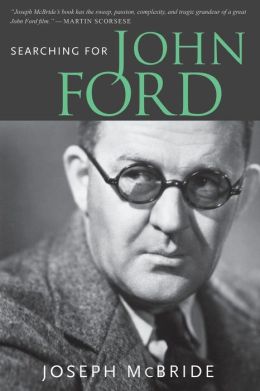
Tuesday, August 6, 2013

Summer Reading: Searching for John Ford


The book that has dominated my summer reading list this year is Searching for John Ford by Joseph McBride, a thoroughgoing (800-page!) biography of legendary Hollywood film director John Ford. While not as beautifully written as Simon Callow's masterful two-part biography of Orson Welles (cited here), McBride's tome makes up for its slight dearth of poetic eloquence by providing an extremely well-researched and nuanced account of Ford's very complicated life and public persona. Given the contradictions inherent in Ford's life and therefore in accounts of his life, McBride's attention to detail, and his ability to weigh and evaluate the merits of conflicting reportage on the volatile director, make this book essential reading for anyone interested in Ford, the Golden Age of Hollywood, and/or the history of the western film genre.

What makes John Ford so complex, and therefore so intriguing? Well, like his contemporary Howard Hawks, Ford seemed to revel in misleading and stonewalling interviewers, downplaying his achievements and disavowing how much he cared about his films. Unlike Hawks, who seemed quite comfortable in his masculinity and genuine in his unchecked male chauvinism, Ford's public front as a rough and tumble "man's man" masked a tortured spirit, plagued by alcoholism, who was always fearful that outsiders might see through to the passionate artist within. In short, Ford had a "feminine" side that Hawks lacked, and this may in part account for the depth and beauty of his work, which is pervasively concerned with the plight of immigrants, outsiders, and women trapped within the domestic sphere.

Ford's most famous public utterance -- his 1950 announcement to the members of the Screen Directors Guild that "I'm John Ford. I am a director of westerns" -- best sums up his superficially laconic attitude, since it both understates the importance of the westerns he made (making his direction of them sound simple and laissez-faire) and simultaneously disregards the many cinematic masterpieces he directed outside his "home" genre (by identifying himself solely with westerns). However, while many of Ford's non-westerns like How Green Was My Valley, The Grapes of Wrath, and The Quiet Man are undisputed masterpieces (and Academy Award winners), in broad terms Ford's identification with the western is appropriate since no other director before or since (with the possible exceptions of Anthony Mann and Sam Peckinpah) has so consistently imbued the genre with such sublime visual artistry and thematic richness. As McBride writes, in his work directing westerns:
[Ford] was searching for what he considered the core American values and testing them under fire. As deeply engaged politically as any director dealing with issues "ripped from today's headlines," Ford invited his audience to contemplate root causes and participate in an emotional and intellectual dialogue with his work.*
To start with the westerns -- and mind you, I haven't yet seen all the extant ones** -- we can easily name the four or five that are simply essential to the history and development of the genre: Stagecoach (1939), My Darling Clementine (1946), She Wore a Yellow Ribbon (1949), The Searchers (1956), and The Man Who Shot Liberty Valance (1962). Stagecoach "legitimized" the sound western and is a near-perfect film, greatly influential upon many other directors. Clementine is one of the best and most influential cinematic dramatizations of the shootout at the O.K. Corral, and Yellow Ribbon is probably the best of Ford's three films on the U.S. Cavalry during the Indian Wars (though Fort Apache is also superb). The Searchers and Liberty Valance darkened and deconstructed the western genre a decade before directors like Peckinpah and Sergio Leone claimed credit for doing the same.

I would also single out Wagon Master (1950) as a personal favorite -- it being an upbeat, intimate little western that seems the closest Ford ever came to capturing the warm, comradely feeling one gets when watching Howard Hawks' Rio Bravo. Normally Ford is darker and more complex than Hawks, but Wagon Master is a delightful, humanistic, relatively straightforward western romp.

Harry Carey, Jr. and Ben Johnson in Wagon Master.

It is important to remember that part of the reason Ford is so strongly identified with the western is not only because he directed several of the all-time best ones but because he directed fifty four westerns over the course of his career!***

Maureen O'Hara and John Wayne in The Quiet Man.

Beyond the western, there are such Ford classics as The Informer (1935), Young Mr. Lincoln (1939), The Long Voyage Home (1940), The Grapes of Wrath (1940), How Green Was My Valley (1941), and The Quiet Man (1952), to highlight but a few. In my view, The Grapes of Wrath is the single best of that lot, and one of Ford's best films, period. The high-contrast cinematography by Gregg Toland is amazing, and Tom Joad is one of Henry Fonda's all-time greatest performances. I consider The Grapes of Wrath a must-see for any film fan, whether or not that fan has any special interest in Ford.

The Grapes of Wrath, one of John Ford's all-time career masterpieces.

McBride also highly recommends Ford's Pilgrimage (1933) from the non-Western side of the director's repertoire.

In addition to necessarily brief discussions of the production, release, and reception of all Ford's many extant films, McBride's book covers in extensive detail Ford's activities during the 1940s and 1950s Hollywood blacklist era. Ford was a FDR New Deal Democrat in the 1930s and early '40s, but his politics leaned to the right in the postwar years. While he never testified before Joseph McCarthy's House Un-American Activities Committee (HUAC), Ford did little to prevent blacklisting in Hollywood, despite his earlier strongly professed loyalty to the other directors in his business. In politics as in all else, Ford was a contradictory man, and McBride nuances Ford's slow, jerky conversion from pro-labor leftist to virulent anti-Communist over the politically tumultuous decades of the Red Scare.

In short, I recommend this book to anyone interested in Ford, who was one of Hollywood's most talented, influential, ornery, and contradictory figures. But while this hefty tome may not be of interest to casual fans of the western or the Golden Age of Hollywood, I cannot emphasize enough that Ford's films are eminently worthy of your attention. If you do nothing more than watch, say, three Ford films -- I recommend The Grapes of Wrath, one western (Stagecoach or The Searchers are probably the best choices), and maybe one adventure film like The Long Voyage Home or Mogambo -- you will be treating yourself to a masterwork by one of the most visually accomplished and humanistic directors the Hollywood cinema has ever known.

To wrap up on an iconoclastic note, here is one of the more amusing Ford factoids revealed by McBride:
Ford devised some deviously clever tricks to safeguard his editorial control [over his films] even further. One was his habit of sitting in his director's chair immediately under the front of the lens of the camera. At the same time he called "Cut," he would put his fist in front of the lens. That way, if the cameraman was inclined to keep the camera running a bit longer than Ford wanted, the extra footage at the end of the scene would be rendered unusable.†

John Wayne and John Ford; the latter made the former a star 
by casting him as the Ringo Kid in Stagecoach.

UPDATE 10/17/2014: Here is a smart online essay about My Darling Clementine.

--
* McBride p. 416, 418.
** Sadly, like approximately 90% of all silent films ever made, the majority of Ford's many silent film westerns are now lost.
*** McBride p. 278.
† McBride p. 252.

Tuesday, July 16, 2013

EW #2: The Godfather (1972)

Marlon Brando as Vito Corleone, shot by "Prince of Darkness" Gordon Willis.

The Godfather is a true American classic, a beautifully shot, lit, acted, directed, and edited film. It stands as one of the best films of the "Hollywood Renaissance" (or "New Hollywood") period, which lasts from roughly 1967 to 1980. The Godfather was an enormous hit in its time, not anticipated to be (nor marketed as) what we would now call a "blockbuster," but seen retrospectively (alongside William Friedkin's The Exorcist) as a proto-blockbuster by film scholars like Thomas Schatz, who says the film helped inaugurate the "blockbuster syndrome" that dominates Hollywood to the present moment, and by film journalists like Peter Biskind, whose dishy but thoroughgoing book Easy Riders, Raging Bulls is a must-read for anyone interested in this unique period in Hollywood history.*

In addition to benefiting from Coppola's notoriously passionate (some might say hardheaded) direction, The Godfather was shot by cinematographer Gordon Willis, who earned the nickname "Prince of Darkness" by artfully using high-contrast lighting techniques borrowed from German Expressionism and film noir, probably helping to inspire the current vogue for "dark" and "gritty" cinematography in today's Nolan-esque blockbusters. Due to the contributions of its production crew and stellar cast, The Godfather brings together all the best tendencies of noir, gangster films, and 1970s method acting into one immensely appealing, melodramatically epic package.

While its narrative structure basically follows the "rise and fall of a crime lord" pattern germane to classic gangster films like Little Caesar, The Public Enemy (both 1931), and Scarface (1932), The Godfather is really a male melodrama, interested in showing us the emotional turmoil and personal sacrifice endured by Vito Corleone as he struggles to preserve his family (in both senses of the word). His suffering throughout the film renders him heroic to us, allowing us to see him as a morally just man even though he is no doubt responsible for many illegal and violent acts (which, since they lie safely in his past, we never see).**

The Godfather as male melodrama: Vito, who spends most of his screen time 
convalescing in bed, verges on tears when he learns of Michael's fate.

EW's placement of The Godfather at #2 marks the beginning of a streak I notice across the whole EW "Greatest Film" list: a pronounced favoritism shown toward Hollywood films of the 1970s. Now I am the last person in the world to disagree that these are by and large truly great films; with the possible exception of the 1930s and '40s (the "Golden Age"), the 1970s was surely Hollywood's greatest decade ever. However, I think the prevalence of 1970s "Hollywood Renaissance" films on the list reveals the EW staff's tendency to overvalue the domestically produced films of their own generation; I presume that most of the list's creators are Baby Boomers who grew up with this stuff or else Gen-Xers like myself who came to appreciate these films when we got a little older.

In any case, EW's list gives short shrift to some more recent films and filmmakers of note: I'm happy they got Richard Linklater and P.T. Anderson on there, but no Coen brothers? Not even Fargo? And nothing by Errol Morris, the greatest living documentarian? The list also egregiously overlooks many older works: Sunrise, Griffith, and Chaplin aside, where are the silents? No Nosferatu? No The Passion of Joan of Arc? Really? Despite the towering influence and talent of Coppola and his cohort, these seem like glaring omissions.

That said, The Godfather is a near-perfect movie and I have no serious objection to its placement so high on the list. It would be lower down on my personal list but would definitely still be on there, probably in the top twenty or thirty or so.

Poor Sonny.

Bonus afterthought: If you have already seen the obvious Coppola greatest hits -- The Godfather, The Godfather Part II, and Apocalypse Now -- you owe it to yourself to see his overlooked masterpiece, The Conversation (1974). Made during a brief pause between the first two Godfather films, The Conversation is one of the best Nixon-era paranoid thrillers ever made -- only Alan J. Pakula's The Parallax View and All The President's Men are in the same league. It also contains one of Gene Hackman's best-ever performances, utterly different from, but rivaling, his insane turn as Popeye Doyle in The French Connection. The Conversation also carries the distinction of being one of only five films to feature the brilliant 1970s character actor John Cazale.***

--
* Schatz, "The New Hollywood" in Movie Blockbusters, Ed. Julian Stringer (Routledge, 2003) p. 23; Biskind, Easy Riders, Raging Bulls (Simon & Schuster, 1999) pp. 162-4, 224. There is also a film version of Easy Riders, Raging Bulls (2003, dir. Kenneth Bowser) which is lots of fun but not nearly as good as Biskind's book.
** For more about melodrama in American film and culture, see Linda Williams, "Melodrama Revised," in Refiguring American Film Genres, Ed. Nick Browne (U. Cal. Press, 1998) pp. 42-88.
*** The other Cazale films (besides The Godfather and The Conversation) are: The Godfather Part II, Dog Day Afternoon, and The Deer Hunter. For those interested in 1970s films and/or Cazale, I highly recommend the documentary I Knew It Was You: Rediscovering John Cazale (2009, dir. Richard Shepard).

Saturday, July 13, 2013

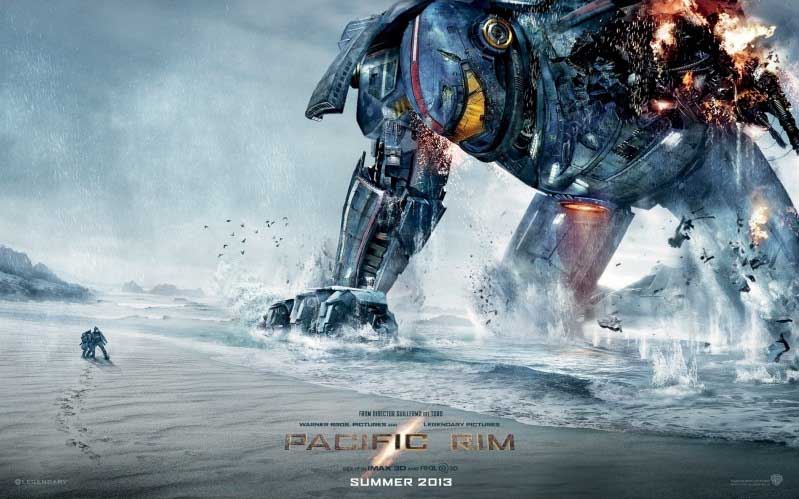
Pacific Rim = A Great Blockbuster

As the sense of scale here should make clear, Guillermo del Toro's 
superb blockbuster Pacific Rim is a film you should see in the theater.

I just saw Guillermo del Toro's Pacific Rim last night, and declare it to be one of the two or three best, most enjoyable blockbusters I've seen in the past two years. It is pretty much flawless, in terms of what I want out of a big summer popcorn movie: it is unpretentious, it delivers what it promises, and it even springs a few great surprises I didn't see coming. Most importantly, it is:

(1) Fun, and

(2) Visually stunning.

We mustn't underestimate the power of #1 up there, because my single biggest complaint about many recent blockbusters, particularly those of the Christopher Nolan stripe, is that they take themselves way too goddamn seriously. They get so bogged down in being "gritty" or "dark" or "serious" that they just aren't any fun anymore. This is why, for me, I rate Joss Whedon's The Avengers and Sam Mendes' Skyfall (both 2012) very highly among recent summer blockbusters, but have not yet been motivated to see this year's Man of Steel. To be fair, even without having seen it I would expect Zack Snyder's Superman movie to fulfill my criterion #2 -- I am sure it is visually stunning -- but personally I just have no interest in seeing a "gritty" or "realistic" Superman movie, especially one scripted by David S. Goyer, who I think is an extremely sloppy and inept screenwriter.

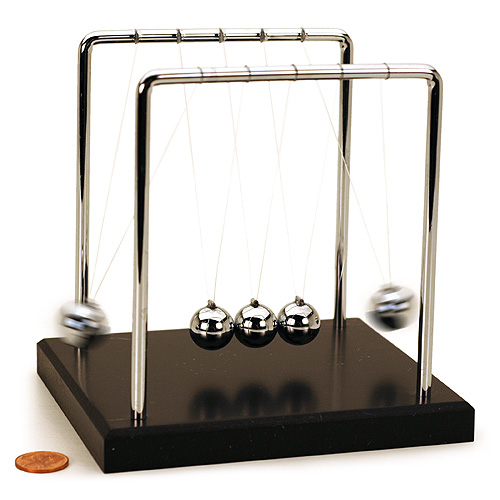
But I digress. What makes Pacific Rim so enjoyable and effective? Well, in order to let you know where I'm coming from, let's consult a chart and define a few terms:


First, complex vs. simple: complex plots twist and turn and rely upon narrative "reveals" or big surprises for their tension. Nolan's films are notoriously complex (some would even say convoluted) and I place Star Trek: The Motion Picture in here as another example of this trend.* The Trek film is quite heady and relies upon a mystery that is slowly revealed to the audience: what the hell is "V-ger" and what is it up to? As in Nolan's films, we (the audience) do not know the answer until/as the protagonists gradually figure it out. Die Hard is the same way: Hans Gruber's plan involves layer upon layer of embedded complexity, and not until very near the end do we understand the full scope of it. Sure, as genre films we know generally how these movies will end -- i.e., the good guys will win -- but we are not totally sure how they will win. Major salient facts are withheld along the way.

By contrast, simple blockbusters are those that make pretty clear from the get-go what is at stake; the plots do not depend upon mystery or surprise quite so much. Films like The Avengers and Pacific Rim are of this stripe: there is some major bad guy who needs to be clobbered, but the exact nature of his plans are not really all that important -- usually they can be summed up as "wants to end / rule the world." In Pacific Rim, we know what the film's climax will be about ten or twenty minutes into the movie: Marshal Pentecost (Idris Elba) tells us what the big mission is going to be, and the rest of the film involves our team of heroes fighting defensive battles until their moment arrives to execute that plan. There are a few minor twists but they do not sway us from (or materially change the circumstances of) that Big Battle scheduled for the end of the picture.

Now to the other axis. By "creative" I do not mean complex plots, but rather a visual style and/or tone that differentiates the film from other blockbusters of its type. I guess I mean authorial stamp to some extent, but remember that I am NOT talking about totally violating or hybridizing a genre either, just playing within a genre in a way that makes it appear fresh, e.g. Tim Burton's use of gothic sets and a carnivalesque tone for his two Batman films in 1989 and 1992. Nolan's recent films are also "creative" in this sense, he being the director widely credited with bringing a "gritty," "dark" tone to superhero blockbusters.

"Generic" means films that adhere more closely to the established parameters of their genre, with less evident authorial flourishes or deviations in tone or visual aesthetics.

Please note that I do not privilege "creative" over "generic" -- I have great admiration for films that hew closely to genre conventions but still make the viewing experience exciting. In fact, one of my favorite recent blockbusters, The Avengers, is extremely conventional with respect to plot and other conventions of superhero films, but it does its thing with such witty panache and delightful character interactions that it is completely successful even though it is visually and structurally unremarkable.

"We may not be complicated, but we're fun!"

In his rather scathing review of Pacific Rim, Buffalo-area author and filmmaker Greg Lamberson writes that "there is no real climactic fight that tops everything that came before it, but a corny finale that's telegraphed as soon as Elba comes on screen. Epic fail." However, as I argue above, Pacific Rim's ending is not an epic fail -- though perhaps it fails to be epic -- but rather is exactly what the film promises to deliver given its setup. I for one am rather tired of the notion that the final battle in a blockbuster has to be "bigger" or "more epic" than anything that came before -- I just want it to dramatically resolve the plot of the film. Epicness is overrated.**

Lamberson also states that "not one single character is interesting." Though I disagree with this, I think that in broad strokes it is an accurate statement if not a reasonable one, by which I mean that I would not personally expect del Toro to fully round out his characters and complicate his plots when making a superhero movie like Hellboy or a big summer action blockbuster like Pacific Rim. The generic ground rules and audience expectations here are totally different from those we would expect from artsy psychological thrillers like The Devil's Backbone and Pan's Labyrinth. And frankly, I enjoyed Pacific Rim's characters even though, like Lamberson, I did not find them to be psychologically complex. How many blockbuster protagonists truly are? None that I can think of.

Nevertheless, I accept as a valid critique the notion that some of the key characters in Pacific Rim are not well-rounded enough. Again, I think this is a function of the type of movie it is -- a "simple" blockbuster -- and this factor did not strike me as a major deficiency as I watched the film, yet I admit that would like to know more about the world in which Pacific Rim is set. Maybe, if we are fortunate, we will get a sequel and / or a prequel, as this reviewer suggests.

All that said, I agree with Lamberson that del Toro has set a very high bar for himself with his early films -- I love them a lot and would argue that Pan's Labyrinth definitely belongs on Entertainment Weekly's "100 All-Time Greatest Films" list. But my expectations for Pacific Rim were not directly informed by del Toro's amazing earlier works, except in one specific sense: I assumed the film would be a visual knockout, which it is. The world of Pacific Rim feels very lived-in and "real." With a great many scenes shot at night, Pacific Rim is visually evocative of Blade Runner or Hellboy II, and I love it for its noir-inspired cinematic richness.

Yet despite its dark lighting and post-apocalyptic mise-en-scene, the film's general tone is light, peppy, and fun. I appreciate this very much. While I TOTALLY agree with Lamberson's sentiment that in general, blockbusters these days are running way too long, Pacific Rim never dragged for me the way the second two Lord of the Rings films or the third Nolan Batman film did. Sure, there isn't much laugh-out-loud humor or witty inter-character verbal sparring as in The Avengers, but Pacific Rim does feature a few really fantastic visual gags -- my personal favorite of which involves one of these:


In his own lukewarm review, Entertainment Weekly's Chris Nashawaty says of Pacific Rim that "del Toro's monsters are so big, and shot in such unrelenting rainy darkness, that the audience never gets a chance to dissect and fetishize their monstrous anatomies and be swept away by their weirdness." Reading that, I think Nashawaty must have seen a different movie than I did.*** I felt like the film moved pretty quickly from set piece to set piece, spending most of its running time on those spectacular monster battles -- in sum, the film does not skimp at all on mind-blowing, beautifully choreographed and well-shot action sequences. And for that reason alone, I urge my readers to strongly consider seeing Pacific Rim while it is in theaters. It may not be perfect, and it obviously does not "hit the spot" for every (re-)viewer the way it does for me, but it is well worth your time to check out, as del Toro is head and shoulders above most other blockbuster directors in terms of the lushness and lived-in "reality" of his visual style.

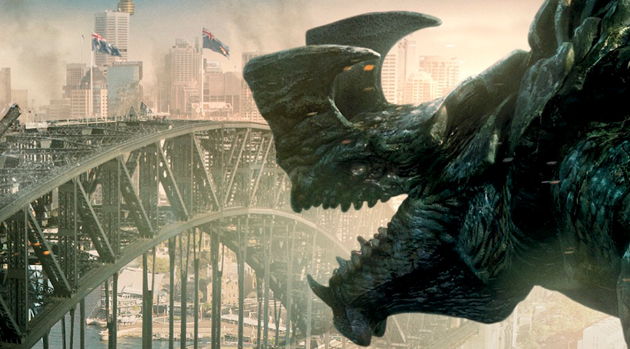
The kaiju sez: "Come see my movie or I'll crush your civilization!"

UPDATE 10/14/2014: British critic Mark Kermode agrees with me and has some very smart things to say about what makes Pacific Rim great in the linked video.

--
* I realize that this is a bit of a cheat on several levels. For one, Star Trek: The Motion Picture was not released in summer, but December; also, it is not an "action" film, as summer blockbusters, by definition, are. Yet it is a big-budget picture that was released "wide" in an attempt to cash in on the popularity of Star Wars, so I include it here as a representative of some of the trends I am attempting to illustrate.
** For a cheeky yet accurate discussion of this "epicness" problem in contemporary blockbusters, check out this video review of Man of Steel, especially the part near the end where the reviewers discuss the difference between Snyder's film and Superman II (1980).
*** UPDATE: Since writing this review I came across this article about possible Pacific Rim sequel ideas which includes this illuminating (ha, ha) comment: "My main issue with the dark visuals of Pacific Rim are probably the fault of the 3D projection at my cinema more than the cinematography." This may indeed explain a lot, including Nashawaty's review, assuming he saw the picture in 3D, which notoriously darkens the image. By contrast, I saw the film in 2D -- wearing 3D glasses always gives me headaches.

Sunday, July 7, 2013

Safety Last at the Dryden

The great silent-era comedy star Harold Lloyd.

I live in the Rochester area and therefore am lucky enough to live fairly near to the Dryden Theater, a superb art-house cinema attached to the historical George Eastman House. The Dryden is my favorite theater in the region; it shows a wide array of stuff, from foreign cinema to silent cinema to arthouse cinema to Golden Age Hollywood classics to even more newly minted Hollywood "classics" from as recently as the 1990s or so. Just take a look at the Dryden's linked schedule and you'll see what I mean. If I had endless resources and time, I would likely head over there three or four times a week.

Last night I went with a friend to the Dryden to see Safety Last (1923), the most famous film to star slapstick comedian Harold Lloyd. Lloyd is the least known of the "big three" silent era comedians, the other two being Charlie Chaplin and Buster Keaton. Interestingly, despite his somewhat diminished reputation today, Lloyd was the most economically successful of the big three during their heyday the 1920s.

Despite having a great appreciation for the work of Charlie Chaplin and Buster Keaton, and even though a couple of Chaplin's films (City Lights and Modern Times especially) are among my very favorite silent comedies, Harold Lloyd stands as my personal favorite silent-era comedian. My Lloyd fandom stems in part from early exposure: when I was young, episodes of "The Harold Lloyd Show" aired on a local station on weekday afternoons. (This was NOT an original show, but a syndicated compilation show that simply aired Lloyd silent shorts.) Upon arriving home from school, my brother and I quite regularly watched that show; we found Lloyd's death-defying antics highly entertaining.

Harold Lloyd in Safety Last (1923): this shot of Lloyd dangling from the clock 
is one of the most famous images in Hollywood history.

However, last night I was reminded of another reason I find Harold Lloyd so appealing and funny: to my taste, he has the funniest face and physique of the big three silent comedy masters. You see, both Chaplin and Keaton are diminutive men who play their small size for comedy, often pairing themselves with big and/or fat guys to make their shrimpiness stand out.

Charlie Chaplin next to frequent co-star "Tiny" Sandford in Modern Times (1936): 
an example of the oft-used "small guy + big guy = funny" comedy technique. 

Lloyd, by contrast, was a big fella, standing 5' 10" compared to Chaplin's and Keaton's modest 5' 5". His work is worthy of present-day appreciation in part because it is simply breathtaking to watch a guy of his physical size -- with a disadvantageously higher center of gravity relative to his smaller contemporaries --  execute the harrowing stunts he always attempts in his films. His penchant for fairly dangerous gags, a signature of his style, makes his work stand out from other silent comedies, especially Chaplin's. (One could argue that Keaton displayed a similar penchant for extreme physical risk-taking, especially whenever he got near trains.)

Lloyd's comedy depends upon his donning those funny round glasses and playing a slightly nerdy and buffoonish sort who just wants to fit in and succeed in life. His characters usually exhibit a positive, go-getter type attitude, which stands in stark contrast to Chaplin's more poignantly marginalized, romantically oriented Tramp and Keaton's hapless yet highly ironic "Great Stone Face" character, who never reacts (facially) to the mayhem ensuing around him. Unlike the politically deconstructive Chaplin and the wryly modernistic Keaton, whose personas resonate more easily with contemporary audiences, Lloyd's Horatio Alger-ish screen persona is a major factor contributing to his being generally less known to today's viewers, accustomed as we are to hip cynicism and postmodern anti-heroism.

As a dedicated fan, however, I had a genuinely lovely time last night, laughing at Lloyd's wacky facial expressions (check out that goofy smile he's flashing at the top of the post!) and delighting in his harrowing yet humorous ascent up the exterior of a tall department store building -- the stunt that constitutes Safety Last's famous, climactic set piece. Prior to the screening, as usually happens at the Dryden, a staff member addressed the audience, delivering a succinct rundown of the film's production history and its significance to Lloyd's career. At the end of her talk, the presenter reminded us that even though some of the shots in the film were visually enhanced via clever camera placement, making Lloyd appear to be much higher off the ground than he was in actuality, one important thing to appreciate about silent-era comedies is that, unlike most films made today, it is always the real actor up there on screen endangering his life just to entertain us. In discussion with my friend afterward, we agreed that it was refreshing, even exhilarating to see a film like Safety Last that doesn't need digital effects or incessant rapid-fire editing to create tension, thrills, and laughs. Those techniques have their place, but this silent-era gem was pure cinema: visually elegant, physically dynamic, and -- most importantly -- huge fun.*

Kudos to the Dryden Theater for preserving and screening such wonderful delights from cinema's rich historical past.

--
* The term "pure cinema" was first coined by French abstract filmmaker Henri Chomette in the 1920s, but was later adopted and popularized by Hitchcock, who used the term to describe a purely visual form of cinematic storytelling. That is, in pure cinema one should be able to turn off the sound and still follow the meaning of the action and images onscreen. Hitchcock frequently achieved this goal in his work, which is part of the reason he is so revered -- and why his films hold up so well -- today. Silent films -- the medium in which Hitch got his start -- are almost (except for their reliance upon intertitles) pure cinema by default, since they rely on visuals without the use of any synchronized sound.

Saturday, July 6, 2013

EW #1: Citizen Kane (1941)

Welles as depicted on the cover of Simon Callow's superb biography, 
Orson Welles: The Road to Xanadu*

I am still in the process of learning about Orson Welles; I am surely no expert on the man or his work. But of course I have seen Citizen Kane many times, and have absolutely no objection to its being granted the #1 slot on Entertainment Weekly's "Greatest All-Time Films" list. Like the EW critics, I make this assertion NOT out of adherence to canonical tradition that says we must denote Kane as the Greatest Film Ever, but because it truly is one of the greatest films ever, and its existence is especially surprising given the historical circumstances under which it was made. A strange, perfect storm of factors led to its production: most notably, George Schaefer, RKO's soon-to-be-outgoing studio chief, granting the very young first-time director Orson Welles carte blanche to make whatever the hell movie he felt like making once the screenplay was approved.** Pretty much never, before or since, has a director had that much control over a project produced within the Hollywood studio system.

And much as Welles is an interesting figure in and of himself, I am not here to further glorify Welles. He was surely the driving force behind Kane and his considerable chutzpah played a crucial role in getting the film produced, but there would be no Kane without the vast resources of the studio system itself, particularly RKO's special effects technicians, whom Welles pushed to their circa-1940 limits during post-production on this film. As Simon Callow writes, "RKO had one of the most advanced special effects departments in the industry," run by back-projection expert Vernon Walker and including optical printing genius Linwood Dunn. According to Callow, Walker and Dunn's contributions to Kane are "immeasurable," though in at least one sense they can be quantified: roughly half of all the shots in Citizen Kane feature optical printing work by Dunn.***

For example, again quoting Callow:
[In] the sequence at the Thatcher Memorial Library [the] camera pans down a monumental statue of Thatcher onto the female guard. Both the statue and the pan are entirely the work of Dunn. As [cinematographer Gregg] Toland shot it, the scene started on the guard. Dunn made a miniature model of Thatcher and perfectly matched the base of the statue with what had been shot.

Movie magic: this miniature model shot created by Linwood Dunn . . . 

. . . blends seamlessly with this on-set footage shot by Gregg Toland.

Equally deserving of mention, among many others, is cinematographer Gregg Toland; the vainglorious Welles considered Toland crucial enough to the process and product of Kane to share screen credit with him. Also influential upon the look of Kane was director John Ford, whose 1939 masterpiece Stagecoach (conspicuously absent from EW's "Greatest Films" list) taught Welles (via approximately 45 repeat viewings) almost everything the fledgling director needed to know about how to compose and edit shots at this inceptual moment in his movie career.

The normally egotistical Welles shares Kane screen credit with 
legendary cinematographer Gregg Toland.

One critique I often hear from viewers of Citizen Kane is that it is too cerebral, that the viewer does not feel enough sympathy with protagonist Charles Foster Kane (played by Welles himself) to get truly immersed in the story of his life. I think this is a valid criticism; in many ways, Welles reminds me of Christopher Nolan, another cerebral director who often struggles to achieve emotionally resonant characterizations in his films.

Related to this, Callow says of Welles' acting style that his "great skills as an actor lay in the realm of the rhetorical, in which the actor is absolutely in command of himself and his material; when he touches the personal, which he does rarely, he seems to lose his judgement." Callow calls Welles a "King actor," well-suited to playing grandiose protagonists in an externally focused style, but not particularly suited to smaller supporting roles and internally focused gestures; Callow claims of Welles that that the "common touch was always to elude him."†

Yet my response to the "not enough beating heart in Kane" argument is that, in this case, it is the point of the film that we do not fully empathize nor identify with (the character) Kane; he is, in the end, a tragic figure and a bit of a monster. Where my heart connects with the movie is mainly through the cumulative effect of the events of Kane's life; by the time he is pushing his second wife to be a professional opera singer, or by the time she leaves him in the final reel, I am emotionally hooked. In the earlier sections of the film, it is the supporting cast, especially the affable Joseph Cotten as Jedediah Leland, who humanizes the unfolding tragedy of his closest colleague's narrative arc.

So ultimately, I agree with Owen Gleiberman and company when they say:
Welles didn’t just craft a great movie; he bottled what moviemaking would forever be — and therefore was, from the exhilarating moment that Kane existed. That’s not just an achievement, it’s a miracle, and it’s one we honor by recognizing that no great movie feels quite as alive when you’re watching it as Citizen Kane does.
Hear, hear.

In the capping tragedy of his life, Kane begs Susan to stay -- to no avail.

Bonus afterthoughts: While Touch of Evil, probably Welles' second-best film, will be discussed separately -- it is entry #75 on EW's list -- I want to take the time now to single out a few other Welles films of particular interest. Welles had a tumultuous film career, and a great many of his movies were either edited by studios without his compliance, or were never finished.††  Nevertheless, many of them, even the "butchered" ones, are quite good: gracing the top of my list is his 1947 film noir, The Lady from Shanghai, which is probably my personal favorite Welles film. I also strongly recommend It's All True (1993), The Stranger (1946), and his "visual essay" F for Fake (1973) -- which includes, on DVD 2 of the Criterion Collection edition, Orson Welles: One-Man Band (1988), a fascinating documentary about the director's unfinished projects. Welles also directed several Shakespeare adaptations, all of which are rumored to be at least interesting if not consistently great. I have seen his Macbeth (1948) and loved it; I have heard that 1965's Chimes at Midnight (which I have not yet seen) is probably the best of the lot.

Lastly, I also recommend Richard Linklater's Me and Orson Welles (2008), a warm-hearted little picture in which Christian McKay absolutely nails his portrayal of young Welles with uncanny accuracy. (Jonathan Rosenbaum reviews the film here.) Less accurate but pretty fun if you like dramatic reenactments of Hollywood behind-the-scenes shenanigans is RKO 281 (1999, dir. Benjamin Ross).

A rare still from a controversial scene cut from Citizen Kane.

--
* Callow is a truly gifted and entertaining writer whose Road to Xanadu constitutes only one-third of a proposed three-volume biography of Welles. Volume two, Hello Americans, was released in 2006; volume three is still forthcoming.
** Welles scholar James Naremore notes that "it would be a mistake to assume that Welles ever had total freedom" at RKO, since his stay at the studio "was littered with rejected or abandoned scripts" and even on Kane he had to adhere to the budget limitations imposed by Schaefer. (The Magic World of Orson Welles [SMU Press, 1989] p. 18)
*** Callow, The Road to Xanadu (Viking, 1995) pp. 521-3.
† Callow, Hello Americans (Penguin, 2006) pp. 21, 23-4, 248.
†† For a complete rundown of which films were completed to Welles' satisfaction and which ones were not, Jonathan Rosenbaum's post on Mr. Arkadin makes a good starting point.

Thursday, July 4, 2013

Entertainment Weekly's Top 100 Films

Robert De Niro in Martin Scorsese's Mean Streets, the #7 film on 
Entertainment Weekly's list of the greatest movies of all time.

For its July 5 / July 12 double issue, mainstream entertainment mag Entertainment Weekly (to which I am a longtime subscriber) published a list of the "All-Time Greatest Movies," listing 100 films (in order) that their critics, writers and editors nominated for said honor. Though I usually waggle my private parts at such lists, I do like the way EW's managing editor Jess Cagle frames their project, stating up front that:
We've tried to take into account each work's cultural impact and influence. 
I'm sure you will disagree with some of our choices, and that's how it should be. Personally, I will never be able to look at these lists without wanting to move stuff around.
I find the EW list interesting because it offers a cross-section of the highbrow, the middlebrow, and (here and there) the lowbrow, compiled as it is by professional film critics (who therefore must have more knowledge about world cinema and cinema history than the average casual filmgoer) working at a decidedly middlebrow, mainstream publication (which, given their assumed audience, limits their choices somewhat). So, while HEAVILY and unduly weighted toward Hollywood and other English-language cinemas, the list does include some "important" or canonical non-English-language films like Seven Samurai (#17), Bicycle Thieves (#26), and (personal all-time favorite of mine) Rules of the Game (#39), plus even a couple of bona fide art films like The Seventh Seal (#58) and La Dolce Vita (#87) . But it also includes such mainstream claptrap as The Lord of the Rings: The Return of the King (#43) -- a shitty film by any measure -- and Titanic (#52), which is a good film (in the sense of being well-made) but probably not so meritorious that it deserves to be on a list like this one. These latter entries surely made the cut due to Cagle's "cultural impact" clause; I am sure they would never appear on the more reputable yet "esoteric" (Cagle's word) critics' lists such as the famous one compiled by Sight and Sound.

In other words, the EW list includes, on the one hand, critically acclaimed films that have withstood the test of time and whose canonization may likely relate to their quality, innovation, and/or cultural significance (e.g., Citizen Kane), and, on the other, works whose main claim to fame is mainstream popularity and/or fairly recent cultural / industrial impact (e.g. The Dark Knight, which is as zeitgeist-y as it gets and is surely culturally significant but is actually, from a technical standpoint, an extremely pedestrian, at points even sloppily crafted, movie).*

What this means for our purposes is that this list offers a diverse array of films to talk about, think about, and look at a little more closely.

Sadly, the EW.com website does not (yet) contain the list itself, just this cheesedickish photo slideshow of the top 10, so here is the list in its entirety:

1. Citizen Kane (1940)
2. The Godfather (1972)
3. Casablanca (1942)
4. Bonnie and Clyde (1967)
5. Psycho (1960)
6. It's a Wonderful Life (1946)
7. Mean Streets (1973)
8. The Gold Rush (1925)
9. Nashville (1975)
10. Gone With the Wind (1939)
11. King Kong (1933)
12. The Searchers (1956)
13. Annie Hall (1977)
14. Bambi (1942)
15. Blue Velvet (1986)
16. Singin' in the Rain (1952)
17. Seven Samurai (1954)
18. Jaws (1975)
19. Pulp Fiction (1994)
20. The Sorrow and the Pity (1969)
21. Some Like it Hot (1959)
22. Toy Story (1995)
23. Notorious (1946)
24. The Sound of Music (1965)
25. 2001: A Space Odyssey (1968)
26. Bicycle Thieves (1948)
27. The Maltese Falcon (1941)
28. The Wizard of Oz (1939)
29. North by Northwest (1959)
30. Sunrise (1927)
31. Chinatown (1974)
32. Duck Soup (1933) [!]
33. The Graduate (1967)
34. Adam's Rib (1949) [!]
35. Apocalypse Now (1979)
36. Rosemary's Baby (1968)
37. Manhattan (1979)
38. Vertigo (1958)
39. The Rules of the Game (1939)
40. Double Indemnity (1944)
41. The Road Warrior (1981)
42. Taxi Driver (1976)
43. The Lord of the Rings: Return of the King (2003)
44. On the Waterfront (1954)
45. Mr. Smith Goes to Washington (1939)
46. The Adventures of Robin Hood (1938)
47. A Clockwork Orange (1971)
48. It Happened One Night (1934)
49. Goldfinger (1964)
50. Intolerance (1916) [!]
51. A Hard Day's Night (1964)
52. Titanic (1997)
53. Star Wars Episode V: The Empire Strikes Back (1980)
54. Breathless (1960)
55. Frankenstein (1931)
56. Schindler's List (1993)
57. Midnight Cowboy (1969)
58. The Seventh Seal (1957)
59. All the President's Men (1976)
60. Top Hat (1935) [!]
61. The Silence of the Lambs (1991)
62. E.T. The Extra-Terrestrial (1982)
63. Network (1976)
64. The Best Years of Our Lives (1946)
65. Last Tango in Paris (1973) [!]
66. The Shining (1980)
67. Rebel Without a Cause (1955)
68. GoodFellas (1990)
69. Dr. Strangelove (1964)
70. L'Avventura (1960) [!]
71. American Graffiti (1973)
72. The 400 Blows (1959)
73. Cabaret (1972)
74. The Hurt Locker (2009)
75. Touch of Evil (1958)
76. Lawrence of Arabia (1962)
77. Dog Day Afternoon (1975)
78. Raiders of the Lost Ark (1981)
79. Night of the Living Dead (1968)
80. Dazed and Confused (1993)
81. Blade Runner (1982)
82. Scenes From a Marriage (1973) [!]
83. The Wild Bunch (1969)
84. Olympia (1938) [!]
85. Dirty Harry (1971)
86. All About Eve (1950)
87. La Dolce Vita (1960)
88. The Dark Knight (2008)
89. Woodstock (1970)
90. The French Connection (1971)
91. Do the Right Thing (1989)
92. The Piano (1993)
93. A Face in the Crowd (1957) [!]
94. Brokeback Mountain (2005)
95. Rushmore (1998)
96. Sullivan's Travels (1941)
97. Diner (1982)
98. All About My Mother (1999)
99. There Will Be Blood (2007)
100. Sweet Smell of Success (1957) [!]

[!] = I haven't seen it yet!

The thing that strikes me most about the list is how few of the entries I would outright delete from it: maybe only a half-dozen or so.** Of course, there are a great many movies I can think of that belong on this list instead of ones that appear here, so I suppose that if I were limited to only 100 entries, then more than just six of these would get bumped. Indeed, the most baffling aspect of EW's Top 100 list are its exclusions.***

Despite an occasional gnawing temptation I've had to construct my own such "Best Films" list, I have thus far nobly avoided doing so. Instead, what I propose to do here (and in the coming months) is to riff on EW's list, to write a post for each film they nominate, offering my own view on each film, stating which similar films might be equally (if not more) worthwhile selections, etc. This will of course be filtered through my tastes, but I will attempt whenever possible to offer explanations and various kinds of support for my views about these films. I will attempt to be as positive and equitable and non-snooty as I can be. My ultimate goal is to stimulate conversation and hopefully point readers toward new films and filmmakers with which to invigorate and enrich their own moviegoing palettes.

So stay tuned for my first post in the series, on Citizen Kane . . .

UPDATE 11/23/2013: Saw L'Avventura (#70) at The Dryden Theater
UPDATE 7/23/2014: Saw Sweet Smell of Success (#100)

--
* And thus it begins: regular readers will learn that, with the exception of a few key films, I am somewhat averse to the work of Christopher Nolan. In a forthcoming post I will delineate why this is, both from a technical filmmaking point of view, and from the standpoint of his overrated status among his legion of loyal fans (and perhaps among many pop-cultural critics as well). Let's defer that conversation for now; I simply wanted to mention my general distaste for Nolan's films up front, in the name of full disclosure.
** Titles at the top of my "kill list" include Return of the King, GoodFellas, Silence of the Lambs, The Dark Knight and Notorious.
*** In case you're interested, EW film critic Owen Gleiberman here explains some of the rationale behind the choices made by he and his staffers.

Wednesday, July 3, 2013

Who I Am And Why I'm Doing This

I have always loved movies. One of my earliest and fondest movie memories happened on my 12th birthday in 1983, when my dad brought home a VCR from his workplace and I rented two videos to watch with my friends: Thunderball (1965) and First Blood (1982). The former is the first James Bond film I ever saw, and the latter was one of the first few rated "R" movies I ever saw (though I previously saw both The Awakening and The Blue Lagoon with my friend George -- he had older sisters so his parents were more permissive about watching adult-themed movies at their house).

Me as a kid, watching something on TV. Dig the late-1970s carpet!

These two movies defined my moviegoing tastes for most of the 1980's. My friends and I inhaled action movies starring Sylvester Stallone, Arnold Schwartzenegger, and (later) Bruce Willis, and I became a huge James Bond fan, particularly loyal to the early (but rentable) Sean Connery Bonds. Of course, the John Hughes teen films, particularly The Breakfast Club  and Pretty in Pink, also shaped my tastes in those days, and once Say Anything . . . came out in 1989, I saw my life in Lloyd Dobleresque terms for far longer than I would like to admit.

The point is, I am a child of the 1980s and, in addition to the aforementioned films, the Star Wars trilogy, the Indiana Jones films, and really the whole Steven Spielberg corpus form the basis for what I expect out of movies. That is to say, to this day I prefer "classical" film aesthetics -- well-composed shots, adherence to the 180-degree rule, not too much handheld camera, etc. -- over the "Chaos Cinema" aesthetic that seems to be en vogue at present. (There are exceptions to this, e.g., Kathryn Bigelow's Zero Dark Thirty, but let's defer that discussion until later.)

Once I entered college in 1989 and started watching Hollywood films of the 1970s -- stuff like Chinatown, Midnight Cowboy, Dog Day Afternoon, and Five Easy Pieces -- I truly blossomed as a cinephile. I grew to love movies on a much deeper level and I voraciously sought out new films and new types of films -- offbeat genres, non-U.S. national cinemas, and directors I'd heard about but never seen before -- in order to expand my film appreciation palette.

Now, twenty four years later, I am a professor of film studies at a four-year college in upstate New York; I have my dream job, watching, critiquing, interpreting, and teaching about movies.

The purpose of this blog is to share my love of and insights about movies in a less formal setting than the classroom. While I may (quite likely) use some sophisticated film terminology here to get at specifics of what I like or to support my ideas and interpretations, I am not holding myself to the same rigorous standards that I do in the academic setting. I just want to share my untrammeled enthusiasm for the art of film, and to hopefully fuel yours. I hope some of the films and ideas I post about here will inspire you to deepen your own appreciation for this potent, exciting, and culturally ubiquitous art form.

I will also use plenty of four-letter words and polemical, hyperbolic statements, because ultimately this blog is more about passion than analysis. You've been warned.


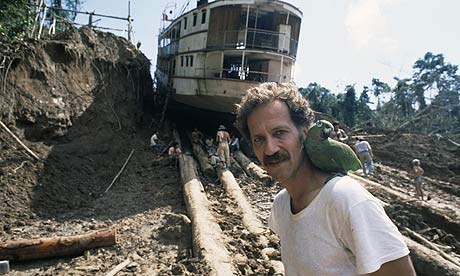
“It is not only my dreams, my belief is that all these dreams are yours as well. The only distinction between me and you is that I can articulate them. And that is what poetry or painting or literature or filmmaking is all about... and it is my duty because this might be the inner chronicle of what we are. We have to articulate ourselves, otherwise we would be cows in the field.” --Werner Herzog